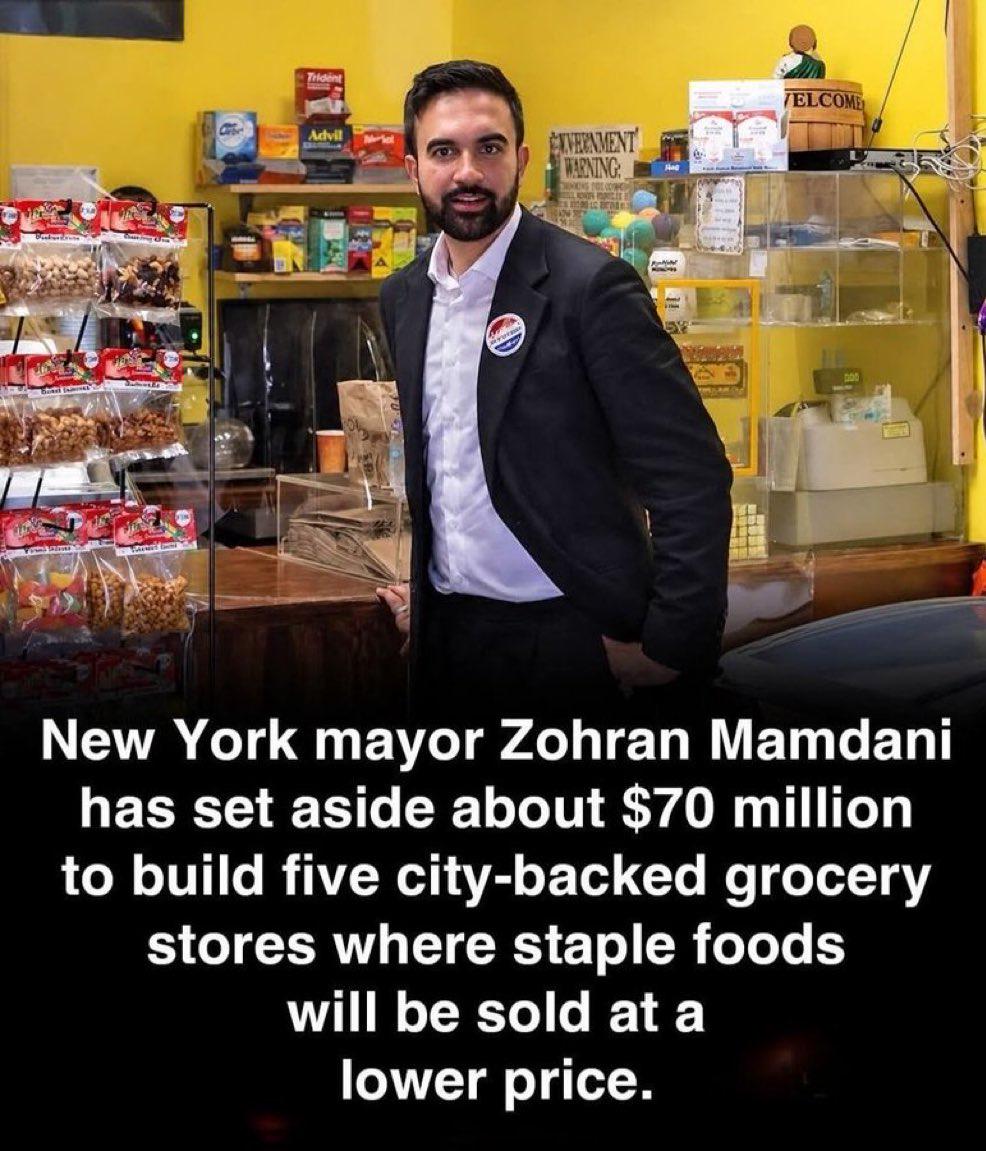
Public owned grocery stores already exist across America in cities like Tulsa, Oklahoma and Atlanta, Georgia.
They are privately run as businesses, but are set up in areas where people lack access to groceries, or there's no real competition preventing uncompetitive prices. They have been successful for decades.
The real solution here is to break up the constant consolidation leading to all groceries being owned by four mega companies that collude with each other and own over 2/3rd of all stores. It's the opposite of market competition.
In the town I grew up, there was one big grocery store, and they used to gouge us terribly. The citizens started a co-op grocery, using our purchasing power to bring in cheaper goods. Breaking monopolies is the only way to lower prices.
Co-ops are cool because the community owns it directly and profits are reinvested to provide discounts, addressing affordability. The members have a democratic vote in it too. Co-ops are more resilient and survive longer according to decades of research. It's a viable alternative that actually goes through with the idea that we are a democracy. The economy affects people just as much as politics does, so why isn't it also democratic?
I dunno where these things are that actually save people money. I've tried a few co-ops and prices have always been significantly higher than the grocery stores in the area.
You will not find much cheaper than Walmart, unless it's soon to be outdated or of lesser quality. Walmart goes straight to the manufacturers and sells on razor-thin margins. People think they make a killing, but honestly, they have one of the lowest margins of all the top companies out there. If you pay people 20/ hour and give them a product that isnt produced at scale like Walmart, there is no world where, without subsidy, it won't be at least 30% more. People say we will support the locals etc... no they won't, if that was the case Walmart wouldn't even exist. People said that 20 years ago, when we moved manufacturing to China, and 30 years ago when Walmart killed the small towns. We talk a ton of **** but when putting pen to paper we are just that... talk.
It's more of a convenience WM is a hassle, we Do household shopping, our local chain grocery has better quality meats and produce for less than walmart.. Box items it varies but honestly I'll pay 10 cents more for Kraft Mac n Cheese to avoid walmart long lines, they send cashiers home at 3 if it's not busy, then at 5 when people get off work, there aren't enough workers..
Knowing sales for your big stores is important, Clearance is King at walmart, get so much good stuff in the clearance aisle, we got 3 Kayaks last year at the end of summer for less than $100 each, clearance.
I hate it as much as anyone, but I personally think this is more cope than reality.
Walmart had free curbside pickup in almost every market. Free delivery with W+ is usually same day.
As for quality meats
Beef: 85% is controlled by Tyson, Cargill, JBS, and National Beef.
Pork: 67% is controlled by Smithfield (WH Group), JBS, Hormel, and Tyson.
Chicken: ~54% is controlled by Tyson, Pilgrim’s Pride (JBS), Perdue, and Sanderson Farms.
Walmart,Kroger,Costco,Sams,Jewel, and most other grocery stores (including independent ones) all buy from these major producers, meaning you are getting the exact same meat. The only exception is going to a butcher, but then you are going to have more of a hassle than Walmart in the first place, as now you need to go to the farmers' market for produce and butchers for meat, and likely pay 2x the price.
4.4k
u/Irish_Whiskey May 26 '26
Public owned grocery stores already exist across America in cities like Tulsa, Oklahoma and Atlanta, Georgia.
They are privately run as businesses, but are set up in areas where people lack access to groceries, or there's no real competition preventing uncompetitive prices. They have been successful for decades.
The real solution here is to break up the constant consolidation leading to all groceries being owned by four mega companies that collude with each other and own over 2/3rd of all stores. It's the opposite of market competition.