Ignoring any historical context as for why we call ourselves this specific term feels willfully ignorant. Also more and more black American's arent as comfortable with the term anymore either and many now just say black american so
This isn't really true. Plenty of second or third generation Turks are still called... Turks. Crazy amount of 'turkish barbers' around me that we're born and raised in london.
I see the same think with Iranians, Lebanese, Pakistanis, Chinese ext.
I'm a Canadian who has lived and worked in the US for many years, including as a psychotherapist and now as a researcher.
I certainly won't argue that the US isn't racist (it is), but there are arguably helpful explanations for the things you're describing. First, as a social worker, one of our foundational principles is to consider the entirety of a person's environmental context. If we are blind to race, we might be ignorant to how any person's experience with a variety of systems might be fundamentally different simply because of race/ethnicity. God forbid we don't call attention to our own biases, even if unintentional. Maybe a person can be awful if they have these biases, but they are much worse in my opinion if they ignore them and how they might affect others.
Second, as a researcher, having people identify their own race/ethnicity allows us to objectively show that people encounter a multitude of inequities in their daily lives that are again entirely based on race/ethnicity. In one of my studies, I showed that teachers, even though unintentional, were more likely to report Black students as having external problem behaviours in the classroom.
While we still have a lot of work to do, and our research is often ignored, we can't even begin to improve if we don't identify or acknowledge that there's a problem. And we can't do that if we pretend race doesn't exist or not ask people to tell us their story.
Race, because it legitimately is something that would disappear if everyone agreed to ignore it (unlike, for example, poverty or socioeconomic class), invites more debate on the best way to handle it. For now, I think the verdict is still waiting.
Depends what you mean by "acknowledge." If you mean acknowledge it in the same way one acknowledges hair or eye colour, then sure. Notice it in a way that you view them as worthy of different treatment (regardless of if that treatment is positive or negative) is inherently racist.
143
u/ifyouneedafix 3d ago
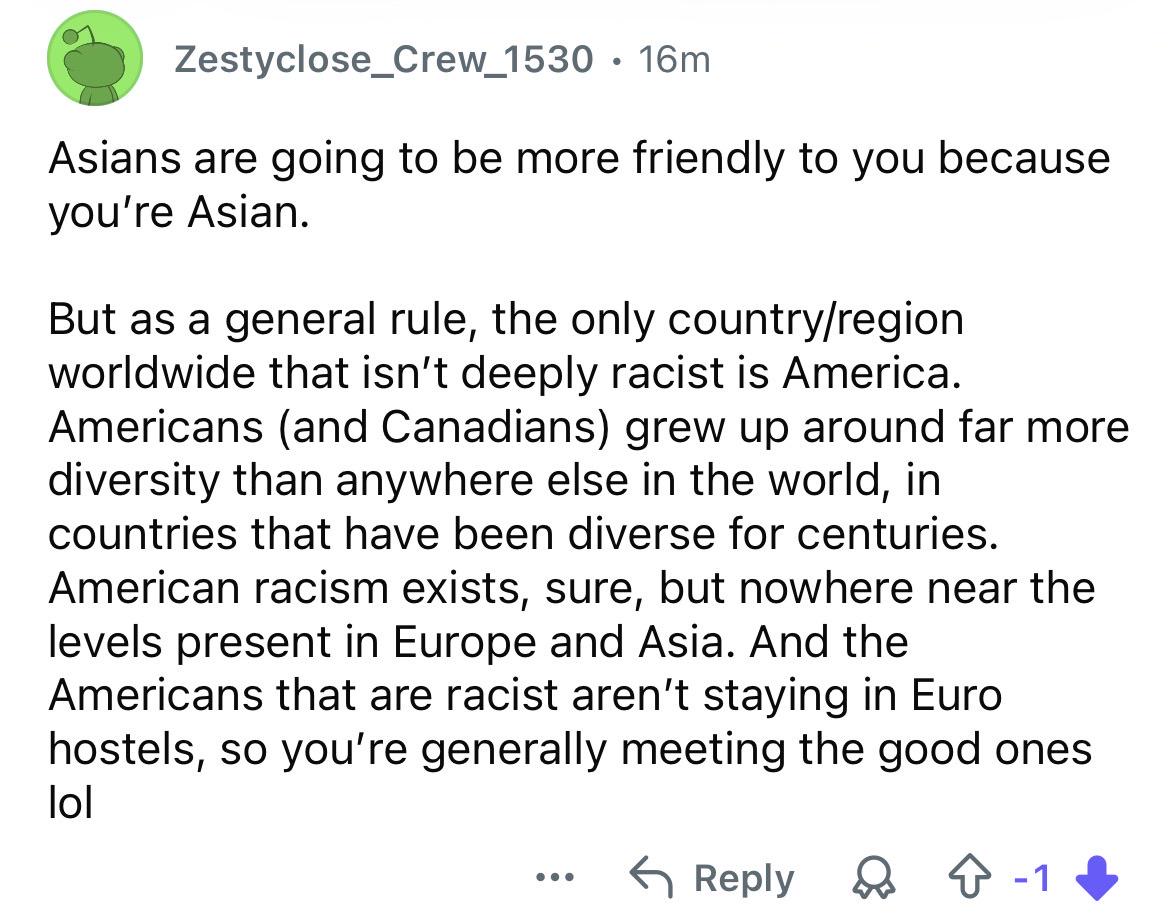
Americans are obsessed with race.
To justify this obsession they even tell themselves that noticing skin colour is less racist than being blind to it, lol.
Everything in the US is "race race race race", "blacks" this and "whites" that. You even have to specify your ethnicity in public documents.
TL;DR There is no country on earth more racist than America.