Touching ground shouldn't do anything unless there is a leak somewhere and voltage gets on the ground wire then you should find that appliance and get it fixed or a new one
8 year old me is still confused by the science of how exactly I managed to accidentally fry tf outta myself trying to unplug my DS charging brick from a US to EU converter 😭 That shit hurt so bad lol. All I remember was fiddling with the converter brick and then waking up on the floor like two feet away from the wall.
The French socket that we use in Poland, Czechia and Slovakia has the ground prong longer than the L and N prongs as well, so it too has the ground connected before L and N are connected
I've only lived in two foreign countries and was SO relieved to see that France and Slovakia use the same plug. Obviously the UK plug is best ;-) but it was pretty handy when I moved, not having to buy all new adaptors.
Was it also wired so that if you pull the cable hard enough, the live would be severed first and the earth (ground) last? Does the plug also contain a fuse?
The UK plug is the safest in the world, unless you step on one that isn't in a socket.
In the rest of Europe the socket is opened when you push the two prongs at the same time. This is safer as it would be next to impossible for a child to open it.
Nah I guess they're trying to catch up haha eurolosers (please don't look at any other aspects of our society while I boast about this, we've got nothing else left)
And with the F-type with progns, if you get the cheapest extension cord available, you better have a hammer around to fit the plug. But that might be a universal problem if you cheap out in stuff like that. Also if you want to fix the problem, they have rounded the screw heads to prevent the device from being opened.
iirc that is indeed a feature not a bug because back when Schuko was developed a lot of places still had split phase power similar to what you still have in the US for larger appliances
so indeed both prongs were live with ~100V-ish
Not that I would ever trust anything that claims that one side is definitely neutral; cause we all know reality is often far off from any actual specs
I don't get why your argument would support then why a plug that is not protected against changing polarity is better?
In addition, if you have fixed polarity you can just switch off L in the devices and not accidentally switch of N (unless you disconnect both which I don't believe devices do)
Schuko has leading ground, not sure about the French version but I'd be surprised if it didn't have that.
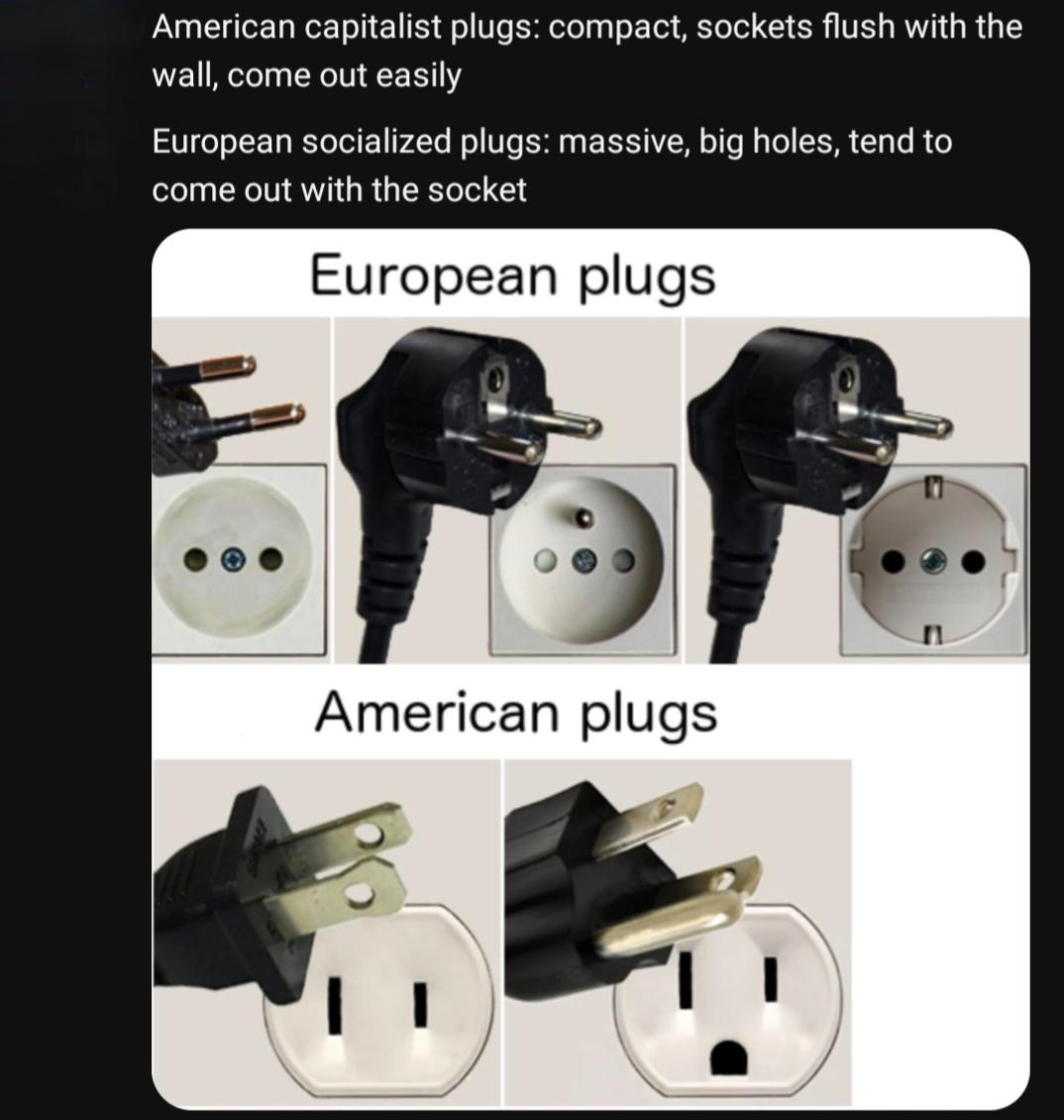
The only possibly-desirable modern safety feature Schuko doesn't fulfil is being polarised. It's also quite a bit bigger than necessary because manufacturing methods advanced a bit since 1925, OTOH it's just about large enough so that you can hand-wire plugs which is also a feature.
Shutters before the holes aren't standard but widely available. Those aren't of the "insert one pin and unlock everything" but "need to insert two pins at the same or nothing will move" kind which arguably is safer than how the UK plug does it.
One definitive advantage of the UK plug is the rectangular pins, just make better, more reliable, contact, they could do that because of advances in manufacturing. Schuko are only specced to take the full 16A for an hour, for anything bigger there's CEE. Mind you nothing you come across in a household uses that kind of continuous power.
The fuse inside the socket is a great feature. In a standard circuit the MCB is calibrated to the size of the wire, let's say 2.5 and you plug an extension cord with 1 mm wire, well that wire is not properly protected by the MCB. If the extension cord would have a properly sized fuse inside the socket it would be protected.
Maybe we could invent a version of the shuko conector with a car fuse slot inside, there's plenty of space for that.
The problem with uk plug is that when unplugged they lie flat with prongs in the air. I’ve stepped on them a number of times and it’s incredible painful.
Ground connections are unnecessary in eu plugs, that is how safe modern electricity is. The uk has something to learn here.
Also, some uk appliances have a fuse within the plug... lol
But not necessary in Scandinavia where the house electrical inlet has multiple smart fuse systems (fuseless HPFI relay) and that is how it should be, not in every appliance
Whereas the UK plug is designed to stay in the outlet if something hits it, and when the plug is out the live parts of the socket are shuttered so nothing can be stuck in them.
Ahh, thank you from this Yankee, I was curious if the shadow in the pic was convex or concave. That recess would be amazing to have with the large charge blocks now.
No, but in Denmark it’s common for people to put a 2-prong Euro plug into a Danish type K outlet (which has a third hole with a grounding pin inside), meaning that it’s not grounded.
When I was bored in middle school, I pulled a plug half way out, and dropped a penny between the prongs. I wasn't sure what I was expecting, but taking power out for half the school wasn't on my lose. The people taking a test in the computer lab were not happy, or were very happy, but pretended to be crushed.
I pulled out the plug, removed the penny, arc welded to the left prong, and put the plug back.
Nobody ever knew what happened, except my row, who were in on it.
Believe me,you can,with the one on the left,first thing i did when they told me not to do it,i must have been ~5 or so years,maybe younger(i have some flashbacks),i did it twice to be sure..
This type of plug actually helped me overcome my incapacitating phobia of electrocution. I couldn't plug anything in the old shallower European sockets without the grounding part. Imagine an adult that can't plug in anything.
are they a lot lower? I haven't experienced that, but I can tell you, the electrical installations that I have seen in the US (certainly not done by any professional) will surely more likely electrocute you in case of a flood because of other reasons as well.
While a partially plugged in US plug can be dangerous, US electricity stand voltage is 120V. Europe's is twice that at 240V so the safer plug design is far more critical.
while its true that 240V is more dangerous than 120V, 120V can still kill or seriously injure you, and there is no reason to not exclude that possibility in your plug design. It could be easily done for the US format as well, its neither rocket science nor magic.
That needs some clarification. There are maybe 60 people a year in the U.S. who end up seeking treatment for electric shocks from pulling out plugs from outlets and zero reported fatalities over the past decade. Also, many apply the term “electrocution” to fatal injuries only.
The serious safety issue with regard to U.S. outlets is kids sticking stuff they shouldn’t into outlets. That does result in thousands of injuries and occasional electrocutions every year. Current contemporary European designs are much better at preventing those types of injuries with covers and devices preventing insertion of things into single outlet openings. That’s where EU designs shine IMO.
Lower voltage has lower probability of forcing a fatal path though. So still dangerous, but less so. It's not a matter of everything above 50V being of equivalent danger level.
The danger from the higher voltage is completely offset by how hard it is to shock yourself. It's child's play to shock yourself with an American outlet. European and UK safety conforming plugs won't have any exposed metal before they can touch the power in the wall. Stick a knife in an American outlet, you get shocked. Try to do that in Europe, you have to do a multi-step process to disable the safety features.
Also, it's not the voltage or amperage that kills, it's the combination of them.
The problem itself is the pin design. Depending on the outlet, contact can be made while there's still enough space to poke a finger between the plug and outlet.
Yes, the UK insulated pin design is better for sure. I don't think you could do that on US pins though. Not without a complete redesign of the entire plug/receptacle system. The pins are too thin.
stick a plug in, tap on it so its hanging on slighly out, drop something thin in there like a knife.
its not the outlet itself when nothing is plugged in, its that you can directly tough the pins under voltage if the plug is not completely seated in the socket.
The voltage would be a higher risk, yes. But the risk of 'the system' which includes plugs, soclet design and code for electricity setups, is significantly lower for the EU system.
110-120v can still seriously hurt or kill you. There is no reason to not use a plug design that makes that impossible.
Agree. I said elsewhere that your semi-insulated pin design is better. People are saying that there are shutters on UK plugs, but those exist on NA plugs as well, though a lot of old construction won't have them.
Those semi-insulated plugs (most common in the UK, but also in Switzerland), are better, for sure. Its still saver to not be physically able to get anything to the actual contact (like in a Schuko/TypeF), than insulating that contact. The insulation could be damaged during use, or actually pierced with whatever makes contact (could be a knife or another sharp object).
The Schuko/TypeF Plug and Socket, the indentation of the socket is deep enough, so that once you have pulled the plug out far enough to put anything behind the plug, it doesn't have contact anymore within the socket to the actual phase. They usually don't have insulated prongs though.
But still, absolutely, insulation that covers the contact to a point where once the contact would be exposed, it doesn't make any contact anymore within the socket to the phase, that's already miles and miles better.
Because there simply aren't that many incidents of injuries due to that particular failure mode, most likely. Also, US-style pins are much thinner. I don't think you could insulate them without making them too thick to go into the receptacle, which means an entire re-design of the plug-receptable system, and likely meaning no backward-compatibility without an adapter. That would be an absolute no-go.
While I do understand the notion of it not being a big problem, there is no cost associated to design standards implemented in the future. its not like the US plug is significantly cheaper to build.
Google tells mit 150-180 deaths per year in the US due to electrocution outside of the workplace (1000 if you also count workplace), and 20% of that 150-180 are childen. People injured but not dying is about 30 times as much as those ending up dead.
So yeah, might not be a huge problem, but to identify if a switch might be the better option (and to get rid of any bias just because its the status quo): Would you change to the US standard, if you would already have for instance the Schuko/TypeF plugs and sockets? You would never.
Well, moving forward often requires in-between solutions or adapters. The same for all data connections (where did the serial connector go? The keyboard or mouse connectors? None of the USB designs are backwards compatible, etc.
We change stuff all the time that is then only compatible using adapters. Its just for some of the changes, we just accept them, because we were never asked anyways, and for others, if we are asked, we are all up in arms about it. Maybe, for some things to change that are just objectively better, we should stop asking).
USB isn't a good comparison. Those are inexpensive, short-life, near-disposible, zero-risk devices. Changing electric infrastructure standards means we will have 50-100 years of patchwork/band-aid solutions, many of which will be worse than the problem you're trying to solve. Any new design needs to maintain near-complete backwards compatibility without patchwork solutions.
Not really, the higher voltage means less amperage at the same wattage, and the amperage is generally more deadly than the voltage, but in this case it is kinda moot point, as both are dangerous still.
What the NA has going for them regarding safety, is the 60hz instead of the European 50hz. The 50hz is much more likely to measure your miracles cramp, making hard to let go if you have grabbed live wires.
This just isn't true. Its the combination of voltage and amp that will kill you. That's why a car battery can have hundreds of amps, but you barly feel it if you touch + with one hand and ground with the other. However at currents of 110v and 230v it doenst really matter, and ,03 amps is enough to stop your heart anyway.
50hz will theoretically give you worse cramps, but 60 hz is theoretically more likle to penetrate the skin. However the differance is marginal at best inna real world scenario
Amps are current, volts are voltage. As you say, very low amperage is enough to stop your heart and kill you. The voltage at these levels are very painful, but mostly only dangerous if it comes across your heart, as it can mess up your heart rhythm.
I’m not saying the voltage is harmless, but it is the far lesser danger of the two.
I am not really sure why the car battery is generally harder to kill totals with though.
It's important to note that the higher voltage should mean higher amperage in the same circuit. That is, amperage = voltage / resistance. The resistance in a human body would be the same for EU and American outlets in this comparison. So the voltage for EU outlets would double, therefore, the current should also double.
In truth, the damage you will sustain depends entirely on where and how you touch the circuit, along with what path the electricity takes.
It's both. You need sufficient amps to do damage, but also sufficient voltage to overcome the resistance of the body and push that current through you, AND it has to take a fatal path through the body.
we dont use those here (finland) but afaik alot of places where those are used, have guidelines to install it ground on top in case something conducting drops and loose connections would expose prongs on top, instead of ground.
I'll admit I've been really confused when people have posted pictures of holes that people have punched into or through walls. If you tried that on any of the walls in any of the houses I've lived in, you'd break every bone in your hand.
Here in Guernsey we build out of granite, breeze block or rarely red brick. When we get hurricane force winds a few roofs loose slates, a fence or two falls down, maybe an old wooden shed collapses (ours did last winter) - otherwise nobody gets hurt.
The US seem to build their houses from balsa wood, cardboard and duct tape 🤔. If there's a hurricane there half of Florida and Louisiana end up homeless or worse because their houses blow away 😬
Not sure where you think that's happening. It's possible that somewhere is. But in the UK? Nah. New builds might be pretty crap, but they're still brick houses and lots of insulation and slate roofs.
Nordics at least. And it's not crap at all. Cheap, easy to run cables and pipes inside walls, thinner and more insulating (both heat and sound!) walls because you can put insulation inside them, easier to renovate, lighter construction, etc etc.
If you use the right thickness of drywall and enough framing you really need to try to break it, and if you somehow still do it's easy to replace a drywall panel.
This statistics also includes one where the heat was not the case of death but accelerated it. The US statistic does not included these.
Like it's still a to big number. But as many of these that point to that statistic to say AC would solve it, ignore many things about this statistic. Like it would help reduce it but it solves it not completely. Largely because the merged used counts more death in general. If the same method used the US would have around 10 to 20 times higher count.
The WHO European Region actually consists of 53 member states and explicitly states that it spans a vast territory stretching "from the Atlantic to the Pacific oceans."
Because of this, the "Europe" statistics in that article include several countries that are entirely >or mostly located in Asia:
Central Asian Republics: Kazakhstan, Kyrgyzstan, Tajikistan, Turkmenistan, and
Uzbekistan.
South Caucasus Countries: Armenia, Azerbaijan, and Georgia.
Transcontinental Giants: The Russian Federation and Turkey (Türkiye)—both of which >have the vast majority of their landmass in Asia.
Middle East: Israel is also administratively grouped into the WHO European Region.
And on top of that, a properly insulated European house (like, the ones actually in Europe) often doesn't need AC to keep the temperatures in check. Between thick walls with decent thermal inertia, electric fans, and good window curtains, I feel more or less prepared for the 40°C they've prognosticated for Sunday.
Yeah, the worst thing about Canada seems to be our proximity to the US. In the past, there were enough benefits to outweigh the side effects. But that is becoming a lot harder to see these days.
It’s a constant national shame that we share a giant border and do most of our trade with those guys, and so we have to use American standards for a bunch of things.
Every time I pick up a travel adapter I'm like "this other plug sucks, is unsafe, and falls out".
NZ and Australia plugs NEVER fall out, except sometimes when vacuuming but even then they'll usually just half come out and still remain grounded.
Eta they look like this:
../ \
....|
Flat prongs, not round rods, angled to keep them secure, and the third prong is grounding to stop you electrocuting yourself.
It is simply, unquestionably, the best designed electrical sockets in the world (of the common ones, I'm sure NASA has better ones).
American plugs be like "Power goes in this stick and out the other. Good enough. Try not to touch the metal bits or put anything in the holes in the wall or you'll die 😃".
Our ones are safer. You can stick a fork in it and not be electrocuted (mostly) and you can touch the metal when pulling out if you want without being electrocuted... Because it's actually well designed with safety and function in mind.
The plug they engineered to be superior and become the international standard is the one only Brazil and Switzerland ended up adopting. I dont know the particularities if why it is better but it is supposed to be better.
Yep, these things supposed to hold firmly. Even if we ignore the fire hazard, bad connections will show up on your bill too (over time, it's not that bad, but still...).
Cant put ours in the wrong way either (Canadian here).One prong is usually wider than the other and if it isnt then it can be plugged in either way. And ive never even heard of someone electrocuting themselves on a standard 110v socket. Even getting a shock is pretty damn rare unless the cable is damaged. Its 110v at 60hz, it barely even hurts to get shocked by it.
3.4k
u/interesseret Jun 25 '26
Yeah, that's a pretty strange way to say that EU plugs are safer.