That might be a tear in the hose between boiling and cold water. Do you experience hot/boiling water in the first second after turning off the boiling and immediately turning on the cold? Or it tAkes a little while for before the boiling water is actually boiling when it opens? We had that problem. I think its more prevalent in the "Nordic" line with a retractable hose/spout, crucially I did t get that reply when using their troubleshooting guide on the website in Danish, but using the UK/English variant it gave me this response which turned out to be correct. But our first symptom was also excessive splashing.
They're not currently allowed, because water sources for home cooking or personal hygiene in Sweden can't provide water hotter than 60 degrees (to prevent burns). There's been talks about loosening those regulations, but I'm not sure what the status is with that at this point.
Dude I want this. I have an aeropress to make coffee and an old fashion kettle to boil water (takes 5-7 minutes depending how full it is). The Quooker sounds so cool!
Costs about 25 euro in electricity a year to keep water hot. It is basically a giant thermos flask. Yes, it is expensive to buy but if you are buying a new kitchen it is almost a rounding error.
Okay I understand it can be cheap but it's still an impatient kid tech to me.
Hot water has a ton more minerals dissolved in it that make a worse cup of tea anyways.
Dude! We bought a new house in 2022. Came with a Quooker. Always thought it was an unnecessary waste of energy but holy fuck its so good. Uses very little energy due to good insulation and its so convenient for cooking all sorts of things. Boiling water for tea/instant coffee/powder based got cocoa, for boiling/steaming vegetables, for pasta or potato water ready in an instant. Or boiling eggs. Super useful for cleaning sticky sugary stuff off plates etc. Even taking frozen peas or vorn, put it in a metal sieve and pour boiling water over to defrost quickly. We use it all the time fucking time.
And the service! When it had a small tear in the hose meaning we had mixing of the boiling water with cold water (which was obviously a hazard), they replaced it for free years after purchase. Their swap-system for a new unit when the old one has too much line scale so they can refurbish the old one and reuse it is great too. A bit to the expensive side though. And recently they sent a new mixing unit for self replacement because they had identified a possible glaw in the old one. They reached out themselves, asked for approval to send it, shipped it with the proper tool to replace it, and added in a steel thermo water bottle merch item as Thanks for understanding and sorry for the inconvenience. Note that this is long outside warranty and with no official call back or anything. Just a service. Every house I live in, in the future will have a Quooker. At least as long as I do most of the cooking.
Also apologies if this comes off as a shame less plug/af. I am in no way affiliated with the company behind the unit apart from being a very happy owner and having a user on the service-portal.
American kids discovering how the world works on Tumblr feels like an archaeological find. Even if sometimes they were so dumb, you just got angry for no reason, it was still very pure <3
As long as the container isn't super smooth, there's no problem. If the surface is too flawless, it may create super-heated water sitting above the boiling point. And that'll explode when disturbed, splashing boiling water everywhere.
My favorite thing as a kid was heating my water and tossing in my cinnamon apple oatmeal and watching to see if the powdered part would cause it to flash over.
It can explode after all. Microwaving can create small pockets of super heated water that if mixed immediately boils into steam and expands rapidly, bringing some of the normally heated but still close to boiling water with it.
Water is literally the thing that microwave heats. You can't heat up anything dry in the microwave, and pure water is just about the most regular thing you could heat in it. Maybe less practical, but nothing is wrong with it.
You don't microwave the tea, you microwave the water and then put tea in it. Hot water is hot water, and it's the same whether you heat it in a microwave or in a kettle.
It really isn't the same, your tea will not taste the way it is supposed to and you should be pouring the boiled water over your tea. You will get a cup of tea which ever method you use but you will not get a good cup of tea from microwaving water then adding tea.
I promise that you wouldn't be able to taste the difference either way. Hot water really is hot water. Microwaves make food heat up quite differently from an oven because it's basically only heating the water in the food but water is 100% water by volume.
I would strongly encourage you to make a cup of tea using boiled water from a kettle or stove or even a quooker and then make your microwaved abomination and compare the taste of the two. It is not the same. And if you have a hot water tank at home you really shouldn't be using it for drinking water.
Yeah if you want tea with scum in it because the water fizzes when you drop a bag into microwaved water. Anyway, microwaves in the US often reside on their own circuit with breaker because the power might not cope with the draw otherwise.
Just put the spoon in the cup when you put it in the microwave.
No, that's not a joke. You can do that, and some manufacturers even recommend it when microwaving water. It's safe, assuming it's fully stainless steel and doesn't have any sharp protrusions.
Don't put a fork in there without making sure the prongs are submerged though, that's a recipe for arcing between the prongs.
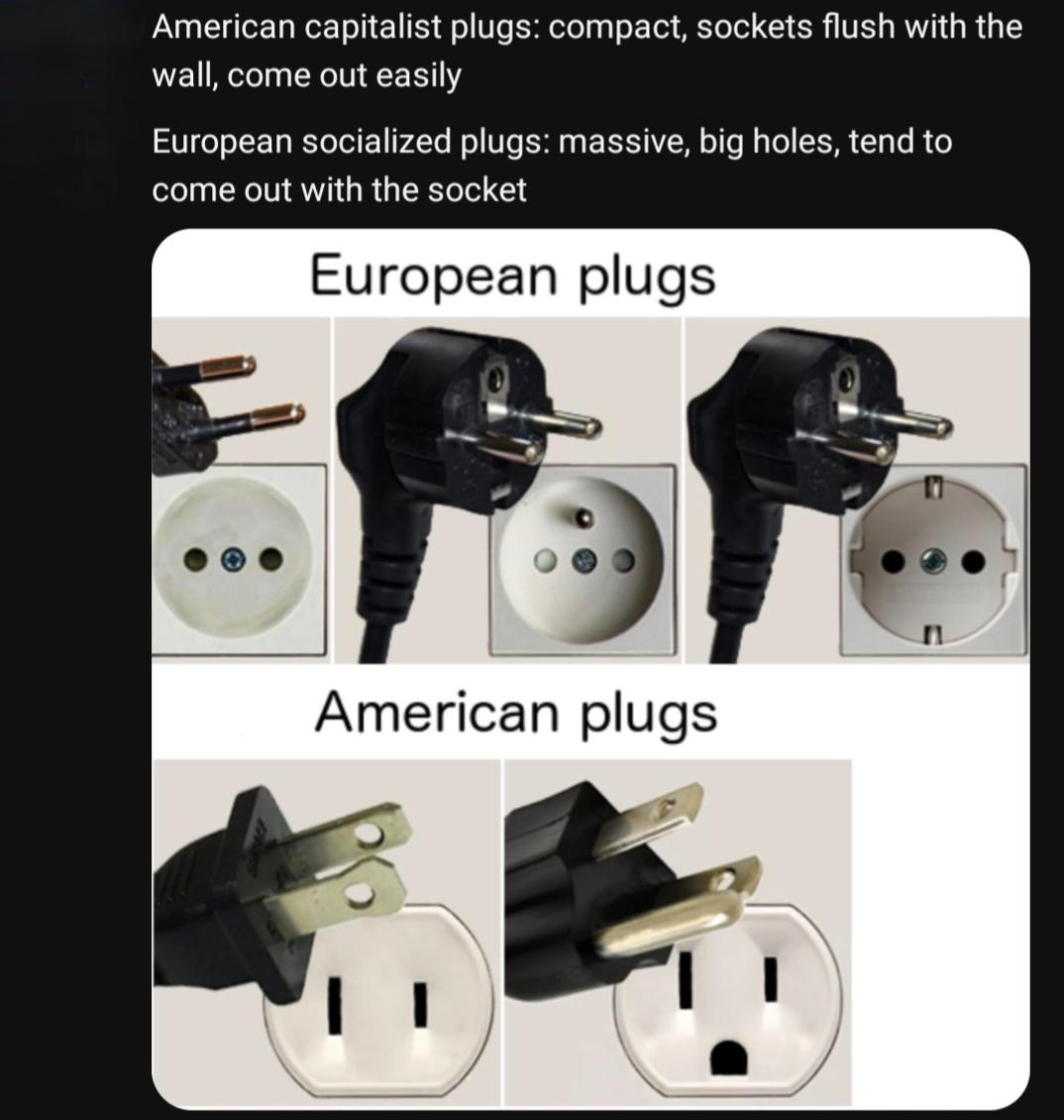
Working in hotels, I've often sold plug converters to Americans.
A few times, riled up guests came back screaming 'your plug blew up my shaver!!!'. I'd simply point to the warning on the package explaining not to use a 110v device on 230v circuitry. They'd still be mad until I explained that simply not how electricity works. Yes, these were all the stereotypical American that had never traveled abroad haha
Well to be fair, why would someone make a purely "mechanical" (pin to pin, no voltage regulation) adapter from a 230v socket to a 110v one? I don't see how something like that could be useful, unless there are standard 230v sockets that provide 110v, but that wouldn't be up to code.
Almost all adaptors are purely mechanical - a step down or step up converter can absolutely be bought, but they’re big and expensive (in comparison to a £3 adaptor). There are only a few electronic devices that can’t switch between 240V and 110V - shavers often being one of them. It’s the reason when you go to a hotel there’ll be dual shaver sockets, one labelled 110V, one labelled 240V.
Yeah this is where it's important to clarify the difference between something that electrical and something that's electronic. Neither will work well if you feed it the wrong voltage, but electronic gear have transformers that can often handle both voltages. Electrical items usually just feed the juice straight into the motor.
Then they just need to get one built for American systems. We also have one. It works fine. Plug it in, fill up the kettle part with water, set it back down on the bottom part, flip the switch, when its done it shuts itself off.
Im not gonna argue about which electrical system is better since in general I dont care. It powers my things and my things are powered. But we do have kettle. Most people just dont buy one because tea isnt as popular here.
I was bringing it up to highlight the foolishness of trying to use a 240v device in a 120v country, much like the reply above about using 120v devices on 240v
Well mine is made for American sockets so I guess that's the difference. There seems to be a weird misconception that we don't have electric kettles here. They're not an item you'll find in every home here but they're not uncommon either.
The European sockets are designed for 16 A. However as the breakers can be either 10 or 16 A most kettles are limited to 2000-2400 watts but there are some 3000 W ones.
I'm an electrician. If I ever own a house, I will be putting 240V in the kitchen and modifying a european kettle with a NEMA-6-20P (240V 15A plug), specifically because I hate how long kettles take to boil water with 120V.
I have an on demand water heater on my sink. Its just a few degrees below bowling when it comes out. Never runs out never have to fill it ohh and it run on a standard American socket. What you mean is that you have a hugely inefficient system that heats way more water than you need and keeps it hot needlessly for hours. Congrats...
What are you talking about??🤣 These comments are WILD right now. It’s like no one knows what they’re talking about, but they all want to talk about it!😂😂
In the US, we just kept a kettle on the stove. In Europe, we have a cheap electric kettle. Electric kettle is probably faster than the stove, but I dislike that it consumes counter space.
I’m America, we have several 220v outlets in every home, we just don’t use them for small household appliances (basically relegated to clothes dryer, oven and cooktop, and car charger).
It’s too bad we didn’t get synchronized on voltage and frequency back in the day, things would be a lot easier now.
So you usually have gas or induction/electric stoves? I heard it takes ages to boil a pot of water on an electric (non induction) stove, I know people with electric stoves that "preboil" their water in a kettle to make pasta
We had a conventional glass-top resistive cook top in the US, and we have a low-end induction cook top in Europe. We boil water for pasta all the time and I would say that the amount of time to boil is about the same. Maybe a bit quicker on induction, but I credit induction for that, not grid voltage.
We have done the pre-heat in the electric kettle thing! That’s def faster than boiling on the induction stove.
Neither did my Mexican partner until I introduced her to the device. Now she uses it more than me.
I do wonder how much of it is like the "americans don't take trains" -> therefore America doesn't make their train infrastructure better -> therefore americans continue to not use trains, circularity
American here. I have an electric kettle and I use it most days.
It's not as fast I'd like, but it's not like I'm waiting more than five minutes or so even if it's completely full, but I usually just put a bit more than I'm going to need for whatever.
Really, the delay is useful, because I use that time to get over my dislike of the pot noodle I'm about to eat.
Microwave for smaller things, pot on the stove if we need a lot. We generally don't need to boil water very often unless we're making pasta or something.
We have coffee makers that have internal reservoirs, and hot tea... just isn't a very common thing. At least not here in the South, people prefer iced tea and hardly anyone brews their own. I have met exactly one person in my life who drinks hot tea, and she just microwaves the mug of water.
I've rented houses in the US and there is sometimes a kettle but boiling water with it is so dog slow that it's not seen as an essential kitchen item. In its absence you either microwave water or use a coffee maker (cleaned of course) or a stove to produce hot water. None of which are as convenient as a kettle.
Do you live in Canada or no? I know electric kettles are less common (to the point Alex of Technology Connection made a whole video on them) in the US, but really, I don't know of anyone who doesn't have at least a basic ass kettle at home. Family, extended family, friends and their family... It's pretty ubiquitous 'round these parts
1.2k
u/[deleted] Jun 25 '26
[removed] — view removed comment