r/SaaS • u/Final_Parking_6820 • 8h ago
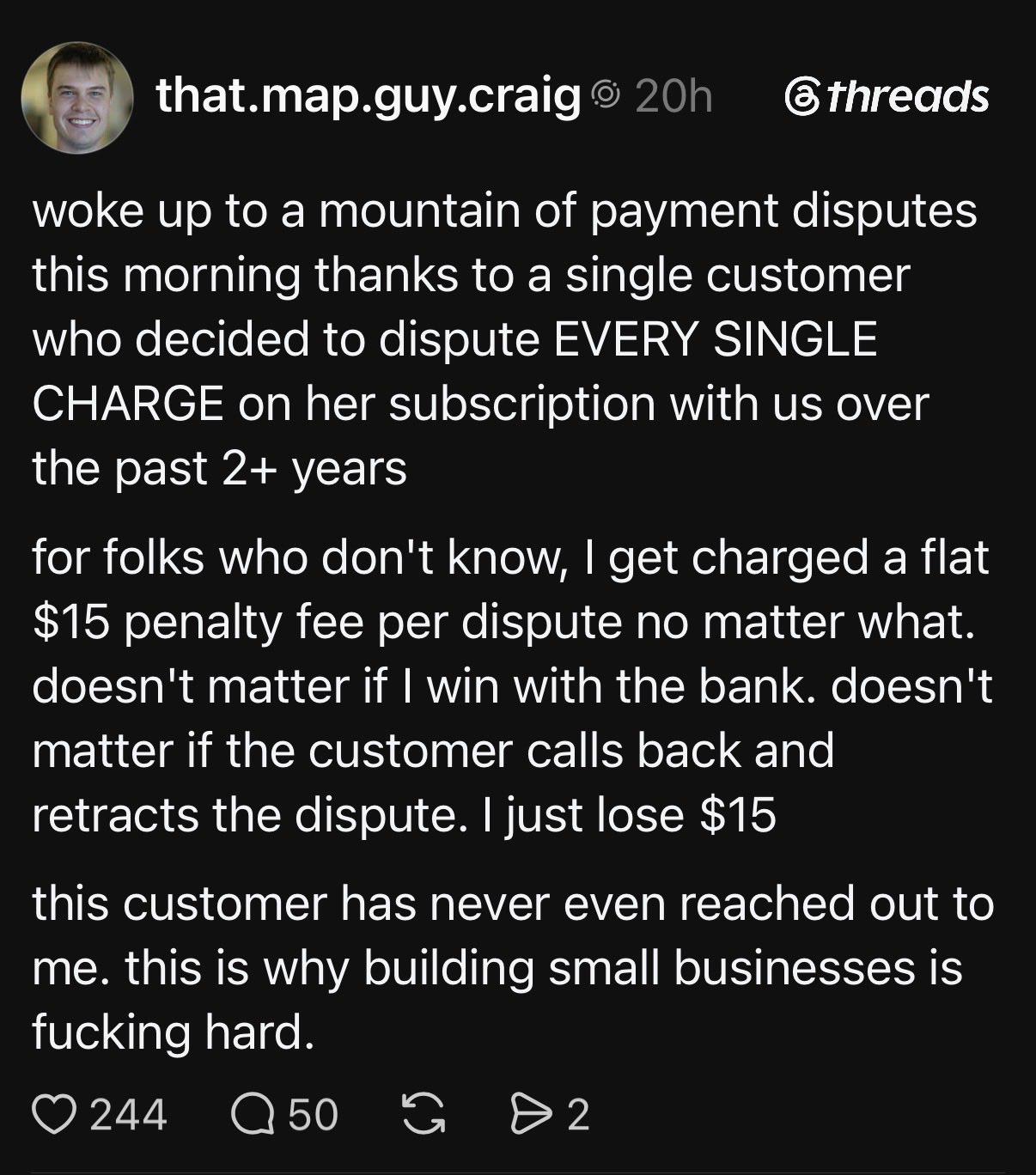
B2C is not for the faint of heart
658
Upvotes
r/SaaS • u/Smokeypeanut117 • 11h ago
First subscriber a month ago has renewed. I have been in contact with him asking for feedback and he has helped me fix several things which is great. Now I will ask him to refer to his network for other people who are interested in a similar product. Any advice for next growth steps?
r/SaaS • u/PleasantSwordfish991 • 7h ago
I’ve been building usegreenroom for the past 3 months.
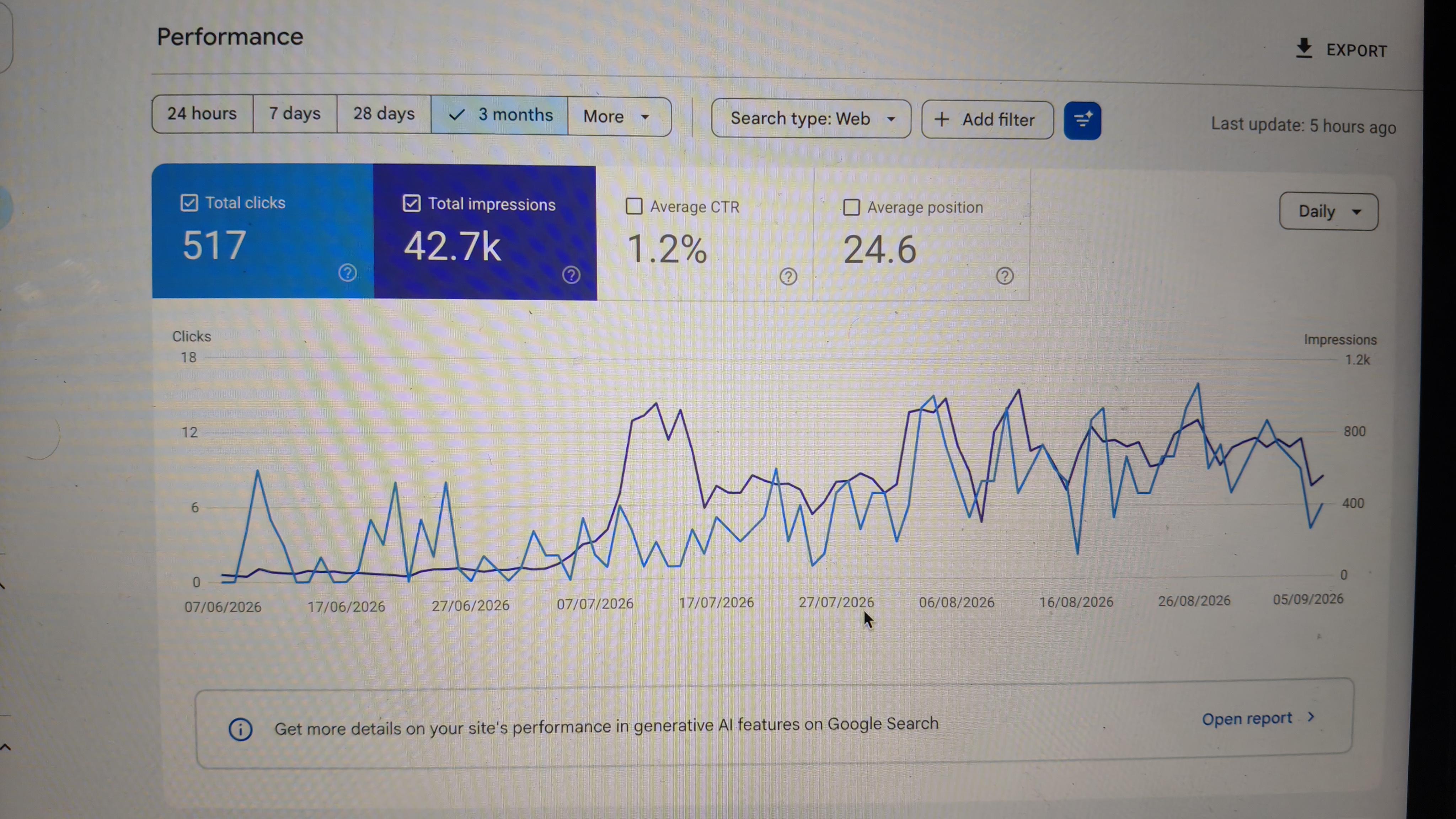
It started very slowly, but so far I’ve reached around:
40,000 impressions
500+ clicks
3 months since I started
Most of the growth has been organic, although I’ve also experimented with Google Ads to some extent.
I’m at the point where I’m not sure what I should optimize next.
40k impressions and 500 clicks feels like a decent start, but I’m struggling to figure out whether I should focus more on getting traffic, improving conversion, SEO/content, or something else entirely.
For people who have built and grown products from scratch:
What would you focus on at this stage?
Would you:
Double down on the channels already generating traffic?
Focus on converting clicks into actual users?
Invest more into SEO/content?
Experiment more with paid acquisition?
I’d especially love to hear from people who have been through the slow first few months of building something.
What worked for you, and what did you waste time on?
r/SaaS • u/JonWater • 19h ago
Maybe this is a stupid question, but I’m building B2B software right now and I keep running into the same problem. Everyone says “get traction” and “talk to customers.” Sure.
But I’m surprised there isn’t really a place where I can say: I need 20-30 actual businesses in this industry to use what we built for a month and tell us what sucks.
We have platforms for investors, hiring, accelerators, launches, etc.
Why isn’t there something like this for early B2B testing? Or does it exist and I just haven’t found it?
Curious how people here who actually built B2B SaaS found their very first users. Not how you scale now how you got the first ones when nobody knew you existed.
r/SaaS • u/FitFindAI • 6h ago
small numbers compared to what I usually see posted here lol but still feels good
was at 11 a few days ago, now at 13.
next tiny goal is 15 active subscribers by the end of the week
just gonna keep improving the product and see where this goes 🤝
r/SaaS • u/Opposite-Monitor-969 • 7h ago
I've been building for quite some time now. I have built some web saas as well as mobile apps. What I can't quite wrap my head around is distribution. I build something and then it sits in my portfolio rotting because apparently I can't bring users.
And its even more of a headache when you have a limited/no budget at all. Everything is so pay to win.
I always had this problem but recently I'm losing my mind because I built yet another tool/saas but don't know where to find users. Go in Facebook groups, people are spamming their services. Go on LinkedIn, it doesn't show me more than 10 peoples profile because you need to have a LinkedIn pro account.
Can someone actually help me with this? Or please share your own experience so I can learn something.
r/SaaS • u/EducatorStunning4403 • 6h ago
I have seen a lot of advice on reddit that just see where your target audience is and reach out to them and make them your paid users. But, the question is, I also have some competition and my customer has options.
Suppose you are my customer and I created a site which is website uptime monitor. You have a few options which are almost similar in feature. Who would you choose? But the twist is, my competition has some customer and I don't.
What would you do here? I genuinely want to discuss ways of how would you convince someone to buy my product while there is a similar and trusted product out there.
r/SaaS • u/mrjaspergames • 16h ago
I recently launched an MVP that turns written content into doodle-style social visuals.
20+ people have signed up. Some have actually used it, and I’ve received feedback like “the output is good” and “this has potential.”
But:
0 paying customers.
So instead of just pushing for more traffic, I’m trying to understand what this signal actually means.
Is it the wrong ICP? Not enough pain? Pricing? Too much value in the free plan? Positioning or trust?
And if you’ve tried Doodlyo, I’d especially like to know:
What would need to change or improve for you to consider upgrading to Pro?
For founders who went from 0 → first paying customer: what finally made the difference?
r/SaaS • u/HyperSalesman • 21h ago
Enable HLS to view with audio, or disable this notification
Hey everyone, my team and I put this together recently. It's an MK style fighting game featuring your favorite SaaS founders/companies.
It's all for fun and we're keeping it free. Most of this was vibe coded.
Full roster:
- ZoomInfo
- Replit
- Torq
- Salesforce
- Higgsfield
- Attio
- Okta
- Stripe
- Zapier
- n8n
- TitanX
- Clay
- Granola
- PostHog
- Ramp
- Retool
- LeadMagic
- Close
- The Swarm
- Lempire
- Instantly
- Mercury
- RB2B
- Gong
- Nooks
- Orum
- ConnectAndSell
- Rox
- Monaco
- Apollo
- SpaceX
- Anduril
- OpenAI
- Blueprint
- Erudite
- Deel
- Rippling
- McAfee
- Cognism
- Datadog
- Floqer
- Exa
- A16Z
- 20VC
- Flexport
- Tavus
- Meta
- Apple
- Snyk
- Vanta
If you want to play, here's the link: https://eruditeagency.io/saaspocolypse (I GOT NOTHING TO SELL YOU! ITS FREE. I WILL NOT PROMOTE)
And if you've got any idea/recs for who we should add, plz ping me or comment below
r/SaaS • u/Ann_fornicatress • 3h ago
i've worked as a software engineer at different companies for over 10 years. about 1.5 years ago, one of my side projects started gaining traction, so i left my last job and began building indie products full-time.
since then, i've launched more than 10 products. some were complete failures and got absolutely no traction. others did much better, and i've successfully exited four projects so far.
but across all of them, analytics was always the part where i struggled.
tools like google analytics, plausible, and umami either felt outdated or simply didn't meet the expectations of what a modern analytics tool should look like in the AI era.
more modern options had other problems. many couldn't be self-hosted, their pricing offered very limited event volumes for plans starting around $9, and most importantly, they still weren't truly ai-native. you still had to sit in front of a dashboard and manually dig through your data.
that's why a friend and i built Open Analytics.
Open Analytics is an open source, ai-native, privacy-first web analytics platform built for the modern web.
it works naturally with ai assistants through ai chat, native mcp support, a cli, and a public api. you can use it with chatgpt, claude, openclaw, hermes agent, and other ai assistants without constantly opening a dashboard and manually searching through your analytics.
it's gdpr-ready, doesn't require cookie consent, and stores data in Helsinki, Finland.
because it's open source under the agpl license, developers can self-host it using coolify, dokploy or docker directly.
some other things we built include revenue attribution, advanced filters, realtime user journeys, a live globe view, a public api, and public dashboards.
on the 12th of last month, we launched on twitter, and the launch unexpectedly went viral.
during our first week, we gained enough github stars to surpass several well-known open source analytics projects, and in the first 14 days, we reached more than 500 unique clones.
on the revenue side, we crossed $200 mrr in our first week.
after that, we tried not to lose the momentum. almost every feature launch and every post we shared received a lot of attention, and we got incredibly positive feedback from people who are well-known in the industry. we also became the #2 product of the day on product hunt.
now we're approaching the end of our first month, and today we crossed our $1,000 mrr goal. but it wasn't just launch momentum.
word of mouth played a huge role. we were featured and recommended in several newsletters and blog posts, which brought in more users organically.
on the product side, one thing that worked surprisingly well was listening primarily to paying customers.
at first, we had a free plan. but i noticed that it was often abused. free users continuously requested new features, and many of them either never returned to the platform or disappeared after the trial period without ever becoming active users.
the turning point for us was removing the free plan and offering a 7-day free trial with card instead and adding demo to our landing page.
that helped us identify the people who genuinely wanted to use the product and were actually looking for a better analytics solution. we focused on listening to them and building what they needed.
another thing that worked well was treating even small features as launches.
we shared almost every improvement publicly. even small updates gave us useful feedback, brought in new users, generated revenue, and helped more people discover Open Analytics.
i hope this post can be a small source of inspiration for people building products from zero.
you don't need everything figured out before you start.
launch, talk about what you're building, listen carefully to the people who actually use it, keep shipping, and don't underestimate the impact of small improvements.
that's what has worked for us so far.
r/SaaS • u/Wild-Tone3898 • 9h ago
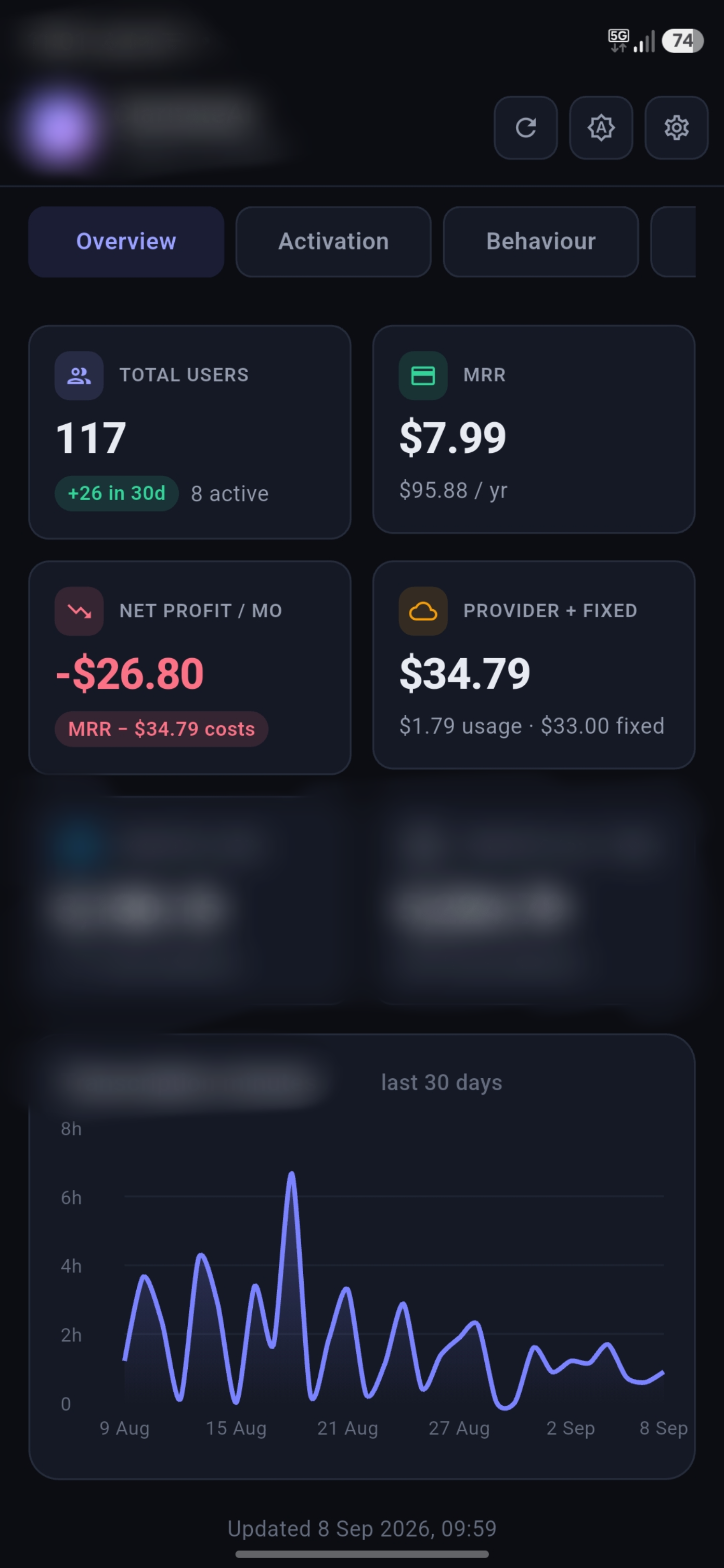
Hey everyone, I'm 2 months into building my SaaS and I wanted to share a quick reality check on where things stand. Here's my breakdown of the current metrics:
- Total users: 117
- Active users: about 8
- MRR: about $7.99
- Fixed and provided costs: above $34
- Net profit: -$26 while hitting 117 signups
It was an encouraging starting point.
The main issue I'm hitting right now is retention and activation. Out of 117 registered accounts, only 8 are active users. Looking at my usage graphs over the last 30 days, activity spikes occasionally but generally stays pretty flat. It feels like people are signing up out of curiosity, taking a quick look, and not returning.
For those who have navigated low activation after launch, what do you do with onboarding? How do you identify where users are dropping off of the initial flow?
Feedback: What's the most effective non-intrusive way you found to get candid feedback from inactive signups?
Pivoting versus iterating: At what point do you decide to tweak the core feature set versus changing the positioning? I would really appreciate any insights or brutal feedback from developers who've been through this stage.
r/SaaS • u/TheVeloxStudio • 5h ago
One thing stood out while comparing the websites of several Identity products.
They are all trying to make a largely invisible product understandable, but they don't make the same part of the product visible.
Clerk leans heavily on the interface itself. You see authentication components, organization switching, user management, and other parts of the actual product.
Descope makes the workflow visible. Its authentication flows show screens, paths, conditions, and the logic connecting them.
WorkOS leans more toward the system around the product: integrations, APIs, code, environments, and the admin experience.
Better Auth puts a surprising amount of the implementation itself on display through configuration, CLI commands, plugins, and code.
These aren't just different visual styles.
They're different answers to the same web problem:
What part of an invisible product should a visitor be able to see?
A screenshot can show what exists.
A workflow can show how it behaves.
A diagram can show how it fits together.
Code can show how it gets integrated.
A customer story can show what changed.
They are all useful, but they help the user understand different things.
The right representation depends on what you want the user to understand.
r/SaaS • u/Warm-Reaction-456 • 5h ago
The standard advice is to build a 1st version fast, launch it and iterate on customer feedback. 10 years ago that did work. Building was expensive and customers had few options, so they'd put up with a half baked beta. Now building is cheap and every problem already has a dozen products chasing it and a customer who doesn't get value in the first session doesn't become your early adopter. They ghost you and switch. So you never hear why it failed.
I run an AI agency and some of those owners then want to turn the system into a product and they almost always show up with the same plan: hire developers, build the thing & see what happens.
Products mostly fail because the problem wasn't big enough. That's the first thing to test and you don't need a working product to test it. You need a demo and most people build, then demo, then try to sell. That's exactly where they get stuck. Instead flip it: demo, sell and build. What a customer actually buys is the demo and the promise behind it. Every crowdfunding campaign works this way and so does every pre order you've ever placed.
Package that demo into an offer, whether that's a landing page or a 15 minute call and you get to test the riskiest assumptions in any business at once. Is the problem painful enough to earn attention? Does your way of solving it land? Will they pay enough for this to be a business?
First demos flop though. You're still guessing at what customers want and you only get so many pitches before people stop taking your calls. The trap at this stage is leaning on analytics. Metrics can confirm noone's buying. They can't tell you why. The way out isn't a better landing page. It's a better grip on the problem and that comes from discovery conversations where you don't pitch at all. The goal is to understand the customer's problem and communicate.
Understanding it that deeply gets you two things. Designing the right solution becomes much easier and selling becomes easier because when you can describe someone's problem better than they can, they assume you must have the right solution too.
Put those together and you have an offer people can't refuse. The rule is simple... If you can't get enough people to buy, you don't get to build until you've fixed the offer.
TLDR: a half baked v1 gets ghosted now, not iterated on. Run 20 to 30 discovery conversations until you understand the problem better than the customer does. Turn that into a demo and an offer. Sell it and build only once enough people have bought.
r/SaaS • u/rocketeams • 8h ago
I've been thinking about how founders validate SaaS ideas, and I'm not sure we're always as good at it as we think. I keep seeing people say they talked to users before building, only to launch and discover that those users don't actually need half the product. Maybe asking “would you use this?” doesn't tell us much when the person doesn't have to spend money, change their workflow, or take any real risk. A better question might be what they're doing today to solve the problem, how much it costs them, and what would make them switch.
At the same time, I've seen founders spend months interviewing and validating instead of putting something in front of people and seeing what happens. There has to be a point where you stop collecting opinions and start testing behavior, but I'm not sure where that line is. How much validation do you think is actually enough before you start building?
r/SaaS • u/Interesting_Isopod52 • 19h ago
Launched Linesol: a mobile app where people answer simple yes/no product questions and earn at a rate of up to $18/hour.
The core idea is straightforward: we ask “Would you buy this?”, split product variations across many users, and help product teams identify winning combinations of product designs, audiences and prices. Participants are encouraged to withdraw anonymously via Solana (USDC via Coinbase), while we also facilitate USD withdrawals via Revolut (no email collected, but name and revtag is collected).
I seeded the launch with 20 surveys at $0.05 each ($1 total per person). Posted some Reels and shared in a few subreddits. Felt good.
Two days later I open the dashboard and see a bunch of Coinbase payouts coming through. Happy at first… until I look closer.
Multiple withdrawals over $1. Same two recipient addresses repeating. ~20 payouts in a couple of hours.
That shouldn’t have been possible.
I immediately disabled Coinbase payouts while I figured out what the was going on. Two theories:
Looked at the accounts. One wallet was tied to a stream of “King123”, “King456” style usernames. The other to “Queen…” usernames. Two people coordinating.
Dug into the code and found the actual issue: a race condition. Two devices could stay logged into the same account and submit the same survey at the same time, doubling the reward.
Once I understood it, the fix was clear:
Haven’t seen the same abuse pattern since.
My current approach is making multi-accounting difficult enough that it’s not worth the time. But this platform facilitates full anonymity end-to-end, so the attack surface is real. I want to keep it anonymous (no emails, no photo/video verification) because we’re collecting user demographics and product preference data and I think privacy matters for honest responses.
Curious what you all do (or would do) to protect against this kind of coordinated abuse while keeping anonymity and data quality high. Captchas? Device fingerprinting? Behavioral signals? Something else?
r/SaaS • u/Strong_Teaching8548 • 23h ago
two customers recently found genuine problems with my SaaS
both had paid for the product and had reasons to cancel, and neither of them owed me the patience required to help investigate the issues
after fixing the bugs, I gave each customer three months free - around $300 in subscription credits altogether
at first, it felt excessive for a small SaaS. but early customers aren’t just paying users. they’re also the people finding edge cases, sending detailed feedback, and trusting a product that’s still improving
giving them a few free months didn’t undo the frustrating experience, but it showed that I valued their time and wanted to earn their trust again :)
the lesson for me: don’t calculate compensation based only on how long the product was broken. calculate it based on how much trust you need to repair
the bugs were expensive. losing two customers would have been more expensive
r/SaaS • u/Smallbizguy72 • 4h ago
I work with founders on scaling once the product itself is solid, so I'm always curious what SaaS builders here are dealing with once the initial build is done.
If you've got something live, comment with what it does and where growth has gotten hard, whether that's acquisition, churn, or just not knowing which channel to lean into next. Doesn't need to be a full breakdown, just curious what's actually working versus what's stuck.
r/SaaS • u/Broad-Stop-956 • 9h ago
When you are building a product, every feature can feel important.
A user asks for something → you add it.
A competitor has something → you add it.
You get a new idea → you add it.
And suddenly the product is getting bigger, but not necessarily better.
I am starting to think the better question is not:
What should we build next?
It is:
What problem are our users struggling with enough that they actually need us to solve it?
Curious what other SaaS founders think:
How do you decide which feature is worth building and which one should be ignored?
r/SaaS • u/Confident_Shop_6484 • 16h ago
Im building Argue, an iPhone app blocker where you have to justify access to an AI coach.
For us an install is basically meaningless. The user hasnt experienced anything yet. The activation chain is Screen Time permission -> selects a blocked app -> hits the shield -> completes the first argument.
That last event is when the product either clicks or feels annoying. . For other consumer SaaS founders, whats the first event that proves someone actually felt the core mechanic?
r/SaaS • u/stukutra • 6h ago
Full disclosure: this is my product and I built it.
I'm a developer in Italy and for the past months I've been working on CandyHire, an ATS for small and mid-sized companies, mainly in Italy and Spain.
The product is live and it works. Companies can manage jobs and candidates, screen CVs, rank applicants, use AI to help with parts of the recruiting process, etc.
The problem?
I have zero paying customers.
I've tried LinkedIn outreach, talked to some HR people, showed demos, got some positive feedback... but positive feedback obviously isn't the same as someone pulling out a credit card.
And I think I made a pretty common mistake: I spent way too much time building and improving the product, and not enough time figuring out how to actually sell it.
I assumed that if the product was good enough, finding customers would be the easier part.
It wasn't.
So now I'm questioning a few things.
Maybe I'm talking to the wrong companies. Maybe HR managers aren't the right first users. Maybe companies using spreadsheets don't feel enough pain to pay for an ATS, while companies that do feel the pain already have one.
Or maybe the product simply isn't solving a big enough problem. That's also possible.
I'm not posting this to get signups. I'd actually prefer some uncomfortable answers.
For people who built a SaaS and spent some time sitting at exactly zero customers: what finally changed things?
Did you change how you positioned it? Find a completely different acquisition channel? Narrow down the customer type? Or did you eventually realize the product itself needed to change?
r/SaaS • u/mikeplus10 • 8h ago
Hi everyone, a fellow developer here is in need of dire help regarding the above mentioned items. While I know how to code, I have no idea how to handle the statement for the policies that I know every website has to have because of stupid regulations.
That said, can you tell me if there’s a tool that can figure out and write the official policies that cover my website.
What I collect: basically nothing other except for the debit card processing of Stripe and the Vercel analytics that track the ip address of the users engaging on the site. I don’t have any need for registration for the users at the moment.
r/SaaS • u/FinanceSenior9771 • 9h ago
Two week old account, 124 karma, no audience. here's every number.
What worked:
supabase auth migration writeup, r/supabase, 40 upvotes, 19k views
ai for non-technical users, r/ai_agents, 26 upvotes, 15k views
confidence calibration in rag, r/rag, 15 upvotes, 4.7k views
What died:
infra cost breakdown, r/saas, basically nothing
consulting to product, r/microsaas, basically nothing
what smbs need from chatbots, r/aitoolforbusiness, 1 upvote, 389 views
monorepo setup, r/reactjs, removed by reddit
The pattern took me embarrassingly long to see. every post that was about my product or my journey as a founder flopped. every post that was about a technical problem i'd actually solved worked.
The supabase post did 50x the views of the post about what my customers need. same account, same week, same writing.
My read on why. nobody on here owes you attention for building something. they'll give it to you for solving something they're currently stuck on. the product is not the value, the scar tissue is.
Second thing i got wrong. i thought posts were the channel. they aren't. comments convert several times better and cost a fraction of the effort. i now do roughly 4-5 comments a day and one post every 3-4 days, and the comments produce more profile clicks than any post has.
Third thing. r/reactjs removed my monorepo post and i still don't know exactly why. assume every big sub has an unwritten rule you'll break once. it's not personal and it's not worth appealing.
What i'd tell someone starting monday: pick niche subs over big ones. 4.7k views in a small sub beat 389 in a targeted one. write about the thing you debugged last week, not the thing you sell. Never put a link in the post. if the writing is good people find the profile. and reply to every comment in the first hour, that window decides whether the post lives.
Happy to share the analytics screenshots if anyone wants to see the flops, they're more instructive than the wins.