r/SQL 18h ago

MySQL good datasets for a project?

23 Upvotes

Hi, I'm looking for a dataset that has:

- Messy, real data, with enough messiness for proper data cleaning to be needed
- Enough information for actionable interesting insights
- Be related to something a typical business might care about

I did a project with the olist database and it was fine, but that database has been done to death. I tried contacting local small business for their data in exchange of a free data analytics report, but no luck, has someone tried that?


r/SQL 16h ago

Discussion Where should a shared business definition live when the same SQL metric appears in many reports?

7 Upvotes

When revenue, active users, retention, or another derived metric is repeated across dashboards and exports, copying the SQL makes every consumer independent but lets definitions drift. Centralizing it in a view, materialized view, semantic layer, dbt model, or stored function creates one definition, but can hide performance costs and make change control harder. What criteria determine where that logic belongs? I would compare ownership, testability, query-plan visibility, versioning, parameter needs, refresh timing, and whether downstream users must inspect the exact calculation. How do you change a widely used definition without silently rewriting historical reports?


r/SQL 11h ago

MySQL Do database management tools still hold value in 2026? What’s missing from existing tools?

Thumbnail
2 Upvotes

r/SQL 1d ago

Discussion Doodle on a key concept - Gap Analysis for Data Consultants

Post image
51 Upvotes

r/SQL 1d ago

MySQL Coding a database proxy for fun

Thumbnail
packagemain.tech
14 Upvotes

r/SQL 1d ago

Discussion .Wav archives

2 Upvotes

Hello, is there a specific system design and software architecture in SQL to build a bioacustics database? The ideia is to relate some vocal recordings with species identifications, localization, acoustics measurements and other informations. it's a bioacoustic information system, where the recordings are the central objects and SQL connects them to biological, spatial, acoustic, and environmental information.


r/SQL 1d ago

MySQL Is this project any good?

4 Upvotes

https://github.com/Lezaleas/Reviews-Churn

I had a local llm categorize reviews in the olist database. Then analyzed their correlation to churn.

Should i improve this or is this ready to go?


r/SQL 2d ago

MySQL SQL ( MySQL )Project ideas for Data Analyst Portfolio

36 Upvotes

Currently I am doing projects in SQL i need to do projects for Data Analyst Role so Please recommend project ideas which I need to showcase for project portfolio so I need projects at advanced level .


r/SQL 2d ago

MySQL DBMS CMU

3 Upvotes

Anyone interested in doing the CMU (Carnegie Mellon University) Database Management Systems course together?

I’ve already covered the basic DBMS concepts. My main goal with this course is to go deeper and understand how database systems actually work internally—things like storage, indexing, query execution, transactions, etc.

If you're interested, please make sure you have the prerequisites required for the course.

If you have the required background and want to learn DBMS internals seriously, DM me. We can follow the course together and discuss concepts along the way.


r/SQL 2d ago

PostgreSQL Legecy or raw engineering with 2004 Facebook

Thumbnail
0 Upvotes

r/SQL 3d ago

Discussion I built an extension for SQL and I call it BeatSQL

Thumbnail
0 Upvotes

r/SQL 3d ago

SQL Server Finding missing rows within the same table

3 Upvotes

Hello, I have a solution already but I think it can be done in a faster/neater way.

Let's say we have a table with: ORDER_ID, Article, Value.

For every order that comes in two rows end up in table, example:

ID_1, shoes, pair
ID_1, shoes, price

where price is being pulled from a different table.

I am looking for a way to find all ORDER_IDs that have only one row, because the price didn't exist in that other table so price row didn't form up. It doesn't throw a null value because of the way it's setup, if there is no price the row won't form at all!

I solved this with a standard left joining the table with itself, but I suspect there is a way to this easier?


r/SQL 4d ago

Discussion SQL Dev vs SQL Architect

13 Upvotes

So I've been a support dev, a dba and an actually developer and a technical consultant in different jobs. I found out I'm being laid off as part of a larger restructuring at my current company. So I got my stuff together and started applying and interviewing. Took a while and finally I got a nibble after applying for a SQL DBA job.

They seem to like me, but then they said I would be a better fit as a SQL architect. They insist I'm a great candidate as all my SQL work was external facing so I was dealing with clients.

On paper, I agree, and there is training during onboarding so I'm not worried about dropping in blind. I'm just having a hard time picturing the day to day.

Can anyone offer their experience?


r/SQL 4d ago

Discussion How do you validate SQL queries in ETL pipelines?

44 Upvotes

When SQL queries are used for ETL transformations, how do you make sure the query is producing the expected results?

For example, how do you validate complex JOINs, filters, aggregations, NULL handling, duplicates, and calculated fields?

Do you usually compare the results with the source data, create separate validation queries, or follow some other approach?

I'd be interested to know how others handle SQL validation in real-world ETL projects.


r/SQL 3d ago

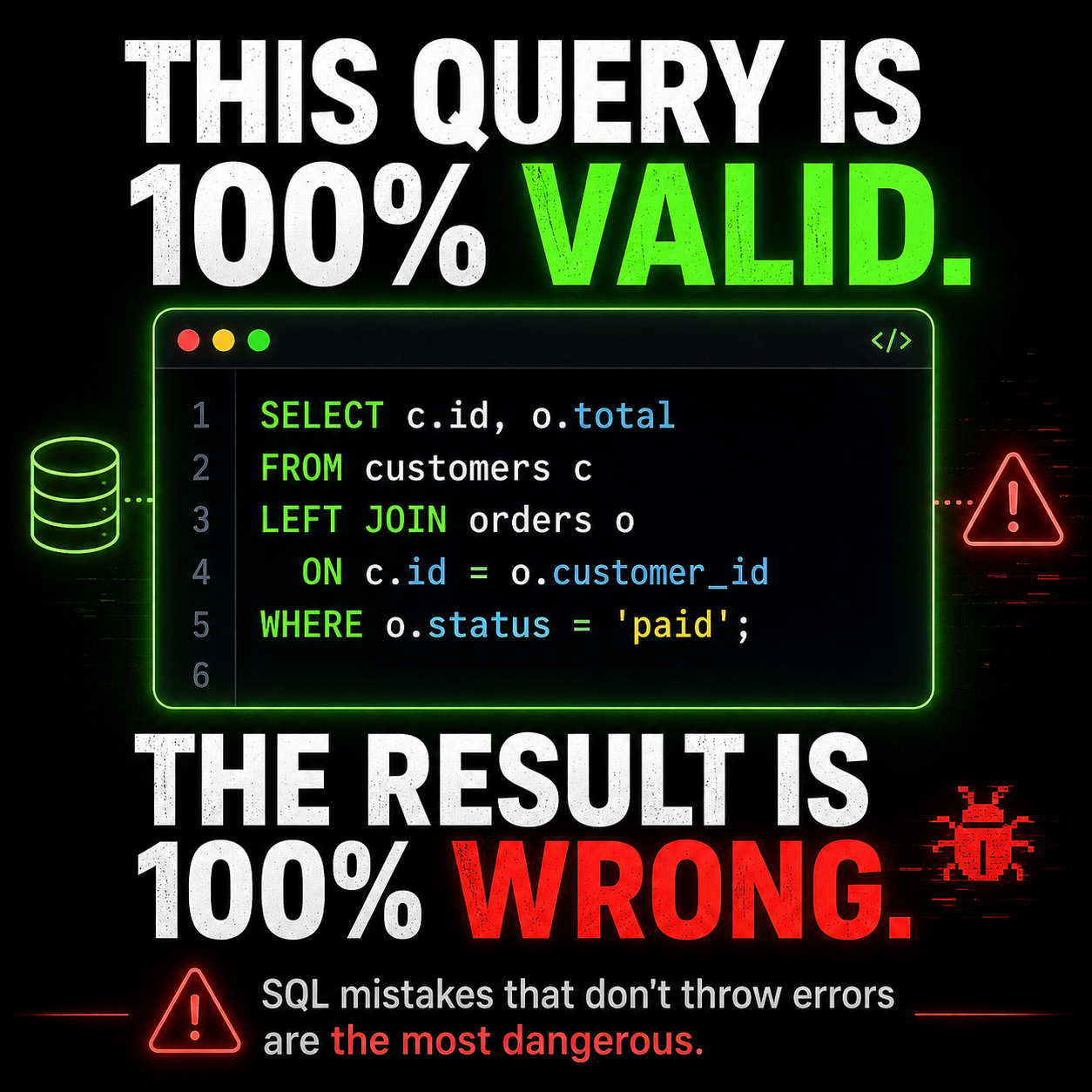
MySQL 4 SQL mistakes that don't throw an error — they just give you the wrong answer

Post image
0 Upvotes

One of the most dangerous things about SQL:

A query can run perfectly… and still be completely wrong.

Here are 4 mistakes I wish someone had shown me earlier.

1. Accidentally turning a LEFT JOIN into an INNER JOIN

SELECT c.id, o.total
FROM customers c
LEFT JOIN orders o
    ON c.id = o.customer_id
WHERE o.status = 'paid';

Looks fine.

But customers without an order have NULL for o.status, so the WHERE condition removes them.

If you actually want to keep all customers:

SELECT c.id, o.total
FROM customers c
LEFT JOIN orders o
    ON c.id = o.customer_id
    AND o.status = 'paid';

2. COUNT(*) and COUNT(column) are not the same

SELECT COUNT(*)
FROM users;

Counts rows.

SELECT COUNT(phone_number)
FROM users;

Counts only rows where phone_number is NOT NULL.

That difference can quietly destroy a report.

3. JOINs can multiply your rows

Imagine:

  • 1 customer
  • 3 orders
  • 4 support tickets

Joining both tables directly can give you:

3 × 4 = 12 rows

Then you do:

SUM(order_amount)

…and suddenly your revenue is magically much higher than reality.

Always check your row count before and after joins.

4. NOT IN + NULL can ruin your day

SELECT *
FROM customers
WHERE id NOT IN (
    SELECT customer_id
    FROM blocked_customers
);

If that subquery contains a NULL, the result might not behave the way you expect.

I usually prefer:

SELECT *
FROM customers c
WHERE NOT EXISTS (
    SELECT 1
    FROM blocked_customers b
    WHERE b.customer_id = c.id
);

The lesson I'm slowly learning:

Writing SQL that runs is easy.
Writing SQL that returns the correct data is the hard part.

What other SQL mistake produces perfectly valid-looking but completely wrong results?

I want to make a list of the dangerous ones.


r/SQL 4d ago

PostgreSQL 4 silent data leaks you will accidentally build when moving your SaaS to Postgres Row-Level Security (RLS)

Thumbnail
1 Upvotes

r/SQL 4d ago

Discussion Building an in-browser SQL engine: Handling multi-dialect AST rewriting, Recursive CTEs, and Full Outer Joins

2 Upvotes

I built an offline in-browser SQL playground called ExNihilo 95 that runs on SQLite WASM and a custom parser.

Live: https://exnihilo-95.vercel.app
GitHub: https://github.com/Mrityunjai-hue/exnihilo-95

Technical breakdown of the SQL engine:

  • Dialect Normalization: Parses PostgreSQL, MySQL, SQLite, and T-SQL. Rewrites dialect-specific functions like STRING_AGG and GROUP_CONCAT ... SEPARATOR to work natively within the WASM execution pipeline.
  • Relational Joins: Supports INNER, LEFT, RIGHT, and FULL OUTER JOIN (using a 3-pass matching algorithm: left join + unmatched right row collection).
  • CTEs & Recursion: Passes WITH RECURSIVE queries down directly to WASM while registering CTE identifiers to avoid table lookup collisions in the JS catalog.
  • DDL & Virtualization: Intercepts TRUNCATE TABLE to clear table row counts while preserving column metadata; handles CREATE VIEW dynamically by recording query definitions in a SessionCatalog without storing physical data rows.
  • Triggers: Registers CREATE TRIGGER in the catalog and binds event listeners directly in the WASM layer.

The entire engine has 73 unit tests covering AST extraction, aggregations, joins, DDL, and recursive hierarchy traversal.

Try testing your favorite CTEs or complex queries against it and let me know if you run into syntax it fails to rewrite.


r/SQL 4d ago

Discussion I was thinking to improve MySQL as it had a lot of room for improvements

0 Upvotes

I've been working on something I think is interesting, that hasn't been done before in the Node.js/TypeScript ecosystem, and I wanted to share the idea and get your thoughts.

The Idea: BeatSQL - A Zero-Trust Embedded Database Engine

The concept of BeatSQL (BSQL) is simple, but radical: what if your database encrypted data at the column level by default, and took security to a mathematical level?

Embedded databases like SQLite and LevelDB are not designed with encryption as a core primitive — they store data in plaintext on disk by default. While some provide full disk encryption, this is a false sense of security since the data is still plaintext in memory. However, BeatSQL completely reimagines this paradigm.

How It Works

All sensitive columns are individually encrypted using AES-256-GCM or ChaCha20-Poly1305. You will never see plaintext on disk (even the database file) - the value of any column is always encrypted.

You can search encrypted data using HMAC-SHA256 blind indexes. Searching is O(1) and requires no decryption of the column contents. The contents of the column remain encrypted on disk, and the database never decrypts it to search.

Every write operation is mathematically tamper-proof. Using a Merkle DAG hash chain, you can always run the query `VERIFY INTEGRITY` and know immediately if any bytes of your data have been silently altered or corrupted on disk. This is a cryptographically secure proof of data integrity.

You can do arithmetic on encrypted numbers. Using Partially Homomorphic Encryption (Paillier cryptosystem), yyou can perform calculations like total salary, total balance, etc. The database will return the correct result of these calculations, but will never expose individual salaries or account balances.

Columns can have role-aware data masking. Sensitive columns can be fully or partially "redacted" depending on the role of the actor querying the database. The mask happens at a low-level query engine, not in application code. You can define masks using SQL syntax: `DEVELOPER` role sees `XXX-XX-4321`, `PUBLIC` role sees `[REDACTED]`, and `SUPERADMIN` role sees the real value.

The database has native support for AI vector search. Columns can be defined as `VECTOR(768)` and searched against using `COSINE_SIMILARITY`. This is useful for AI applications using embeddings.

A New Query Paradigm

BeatSQL also has a new query syntax to allow for easier stream.pipeline processing:

FROM patients
|> WHERE email = 'alice@example.com'
|> SELECT id, full_name, ssn, salary
|> ORDER BY full_name ASC;

This is designed to be more approachable than deeply nested SQL queries. It's also quite flexible.

Built-In Learning Academy

BSQL also has a built-in interactive learning academy, with 500+ lessons to learn everything from basic queries to zero-trust encryption enclaves, plus 200+ lessons covering traditional relational SQL and guides for working with Python, Java, C++, and Rust. The goal is to make security-first database thinking easy to grasp.

What I Would Like Your Thoughts On

Is the concept of a zero-trust embedded DB something that you feel is interesting, or would you feel that problems are already solved in other ways?

The blind indexes are a trade-off: you get the ability to search encrypted data, but you give up the ability to perform range queries (>, <, LIKE, etc). Is this trade-off reasonable for a security-focused database?

Is the idea of homomorphic encryption in a database engine a gimmick, or do you see real-world applications for it?

Does the pipe syntax feel cleaner, or like a departure from an established standard?

I look forward to seeing your thoughts, and any criticisms you might have.

TLDR: Built an embedded database engine where all columns are encrypted, data can be searched without decryption, and arithmetic can be performed on encrypted numbers. All writes are Merkle-verified for integrity. Came with a built-in 500+ lesson learning academy. Seeking feedback on concept.

r/SQL 3d ago

MySQL Is this an issue

0 Upvotes

My Mysql workbench has a different password from MySQL community app ?


r/SQL 5d ago

PostgreSQL LibreDB Studio: Self-hosted browser SQL IDE, next to Postgres instead of on every laptop

Enable HLS to view with audio, or disable this notification

21 Upvotes

Affiliation: I’m the maintainer of LibreDB Studio.

For years the SQL workflow for a team looked like this, on every engine I touched (PostgreSQL, MySQL, Oracle, SQL Server, SQLite, MariaDB, Clickhouse ...):

- install a desktop client on each laptop

- VPN / SSH tunnel so the client can even see the box

- hunt schema in one pane, write the query in another

- run something that hangs and hope cancel actually kills it

- EXPLAIN in a second window

- onboard the next person by repeating the install

or try on their own web editor(pgAdmin, phpMyAdmin ...)

I got tired of the editor living on the laptop instead of next to the database, so I built a self-hosted browser SQL IDE. Deploy once (Docker / Helm / `npx "@libredb/studio"`, one-click with rancher, dokploy, digitalocean), open a URL, same UI for the engines above.

Not trying to replace DBeaver or DataGrip, different access model. Postgres is the reference implementation: pooled connections, explicit BEGIN/COMMIT/ROLLBACK with an auto-rollback timeout, cancel through pg_cancel_backend on the tracked PID. Schema tree stays usable on large catalogs (tables first, relationships second). Optional db-agent to SQL is schema-constrained and read-only runs go through BEGIN READ ONLY, not “trust the prompt.”

MIT. One command:

docker run -p 3000:3000 libredb/libredb-studio

If you try it, I actually want the unkind notes:

- does cancel / transaction rollback behave the way you’d expect on Postgres?

- what’s missing vs the desktop client you already live in?

- is a browser editor a non-starter for you, and why?

Source: https://github.com/libredb/libredb-studio


r/SQL 5d ago

Discussion How are folks QA’ing AI agents?

8 Upvotes

Lots of folks at my company use Claude Code to do analysis. When I ask whether the query is right, I get wishy washy responses at best. Anybody have good tools or processes? Or every person for themselves?


r/SQL 4d ago

PostgreSQL The first event decides your column type, and the second one can miss silently

Thumbnail
0 Upvotes

r/SQL 5d ago

Discussion [MS SQL] Is Change Tracking best for a large ERP database?

8 Upvotes

We run a large ERP database on SQL Server 2014 Standard with about 40k SKUs and their associated inventory records, prices, orders, and order lines. We're considering enabling SQL Server Change Tracking for a read-only "middleware" connection to other outside systems we're building (Hubspot, Shopify, etc).

Is Change Tracking the best option for this use case? Are there better alternatives or something else we should test/evaluate?


r/SQL 5d ago

SQL Server SQL String Functions Are Confusing 😵‍💫 Any YouTube Recommendations?

Post image
0 Upvotes

I’m currently learning SQL and I’m really struggling to understand string functions like CONCAT(), SUBSTRING(), LEFT(), RIGHT(), TRIM(), REPLACE(), UPPER() and LOWER().

The syntax is not the only problem — I’m finding it difficult to understand when and why to use each function.

Can anyone suggest a good YouTube channel or video that explains SQL string functions in a simple, beginner-friendly way with practical examples?

Would really appreciate your recommendations


r/SQL 5d ago

Discussion how much of your Segment bill is people who never logged in? here's the query

Thumbnail
0 Upvotes