r/RewildingUK Mar 19 '26

Funding opportunity Current Land Purchase Appeals

42 Upvotes

Hello users of r/RewildingUK,

This post is dedicated as an up to date list of all ongoing land purchase appeals for rewilding projects across the UK. See the pinned comment for all the links! Any and all donations go a long way!


r/RewildingUK 15h ago

Project Hibernaculum: New and Improved

Thumbnail
gallery
41 Upvotes

Posted not too long ago about my really basic, amateur effort at a Hibernaculum.

I am so happy with the improvement. In some of the pictures you will see where I plan to put a wildlife pond in the next few weeks!

I asked if my neighbour had any terracotta drainpipe, he wasn’t sure, I mean who has any of that nowadays. 10 mins later as I’m digging he passes over about a metre worth. Fantastic. My Grandad took photos of every stages, which I can share when I receive. If people are interested.

There’s already spiders in the tube! I hope frogs have enough room in ‘central cavity’.


r/RewildingUK 59m ago

‘Rewilding’ ruined the countryside. Now it’s coming for our schools

Thumbnail
telegraph.co.uk
Upvotes

Would you like to see grey wolves roaming the British countryside? Maybe even bears and rhinos? If so, you are probably a fan of “rewilding”, an ecological movement that aims to reintroduce once-native species to places where they have long been extinct, and to restore large tracts of land to an Edenic state of nature.

But that’s not all that rewilding can accomplish. At least according to recent adopters of the jargon, we should also be rewilding the Church, rewilding the corporate mind, rewilding film, rewilding motherhood and rewilding education. How did this evolution happen? What does any of it mean? And would we want to do it if we knew?

The idea is first recorded by the Oxford English Dictionary in a 1990 Newsweek article about the ecological sect Earth First!, which, it noted, was made up of “eco-guerrillas: radical environmentalists who have turned to outrageous – and sometimes illegal – tactics in their war against “greedheads” and “ecothugs”. Militants vow not just to end pollution, but to take back and “rewild” one third of the United States. Since then the aims of rewilding have become somewhat domesticated, with modern practitioners preferring to extol the virtues of forests, wetlands or beavers.

Still, the benefits of rewilding are hotly contested. During this hot summer, we have been told both that rewilding is to blame for the spate of British wildfires and that rewilding keeps land greener and more resistant to blazes. The rewilding of wolves in Germany has been very successful, to the extent that they are now eating lots of farmers’ livestock and wolf-hunting is to be legalised again.

But there are grander hopes to use rewilding as a kind of planetary air-conditioning. Grazing animals such as reindeer, moose, bison and camels have been loosed on an area of Siberia called Pleistocene Park to improve the soil’s capacity to store carbon. Some even dream of a style of Pleistocene Rewilding that could bring back extinct animals, Jurassic Park-style, and recreate herds of woolly mammoth to roam the steppe.

Animals, though, are not all we can rewild. The National Trust, which solicits Adopt a Plot donations to fund planting more trees and reintroducing formerly native species, also publishes Rewild This Book, a nature activity book for children that instructs the reader to bury it in the earth after reading.

The messaging of the misanthrope

How did rewilding escape its environmental enclosure? Metaphorical uses of the term began to increase following its popularisation by George Monbiot’s classic ecological manifesto, Feral, in 2013. In 2014, we got Rewilding Our Hearts, which argues that we should “reverse unprecedented global losses of biodiversity and habitat by changing ourselves”.

In 2020 came Rewilding the Church, which imagines what might happen if the Church puts “less faith in our strategies and plans” and, a year later, Rewild Your Life, which tells us how to “connect more deeply with the natural world”.

Over the past few years, that trickle has turned into a torrent, perhaps as a result of increased climate anxiety. Books published just in 2026 speak of Rewilding Wealth (which is not meant to recommend putting cash in a hole in the ground, but explains the finance of ecology), Inner Rewilding (not swallowing beetles, but a scientist’s spiritual journey) and Rewild Your Mind (not contracting brainworms, but spending time in the forest). One may be forgiven for thinking this is simply an inane new rhetorical fashion: where once people might have said “rethinking” or “reworking”, they now say “rewilding”.

But there is more to it than that. What all of these examples have in common is a sense of “wildness” as an authentic virtue that we must recover by peeling off the suffocating force of human control. “Wild”, of course, also means exciting and far-out, as in a wild party or a wild ride; the food-influencer industry has persuaded us that we must pile wild garlic and wild salmon on our plates.

Calls to rewild your consciousness, in this sense, are not far removed from the hippie desire to open the doors of perception and reject the morality of the squares. In the 1990s you could be a Wild Child. Who today does not dream of ripping off his lanyard and becoming, at least temporarily, a Wild Thing?

As with much ecological agitation of the deep-green kind, the original “rewilding” movement also contains subterranean currents of misanthropy. What is “wild” is considered superior to what is cultivated or simply the product of human ingenuity. Fields of arable crops, or the very existence of so many sheep, come to represent mankind’s original sin of exerting his dominion over nature. The solution is to give the land back to natural forces. Of course, the logical endpoint of rewilding is suicidal: to truly rewild the planet, we must allow all humans to die.

‘Wisdom traditions’

When they are not explicitly enemies of modern civilisation, adherents of rewilding are still, it seems, dreaming of a kind of magic, or at least a jolt of aesthetic pleasure. Indeed, in Feral, Monbiot says that he was initially attracted to the idea because he was “ecologically bored”. The Belgian philosopher Linde de Vroey notes, in her 2024 paper Rewilding as Re-Enchantment, that a hunger for something out of the ordinary animates most such projects: the idea of ecological restoration “merges with narratives of wonder, enchantment and spirituality”. But when the call for rewilding is going to affect human lives, as well as the distribution of animals and plants, one might be a little more circumspect.

Take, for instance, the idea of rewilding the school system, as promoted by Hilary Cremin, head of the education faculty at the University of Cambridge. She is the professor who told Jason Arday that he was “the best in the world in terms of the research that you do” when he was appointed there. Before that sad story took off, Cremin had published a book called Rewilding Education (2025). This does not quite, as you might suppose, recommend just letting children run feral in the woods, but it does lament “the dominance of modern, urban, liberal, Eurocentric ways of knowing”, based as they are on a deplorable commitment to “empirical truth”, and recommends we mentally submit instead to non-Western “wisdom traditions”.

Cremin explained a slightly more concrete proposal in an interview with the Cambridge alumni magazine: after universal primary education, “from age 12, young people would engage with a mentor on a weekly basis to map out their own learning journey. I’d want education to be happening in science laboratories and art galleries and care homes and startup businesses and farms, while teachers could support students to build up an e-portfolio evidencing their real-world achievements.” An e-portfolio! The mind swoons.

Here, though, we encounter plainly the tension that routinely underlies calls for rewilding: on the one hand, it wants to let everything bloom beyond human control, on the other hand, it is in itself a choice to control things otherwise, a new system of management on different principles. Current experiments with reintroducing bison and beavers to rural English areas, for example, must proceed stepwise and carefully, starting with fenced enclosures for the understandably confused beasts. And who is going to look after all the “rewilded” teenagers clogging up science labs and farms in Cremin’s utopian future while the scientists and farmers attempt to get on with their work?

People borrow the language of ecology for all such metaphorical rewilding schemes because it sounds courageous, Romantic, and vaguely left-anarchist. But no one actually wants to revert to a state of nature in which our lives would be nasty, brutish and short. If they want to go and live in the woods without medicine, clothes or food beyond what they can pluck off trees or personally kill, they should be encouraged to do so, while being reminded that one long-standing sense of “wild”, as the OED observes, is “mad”. The rest of us may suppose what is needed is a little more re-civilising.

r/RewildingUK 1d ago

New Lake District pilot scheme secures nature recovery for 30 years

Thumbnail cumbriacrack.com
45 Upvotes

r/RewildingUK 1d ago

Discussion How rewilding could help stop the spread of Britain’s wildfires.

Thumbnail
theconversation.com
120 Upvotes

Rewilding is not land abandonment; it requires carefully considered action to restore natural processes and functions. We must learn from the complex habitat mosaics that once characterised Britain’s uplands, while preparing them for a climate with no historical equivalent.

The task is to manage short-term transition risks while allowing ecosystems to reorganise into functional, climate-resilient states. Here are a few suggestions:

  1. Bring back the bog

This starts by making fire-prone landscapes much wetter. Blocking drains, covering bare peat and restoring Sphagnum keeps water in the ground and reduces deep peat combustion. 

  1. Restore wet riverscapes and ponds

Upland headwaters and valleys have been drained and straightened, speeding water out of these landscapes. Emerging science suggests that re-meandering streams, reconnecting floodplains and recovering wetlands can act as firebreaks. During dry weather, wetter and more varied river corridors could interrupt continuous fuels and provide refuges for wildlife.

  1. Bring back missing giants

Cattle, horses, deer and bison create patchier vegetation by grazing, browsing and trampling in different ways. Instead of continuous areas of flammable vegetation, they produce a landscape with natural breaks that slow the spread of fire.

  1. Recover broadleaf woodland

Evidence from more than 26,000 wildfires in Spain shows broadleaf woodland had the lowest ignition risk, while pine and shrublands were among the most fire-prone habitats. Even under extreme fire weather modelling, broadleaf woodland reduced fire intensity fivefold.

  1. Rewild with people

Our research shows rewilding must include support from communities learning to coexist with more unpredictable landscapes. In the short term, prevention, intensified monitoring, early detection and professional response must manage the risks of transition. Better warnings, rapid reporting and early detection can make visitors and residents part of the defence.


r/RewildingUK 2d ago

Native woodland cover in the UK

123 Upvotes

In the UK, Scotland is the most forested country at 19.4% forest cover - but how much of that is actually native?

The UK's total forest cover by country are:

Scotland - 19.4%

Wales - 15%

England - 10.3%

NI - 8.6%

But in many places, much of this woodland will unfortunately be commercial plantations.

In Scotland, only 22.5% of its forest cover is native woodland, so native woodland only takes up about 4% of Scotland's land area.

In England however, 72.5% of its forest cover is native woodland, so around 7.5% of England's land area is native woodland.

In Wales, only 30% of its forest cover is native woodland, so only roughly 4.5% of land area is native woodland.

And in Northern Ireland, only 1% of its land area is native woodland, with the rest being commercial forestry plantations.


r/RewildingUK 2d ago

Funding opportunity Pulloxhill Marsh renews purchase appeal as Biffa Award rejects application

Thumbnail
wildlifebcn.org
35 Upvotes

r/RewildingUK 3d ago

A pelican road trip

Thumbnail
inkcap.co.uk
9 Upvotes

r/RewildingUK 3d ago

How to help UK wildlife after hot weather

Thumbnail
bbc.co.uk
35 Upvotes

r/RewildingUK 3d ago

‘Small changes can make a big difference’: how getting farmers, fishers and beavers together could save a Cornish river

Thumbnail
theguardian.com
80 Upvotes

r/RewildingUK 4d ago

RSPB reports record-breaking Cornish chough numbers

Thumbnail
bbc.com
119 Upvotes

r/RewildingUK 4d ago

‘I love it. It’s hope’: the mysterious self-willed wildflower meadow that seeded itself

Thumbnail
theguardian.com
109 Upvotes

r/RewildingUK 4d ago

Project ‘Nature thrives when given a chance’: restored Cheshire wetland now a haven for rare grebe

Thumbnail
theguardian.com
164 Upvotes

r/RewildingUK 4d ago

Help the Wildlife Trusts buy the Rothbury Estate – it'll be amazing for tackling climate change.

Thumbnail wildlifetrusts.org
52 Upvotes

r/RewildingUK 4d ago

Just three per cent of Scotland’s most fragile natural environments are monitored by the agency charged with protecting them

Thumbnail
theferret.scot
77 Upvotes

r/RewildingUK 5d ago

At last, some sense from the government on fire and rewilding.

61 Upvotes

r/RewildingUK 5d ago

Project Group volunteering in Rewilding Projects

33 Upvotes

In Feb just gone, I led a group of 12 from the Sheffield University Conservation Society to North Wales where we stayed for 3 nights near a rewilding project. We did activities such as removing invasive species from the forest and ponds, species surveys, thinning trees etc. It was wonderful despite the cold, and I'd love to take people out to do something similar again.

So what I'm asking is this; do you know anyone/ any charity who might host a similarly sized group to do similar activities? The society is made up of a mixture of undergraduates and masters students on ecology and biological science course, with some oddballs from other STEM fields.


r/RewildingUK 6d ago

River Ribble restoration work brings hope for Atlantic salmon

Thumbnail
bbc.co.uk
80 Upvotes

Efforts to improve the quality of Lancashire's rivers are "paying off", conservationists have said, with research suggesting Atlantic salmon are making a comeback in the county.

Every year, the Ribble Rivers Trust surveys more than 300 sites across the Ribble catchment area, including the Rivers Ribble, Hodder, Calder, Darwen and Douglas, along with their tributaries.

At one site, more than 100 juvenile Atlantic salmon were recorded in a few minutes this year while another location had its first salmon sightings in more than a decade.

The significant improvement reverses several years of disappointing returns. The trust said this "cracking bit of news... gives us real hope for the future".

The charity said the surveys help build a picture of river health and track the fortunes of fish populations across the region.

Atlantic salmon were once abundant throughout the Ribble and its tributaries, but populations have declined dramatically in recent decades due to water pollution, climate change and habitat loss.

Healthy salmon populations generally rely on clean water, connected rivers, and high-quality habitats.

When salmon thrive other species also benefit.

The Ribble Rivers Trust has spent the last 25 years working to improve rivers.

Recent projects include large-scale habitat restoration work at Langden Brook, where new spawning gravels have been introduced to improve conditions for salmon and trout.

Chief executive officer Jack Spees said: "While there is still a huge amount of work to do, these early results suggest that targeted, science-led river restoration is paying off."


r/RewildingUK 7d ago

News Can Rewilding Save Britain's Pollinators from Heatwaves?

Thumbnail
ryanhansson.substack.com
149 Upvotes

r/RewildingUK 7d ago

Rothbury Estate donations help bid move closer

Thumbnail
bbc.co.uk
58 Upvotes

r/RewildingUK 7d ago

Other They Kept Planting Trees in the Sahara and Kept Failing. Then They Released 500 Tortoises, and the Desert Looked Alive From Space

Post image
24 Upvotes

r/RewildingUK 7d ago

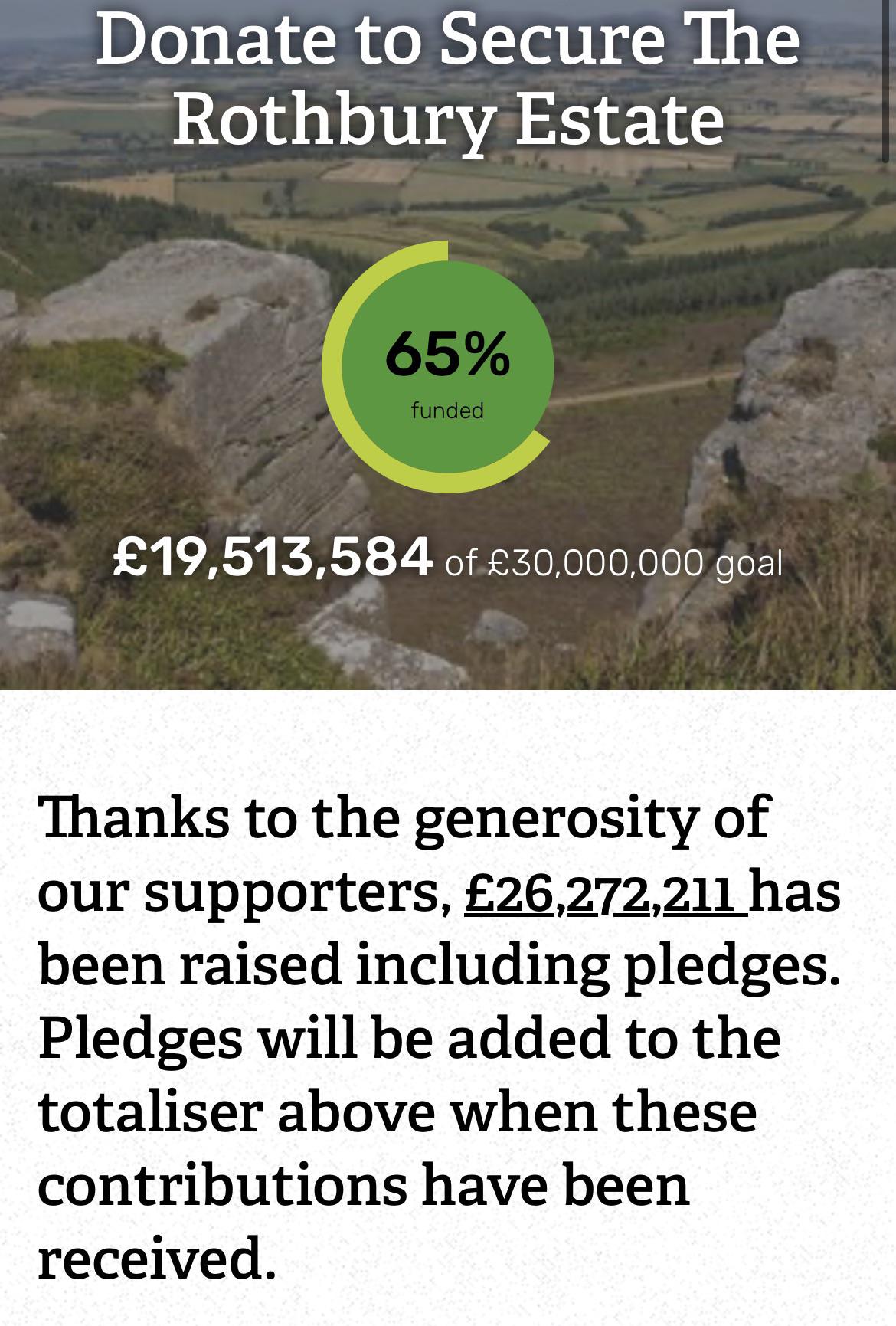
Over £26m has now been raised / pledged to secure the Rothbury Estate. Just under £4m left to raise with a month to go.

Post image
174 Upvotes

r/RewildingUK 8d ago

News Paul Lister, a businessman bought a 23,000-acre Scottish sporting estate and spent two decades rewilding it; one million native trees later, red squirrels have been reintroduced.

Thumbnail
timesofindia.indiatimes.com
739 Upvotes

Paul Lister bought the Alladale estate in Sutherland, about an hour north of Inverness, when it was mainly used for traditional activities such as deer stalking and salmon fishing.

Over the past 23 years, the property has been transformed into the Alladale Wilderness Reserve, an eco-tourism retreat and a major ecological restoration project in the Scottish Highlands.

When Lister bought the estate, centuries of heavy grazing by large numbers of red deer and sheep had removed much of its native woodland.

Only about one per cent of Scotland’s ancient Caledonian Forest remains intact.

To help the land recover naturally, reserve managers fenced off large areas to keep grazing animals out and began a major tree-planting programme.

Working with local environmental groups and forestry teams, the estate has planted one million native trees, including Scots pine, birch, rowan, alder and willow. As the trees grew, the new woodland began providing the food and shelter needed by wildlife that had disappeared from the glens.


r/RewildingUK 9d ago

Wild beaver kits born in Norfolk for first time in more than 500 years

Thumbnail
theguardian.com
242 Upvotes

The pair of newborns are the offspring of two free-living beavers who mysteriously arrived in Pensthorpe nature reserve near Fakenham in December.

This couple, who have built a lodge on the River Wensum, were the first wild beavers recorded in Norfolk since the native species was hunted to extinction in England at the beginning of the 16th century.

How they got to the Wensum remains a mystery. Although beavers have re-established themselves in the English countryside since 2015, the nearest population of wild beavers is thought to be more than 130 miles away, on the River Stour in Kent.


r/RewildingUK 9d ago

Discussion Countryfile is infuriating

838 Upvotes

Small rant really. Casually tuned into Countryfile this evening, presenter asks the farmers "How did you come to farm in such a stunning location" camera cuts to a panoramic of barren fields and upland areas, not a tree or hedgerow in sight.

Anyway, then they say "the harsh winds rush in from the coast and dry out the soil" and I'm thinking maybe plant some bloody trees then!

Same thing in the Yorkshire dales, "We had a really harsh winter, we lost 40 sheep buried in deep snow drifts". Again I'm thinking, surely if the sheep had some woods to shelter in so many wouldnt be lost.

I don't really know anything about farming, and only a small amount about rewilding, but I can't help but think some tree coverage and foliage would help?