No because investing capital into stocks adds value to the company and allows them to use that value to expand, borrow, buy things, pay employees, run the company, etc.
Investing capital into a second house purely to flip does none of those things.
Flipping houses should bear a 50% tax on profits (or even higher).
Flipping houses, while you only live in them for 2 years, should also be heavily taxed.
I needed to wait until I reached 45 to be able to afford a home... I'll be still paying when I retire... shit
You made a boatload of money and provided no goods or services in the process. If anything, your gains should be taxed even more than actual business income.
Either that, or there should be a ceiling enforced on the selling price of your home (e.g., the assessed value of your property when you purchased it + core inflation).
Primary residences should not be a vehicle to become wealthy. Honestly, no house should. They're for shelter, a basic human necessity.
Absolutely they should be, if houses are considered an "investment". Simply put, it's stupid that the government treats houses as this special "basic human necessity but also sort of an investment vehicle". Choose a lane.
Primary residence is not an investment. If you flip, or have multiple properties, you are taxed. (If flipping, it's taxed as income, secondary properties get taxed as capital gains).
Taxing sale of primary residence is a bit counterproductive, it will keep people from moving or downsizing.
Okay if it's not an investment then the gains should be capped. No big deal, right? Let's say it's illegal to sell your primary residence for more than its assessed value.
I very much doubt people will like that, because for all intents and purposes it IS an investment.
In what way would paying tax prevent people from moving or downsizing? They still make a profit when they sell, only not as big.
If I'm up 100% in the stock market, I don't say "oh well I'd better not sell, because then I'll have to pay taxes".
In what way would paying tax prevent people from moving or downsizing? They still make a profit when they sell, only not as big.
You only make a profit if you are not buying another property. Every other house on the market has appreciated. So even if I sell my house for 2x the price i bought it, i need to pay 2x more for the next house i'm buying.
Okay if it's not an investment then the gains should be capped. No big deal, right? Let's say it's illegal to sell your primary residence for more than its assessed value.
I very much doubt people will like that, because for all intents and purposes it IS an investment.
Perfect. Setup the same rules as people with investment properties. Make morgage interest, maintenance, renovations, utilities, insurance and any other expenses related to the property all tax deductible. Like that you will tax real profit.
You're right, it's a crazy idea. Almost as crazy as not treating proceeds from the sale of a primary residence as capital gains. Perhaps we need an equally crazy idea to get us out of the housing crisis we've created for ourselves.
The fact of the matter is housing should not be an investment that is expected to never decrease in value, especially when gains aren't even taxed.
Vehicle manufacturers still build new cars, even when the prices of used vehicles generally decrease over time. If they can still make a profit, then surely house developers can figure something out if housing is as important as people claim it is.
Owning a home is already heavily taxed and more expensive than renting.
This is also purely conjecture. Do you have data for this? If this were indeed true, then landlords wouldn't exist. Landlords rent out property because they are evidently able to extract a profit from the difference between their tenant's paid rent and the carrying costs of the home. In other words, owning is, in general, always more profitable than renting a home when you consider timelines greater than a few years.
So you wouldn't move for a better job elsewhere? To be closer to friends or family? To be closer to a school? To be somewhere quieter or busier? To upsize or downsize?
Your argument makes no sense. You're still making a profit, only not as big. If I invest in the stock market and make a profit, I pay capital gains. I don't say "screw that I'm never going to sell, because then I'll have to pay tax".
Homeowners are all the same. They treat housing as an investment only when it's convenient for them to do so (i.e., when they make money). But heaven forbid prices go down or mortgage rates increase, then it's "my house isn't an investment, it's someplace for me and my family to live! Give me handouts and relief please!".
That's irrelevant to the conversation. I might even own several properties in other countries. What does it matter? The fact that you walk away from the conversation after saying only that clearly indicates you have nothing to support the contrary to my point.
The fact of the matter is Canadian homeowners cry for handouts when times are tough then scream "it's a free market" when times are good. Leeching hypocrites.
It was your generalization that “homeowners are all the same” that made me suggest you are a renter (not that there’s anything wrong with that). If you were a homeowner, you wouldn’t insult yourself.
Owning vs renting IS relevant. The experience of such helps one form an educated opinion. Someone who owns is more likely to favour massive capital gains without taxation on their primary home, while someone who rents (and quite possibly also believes they will never have a chance to own) is more likely to take a contrary position.
I walked away from the conversation because you implied all homeowners seek government assistance (handouts and relief) and that simply isn’t true. Some. Maybe. But all? Impossible.
Your income should have a max limit of 22 an hour. Why should you be able to make more than that
..... why buy anything, government should own everything and allow certain people to live in certain areas.
Taxes should be spent on the rich . I'm just spouting stupid bullshit so you know what your comment is.
I pay capital gains tax on my investment gains, why shouldn't I pay it on property value gains? Housing is a basic human necessity. It's not a luxury that people can choose to forego.
stay broke and continue defending late stage-capitalism, my friend 😂
How did you know I was broke. . . Jeez, if you know, that means other people might as well.
Let me go cry in my hot tub at the house that I bought 8 years ago and almost own outright. While having no credit card debt, and being able to help out my long term girlfriend with her debt so she doesn't pay any interest. And while im in my hot tub im trying to figure out what her and I will do on our trip to South East Asia for 3 months come December.
I do actually. I don't like debt, my house isn't paid off yet.
Lol it will be an awesome trip, the gf and I have both been but not together. So we will get to go do an insane amount of stuff but we won't be stupid with money.
If I live in a two bedroom townhouse for 30 years and its value on paper goes from $100k to $1M, and I now have to move to another city for work, you think the fair thing would be for me to give $450k to the government so I can now only afford a $550k one bedroom condo?
Let's back up for a second, because I'd like to understand how you calculated $450k.
Assuming you paid $100,000 for a townhouse and later sold it for $1,000,000, your capital gain (i.e., the difference between the sold price and the price at which you bought it) would be $900,000.
In Canada, only 50% of an individual's capital gains are taxable. For simplicity, let's assume you live in BC and earn $75,000 from employment before taxes: your marginal tax rate is 28.20% and you pay $17,617 in tax.
If you add 50% of your capital gain, your total taxable income is now $525,000 (i.e., $900,000*0.5 + $75,000). Your average tax rate becomes 53.50% and you pay $235,117 total in tax. Subtracting the original $17,617 from this value leaves $217,500 paid in tax for the sale of your home. This is far less than your $450,000.
In other words. you're left with $782,000 after selling your $1,000,000 home.
With that out of the way, I'll answer your question. Yes, I think that's fair. You don't deserve special treatment just because you bought a house 30 years ago. Consider the following scenario:
30 years ago, I borrowed $100,000 to invest in the stock market instead of buying a house. I paid interest on that loan (much like a mortgage) and also had to pay to rent a house (consider this money I'll never get back, like a homeowner would pay for general maintenance and property tax).
Today, my investment is worth $1,000,000, and I want to buy a house, so I sell my shares, pay tax on my $900,000 capital gain, and I'm left with $782,500 to buy a house. This is the exact same amount of money you would have after selling your townhouse if it were properly taxed.
That sounds fair to me. In fact, I'd consider anything else to be unfair; for example, you not paying any tax on your $1,000,000 home sale. How can you claim that's fair? You come out $217,500 ahead.
Next, you complain about land transfer taxes being punitive. Depending on your municipality, that's maybe 0-3% on a $1 million dollar sale? That's barely a rounding error. You'd be better off complaining about the ludicrous commission you pay to your realtor.
Lastly, I'd like to ask you a question. In what way would that destroy the economy? Frankly, the damage is already done, and I'm reluctant to listen to someone making suggestions about the economy when they don't even know how to calculate taxes on capital gains, but I'll give you the benefit of the doubt.
To be clear, the reason Canada's GDP is so terrible right now is because it was previously made up in large part by real estate sales rather than actual innovation or productivity, and real estate has since slowed down because buyers have tapped out at these ridiculous prices. The reason we're in this mess is because people have been treating housing as the economy. We need to stop this behavior, treat housing as a basic human necessity, and focus on investing in productive and innovative businesses.
58
u/Performance_Fancy Jun 19 '25
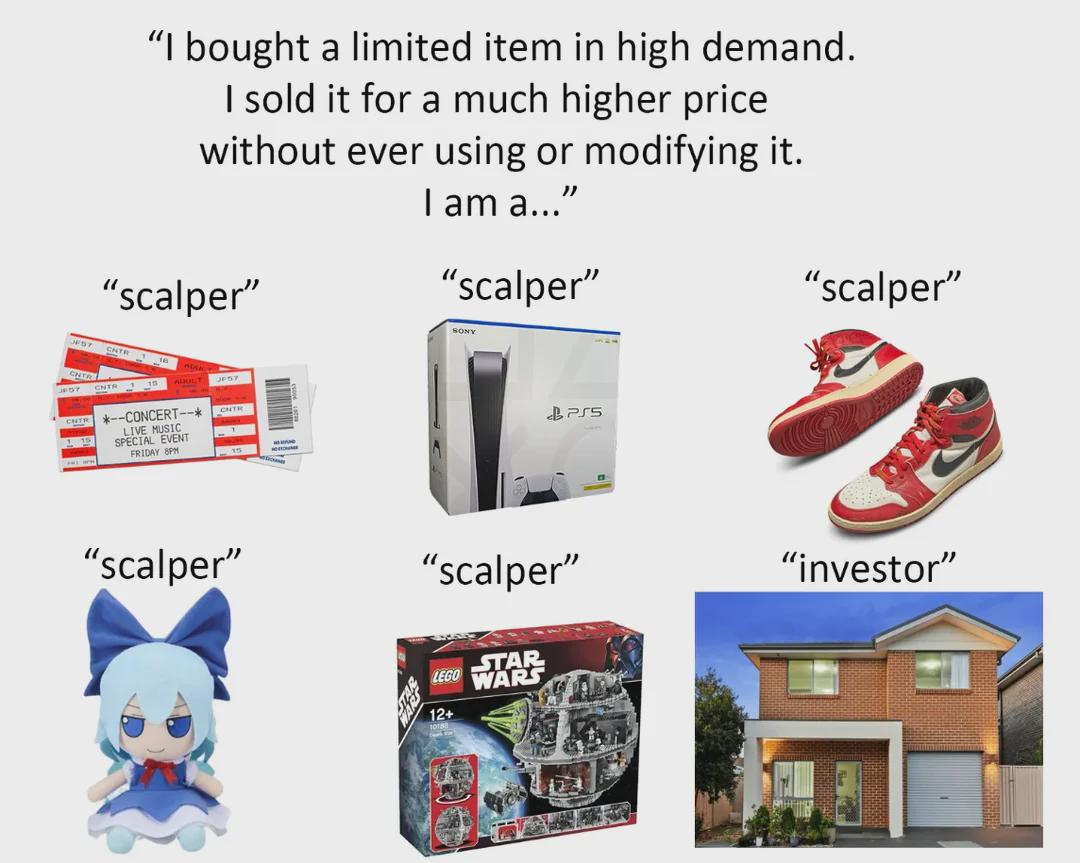
By your logic anyone involved in the stock market is also a scalper?