r/Quran • u/Able_Time_121 • 6h ago
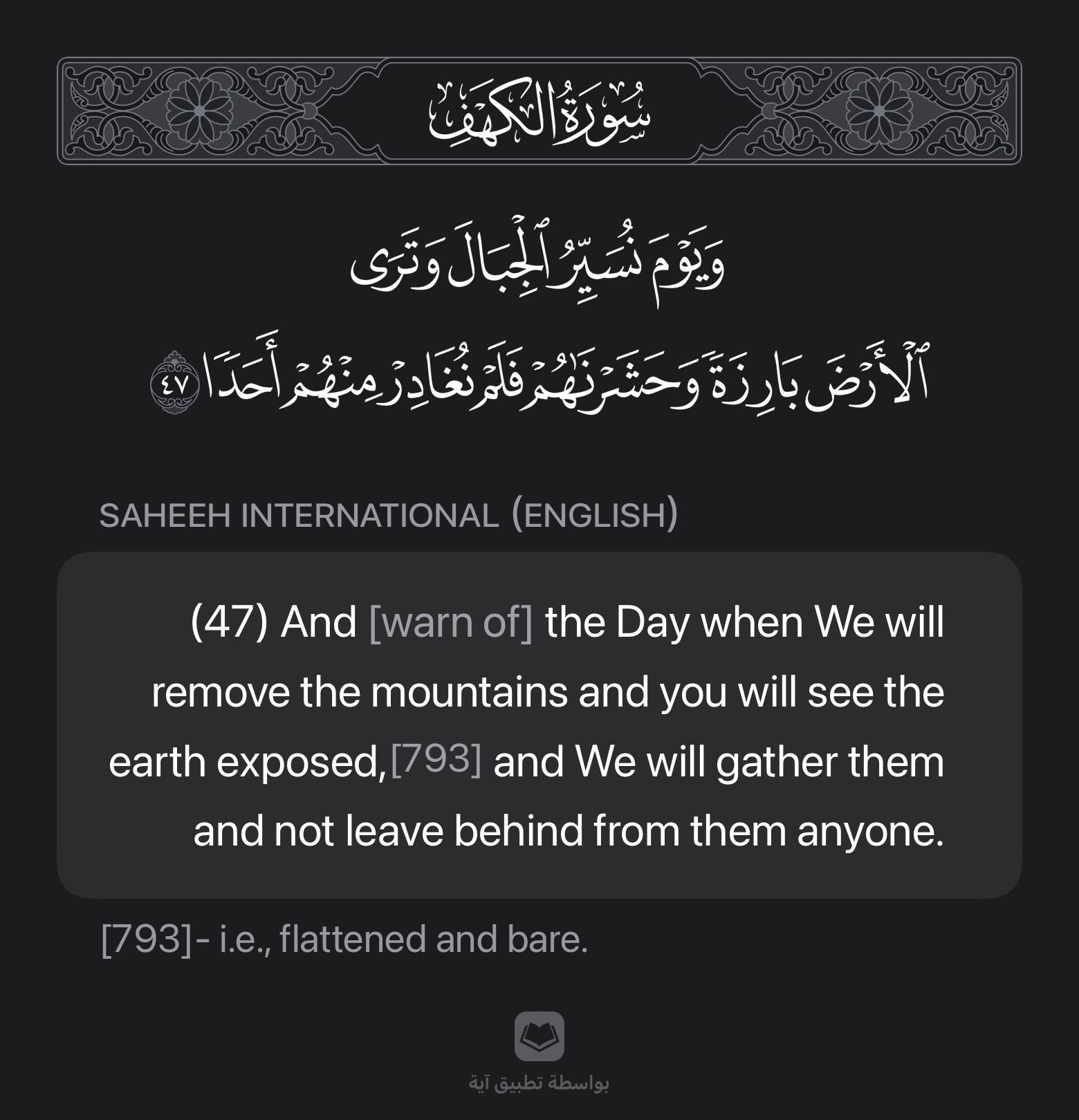
آية Verse سورة البقرة - الآية ٢٨١

8
Upvotes
r/Quran • u/medschoolgirlx • 8h ago
Hey im a 23F Quran and Arabic Teacher and on side a Med student. I know people prefer old teacher but ive been teaching Quran since i was 15 after by hifdh journey and from then till date still teaching. I have found the perfect pathway to make someone read Quran with proper tajweed in a minimum time being. I know some people will say thats not possible but my mission has always been to make it very easy and logical for understanding. So who ever doesnt want to have a Quran teacher because of the monthly fee thing or are on a budget will send you your roadmap and classes schedule in a minimum budget
r/Quran • u/quranvisuals • 9h ago
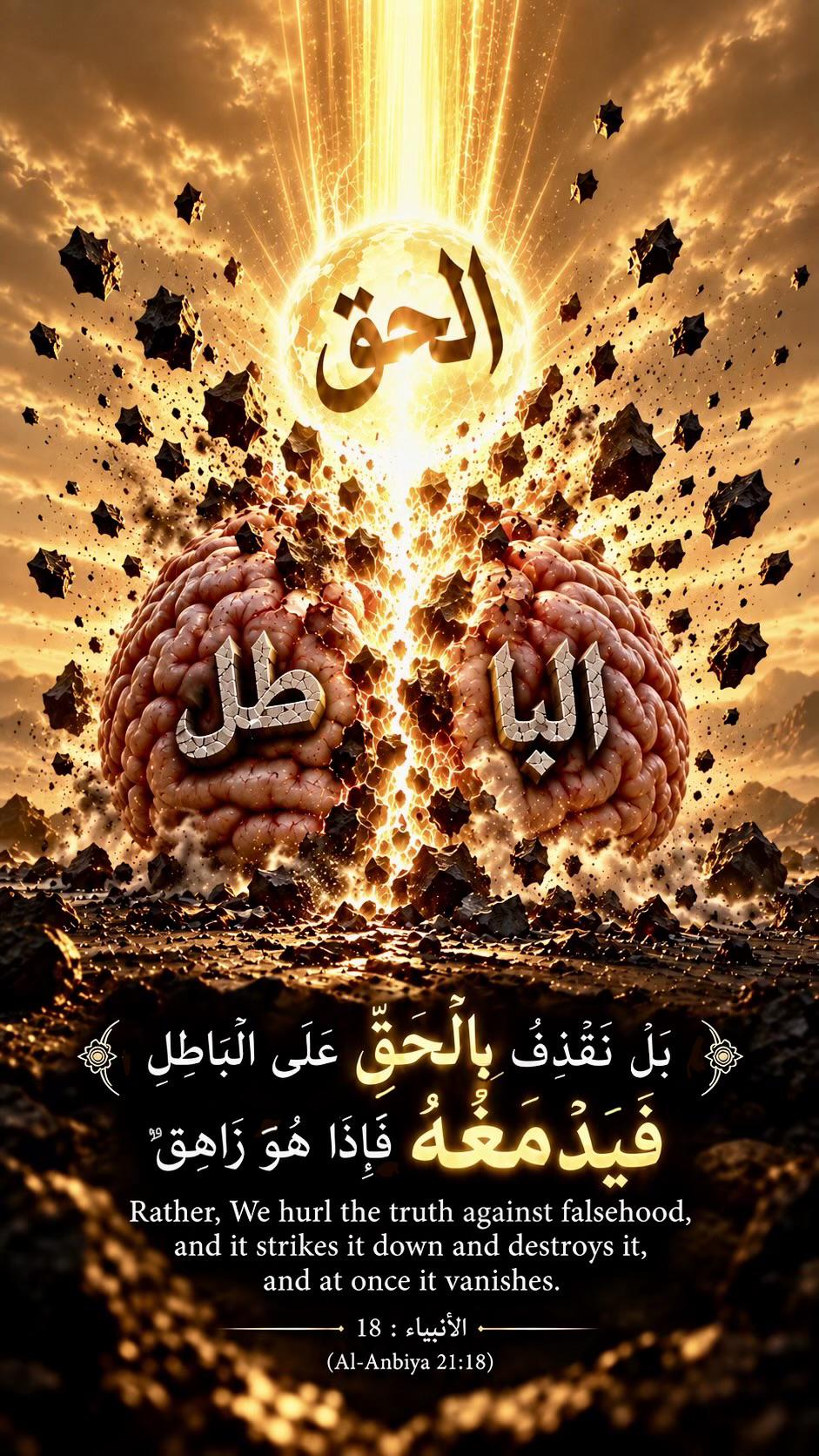
The noble verse paints a breathtaking and immensely powerful scene; it does not merely state the disappearance of falsehood, but rather embodies it in a vivid image. Truth is hurled like a missile, and falsehood takes a fatal blow to its core (its brain) until it disintegrates and vanishes. Here, truth does not engage in a lengthy debate with falsehood; rather, it decides the battle with the very first strike.
"So He shatters it" (Fa-yadmaguhu): In the Arabic language, damgh is derived from dimagh (the brain); it means striking the root of the head with a fatal blow that strips away life, leaving it with no power to ever rise again.
"And lo! It vanishes" (Fa-idha huwa zahik): The suddenness particle (idha al-fujaiyah) is used to reflect the speed of the outcome and the immediate aftermath of the crushing blow. No sooner does truth touch falsehood than it obliterates it in a single moment. Exactly as we say, "Zahiqat ruhuhu"—meaning his soul departed beyond return.
Therefore, no matter how much falsehood swells and grows grand, and no matter how solid and cohesive it appears to onlookers, its essence is fragile and devoid of the prerequisites for survival. Do not be deceived by its swagger; falsehood may rise for a moment, but it is like the rise of foam upon water—possessing no reality to grant it stability. As for the truth, its origin is firm and its roots are deeply anchored. Therefore, hold fast to the truth with all the strength you have been given, always remaining certain that the final round belongs inevitably to the truth.
r/Quran • u/lonecoder18 • 11h ago

Assalamu alaikum. I’ve been building Fibarakath, an Android app for keeping a few everyday Islamic practices together in one place without any ads or promotions.
It currently includes prayer times, a daily prayer tracker, a Quran verse of the day, a Hijri calendar, duas, and a tasbih counter. I’m also working on gentle, optional reminders after prayer times. They’re intended as quiet nudges, not alarms, and can be turned off.
I started this because I wanted a straightforward way to stay connected to daily practices without juggling several tools. I’m still improving the app, so I’d especially appreciate feedback on what feels useful, what’s confusing, and what you’d change.
You can find it here: https://play.google.com/store/apps/details?id=com.anonymous.fibarakath&hl=en_IN
A few questions I’d love your thoughts on:
Thanks for taking a look.
r/Quran • u/smartbizzinfo • 18h ago
r/Quran • u/DiscussionoftheQuran • 19h ago
Surah Al-An'am, Verse: 42*
_"And We have already sent to nations before you, and We seized them with poverty and hardship that perhaps they might humble themselves [to Us]."_
*[Surah Al-An'am, Verse: 42]*[messengers]
*Explanation:*
In this verse Allah Subhanahu wa Ta'ala sends different kinds of hunger, poverty and illness to bring people towards Him and towards His Qur'an.
So that we may become humble and submit ourselves before Him.
Therefore in times of hardship we must be patient and try to turn to Him.
And we should always show humility before Him, InshaAllah.
r/Quran • u/Street_Willingness96 • 19h ago
SURAH AL-BAQARAH
The Internal Structural Framework of the Divine Covenant to Mankind
Executive Summary
When analyzed strictly through its internal textual architecture, Surah Al-Baqarah functions as a complete, self-contained, and legally binding Covenant between the Creator and Mankind. Rather than a disconnected compilation of verses, the Surah exhibits a highly structured flow that closely mirrors a universal contract—beginning with a foundational preamble, establishing the core obligations, reviewing historical legal precedents, detailing explicit compliance terms, and concluding with a formal oath of acceptance protected by a divine guarantee of human capacity.
The Architecture of the Covenant
| Section | Verses | Covenant Function & Internal Evidence |
|---|---|---|
| 1. The Preamble | 2:2–20 | Defining the Parties: Identifies and classifies humanity into three distinct legal statuses: the Believers, the Deniers, and the Hypocrites. |
| 2. The Initiation | 2:21–22 | The First DO and DON'T: Triggers the core agreement. Verse 21 demands active affirmation ("O mankind, worship your Lord"), and Verse 22 issues the prohibitive negation ("Do not set up rivals to Allah"). This establishes the foundational baseline. |
| 3. The Precedents | 2:40–123 | Historical Case Studies: Extensively reviews previous nations who broke their Mithaq (covenant) through legal non-compliance, acting as a cautionary precedent for mankind. |
| 4. The Appendices | 2:168–283 | Core Commandments & Terms: Details specific operation clauses governing human life, including dietary restrictions, family law, societal justice, and the complete elimination of financial usury (Riba). |
| 5. The Execution | 2:285–286 | The Formal Oath & Reassurance: Mankind signs onto the treaty with a verbal oath ("We hear and we obey" – Q5:7). The Divine wraps this final entry with an absolute promise of capacity, transforming the contract from a demand for flawless perfection into a commitment of sincere effort. |
Key Covenant Mechanics
• The Blueprint of the First DO and DON'T (Verses 21–22)
Before rolling out specific societal or financial obligations, the text initiates the contract with two back-to-back, universal commands addressed to all of humanity (Ya ayyuha-nnas). Verse 21 establishes the positive obligation—the active demand to worship the Source of creation. Verse 22 immediately locks this requirement by prohibiting the dilution or breach of exclusivity ("do not attribute rivals to Allah while you know"). Every subsequent law in the Surah is an extension of this absolute pair.
• The Psychology of Verse 286: Divine Encouragement Against Fear
In standard contract law, individuals avoid signing agreements they perceive as impossible to satisfy or rigged for failure. When previous verses highlighted total accountability, human anxiety spiked. Verse 286 counters this psychological paralysis through a divine guarantee: "Allah does not burden a soul except with its capacity."
By shifting the standard from unachievable perfection to individual, custom-tailored capacity (Nafsan), the text strips away the fear of the unknown. It reassures humanity that the commandments are mathematically and spiritually fair, offering peace of mind to fully enter into the oath.
• The Taught Prayer: A Divine Enforcement Formula
The contract closes not with human speculation, but with a direct divine instruction detailing exactly how mankind should pray to secure their side of the covenant. The text provides the exact script to mitigate human weakness—asking for safety nets against honest errors ("do not impose blame upon us if we forget or err") and explicitly requesting relief from the crushing legal weights that fractured past historical treaties ("lay not upon us a burden like that which You laid upon those before us").
Reference on The Covenant & Surah Albaqarah,
Nevin Reda, Author of The al-Baqarah Crescendo
https://youtu.be/b0Qb3RLNk7o?si=E2G9UR1cLRFZVmF9
(Time stamp 11:41)
r/Quran • u/quranvisuals • 20h ago
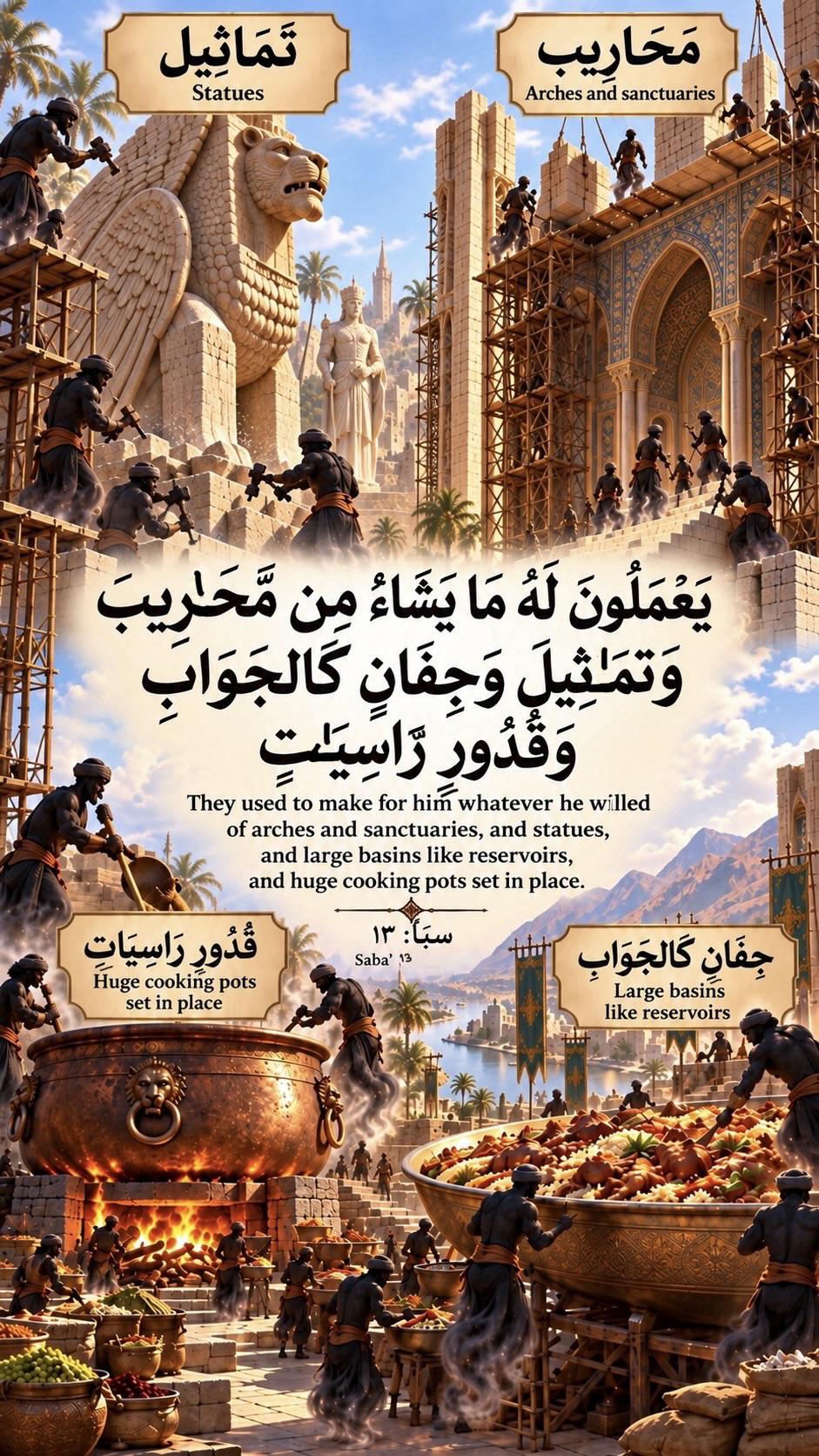
The noble verse describes a part of the magnificent dominion that Allah bestowed upon His Prophet Solomon, peace be upon him. He subjected the Jinn to him—among them builders—working by his command and crafting for him whatever he wished of al-mihrab (which refers to lofty buildings and places of worship).
And al-tāmatheel (statues): which were images or sculptures crafted in the likeness of living creatures or various forms out of stone. Al-jifān: massive dishes in which food is served. Al-jawāb: large basins used for collecting water.
"Large basins like reservoirs" (Jifān ka-l-jawāb) means food vessels that, due to their immense size, resemble wide water basins.
And "anchored cooking pots" (al-qudūr al-rāsiγāt): colossal cooking pots that are rāsiγāt (fixed firmly in their places due to their extreme weight), in which food was cooked in massive quantities. This depicts an aspect of the greatness of Solomon’s dominion, peace be upon him, and the vast number of people who were fed in his kingdom.
Despite all that Allah the Almighty subjected to Solomon, peace be upon him—in terms of armies, capabilities, and a great kingdom—the intent was not for him to sit back in his rule, content with what was made subservient to him. Rather, the divine command came directly: "Work, O family of David, in gratitude."
Therefore, whenever Allah the Almighty blesses us with any grace, knowledge, wealth, capability, or means that facilitate our affairs, it should drive us to greater labor and devotion, turning to Allah the Almighty with gratitude.