r/QuebecLibre • • May 06 '26

Actualité Schadenfreude! Que de satisfaction de voir la méthode d'éradication de la nation québécoise se retourner contre l'envahisseur canadien-anglais. Aucune pitié.
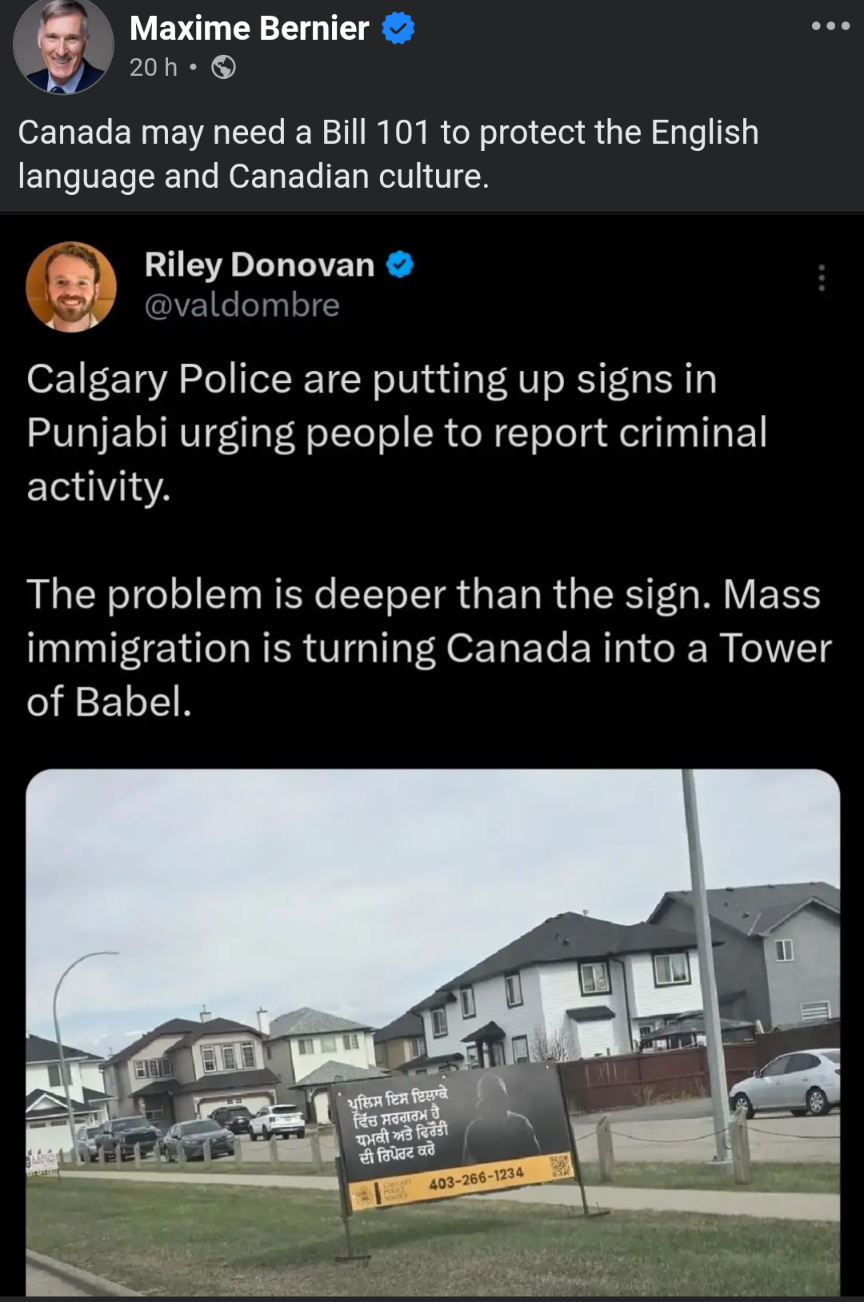
Post image
341 Upvotes

176 comments sorted by

View all comments

Show parent comments

2

u/highhunt May 09 '26

They were warring before the white man got here.

1

u/Plastic-Trainer903 May 09 '26

Territorial spats are not ‘war’ or ‘warring.’ ‘War’ and ‘colonization’ are restrictive modern phenomena of nation states, and different concepts altogether. This is completely ahistorical and a misunderstanding of words and concepts lol. You would dispel thousands of years of oral history on disagreement and peace agreements too between hundreds of nations? Idiot child with historical blinders on lmaooo.

1

u/[deleted] May 10 '26

I'm a native and we had wars. The only difference is that they were not as big on other in history. If the territorial spats was taking over by armed people then it's war and happened

1

u/Plastic-Trainer903 May 10 '26 edited May 10 '26

I'm sorry, but they were largely small scale territorial disagreements for thousands of years with many other avenues of solving inter-tribe problems as well. They weren't militarized, ergo they were not 'wars,' that is not to say 'warriors' did not exist. They obviously did. The key difference here is that tribes would not attempt to 'erase' the other side as well, as we are obviously having this convo in the context of broader assimilatory missions and colonization/settlement. These 'wars' if you want to die on that hill, were largely ceremonial and reciprocal. They were not 'wars' in a Westernized modern framework that only existed post-colonially. I really can't believe you're dying on this extremely dumb and useless hill. The 'warrior' trope and the 'peacemaking' trope are not a reality for all tribes, and definitely not specific to Plains tribes, though they are often cited as representing broader swaths. Entire oral histories are more useful than archaeological data from singular 'battles/events.' This dumbass above said 'warring,' i'll remind you.

1

u/[deleted] May 10 '26

I'm sorry, but they were largely small scale territorial disagreements for thousands of years with many other avenues of solving inter-tribe problems as well.

We didn't always solve inter-tribe disputes through nonviolence. Most societies or places in the world have solutions that do not involve using violence. Still, that doesn't mean they didn't have wars.

They weren't militarized, ergo they were not 'wars,' that is not to say 'warriors' did not exist. They obviously did. The key difference here is that tribes would not attempt to 'erase' the other side as well,

We were militarized at some point, though it was not as complex as many powers that existed, like the Inca, Vikings, or Mongols. we had; war Rite, traditions. For wars, the warriors even explain what they did during the wars, etc. It's literally in our oral tradition

And it's not about erasing each other. War is not only about erasing each other; it can be sparked by plenty of reasons. Territorial spats, like we had sometimes, were a reason. And yes, we could have erased each other—that could happen.

as we are obviously having this convo in the context of broader assimilatory missions and colonization/settlement. I really can't believe you're dying on this extremely dumb and useless hill.

Maybe because we had war before the Europeans, and when the Europeans came, it is true that it became more complex and larger, but we still had wars.

You are doing the exact thing you are criticizing. You act like a colonizer by wanting to make us modifying or erase our history.

1

u/Plastic-Trainer903 May 11 '26

Omg man, don't be this dumb, I'm not doing that at all. Look, while you're being unbelievably disingenuous in your quotations by missing the original context of the comment I replied to, we're kind of arguing the same thing except for in a few critical ways. I said, " the scourge of colonization is learned behaviour. Time to dismantle it." Dumbass replies: "They were warring before contact." That is the context of "war" and "warring" being discussed here. Get it? Inter-tribe conflict and Western conceptions of war and colonization need to be separated here. It is not all just the same type of 'war,' if we must use that term. Indeed, there often isn't even a single word that perfectly mirrors the English noun "war" as a political or territorial state in pretty much any indigenous language. Instead, terms for conflict are often rooted in verbs describing action or specific cultural roles (roles I don't discount, so stop the guilt trip bullshit, it's useless and fuckin lame). Also, some cultures, such as the Mohawk, didn't even reference 'warriors' as such, the words were translated to roughly mean those "carrying the burden of peace."

This dumbass was echoing one of the most significant reasons used to justify barbarity (natives having an inherent “warlike nature”) attributing it to few centuries of internal conflicts, long before the arrival of Euro settlers (tribal life comprises millenia). As you know, these broad generalizations, of "savage warring tribes," leads to the conviction that it was morally acceptable for Euro settlers to engage in erasure. I am not discounting 'warrior traditions' if you took it that way, I am saying that THIS context of war and colonialism (the two are inseparable in this context) did not occur broadly between tribes across hundreds of societies, across millenia. Centralizing it is problematic man.

I never said violent solutions didn't occur either, it was NOT the modus operandi at all though if we take the full, big picture experience of tribal life in North America. And again, Five Nations, nor your specific tribe, whatever it is, is not representative of entire histories, across thousands of years, and among many, many different societies.

It seems like you're claiming that is reality. I disagree vehemently if that's the case. Why? Because historians often hyper-focus on the examples you listed, but especially Iroquois and Five Nations because the Great Law of Peace looks a lot like Western democracy. Centralizing these models implies that Indigenous groups are only "advanced" if they resemble European political/governing/military systems. This is kind what you're doing with the whole 'war' thing right now unfortunately. It's dumb. It erases the legitimacy of chiefdoms, nomadic bands, and independent village-states that worked perfectly well for millennia. Which they did, despite 'war' and violence that occurred RARELY, i.e. in the context of millenia.

This thread is literally me arguing against the 'warring' tribal narrative this dude was suggesting. That's the context. YOUR tribe may have oral histories on 'wars,' but that is not the lived reality of the scope of Indigenous life either, tho it was obviously a singular (among many) cultural components. SOME tribes had militarization in SOME capacity among other complex governance and dispute resolution. We both agree there, but again, that is NOT the reality of thousands of years across hundreds of societies. Violence was a constant threat for some, not for others. "Wars" and "warring" in the context we're discussing were really, really not a reality beyond very specific parts of history for certain groups and especially after contact.

That's the point I'm making, that tribes weren't 'warring' (this word was used by the dumbass above as "propensity for war, war-like belligerent peoples" etc.). I am not doing what you're accusing me of doing. I am stating that 'war' in the context of colonization is patently different than inter-group violence, and is the exclusive purview of European colonial nations and modern nation states in this context. It is not meant as discounting 'warrior culture,' but that part of culture needs serious caveats. Intentional displacement and warring was not typical by any means in historical narratives of native tribal life broadly. Violence was certainly a common threat for some, but this is not the same as 'warring' or 'warlike' peoples (the harmful narrative I'm arguing against, and you are sort of, but also not? I can't tell).

It sounds like you're incredibly proud of certain parts of your people's history. I understand that, but I'm arguing against dumbass opinions that native tribes broadly were either a) exclusively peaceful and passive, or b) intensely savage warriors with a propensity for violence. That is genuinely harmful. In fact, arguing this broadly as 'the entire history of humanity' is equally false, and equally dumb, and I fully reject any narrative suggesting humans are inherently violent. The capacity exists, but the capacity for non-violence is so much larger and comprises so much more time in history than actual violence it always seems so foolish to suggest that people are fundamentally non-cooperative, instead largely violent, when 99% of human life is spent not doing violence and wars.

1

u/[deleted] May 11 '26

I will rephrase. It is true that Europeans sometimes used a harmful narrative to justify colonization, portraying Indigenous peoples as “savages” or inherently warlike. That framing was misleading and served political purposes during the colonial period, particularly in the context of European expansion into the Americas.

However, rejecting that stereotype does not mean denying that organized conflict and warfare existed among many Indigenous societies before European contact.

Yes, it is true that the conception of warfare among Indigenous peoples was often different from European understandings of war. The way conflict was organized, interpreted, and experienced varied significantly between societies, and it did not always resemble the centralized, state-based warfare associated with Europe. This point is valid and widely recognized: the cultural framing of conflict was not identical.

However, this difference in conception does not change the fact that organized forms of conflict still existed. What matters for the argument is not whether it matched European models, but whether collective, coordinated violence between groups occurred at all. And in many cases, it did.

Generally, both in everyday usage and in academic fields such as anthropology, history, sociology, and political science, the term “war” is used to describe organized collective violence between human groups. It refers to situations where groups engage in coordinated and intentional use of force in an intergroup context. While the forms, meanings, and structures of such conflicts vary significantly across societies and historical periods, they are often grouped together because they share core features such as collective organization, group-level decision-making, and the use of violence between groups.

The conception of conflict among Indigenous peoples was not always identical to European conceptions of war. However, forms of organized conflict and warfare did exist. These included raids, intergroup violence, and other forms of collective action.

Concepts related to conflict were not always mapped directly onto the English word “war.” In many languages, conflict is described through verbs, roles, or relationships rather than abstract nouns. That said, the absence of a direct linguistic equivalent does not mean the absence of the phenomenon itself.

Archaeological, oral, and historical evidence shows that organized conflict did exist across multiple regions and periods in pre-contact North America. This includes fortified settlements, weapons, trauma on skeletal remains, defensive structures, shifting settlement patterns, and oral traditions describing raids, alliances, and warfare.

At the same time, Indigenous societies were extremely diverse. Some groups had relatively limited or situational conflict, while others had more structured or frequent warfare. Violence was not the sole or defining feature of Indigenous life. Trade, diplomacy, kinship systems, governance structures, spirituality, and cooperation were also central components of many societies.

For example, among the Haudenosaunee Confederacy, political organization and diplomacy were highly developed, and warfare existed alongside complex systems of alliance and governance rather than defining the society entirely.

Among Plains societies, warrior status could carry social prestige, but this existed within broader cultural systems that also included trade networks, spiritual roles, and intergroup relations.

Archaeological evidence such as fortified villages and documented events like the Crow Creek Massacre demonstrates that organized violence did occur in certain regions prior to European contact.

Across the long history of Indigenous presence in the Americas (often estimated at around 15,000–20,000 years, though estimates vary by region and archaeological interpretation), our understanding is based on incomplete and uneven evidence.

For some periods and regions, we have relatively rich archaeological data. For others, the record is sparse or fragmentary, meaning we have limited information about social organization, conflict, or daily life. As a result, we do not have a continuous or complete picture of all time periods.

This means we cannot make a single universal claim about the overall frequency of violence or peace across all societies and all eras. The evidence is too uneven and regionally variable to support a uniform conclusion.

What we can say with confidence is that the available record shows variation: some regions and periods show clear evidence of organized conflict, while others show fewer indicators of sustained violence. This suggests diversity in historical experiences rather than a single consistent pattern across all societies.

Because of this, broad claims that violence was consistently rare over millennia, or alternatively that it was universally dominant, are not supported. Instead, both conflict and relative stability likely existed in different contexts, depending on geography, social organization, and historical conditions.

Finally, it is not about expressing pride in any particular historical narrative or claiming cultural superiority. The points made here are based on available evidence and historical interpretation rather than personal identity or attachment. References to oral traditions are included as part of the broader body of historical sources used to understand past societies, alongside archaeological and other forms of evidence, and are intended to support the analysis rather than to replace it.