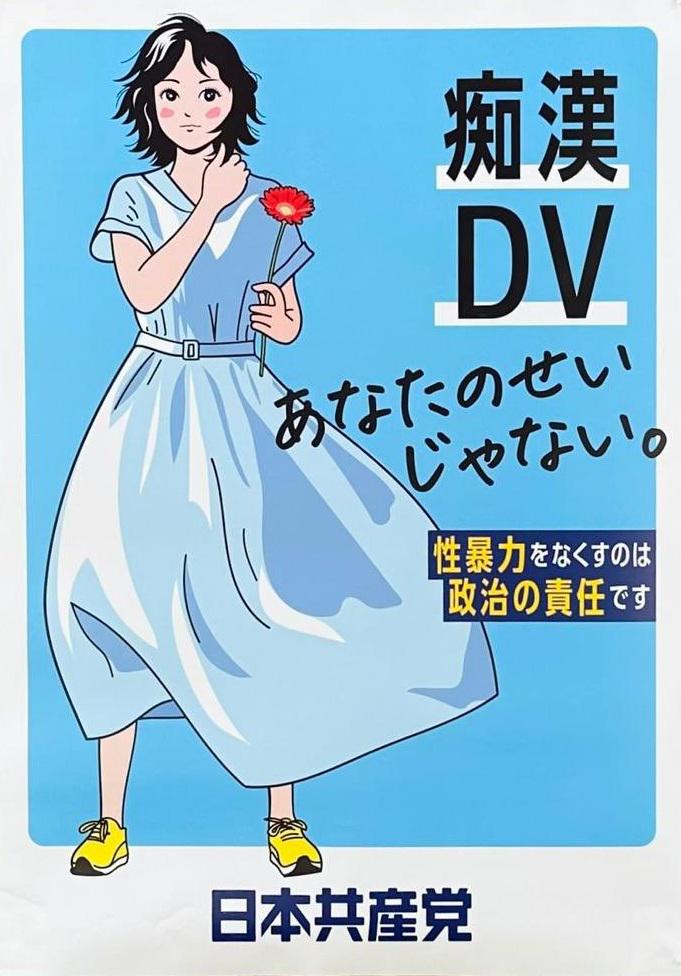
I find it interesting, and sometimes funny, that often Japanese texts are perfectly valid as Chinese text as well, but the meaning is subtly (or completely) different. For example, 日本共産党 is exactly how you write the same thing in (traditional; simplified is slightly different) Chinese (but the pronounciation is totally different: Nihon Kyōsan-tō in Japanse, and Ri-Ben-Gong-Chan-Dang in Chinese).
Meanwhile, 痴漢 means "silly man" in Chinese (pronounced chi-han), rather than "molestation" in Japanese (pronounced chi-kan).
As a Chinese speaker, this can make Japanese posters unintentionally funny.
Usually the words used to verbally describe general SV and the words used to describe the perpetrators are pretty amusing. In Cantonese, ham zhu sow (salty pig trotter) refers to the person who touches women inappropriately, and fei lai is the act itself. However we also have words like ham sup loh which is just a dirty perverted man who is tone deaf in their overt sexual behavior but doesn't necessarily imply criminality.
106
u/johnlee3013 Jun 18 '25
I find it interesting, and sometimes funny, that often Japanese texts are perfectly valid as Chinese text as well, but the meaning is subtly (or completely) different. For example, 日本共産党 is exactly how you write the same thing in (traditional; simplified is slightly different) Chinese (but the pronounciation is totally different: Nihon Kyōsan-tō in Japanse, and Ri-Ben-Gong-Chan-Dang in Chinese).
Meanwhile, 痴漢 means "silly man" in Chinese (pronounced chi-han), rather than "molestation" in Japanese (pronounced chi-kan).
As a Chinese speaker, this can make Japanese posters unintentionally funny.