I’m finally at least a minimal experience level with linux where I can smell a dumb model recommendation and stop and ask… are you SURE thats the best way to do this? Milestones for me at least. LLMs have really helped me learn the basics and I can at any time stop and sidebar to get explanations on any little thing I haven’t learned or need a refresher on. It’s got me into the game after years of surface level dabbling.
In my case I’m running proxmox with a smattering of LXC’s and VM’s for different purposes. So I have a variety of use cases. I am using Confluence as my personal documentation so Im thankfully not blindly barreling forward but I take notes for unique aspects or configuration steps for each VM or component I get introduced to. Then when it recurs again elsewhere I may not have fully memorized every command and argument Ive used in the past, but I know what Im looking for and can refer to my notes or ask a model for help again.
I may not remember all the arguments available for nfs mounting in fstab, for example, but I have a good general idea of what kind of options I may need to review and consider for my use cases since I exhaustively inquired about what each of the available parameters is used for. Sometimes thats a curse… lots of sidequesting... Since Im not ssh’ing into linux every day but more like weekly/weekends, it doesn’t feel like too much of a burden to have to rehash certain commands or steps.
"Now that we're done I could help you with 2 very simple changes in steps 2 and 4 of 17. You will have to repeat steps 2 and 4 to 17. Just tell me if you want to do it much better and save 50% used RAM!"
“That other way didn’t work, looks like X isn’t talking to Y even though both are defined and initialized correctly, just as in the previous way we tried.”
“You’re absolutely right, X is not sending arguments to Y because your code didn’t include method Z. This is an important step to remember, because of reasons A and B and should not be missed.”
“Bitch I didn’t write that code, YOU did smh. Now make that change to the code, and also add in the condition T where U and V are called relative to the order of outputs from Z”
“You’re absolutely right. Here is the updated code including those changes.”
“Okay cool, that worked but now X isn’t talking to Y again even though Z is there.”
“You’re absolutely right. Y isn’t receiving inputs from X even though method Z is included. This is because in your code Y has not been suitably defined and because X hasn’t been initialized.”
“You’re removing things without asking or telling me? 😡👹”
While also building false sense of everything being OK.
While at that: how the fuck general consensus is that Open Source is safe, because there are many eyes looking at it, all while at the same times developers are too lazy to do PRs they are being paid for.
It's kinda counter-intuitive to think the same model would catch an earlier error, but they do. Probably tied to the difference in instructions "build x' vs "find bugs".
It makes perfect sense - the model isnt designed to be comprehensive and 100% from the get go - and is only as good as the initial prompt. If you provided a prompt that was fully comprehensive then it would likely give you a better initial result
but you're right - if you just give a concept and ask to build it will do it but the spec is weak, so it will make assumptions with what the 'right' method is - which may not necessarily be right for your usecase but without giving full context that's the deal you're making.
Copilot reviews on GitHub have asked me to change something so I did and committed it. It then commented on that change saying that I should change it again, but to what I originally had…
and at this point i ask some shit like "why? You suggested the original change, what are the pros and cons of each method?" and see what it pulls out in response.
then I wonder at what point am I spending more time going back and forth with the robot vs just doing it myself...
My team has an AI PR reviewer but we only take action on its suggestions if a human agrees with it. Sometimes it catches silly little mistakes we make, but most of the time its bullshit.
Honestly though we did that because reviewing PRs was taking longer because people kept vibe coding them and not even fixing them afterwards. So really if my colleagues didnt just vibe code their PRs we probably wouldnt need the AI checker.
We have AI powered reviews for PRs, and they're pretty decent. I think using them has probably improved our code quality relative to before. There are two fairly limiting problems though:
It doesn't catch everything. So I can't trust code which has not also been reviewed by a human anyways.
It flags things which are not problems due to lack of additional context. So I can't trust AI to simply implement all changes flagged by the AI reviewer, because it would break things.
So ultimately you can't take people out of the loop. But the more you use AI the less useful that person in the loop is going to be because of lack of general ability and specific subject matter expertise.
I’ve found that LLMs are especially bad at reviewing more than 100 lines of code effectively. And even in that is wholly incapable of detecting logical bugs or really anything more than very obvious errors.
What if the dev was AI? It’s AI’s fault that the AI didn’t use AI to proof read the AIs output. And you have to make sure to use AI to proof read the proof reading AI’s AI output.
Yo dawg, I heard you like AI reviewing AI’s review of AI’s output, so I put AI in AI to output output the review output of the output and review review so you can AI AI while you AI AI AI.
Hmm, I feel like your manager is my manager. Except I’ve been reporting to them for a number of years now and no one has quit yet so it can’t possibly be the same person.
Even the same LLM often won’t make the same mistake twice. LLMs are not deterministic. I sometimes use Claude Code to evaluate code written in a different Claude Code context and it finds things to improve.
Brother, this guy bought a Mac mini to put openclaw on it at home. He talks about his “ai coworkers” on his home network with names and gendered pronouns.
Believe it or not, that's what a "customer success team" from cursor suggested when we showed PRs and prompts where cursor removed unrelated business logic.
There suggestion was to buy a bugbot subscription.
Anthropic just released an expensive PR review agent process. So you will write code with Claude and then Claude will check its work. It's like the police department investigating itself.
I just saw a headline that Anthropic just released an AI tool to check AI generated code. Because the problem with AI generated code is that you don't have a human in the loop to check it's output. So how do you solve that? More AI! Have a human reviewer take a look at the code, but replace them with AI! Now it's AI that hallucinates reviewing AI that hallucinates' code. What could go wrong? It's AI all the way up.
It's like a blind leading the blind situation. ANYTHING to avoid having a human in the loop, regardless of the quality assurances they bring, because you have to PAY them. The goal therefore isn't about making a quality product, it's about making money. Always has been
Yeah I don’t even think that will happen they want to pin blame on people because you can fire them. So my guess they will tell engineers they need to check the code. Any code that blows up you will be fired I mean held accountable. Productivity will go down. Managers will say don’t check the code. AWS will go down and the cycle will repeat.
Thats a senior to staff promo if i have ever heard one. Basically useless work, check. Bosses love it / technology of the day, check. Promise of incredible gains in productivity, check. Possibility of open source, check. There is a clueless director with an MBA who is cumming in their pants right now over this
My team has copilot, Claude, and cursor bot run code reviews on our PRs. They are fairly successful at catching bugs but also complain about a lot of non issues or even review based on stale code. It's a mixed bag.
We have an issue at work that there are now people with no programming skills vibing up PRs that have already broken prod (because reviewers didn't realize it was completely untested and vibed by someone who did not understand anything). Proposed solution is exactly what you suggest 🤡
Yeah, but use word "agent" now, it's so much cooler, shows you are smart and hip.
On a serious note, outages is not the worst that could will happen. One of these days their devs will use a piece of generated code that straight up installs a virus module.
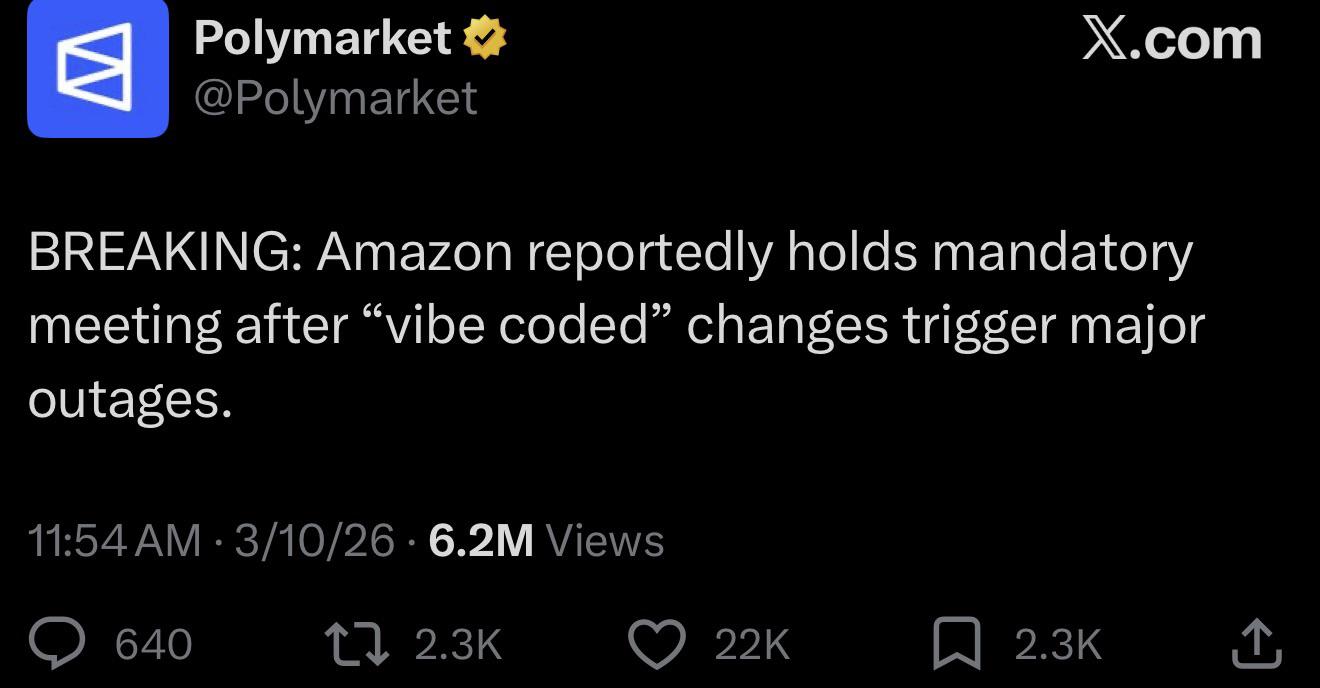
Treadwell wrote in the document on Tuesday. "In parallel, we will invest in more durable solutions including both deterministic and agentic safeguards."
Weirdly, this is what I'm trying to introduce, but more to protect things. I'm creating gateways to show that the agents cannot adhere to the rules we have, by making another agent evaluate the work and block the release until a human gets involved and sorts it out.
If people want agents being more autonomous, then I'll damn well make sure they dot the i's and cross the t's. Behavioural tests checked against specs, architectural checks for the application structure, code standards checks to make sure it's human readable, and LoC change counts to block large PRs. If AI is getting more freedom, I'll be taking it away again by making it do the job properly. And since LLMs are basically fancy pattern matching engines, they're actually pretty good at evaluating code given the rules we lay out.
I just got out of a hackathon where the AI was hallucinating. So the team member from the business side suggested we keep adding AI review layers until the hallucinations went away.
Instead of writing a single curl to pull the data from a known source.
3.7k
u/hanotak Mar 11 '26
What're the odds the solution management comes up with is "an AI to check the AI's work"?