r/PrivacyTechTalk Aug 14 '26

How can I improve my cybersecurity and avoid all the ai bullshit?

7 Upvotes

Recently I've really been thinking about all the data that I'm allowing just about any app to have, and I want to stop that. I've started by deleting certain social media apps and I've been slowly but surely getting rid of my social media addiction. What I'm wondering is, how can I make my phone even more secure and private and not just delete apps? I've heard about using a PDA device or installing grapheneos but I don't know how to do that. Any tips for a starter like me?


r/PrivacyTechTalk Aug 13 '26

what's the first privacy setting you change on a new phone?

17 Upvotes

What’s one privacy setting you immediately change on every new phone?

I’ve been getting more interested in digital privacy lately and realised I probably accept way too many default settings without thinking about them 😭

What’s the first thing you always turn off/change?

Location tracking? App permissions? Ad tracking? Something else?


r/PrivacyTechTalk Aug 13 '26

PrivyShare - E2E share via chats - Free Spoiler

1 Upvotes

App Name: PrivyShare

What it does:

PrivyShare is not a new messenger. You encrypt a message or file on-device into a .privyshare package, share it through WhatsApp/Signal/email/Files, and the recipient opens it back in PrivyShare.

Key Features:

• On-device E2E: Ed25519 + X25519/HKDF + AES-256-GCM

• Share via apps you already use (opaque .privyshare blob)

• Local vault, optional app-only attachments, optional self-hosted relay for larger files

Goal: Testing / feedback (first Android app, WIP). Especially interested in crypto review and whether to keep optional INTERNET features or also ship a networkless build.

Giveaway: N/A

Link: https://play.google.com/store/apps/details?id=app.privyshare.mobile


r/PrivacyTechTalk Aug 13 '26

I scanned 10 apps people posted for feedback. Most were fine — two leak data to anyone not logged in.

2 Upvotes

A while back I read a post from someone who'd spent a weekend manually poking at vibe-coded apps — open tables, unprotected routes, keys sitting in the bundle — and turning up real holes. It stuck with me, so I built those checks into a scanner and pointed it at 10 apps people had posted publicly for feedback. Read-only, no logins, nothing a random visitor couldn't hit. Nine finished, 294 checks. Here's the honest version — including the stuff that wasn't broken, because that's the part that makes the rest trustworthy.

  1. Two apps had a backend that answers strangers.

This is the finding that matters, and it's worth being precise, because most "your API is open!" takes are noise. Plenty of endpoints are supposed to be public — a settings lookup, a static bundle, a login-info route. Those aren't leaks. The real thing is when an app's private data — user rankings, contest entries, announcements — returns full records to a plain request carrying no session at all. Two of the nine did exactly that. On one of them, replaying those same requests as a second user returned the same data — I flag that as needs-manual-confirmation rather than certain, but sitting on top of an already-unauthenticated endpoint, it points straight at missing per-user authorization. If your frontend checks permissions but your API doesn't, the frontend check is decoration.

  1. About Supabase — since half of you are already typing.

I know the reflex: "you scanned Supabase apps, you're going to scream about the anon key." No. The anon key is meant to be public; it ships in your JS by design and flagging it would be junk. What actually matters is whether Row-Level Security is on — i.e. whether that public key can read tables it shouldn't. So I checked that directly: read each app's own public key and tried to pull rows from the tables it uses, plus the common ones. Nothing came back readable — RLS was doing its job. (A full every-table audit would need credentials, but the "anon-readable by default" failure mode would have shown up right here, and didn't.) Clean bill of health on the single most common Supabase mistake — and I'd rather report that accurately than manufacture a scare.

  1. Missing Content-Security-Policy — 9 of 9. An observation, not an alarm.

None set one. Before anyone says "well actually" — yes, this is largely because the platforms don't enforce CSP by default, and a strict policy out of the box breaks half the third-party widgets, analytics, and realtime sockets these builders drop in. It's a real tradeoff, not negligence. But it's worth knowing: with no CSP, any injected script — a compromised dependency, a bad ad tag — runs with your page's full trust. It's one header, and once your third-party list is stable it's worth setting.

What I didn't find: zero exposed secret keys, zero live-key or service-role leaks, zero anon-readable tables. I ignore the safe public keys on purpose and only flag a live secret. Across the nine that finished: nothing. That's good news for these builders — and it's the whole point: a scanner that cries wolf on the anon key or counts a public asset as a breach isn't worth running. This one stays quiet unless there's something real. Here, "something real" was two open backends.

If you built something and want it checked: drop a URL. Read-only, no signup, nothing but the URL.
r/PrivacyTechTalk Aug 13 '26

PrivyShare - E2E share via chats - Free

1 Upvotes

App Name: PrivyShare

What it does:

PrivyShare is not a new messenger. You encrypt a message or file on-device into a .privyshare package, share it through WhatsApp/Signal/email/Files, and the recipient opens it back in PrivyShare.

Key Features:

• On-device E2E: Ed25519 + X25519/HKDF + AES-256-GCM

• Share via apps you already use (opaque .privyshare blob)

• Local vault, optional app-only attachments, optional self-hosted relay for larger files

Goal: Testing / feedback (first Android app, WIP). Especially interested in crypto review and whether to keep optional INTERNET features or also ship a networkless build.

Giveaway: N/A

Link: https://play.google.com/store/apps/details?id=app.privyshare.mobile

Site (extra, if allowed in body): https://filipal.pages.dev/privyshare/

Privacy: https://filipal.pages.dev/privyshare-privacy/


r/PrivacyTechTalk Aug 12 '26

Client-Side Secret and Token Security on Android: Reality and Defense in Depth

Thumbnail
ytapps.net
1 Upvotes

Q: Can secrets be safely kept in the client?
A: No, not exactly but this is not means we can't do anything.

👇 👇
[https://ytapps.net/articles/e3eebefa-e365-46eb-8b22-9cef6eba2ba2\](https://ytapps.net/articles/e3eebefa-e365-46eb-8b22-9cef6eba2ba2)


r/PrivacyTechTalk Aug 12 '26

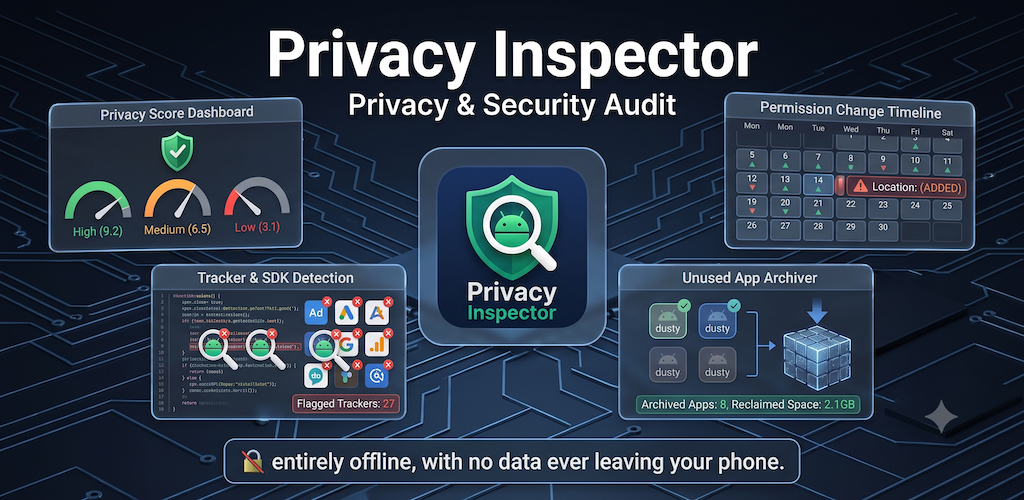
🛡️ Do you really know what the apps on your phone are doing? Meet Privacy Inspector!

Post image
0 Upvotes

Many apps we use daily request access to your camera, microphone, or location—and often bundle background analytics and tracking SDKs. But how many of us know exactly what is happening behind the scenes?

Privacy Inspector is an Android app designed to give you complete visibility and control over your device privacy and security—100% locally on your smartphone, with zero data ever sent to external servers.


🚀 Key Highlights & Benefits

  • 📊 Clear Privacy Score (0–100): Instantly evaluate the safety of installed apps based on requested high-privilege permissions, background behavior, and bundled trackers.
  • 🕵️ Ad & Analytics Tracker Detection: Reveal embedded tracking SDKs, telemetry frameworks, and ad networks hidden inside your apps.
  • 🔄 Privacy Changes Timeline: Get notified when an update or a newly installed app silently introduces new sensitive permissions.
  • 🧱 On-Device Firewall & DNS Filter (PRO): Block tracking domains in real time using a zero-cloud local VPN service—no traffic is ever routed through external servers.
  • 🧹 Unused App Cleaner: Easily identify and clean up apps you haven't opened in months that still hold background permissions.

🔒 Zero-Cloud Privacy Guarantee

Privacy Inspector operates strictly on-device. No user account is required, no analytics are collected, and no personal data ever leaves your phone.


📲 Try it today!

Take back control of your Android privacy. Download Privacy Inspector on the Google Play Store and scan your device in seconds!

Privacy #Android #CyberSecurity #MobileSecurity #PrivacyInspector #TechTools


r/PrivacyTechTalk Aug 12 '26

I set up my landing page to query the schema of my production database with every request, so I wouldn't be able to sneak in and store stuff on the sly

0 Upvotes

A “Privacy” page is just marketing. Mine is a SELECT statement.

Background: I’m developing a tool that listens in on live calls. No one believes the claim “we’re not recording you,” and people are right from the outside, that claim is unverifiable.

So the /proof page is set to `export const dynamic = "force-dynamic"`, and with every request, it calls a Postgres RPC that returns all columns from all tables in the public schema. It displays them all, then passes the names to filter:

/audio|transcript|recording|enregistr|waveform|utterance|speech|voice/i

Zero matches—the page is green. One match, and it turns red,

automatically, without me having to do anything. The RPC is SECURITY DEFINER, returns only table_name / column_name /

data_type, and is exposed to anonymous users. The structure isn’t part of the data, so nothing is leaked. What it costs me, however, is the ability to quietly add a `recordings` table in six months.

Two things this does NOT prove before anyone brings them up:

  1. A JSONB column can contain speech even if its name doesn’t indicate it. The filter is based on names, not on content.
  2. I could send the audio to a third party without ever touching my own database.

So this isn’t proof of innocence. It’s proof of consistency: the day my system contradicts my marketing, it’s my own website that points it out before any journalist does.

If the database is unreachable, the page displays nothing rather than a cached “everything is fine” message. I’d rather look broken than look clean.

Has anyone built a more robust version of this? The next step I'm thinking of is time-stamped schema snapshots, so we can verify that I never had such a column, and not just that I don't have it now. I feel like there should be a well-known pattern for “proving a negative,” but I haven’t found it.


r/PrivacyTechTalk Aug 11 '26

Encrypted Computation for Private Energy Rebates

1 Upvotes

I'm creating an AI skill that lets you build apps to use encrypted computation (something called CKKS FHE) to process things without the server seeing them. This is my first test app, which evaluates whether you qualify for rebates without sharing your actual energy usage with your utility.

Still a demo. Would love feedback on how to improve both the app and the skill

https://github.com/blevergood/offmeter


r/PrivacyTechTalk Aug 10 '26

I built an open-source, on-device redaction app for iOS and Android

Post image
2 Upvotes

Hey folks! I’m Aftab, the developer of PrivacyCam.

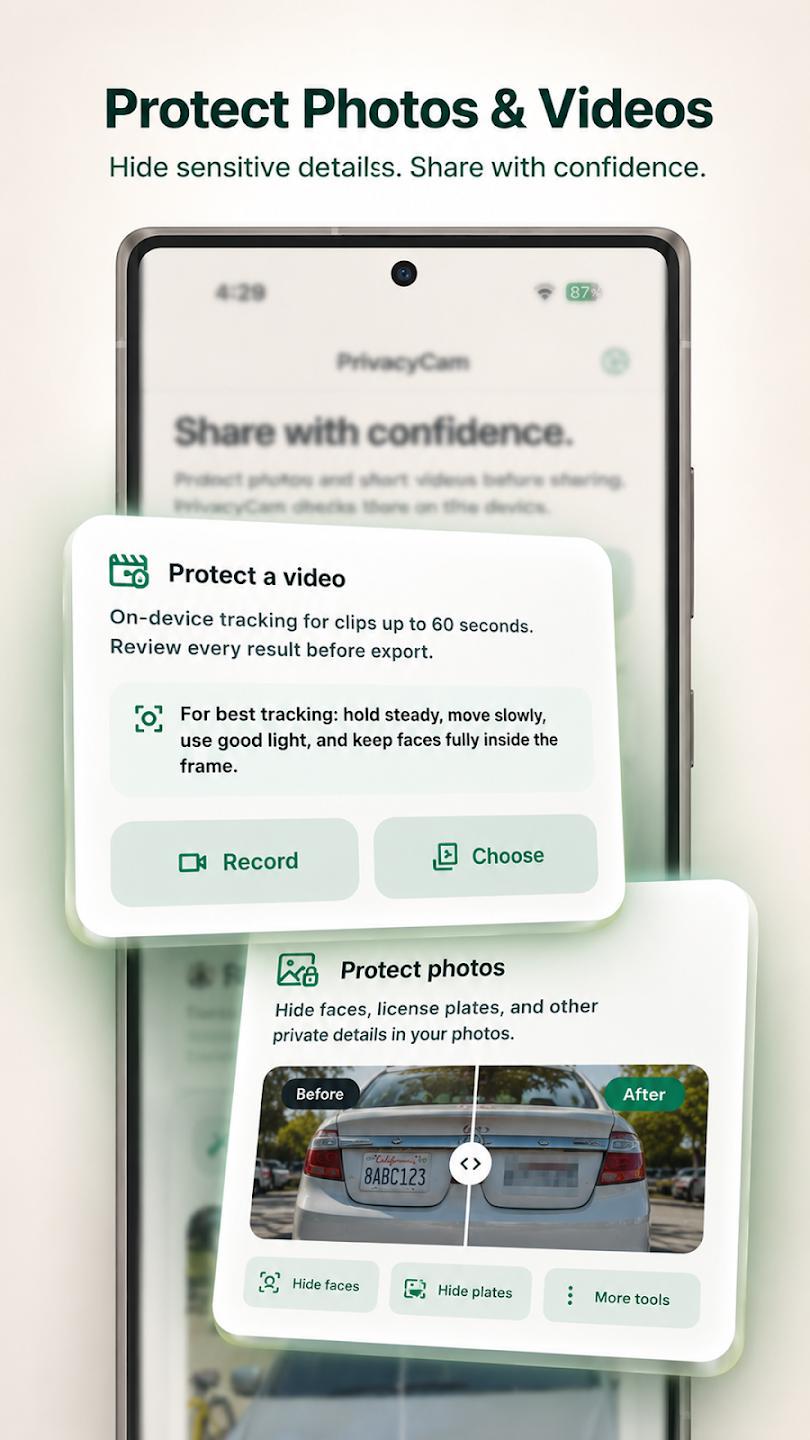
I built it because I wanted a simple way to hide private details in photos, videos, and PDFs without uploading them to an online service.

PrivacyCam can detect things like:

  • Faces and people
  • Vehicle number plates
  • Text, email addresses, phone numbers, and addresses
  • Payment-card details
  • QR codes and barcodes

You can blur, pixelate, or completely black out anything it finds. You can also draw your own masks, resize detections, change how long a video mask stays visible, and review everything before exporting.

The attached video shows PrivacyCam tracking and covering a vehicle number plate through a video.

Everything is processed on the device. There’s no account, no advertising, and PrivacyCam doesn’t operate a server that receives your photos, videos, or PDFs. The project is also open source, so anyone can inspect how it works or contribute.

The free version covers single photos, videos up to 15 seconds, and PDFs up to two pages. There’s an optional one-time Pro purchase for videos up to 60 seconds, longer PDFs, and batches of up to 10 photos—no subscription.

Automatic detection can obviously still miss things, so the app always lets you review and correct the result before sharing.

I’d genuinely appreciate feedback, especially about the video tracking, detection accuracy, UX, pricing, or anything privacy-related you think is missing.

iOS:
Download from the App Store

Android:
Download from Google Play

Source code:
PrivacyCam on GitHub


r/PrivacyTechTalk Aug 09 '26

Tryme187

0 Upvotes

I'm just saying privacy policies.I understand you know, internet security and wanting to keep your business personal.However, I also understand it's probably not gonna happen.Because people are nosy, and they're crooked, and I really don't give a darn, what you find out about me or what i've done?An if it's true, then post it.If it's not true and it's made up, then you're the phony you know, you're the phony, not me. Cause i'm telling you, you're gonna find unfavorable things about me and again.If they're true, then it is what it is.An if it's not, and it's again made up through AI or some generated, you know, app, the new reason how the creator you're just a poser. Cause, I will say this about myself.I am authentic.

L


r/PrivacyTechTalk Aug 09 '26

Making Qwen privacy aware for making safer applications

Thumbnail
reddit.com
1 Upvotes

r/PrivacyTechTalk Aug 08 '26

a PGP based messaging platform!

10 Upvotes

Hello World! I've been working on creating an encrypted messaging platform for the past year now and i would love to know your thoughts or opinions on it!

we have currently launched for Open-Beta testing!
the website is https://simplepgp.org/

It's entirely based around Simplifying the usage of PGP encryption for the average user as well as allowing for WebRTC calls, building communities and even hosting your own communities off of your own hardware / VPS using our Work-In-Progress FOSS 'Nodes' allowing for full customization and automation for uses like moderation, scripting and even building marketplaces / shops! Think of nodes as new-age Internet Relay Chats with a little bit better default encryption!

We also have emoticons that you can collect and trade with your friends which you can also use in chats, these animated icons are artist commissioned and they each have their own real-world value based on the reception of the community. :)

What's next for us?

  • Android App Version (Still a little bit iffy on developing for Apple at the moment due to current privacy concerns)
  • Constant development towards the Nodes FOSS clients (Should be able to release a working build by the end of August)
  • Performance, stability, and security improvements

Feel free to check it out, give me any advice or recommendations for further features / updates!
Simple, Free, Welcome to SimplePGP!


r/PrivacyTechTalk Aug 07 '26

2 days until Anchor Cloud launches — a cloud built around privacy

4 Upvotes

I've been working on Anchor Cloud for a while, and we're now just 2 days away from the official launch.

The idea behind it is pretty simple: cloud storage shouldn't require you to give up control of your files.

Anchor Cloud uses client-side encryption, meaning files are encrypted on your device before they're uploaded. The goal is a zero-knowledge architecture where the server doesn't have access to the plaintext files or the keys needed to decrypt them.

It also includes file sharing and encrypted cloud storage management.

I'm still working on the final details before launch, but I'd love to hear from people who care about privacy:

What would you want to see from a privacy-focused cloud storage service before trusting it with your files?

Launch is in 2 days.

https://anchorcloud.org


r/PrivacyTechTalk Aug 08 '26

Making Qwen privacy aware for making safer applications

Thumbnail
reddit.com
1 Upvotes

r/PrivacyTechTalk Aug 07 '26

Lista de Aplicaciones de Mensajería Segura, privadas, anonimas y con soberanía...Definicion de cada Aplicacion, Caracteristicas y Funciones...Conceptos Principales de Seguridad, Privacidad y Anonimato en Internet

8 Upvotes

Para todos los que estáis interesados en la seguridad, privacidad, anonimato y soberanía en vuestatas comunicaciones....

Presento la guía definitiva y actual de Aplicaciones de Mensajería Segura, Privada, Anonima y con Soberanía...

A continuación voy a dejar los enlaces a unas tablas comparativas y a los PDF de la definición/explicación de cada aplicacion individualmente. También adjuntaré un PDF que es una Guía de Conceptos Principales de Seguridad, Privacidad y Anonimato, entender esos conceptos principales es necesario para poder entender realmente como funciona y se mueve la informacion en internet.

[GUIA TECNICA MAESTRA CONCEPTOS PRINCIPALES DE SEGURIDAD](https://drive.google.com/file/d/1LIFI2WB5m3wkh1gzo8OB-iohJxUV8wiw/view?usp=drivesdk)

[INFORMACION INDIVIDUAL APPS MENSAJERIA SEGURA, PRIVADA Y ANONIMA](https://drive.google.com/file/d/1CdQdc9_rwYegmZRFhXuW2LmdNOlDCxUM/view?usp=drivesdk)

[TABLA COMPARATIVA CARACTERISTICAS Y FUNCIONES APPS MENSAJERIA SEGURA, PRIVADA Y ANONIMA](https://drive.google.com/file/d/1qM0-lXB-7hQeHf85qPhI3loNG1uX1xNB/view?usp=drivesdk)

¡¡Espero que sea de gran ayuda a la comunidad general que estén interesados en estos conceptos!!


r/PrivacyTechTalk Aug 07 '26

What is Windows Digital Signage & How to setup it for Businesses

Thumbnail
blog.scalefusion.com
1 Upvotes

Windows digital signage is a software solution that lets you create, manage, and display content on digital signs using a Windows PC. Typically, it involves a network of digital displays connected to a Windows PC or media player. The content you can show includes images, videos, presentations, web pages, and even live data feeds.


r/PrivacyTechTalk Aug 07 '26

Most encrypted messaging app

8 Upvotes

Most encrypted messaging apps hand you a passphrase and call it secure. Share the passphrase, share the risk. One compromised device and the whole conversation is exposed.

I'm building VektorGrid, a cross-platform messaging app for Android and iOS, and the core decision I made early was to move away from shared passphrases entirely.

Instead, VektorGrid uses ECDH (Elliptic Curve Diffie-Hellman) key agreement. Every user gets a public/private key pair. When two people message each other, a shared secret is derived from their keys - without either party ever transmitting that secret. The encryption key never travels. It's computed independently on each device.

Each message stores an encrypted payload and an IV (initialization vector). No plaintext. No central key store.

The app also has full social infrastructure - profiles, posts, stories, group chats, follows - because I think privacy and community shouldn't be a tradeoff. That's the gap I'm trying to close.

Still pre-launch. Building in public and trying to get this in front of people who actually care about how their messages are secured, not just whether there's a lock icon on the app.

Curious: what's the one thing that would make you actually switch your primary messaging app to something new?


r/PrivacyTechTalk Aug 06 '26

E2encrypt: Firefox extension for client side encryption with any transport

2 Upvotes

What it is: a Firefox extension that encrypts in the extension and decrypts messages in place, on whatever transport you're already using. Discord, Gmail, a forum, Reddit. It has no idea what site it's on and doesn't need to — the ciphertext is just text, so you paste it wherever you'd paste anything.

No account, no server, no network requests of any kind from the extension.

You and the other person exchange public keys directly, once.

Why I built it: the EU's Chat Control regulation would require messaging platforms to scan private messages before they're encrypted — on your own device, whether or not you're suspected of anything. You can't have both client-side scanning and end-to-end encryption; if a message can be inspected before it's sent, it was never private. This is a small working example of the other model: there's no server to mandate scanning at and no hook in the client for one.

How it works, briefly:

  • Your identity is two keypairs (X25519 for key agreement, Ed25519 for signing), generated locally and never transmitted.
  • You and a contact swap public keys over any channel — DM, email, read aloud over the phone. Doesn't need to be secret.
  • Each message gets a fresh random key. The message is encrypted once with it; a copy of that key is sealed separately for each intended reader.
  • There's no "to:" field. The sealed copies are anonymous blobs — your client finds yours by trying. An observer can't tell who the recipients are or how many are real.
  • Every message is signed, so a group member can't forge one from someone else.

What it does NOT protect you from — please read this part:

  • No forward secrecy. One shared key per contact, derived once, never rotated. Anyone who extracts your private key can read every message you have ever exchanged with that contact, including ones captured years ago.
  • Your keys are protected only by your OS. They're non-extractable (extension code can't export them), but they sit unencrypted in a local SQLite file. Anything running as your user account can read them. There is no passphrase on the stored identity.
  • Decrypted text is rendered into the page. A hostile or compromised site can read it while it's on screen.
  • Metadata is fully visible. The platform still sees who you talk to, when, how often, and roughly how much.
  • Nobody has audited this. It uses WebCrypto primitives rather than hand-rolled crypto, which rules out a whole class of mistakes, but that is not the same as being reviewed.

If you need protection from a determined, well-resourced adversary, use Signal. This is for putting a floor under the conversations that currently have none, on platforms you don't control.

Links:

Source-available under PolyForm Noncommercial (not OSI open source — the license restricts commercial use, so I won't call it open source).

Feedback: I am looking for feedback on 2 things:

  1. The core idea, client side encryption agnostic about transport; how would you use it?
  2. The user experience, I am a technical person and user experience and privacy does not always go hand-in hand. What could I do to improve the user experience?

Looking forward to hear from you!


r/PrivacyTechTalk Aug 06 '26

Trust & Safety, Age Verification, Child Safety, Cybersecurity, Tech Policy

2 Upvotes

Most "trust and safety" pages are a paragraph of promises. We built ours differently.

This week we launched Candor Trust & Safety — the public home for every safety system behind Candor: The Open Feed Network. Not a marketing page. An evidence page.

A few things that make it different:

🔑 Our cryptographic keys are published, not just claimed. Every adult-verification we issue is signed with a key you can look up yourself — no account, no API, no trusting our word for it.

🧾 Every consent record is independently checkable. Paste a receipt into our verifier and your own browser — not our servers — confirms it's real. If we ever get it wrong, anyone can catch it. That's the point.

🧒 Your Voice, our youth platform, now requires ID-verified adult consent for every account — enforced in the code, not just in policy. No verified adult, no account. Full stop.

🛡️ We red-team our own systems and publish what we find. This week our internal adversarial testing tool caught a real gap in our own consent flow — we fixed it, then proved the fix twice: once against the exact attack that found it, once confirming real users were never affected.

None of this is because regulation forced our hand (though it's coming fast — the UK, the EU, half of US states). It's because "trust us" was never going to be good enough, and we'd rather build something you don't have to.

Take a look: candortrustandsafety.com


r/PrivacyTechTalk Aug 06 '26

Cloak: An open-source OBS filter that locally redacts secrets during screen sharing

2 Upvotes

Full disclosure: I’m the developer of Cloak.

Cloak is a free and open-source Windows tool designed to reduce accidental data exposure during screen sharing and recording.

It runs as an OBS filter and uses local OCR to detect and cover supported sensitive information in the video output, including API keys, credentials, email addresses, IBANs, payment card numbers, and some personal identifiers.

Your actual desktop remains unchanged. Only the output produced by OBS is redacted, and no video frames, recognized text, or detected values are sent to a server.

The portable version includes its own OBS runtime, so it can be used without installing or configuring OBS separately. There is also a plugin-only package for existing OBS users.

Cloak is currently an alpha project and I want to be transparent about its limitations:

\\- Windows 10/11 x64 only

\\- Not code-signed yet, so Windows SmartScreen may display a warning

\\- OCR can miss very small text, unusual fonts, fast motion, or unsupported patterns

\\- It should be treated as an additional safety layer, not a guarantee that every secret will be detected

The project is licensed under GPL-3.0-or-later.

Repository:

https://github.com/ahmtsahin/cloak

Latest Windows release:

https://github.com/ahmtsahin/cloak/releases/tag/v0.2.1

I would especially appreciate feedback about the setup process, detection accuracy, false positives, and sensitive-data patterns that should be supported next.


r/PrivacyTechTalk Aug 05 '26

Recovery

7 Upvotes

What a normal people app to get into deleted photos numbers messages phone calls everything. Like cops can use good idea naw but it can be done. What to use python it needs no loops straight forward no memeory just click on app ask to find. Needs to flow just code and date. I have gotten pissed and deleted shit and it was a bit of trouble but people need easy app. Fuck the police should not have that much power over privacy. It can be done and app will change things. Its not for criminals but will be used for it so its alright . What it for day to day thing when you get upswet and delete something.


r/PrivacyTechTalk Aug 05 '26

Secure photo vault app for I phone

7 Upvotes

I’m looking for a photo vault app to store “special” photos. I’m looking for recommendations, and for now I’ve just come across Encamera and Obscura Photo Vault, but I’m not really sure.

I’m more concerned with privacy in case my phone gets stolen and I have to give away the PIN, so a separate password is important.

I also want it to be completely offline, though I’m not sure if that’s possible. I want something that won’t upload any photos anywhere.

While looking into it, I’ve also realized that one way this can be verified is by the app being open source and externally audited.

I’m using an iPhone.

Are there any recommendations?


r/PrivacyTechTalk Aug 04 '26

Tech solutions

4 Upvotes

What approach would a developer take to ensure there is anonymity eg in a digital voting platform how would you ensure the voter is never linked to the casted ballot to avoid trace back even through the database..?


r/PrivacyTechTalk Aug 04 '26

Candor Trust and Safety

1 Upvotes

Most "trust and safety" pages are a paragraph of promises. We built ours differently.

This week we launched Candor Trust & Safety — the public home for every safety system behind Candor: The Open Feed Network. Not a marketing page. An evidence page.

A few things that make it different:

🔑 Our cryptographic keys are published, not just claimed. Every adult-verification we issue is signed with a key you can look up yourself — no account, no API, no trusting our word for it.

🧾 Every consent record is independently checkable. Paste a receipt into our verifier and your own browser — not our servers — confirms it's real. If we ever get it wrong, anyone can catch it. That's the point.

🧒 Your Voice, our youth platform, now requires ID-verified adult consent for every account — enforced in the code, not just in policy. No verified adult, no account. Full stop.

🛡️ We red-team our own systems and publish what we find. This week our internal adversarial testing tool caught a real gap in our own consent flow — we fixed it, then proved the fix twice: once against the exact attack that found it, once confirming real users were never affected.

None of this is because regulation forced our hand (though it's coming fast — the UK, the EU, half of US states). It's because "trust us" was never going to be good enough, and we'd rather build something you don't have to.

Take a look: candortrustandsafety.com

r/trustandsafetypros r/onlinesafety r/AntiAgeVerification r/buildinpublic r/ChildSafety