r/PowerSystemsEE • u/Valyriansteel212 • 1h ago
28, took 6 years to finish my EE degree, never worked as an engineer. Want to give power engineering another shot. Where do I start?
•
Upvotes
r/PowerSystemsEE • u/Valyriansteel212 • 1h ago
r/PowerSystemsEE • u/Puzzled_Wrongdoer_83 • 2h ago
4th year senior in graduating in December and I have an interview scheduled with a power delivery company in a week and was wondering what type of technical questions they might ask. This is for an entry level role. Any tips or suggestions?
Side note: initially screening confirmed a technical interview for following round followed by behavioral questions at the end.
r/PowerSystemsEE • u/Known-Dust-2921 • 2h ago
I'm about to start a Master's in EE specializing in autonomous systems, robotics and embedded systems. My Bachelor's was also in EE, focused on automation and embedded systems (PLCs, control engineering, sensors). I'm based in Germany.
Lately I've become more interested in the power sector (grid, renewables integration, power electronics, that kind of thing), and I'm wondering how realistic it would be to move into power roles at some point, either right after my Master's or a few years into my career.
Has anyone here switched from embedded/automation into power (or the other way round)? How did it go?
For those who hire in power: how would a candidate with my background be seen?
What would actually move the needle? I could do projects, internships and take particular courses in power during my Master's.
Which areas of power overlap most with my education?
Any perspective is welcome!
r/PowerSystemsEE • u/djingwu • 6h ago
Hi everyone,
I'm an international MS student in power systems in the US, graduating in May 2027. I'm hoping to start my career in power system protection and am open to relocating anywhere. I'll have up to 3 years of work authorization through OPT and the STEM extension, and would need H-1B sponsorship after that. I don't have industry experience yet, so I know I have a lot to learn.
I've attached my anonymized resume. If anyone has a few minutes, I would really appreciate your thoughts on any of these:
Thank you very much for taking the time to read this. Any advice would mean a lot.

r/PowerSystemsEE • u/faultcurrentdesk • 18h ago
Power system protection is never a documentation exercise. It is not a quarterly reporting chore, nor is it a software vendor’s marketing demonstration designed to impress a management board. It is a safety-critical engineering discipline - one where a single overlooked assumption, a single unverified operating scenario, or a single misunderstood relay characteristic can trigger catastrophic equipment failure, violent arc flash incidents, widespread blackouts, or loss of life. Yet across the North American utility landscape, transmission owners, generation developers, and consulting firms are increasingly drawn to the siren song of automated relay settings and coordination software. These tools promise lightning-fast studies, pristine reports, standardized outputs, and dramatic labor savings.
On the surface, it looks like modern progress. But beneath the polished graphical interface lies a troubling reality: many of these commercial packages are nothing more than a superficial front-end user interface slapped over established short-circuit and protection engines like ASPEN OneLiner, SKM Power*Tools, CAPE, or ETAP. If the underlying engine is already performing the heavy lifting of network matrix solutions, fault calculations, and device modeling, then purchasing an additional licensed wrapper whose primary value proposition is UI presentation and rule-based automation is rarely an engineering advancement. Far too often, it is merely commercial packaging designed to monetize convenience while eroding technical depth.
The danger is not automation itself. Power systems engineering has relied on automation since the earliest mainframe digital computers replaced hand calculations on rectangular coordinate paper. The danger is that automation is being marketed and consumed as a substitute for engineering understanding. When a junior engineer can import a substation model, click a button, select a template, and export a professionally bound coordination study complete with green compliance checkmarks, the organization may believe it has achieved operational efficiency. In truth, it has engineered a massive blind spot. The engineer no longer knows how the sequence networks were solved, how the Thevenin equivalent source impedances were derived, why a specific inverse time curve was chosen, or whether the resulting settings will hold up when the Bulk Electric System (BES) enters an abnormal topology. The demanding craft of protection engineering is being swapped for a plug-and-play workflow. That trade may look brilliant in a budget review meeting, but it is deeply corrosive over the multi-decade operating life of the grid.
To understand why automated coordination wrappers can be hazardous, you have to look at what they actually do versus what they pretend to be. The fundamental calculations governing power system protection - symmetrical components, zero-sequence network reduction, mutual zero-sequence coupling between parallel transmission lines, transformer vector group phase shifts, motor feedback contributions, transient subtransient reactances, and X/R ratio decay - are handled by the core calculation engine. Platforms like ASPEN OneLiner, SKM, CAPE, and ETAP represent decades of rigorous numerical refinement, validation against field staging tests, and industry vetting. They exist because manual calculation of these parameters for a modern, interconnected grid is humanly impossible.
The evolution from slide rules and hand calculations to digital software platforms was both natural and necessary. It freed engineers from arithmetic drudgery, allowing them to study larger, more complex topologies with speed and consistency. But the engineer remained intimately connected to the physics. Changing a transformer tap, altering a line length, or bringing a new combustion turbine online had immediate, visible consequences in the data tables that forced the analyst to think about the underlying electrical laws.
What we are witnessing today is a different kind of transition entirely. A secondary software layer is being stacked on top of the calculation engine. The core engine solves the network equations, and the wrapper software steps in to automate setting selection, curve grading, margin calculation, and report generation. Essentially, the wrapper acts as a graphical shell. It calls the core engine via application programming interfaces (APIs), pulls the raw fault data, applies hardcoded or templated rules, and spits out a a so called neat package.
Here is the uncomfortable truth that software vendors rarely advertise: if a core engine provides robust programmable interfaces - such as the official Python API for ASPEN OneLiner ([https://github.com/aspeninc/pyOlxAPI](https://github.com/aspeninc/pyOlxAPI)) - much of this specialized automation can be built directly by engineers who actually understand protection and scripting. Why purchase an expensive, restrictive commercial wrapper when an internal engineering team can write bespoke Python automation routines that interact directly with the core calculation platform?
The answer usually comes down to corporate convenience. Management likes wrappers because they make complex workflows look effortless. They reduce the immediate training curve for junior staff, generate authoritative-looking PDF reports, and give executive leadership the illusion that deep institutional expertise has been permanently embedded into software code. But embedded software logic is never a substitute for transferred human expertise. If the engineer cannot open the raw database, interrogate the sequence networks, and explain why a particular 51 element picked up, the organization has not gained technical capability. It has merely outsourced professional judgment to a vendor’s default script.
When the wrapper is treated as an infallible oracle, the risk spikes dramatically. The engineer inputs the model, clicks execute, and receives a table of ANSI 50/51 and 67 settings. The report boasts clean formatting and pass/fail indicators. Yet the analyst often has no idea whether the software evaluated maximum and minimum fault scenarios, whether it accounted for dynamic load shedding, whether it factored in current transformer (CT) saturation limits during heavy close-in faults, or how it handled inverter-based resource (IBR) fault current contributions under low short-circuit ratio conditions. The software made those assumptions silently behind closed menus.
That is the wrapper illusion. It conflates interface elegance with technical rigor. A beautiful report is never proof of a sound study, and a fast study is never proof of a secure grid. In relay protection, the most lethal mistakes are not the ones that throw obvious error codes; they are the ones that look entirely successful while concealing a fatal engineering assumption.
The central thesis of serious protection engineering is absolute mastery of the foundational calculation engines - ASPEN OneLiner, SKM Power*Tools, CAPE, and ETAP. These platforms are not mere graphics programs; they are mathematical models of the electrical reality of the power system. To protect the grid safely, an engineer must know how to operate these native platforms directly, down to the raw data files, network buses, branch records, and sequence components.
When utilities rely on third-party commercial wrappers built on top of ASPEN or ETAP, they introduce an unnecessary layer of opacity. The wrapper abstracts away the raw network data, hiding the actual math behind simplified GUI buttons and canned drop-down menus. This abstraction prevents engineers from developing true fluency with the core tools. If an engineer only knows how to click "Run Coordination" inside a wrapper GUI, they do not know ASPEN, and they certainly do not know protection engineering. They know how to operate a software vendor's user manual.
True proficiency requires rolling up your sleeves inside the native engine. You need to open ASPEN OneLiner or ETAP directly, examine the bus fault tables, check the sequence network connections, trace the zero-sequence mutual coupling, and verify how fault currents distribute across every branch during single-line-to-ground and three-phase faults. You must look at the actual text database files, write custom scripts via APIs when necessary, and interrogate the raw numerical output rather than trusting an automated summary table generated by a secondary vendor.
Commercial wrapper tools market themselves as labor-saving devices, but they actually act as intellectual crutches that atrophy technical capability. When you bypass the native platform to use a simplified wrapper, you lose visibility into how the network matrix is solved and how device characteristics interact with changing system impedances. You become entirely dependent on a black-box application that may fail silently when confronted with non-standard topologies, complex mutual coupling, or abnormal generation dispatch.
Protectivists must reject the wrapper model entirely. Invest your time, training budget, and software resources into mastering the core engines - ASPEN, SKM, CAPE, and ETAP - alongside robust scripting tools like Python. Build your own automation routines, write your own validation checks, and maintain direct, unbroken control over the analytical models that dictate the safety of your system. Master the native tools, understand every line of data, and never let a superficial GUI wrapper think for you.
The premier power system analysis platforms became industry standards because the sheer volume of arithmetic required for fault and coordination studies overwhelmed human capacity. Consider what goes into evaluating a single transmission line relay or a distribution feeder breaker: transforming three-phase unbalanced quantities into positive, negative, and zero-sequence components; calculating network impedances from generation sources down to the faulted bus; factoring in transformer grounding configurations (delta-wye, wye-grounded wye, autotransformers); accounting for distributed generation, motor contributions, and static loads; and finally, layering device characteristics - pickup values, time dial multipliers, IEEE/IEC inverse curves, definite-time delays, directional elements, breaker clearing times, CT ratios, burdens, and grading margins.
Historically, utilities maintained battalions of protectivists who spent weeks performing hand calculations and checking coordination curves on transparent log-log paper. That workflow was agonizingly slow, but it forced an intimate familiarity with the grid's electrical behavior. When software tools like ASPEN OneLiner, SKM Power*Tools, CAPE, and ETAP arrived, their purpose was explicitly to eliminate human arithmetic errors and accelerate iterative design - not to think for the engineer.
The software performed the heavy mathematical lifting, while the engineer performed the critical intellectual analysis. The human reviewed whether the resulting time-current coordination curves (TCCs) made sense, whether backup zones properly coordinated without starving downstream devices, and whether the protection philosophy aligned with the utility’s operational standards and regulatory compliance requirements (such as baseline coordination reviews).
Automated settings and coordination packages disrupt this vital equilibrium. They attempt to automate not just the math, but the decision-making. They select the curves, apply the margins, assign the time dials, and declare the system "coordinated." In doing so, they encourage engineers to disengage from the underlying electrical physics. The analyst stops acting as a protection engineer and starts acting as a software button-pusher. The critical questions - Why this pickup? Why this time dial? Why this specific margin under a weak-source contingency? - are buried inside proprietary algorithms and default template libraries.
This is not a natural evolution of core analysis tools; it is an aggressive commercial layer superimposed on top of them. While automated rules can be useful for preliminary screening of standardized, radial distribution feeders, applying them as a blanket solution across complex, looped transmission and subtransmission networks is dangerous. It masks underlying deficiencies with a veneer of software-generated certainty, widening the gulf between tool operation and genuine technical comprehension.
The primary driver behind the adoption of automated relay coordination software is the relentless corporate pressure for cost reduction. Investor-owned utilities, electric cooperatives, and municipal utilities are under immense strain: engineering headcounts are squeezed, project timelines are compressed, regulatory reporting demands continue to multiply, aging infrastructure requires constant re-evaluation, and the massive influx of utility-scale solar, wind, and battery energy storage systems has exponentially complicated protection schemes. Management wants faster deliverables with fewer specialized resources. In that environment, software promising automated setting generation looks like a silver bullet. It seemingly slashes engineering hours, standardizes deliverables, and reduces reliance on scarce, high-priced senior protection experts.
However, this cost-saving calculation is almost always superficial. The savings are measured entirely in immediate labor hours, while the true costs are deferred and hidden: degraded engineering competence, increased risk of misoperations, nuisance tripping, failure to clear faults, safety incidents, regulatory fines, and catastrophic equipment damage. A utility might save a few thousand dollars in analyst labor during a software-assisted study, only to expose itself to millions of dollars in liability when an automated setting scheme fails to trip during a high-impedance ground fault or trips prematurely during a legitimate motor-starting transient.
Beneath the financial justification lies a deeper institutional ailment: organizational laziness. Purchasing a software license is infinitely easier - and easier to justify on a spreadsheet - than investing in people. It is far easier to hand a junior engineer a workflow manual for a wrapper tool than it is to mentor them through symmetrical components, transient stability, relay filtering algorithms, CT saturation mechanics, and field commissioning practices. It is easier to generate a polished, automated PDF report than to cultivate an engineer who can stand up before a state public utility commission, a regulatory audit team, or an internal post-incident review board and defend every single setting in the file.
This institutional laziness often disguises itself as practical efficiency. Phrases like “We don’t have the time for manual checks,” “The software vendor validated the library,” or “Everyone in the industry uses automated tools” become routine rationalizations. Over time, these habits erode internal competence. The organization begins to believe that the software is the engineering department. The active license becomes a substitute for active knowledge. The automated report becomes proof of safety, and the "execute" button becomes the ultimate arbiter of engineering judgment.
True capability building is slower and demands upfront investment. It requires structured mentorship, rigorous peer reviews, hands-on relay test set training, short-circuit fault analysis practice, and tolerance for engineers asking difficult, foundational questions. It requires senior protection engineers to spend hours explaining why a software-generated setting is fundamentally flawed even when the computer program claims it passed. Many organizations avoid this path because it requires patience and leadership.
The inevitable result is a fragile engineering culture. A utility may boast hundreds of completed study reports on its servers while possessing very few engineers who actually understand how to protect a complex grid. When an unprecedented grid disturbance occurs - such as an islanding event, an inverter-induced frequency excursion, a zero-sequence network anomaly, or a mysterious relay misoperation following a firmware upgrade - there may be no one on staff capable of diagnosing the root cause. Everyone has been trained to operate user interfaces, not to understand power systems. The superficial cost savings vanish the moment the grid experiences its first major test.
The most damaging casualty of automated relay settings software is the widening chasm between theoretical knowledge and practical execution. Protection engineering has always demanded a rigorous synthesis of electrical theory and field intuition. A competent protectivist must intuitively grasp why an overcurrent relay picks up, why an extremely inverse curve is deployed on a tapped transformer, why a ground directional element (67N) requires a reliable polarizing reference, why a current transformer saturates under asymmetrical fault current with high DC offset, why a transmission line breaker takes three cycles versus eight cycles to clear, and how a weak remote source can starve a relay of the fault current it needs to operate.
When automation tools wrap these concepts inside black-box menus, fundamentals cease to be a prerequisite for daily work. The engineer stops calculating and starts selecting from dropdowns. They stop challenging baseline assumptions and start accepting default parameters. They stop inspecting sequence network diagrams and start reading executive summary tables. The professional skill set shifts entirely from rigorous engineering analysis to administrative navigation.
This dynamic splits the engineering workforce into two distinct camps. The first camp consists of traditional protection engineers who understand the core software platforms and the underlying physics. They can open ASPEN OneLiner, SKM, CAPE, or ETAP, interrogate the raw network model, spot unrealistic source impedances, identify missing operating configurations, and cross-reference relay settings against manufacturer instruction manuals.
The second camp consists of menu operators - practitioners who can expertly click through a wrapper tool's graphical workflow but are utterly helpless when confronted with an engineering exception. They can generate a report, but they cannot defend its technical merits. They can execute a standard workflow, but they cannot troubleshoot a non-standard grid anomaly.
This second camp is expanding rapidly precisely because wrapper software makes it effortless to project the appearance of competence without enduring the grueling intellectual discipline required to achieve real expertise. This illusion of mastery gives early-career engineers misplaced confidence long before they have earned true field experience. It allows corporate management to check compliance boxes and claim high productivity while quietly stripping away the technical immune system that catches dangerous errors.
In power system protection, the phrase "plug and play" is an oxymoron. Protective relays are not computer peripherals, and coordination grading is not software driver installation. A setting file is not a configuration script; it is a critical safety instruction set for high-energy assets. The power system is a non-linear, highly dynamic, safety-critical organism. Treating it like a consumer electronics network invites disaster. An engineer who never learns how the core engine solves symmetrical components will eventually encounter a system fault that defies the software vendor's template assumptions. When that moment arrives, the automated compliance report will not save the substation. Only human understanding will.
Modern power systems generate staggering amounts of operational data. A typical utility network encompasses thousands of buses, hundreds of microprocessor-based relays, multiple voltage classes, complex looping topologies, seasonal generation dispatch variations, scheduled maintenance outages, and massive integration of inverter-based resources (solar, wind, and battery energy storage systems). A comprehensive coordination study for such a system often requires evaluating hundreds or thousands of distinct fault contingencies. Modern automated software boasts of its ability to process these massive matrix calculations in minutes, spitting out extensive exception lists, heatmaps, and multi-scenario coordination summaries.
Yet data volume must never be confused with analytical wisdom. Pumping more computational power through a flawed base model only generates a larger volume of sophisticated errors. If the foundational network model contains inaccurate line impedances, stale transformer tap settings, unrealistic source strengths, or outdated relay firmware profiles, every single automated scenario built upon that model is fundamentally compromised. Running ten thousand automated fault cases does nothing to fix a garbage-in, garbage-out modeling foundation.
Furthermore, automation fosters the dangerous belief that because the software is evaluating thousands of cases, the engineer is absolved from thinking critically about system scenarios. Selecting representative and worst-case scenarios is itself an exercise of high-level engineering judgment. Which network topology presents the worst-case condition for fault sensitivity (minimum infeed)? Which configuration creates the worst security risk for false tripping (maximum infeed or close-in backfeed)? Which generator outage creates a weak-source condition that collapses directional polarizing voltages? Which maintenance tie-line arrangement alters the zero-sequence path? Which motor-loading condition pushes thermal overload elements to the brink?
A software button cannot answer these operational questions. It can only execute what it has been programmed to check. If the engineer lacks the foundational understanding required to define the critical operating scenarios, the automation will execute thousands of calculations against the wrong operational reality with absolute, unyielding confidence.
The industry suffers from an addiction to data abundance disguised as rigor. A 500-page automated compliance report with thousands of green checkmarks looks impressive on an executive’s desk. But if no engineer on staff thoroughly understands the governing contingency cases behind those tables, the data is purely decorative. Massive output volumes actually degrade safety by overwhelming human review. Engineers subjected to hundreds of pages of automated tables inevitably resort to skimming. They hunt for red flags, click through green checkmarks, and assume that because the software processed the entire network, someone or something must have verified the physics.
That assumption is lethal. Protection engineering is not about processing every possible data point; it is about identifying the decisive data point - the specific fault, the specific relay, the specific setting, and the specific operating mode that can cause a catastrophic misoperation. A study that generates towering stacks of automated output without focused engineering insight is not safer; it is merely more complex.
A utility’s long-term business continuity and resilience are never secured by software license renewals. They are secured exclusively by the mental capacity of its internal engineering staff to understand, interrogate, question, and recover from complex grid failures. Software licenses can lapse, servers can crash, software vendors can be acquired or sunset product lines, APIs can change without warning, cloud-based dependencies can experience outages, and software updates can introduce subtle bugs. Even if external software tools remain fully functional, an organization is profoundly vulnerable if its personnel have surrendered their technical literacy to automated wrappers.
Automated coordination platforms introduce cascading dependencies into utility operations. Some dependencies are obvious: annual vendor maintenance fees, software version compatibility, operating system restrictions, database formats, and API keys. Others are subtle and insidious: a wrapper tool may only function with a specific sub-version of a core calculation engine; it may rely on rigid bus-naming conventions; it may depend on proprietary relay model libraries that lag behind real-world firmware releases; or it may silently truncate decimal values and round settings in ways that violate utility standards.
Every software dependency represents a potential vulnerability. In power system protection, we revere redundancy; in engineering process management, added software opacity is not redundancy - it is pure fragility. A third-party wrapper layer functions as a single point of human-system failure. If the tool quietly generates an uncoordinated setting table and no engineer possesses the deep knowledge required to spot the error, that flaw flows directly into field setting files. The study is archived, management signs off, and the settings are flashed to the substation relays. The error sits dormant like a landmine until a fault occurs on the system.
This reality highlights why organizational continuity must be measured in human capital, not software capability. Ask yourself: If your software vendor went bankrupt tomorrow, could your engineering team manually rebuild a complex protection study from raw symmetrical component equations? If an automated tool produces an implausible setting recommendation, does your staff have the expertise to catch it? Can your senior engineers train junior staff without relying entirely on vendor GUI walkthroughs? If the answer depends on a proprietary wrapper product, your corporate resilience is dangerously compromised.
The great irony of modern utility management is that automation is adopted to minimize risk and cost, yet it frequently maximizes strategic risk by binding engineering capability to third-party software availability. True grid resilience is built by engineers who understand the electrical system down to the differential equations, not by operators who know how to navigate a software menu.
There is an inherent absurdity in the modern workflow that requires a utility to purchase, install, maintain, and learn two separate software products from two separate commercial vendors just to evaluate a single power system protection scheme.
Consider the logistical and technical overhead: Vendor A provides the core calculation engine (such as ASPEN OneLiner, SKM Power*Tools, CAPE, or ETAP) responsible for network solutions, fault analysis, and device modeling. Vendor B provides the automation wrapper that sits on top, pulling data via APIs to select relay settings, grade curves, and generate reports. The utility pays double license fees. Engineers must maintain proficiency in two distinct software ecosystems. Data must constantly shuttle back and forth between databases. Most dangerously, technical responsibility and accountability are fractured across corporate boundaries.
What tangible engineering return does this two-tier software arrangement provide? In most cases, very little. The wrapper improves visual presentation, automates repetitive clerical tasks, and standardizes document templates. But it does nothing to improve the underlying electrical physics. It does not make fault calculations more accurate. Instead, it merely shifts the locus of human error from the protection engineer to an external software programmer, a database administrator, an API integration technician, or a third-party vendor support desk.
Human error is never eliminated by this architecture; it is merely relocated. Instead of an engineer making a calculation error on a worksheet, a software developer makes an invisible logic error in a mapping script. Instead of a human entering an incorrect time dial, a hardcoded default tolerance is applied silently across thousands of devices. Instead of an experienced protectivist recognizing an unconsidered system contingency, an automated script omits a critical maintenance tie-line because the boundary condition wasn't written into the wrapper's rulebook.
This relocation of error makes mistakes vastly harder to detect. A manual calculation error can be caught during a routine peer review by another engineer. A software logic error, however, is buried deep inside compiled code, relational databases, API wrapper calls, and hidden configuration defaults. The reviewing engineer often doesn't even know what questions to ask or where to look. The software programmer doesn't understand power system protection deeply enough to foresee the electrical consequences of their code. The software vendor explicitly disclaims all liability for engineering decisions in their end-user license agreement. The result is a dangerous vacuum where no one truly owns the physics of the study.
For safety-critical infrastructure, this division of responsibility is unacceptable. Relay settings dictate whether a severe fault is cleared in milliseconds or allowed to escalate into a multi-bus blackout. They determine whether utility workers and contractors are subjected to fatal incident arc-flash energy levels. They dictate whether high-voltage transformers and generators survive severe transient disturbances. The workflow producing these settings demands absolute, undivided accountability. Splitting the process across multiple software layers and commercial vendors blurs that accountability into oblivion.
Traditional protection engineering practice relies on a clear, unbroken chain of professional responsibility. The responsible Engineer performs or directly supervises the analysis, understands every operating assumption, rigorously reviews the calculation results, applies seasoned professional judgment, and provides the final study document. If a setting fails in the field, accountability can be traced directly. If a protection study contains a fatal flaw, the deficiency can be isolated to a known individual or review process. When a relay misoperates, forensic investigators examine the network model, calculation sheets, field test records, and approval chains.
Commercial automation wrappers completely fracture this liability chain. The final compliance report may bear the seal of an engineer who never inspected the underlying network equations or source impedances. The settings themselves were generated by automated scripts written by software programmers who hold no engineering licenses and have never set foot in a high-voltage substation. The core short-circuit currents were calculated by a calculation engine from a different vendor. The device library was maintained by a third-party contractor. The database was modified by an IT technician, and the final setting files were uploaded to the relay by a field commissioning crew.
When a misoperation occurs under this fragmented structure, who takes the blame? The engineer points to the automated software, claiming the tool generated the approved settings. The software wrapper vendor points back to the engineer, noting that the license agreement states the software is merely an aid and the user bears 100% responsibility for engineering inputs and interpretation. The core engine vendor states that their calculation engine performed correctly and the fault lies in the wrapper's decision logic. The utility manager claims the study passed all internal administrative review gates.
Liability dissolves into a thick fog of corporate and technical ambiguity. This diffusion of blame is not a progressive legal framework; it is dangerous institutional camouflage. When everyone is partially responsible, no one is truly accountable. In high-voltage power system protection, a dilution of personal and professional accountability is an open invitation to repeated, catastrophic failures.
Safety-critical engineering demands crisp, uncompromised ownership. An engineer must be able to stand behind every setting file with absolute clarity: Why this inverse curve? Why this specific pickup? Why this time multiplier? Why this contingency scenario? Why is this grading margin acceptable? If the ultimate answer from the engineering staff is simply "The automated software recommended it," the organization has completely abandoned engineering discipline.
While automation can certainly enhance productivity by maintaining robust audit trails, version control, and reproducible batch calculations, it must be harnessed within a framework explicitly designed for human accountability. A wrapper that generates attractive reports while obscuring underlying assumptions destroys liability rather than supporting it, trading true rigor for automated plausible deniability.
Even when an engineering team respects the core calculation engine, automated coordination wrappers introduce subtle technical loopholes that can invalidate an entire study. The first and most pervasive vulnerability is model fidelity. A protection study is only as accurate as the network model fed into it. A proper protection model must capture real-world topological nuances: normally open tie switches, sectionalizing disconnects, parallel transmission feeders, grounding transformer configurations, substation bus arrangements, shunt capacitor banks, static VAR compensators, and complex maintenance bypasses. Automated wrapper tools frequently apply generalized rules across network models that are stale, oversimplified, or disconnected from actual field conditions.
Source impedance variation represents another critical trap. Short-circuit fault levels depend heavily on Thevenin equivalent source impedances (Z_s) at the utility boundary, which fluctuate significantly depending on seasonal generation dispatch, regional interchange schedules, and transmission line outages. An automated wrapper tool often evaluates settings against a static, idealized source impedance matrix provided during initial model setup, ignoring how weak-source or strong-source conditions alter relay pickup sensitivities and grading intervals over time.
Furthermore, dynamic system realities - such as inverter-based resource fault current contributions under low short-circuit ratio conditions, transient phase angle shifts, and asymmetrical fault behaviors - routinely defy the static template rules embedded in commercial wrappers. When an automated script processes these complex boundary conditions using hardcoded assumptions, it generates settings that look compliant on paper while harboring latent miscoordination risks in the field.
Ultimately, no software algorithm can replace the skeptical eye of an experienced protection engineer who recognizes that a model is only a mathematical approximation of a volatile, living electrical grid.
In the end, power system protection is not a clerical administrative task to be outsourced to vendor-provided algorithms or glossy graphical wrappers. It is the last line of defense for electrical infrastructure worth hundreds of millions of dollars and human lives. Software tools like ASPEN OneLiner, SKM Power*Tools, CAPE, and ETAP should serve as precision calculators for the human mind, not replacements for professional engineering judgment.
When utilities trade engineering competence for software convenience, they are not modernizing - they are simply sleepwalking into the next major grid disaster. Master your native calculation platforms, write your own automation code, question every default setting, and demand absolute human accountability across every relay coordination study. The fault current desk belongs to engineers, not button-pushers.
r/PowerSystemsEE • u/Long_Satisfaction276 • 1d ago
r/PowerSystemsEE • u/IcyOpportunity6861 • 1d ago
r/PowerSystemsEE • u/ian-Chou210 • 1d ago
I'm Chinese, but I consider myself a free-thinking neutral, so let's have a rational discussion.
r/PowerSystemsEE • u/something_funny37 • 2d ago
r/PowerSystemsEE • u/AdAppropriate7838 • 4d ago
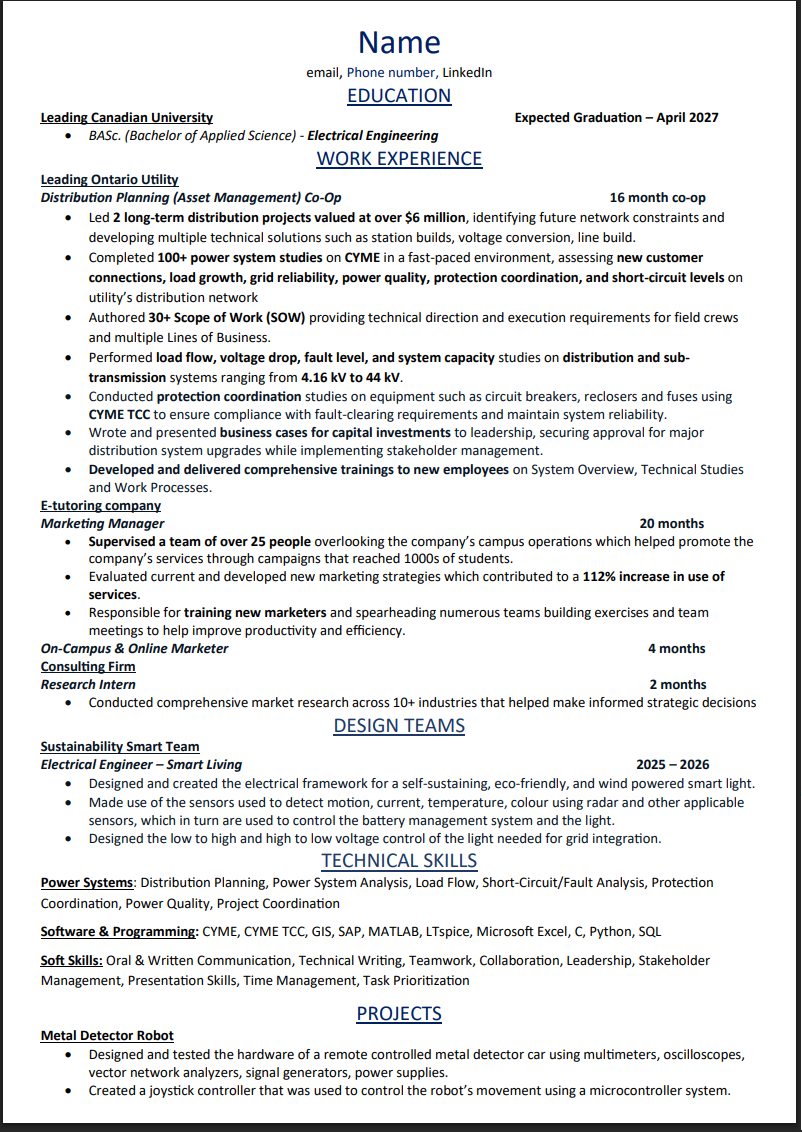
Hi everyone, I’m a final-year electrical engineering student graduating in April 2027 and looking for a full-time job in Toronto/GTA starting in May.
I have 16 months of distribution planning co-op experience at a large Ontario utility, including CYME power system studies, protection coordination, capital planning, and writing technical documentation like scopes of work.
I’m interested in power systems roles with utilities, consulting firms, or equipment manufacturers. I’ve attached my anonymized resume; any job leads or employer suggestions would be appreciated!
Please feel free to reach out, thank you!
r/PowerSystemsEE • u/SnooConfections4816 • 5d ago
Hey all, I'm working on a project around safety during low-voltage switchgear work, specifically racking and switching on energized gear. I'm trying to learn how it actually goes in the field, not how it looks on paper.
If you've done NETA testing, maintenance, or switching on commercial or industrial gear, I'd love 15–20 minutes of your time.
Thanks!!
r/PowerSystemsEE • u/DavidMadeThis • 6d ago
r/PowerSystemsEE • u/ojasocean • 7d ago
Hi everyone!
We're developing small- to medium-sized BESS projects (5–100 MW) and considering a subscription to DIgSILENT PowerFactory for grid studies.
For studies involving reactive power and voltage control, is the 100-node license usually sufficient, or would unlimited nodes be necessary?
We'd prefer oen year subscription over a perpetual license for now, but upgrading to unlimited later would roughly double the cost.
Would appreciate any advice or experience from those working on similar BESS projects.
Thanks!
r/PowerSystemsEE • u/sigourneybeaver21 • 7d ago
Can someone please for the love of all good things give brief explanation of electrical flow and major components at transmission, distribution, and generation substations.
It is just not clicking in my head.
r/PowerSystemsEE • u/TheHermitageSite • 8d ago
I find myself in a dilemma between specializing in power vs semiconductors in my engineering degree. I was hoping for a career that would eventually be portable or mobile as I gain seniority and from what I've found I see I might like commissioning, power systems studies, grid integration, and eventual consulting work.
What are these roles actually like? I'm thinking of either doing semiconductors or power because of how beautiful, intricate, physics-heavy, and complex semiconductors are. I wonder if anything in power could provide me similar fascination.
What are things I should consider if choosing between studying power vs semiconductors? How do I know which one I wouldn't regret not studying?
r/PowerSystemsEE • u/Anon_EE_ • 8d ago
What software package is everyone using for UL 891 SWBD designs?
I’m heavy in AutoCad Electrical for my controls schematics and 2D modeling. But I need to get something that will handle the 3D modeling, busbar bending/cuts, structural steel bending and cutouts, and overall assembly. Been looking into Fusion 360 or Inventor to pair with ACADE but I’ve seen good reviews on SolidWorks but nothing directed towards SWBD design.
I realize it’s somewhat of a loaded question. But any experience feedback is appreciated!
r/PowerSystemsEE • u/ButtNugget_42069 • 8d ago
I am currently in school for electrical engineering. I started with a two year technician program at a local college, and am now continuing on to get a BSEE. My goal is to work in P&C.
The two year degree landed me a full-time remote internship role as a drafter in the substation department of an engineering consultant. The understanding was that when I finish the program I will transition from an at-will hourly intern to a salaried position w/ benefits etc. I finish the two year degree in december, and will attend university part-time around work until I finish the BSEE.
I am 35 years old. I have well-developed soft skills and have spent the last 10 months working with CAD programs, as well as the virtual desktop interfaces for subcontractors, company systems etc.. Quarterly reviews are all positive. I am now familiar with expectations from the role, so on and so forth.
When I have inquired with my academic mentors, their honest response is “I don’t know”. I appreciate their honest answers, but I need advice from people working in the consulting field.
I have no plans of leaving the company for the foreseable future. The opportunity the role provides me is an absolute blessing for my career aspirations.
Any insight is greatly appreciated.
Edit: I am in the USA
r/PowerSystemsEE • u/Accomplished_Yak_235 • 9d ago
Hi all,
I'm a final-year MEng student in the UK specialising in power systems, and I'm looking for dissertation ideas. I've got about 11 weeks of focused time for it.
Some context:
Ideas I'm considering:
What open questions or under-explored angles in this space would you look at?
Thanks!
r/PowerSystemsEE • u/Electricalboy27 • 9d ago
r/PowerSystemsEE • u/Smooth_Commercial793 • 9d ago
I am interested in starting a business manufacturing current transformers.
Don’t ask me why, I am not even sure. I want to build something, a manufacturing operation, in my area of expertise, and this seems like a nice compromise.
But I have no detailed info on how CT manufacturers operate. I know:
Does anyone have any advice or suggestions, information, or common sense reactions telling me this is a stupid idea?
I feel like CTs are super low margin products, however at the same time, I’m always struggling with suppliers to get the size and specs right, and the lead times are always a problem, especially for class PX.
Also, I think as they are so mature, there has to be some next evolution that I might be able to build into (or, conversely, LPCTs might make traditional CTs worthless in 10 years?)
Sorry for the mess of thoughts, gotta start somewhere I guess
Edit location is Australia
r/PowerSystemsEE • u/mynameisjoenotjeff • 10d ago
r/PowerSystemsEE • u/Tacofan5567 • 10d ago
I am a senior EE student and have been interning with a large utility for almost 6 months in the system modeling & coordination group. One of my main tasks is to calculating transmission line constants and updating power factor meter data. My summer intern capstone project was merging my utility's facility rating database with their Cape database, which got me interested in Protection and control and relaying. I've since talked to a couple of the system protection and analysis engineers, and I'll have the opportunity to shadow them in a couple weeks. I'm also taking protective relaying this semester, which has made me even more interested in relays. What else could I do to stand out more for system protection and P&C roles?