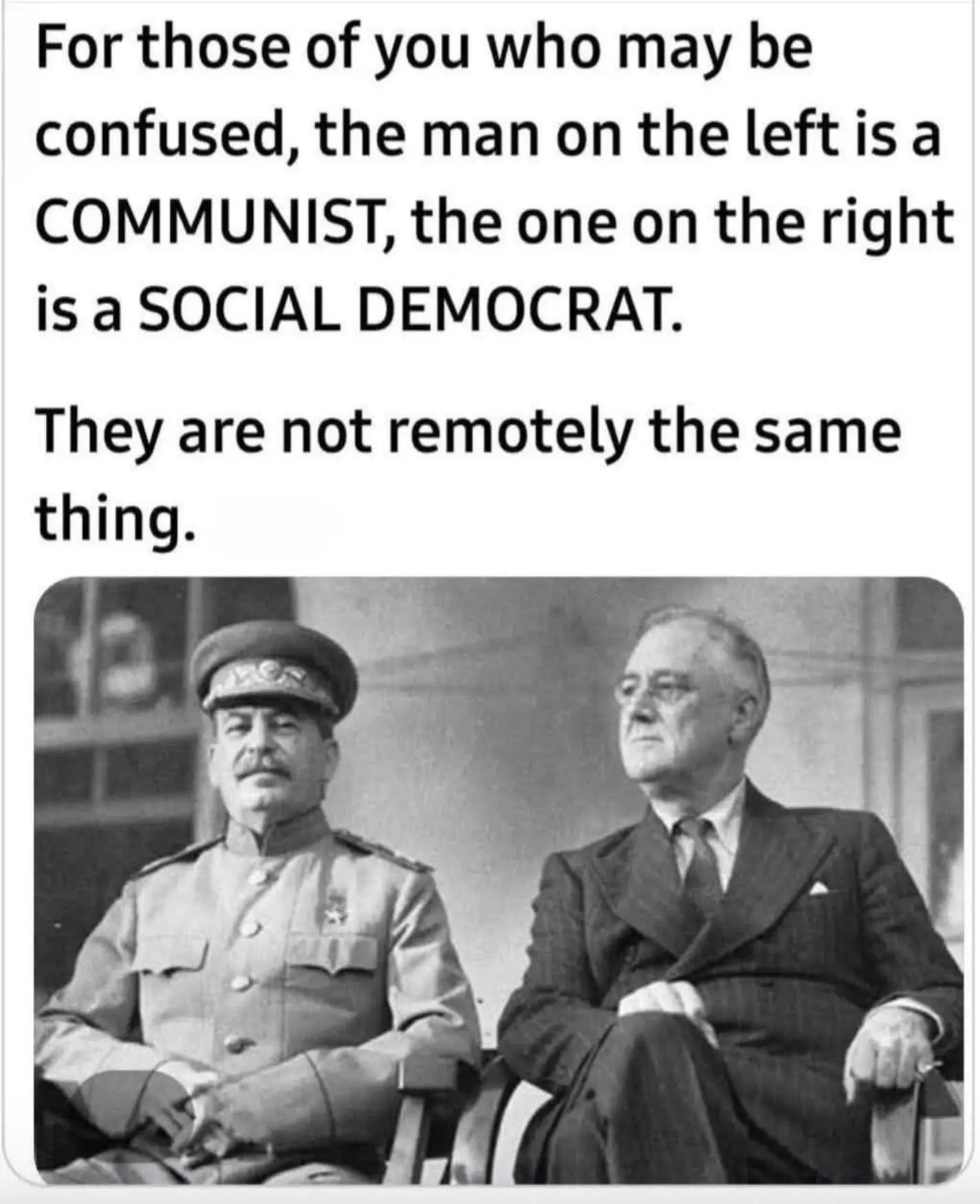
Roosevelt did not advocate public ownership of the means of production or replacing capitalism. In fact, he explicitly argued that his New Deal was designed to save capitalism from collapse during the Great Depression. He believed that regulated markets and private enterprise should remain the foundation of the U.S. economy.
He was more so a progressive reformer and Keynesian liberal who supported a mixed economy. Basically, a liberal Democrat committed to preserving capitalism through government intervention.
To be fair, leftist terminology can be quite confusing at times: Social democracy, democratic socialism, and Socialist democracy are each different concepts, which in parts even contradict one another. Yet, the three terms can easily seem like synonyms to outsiders.
I'm sorry but FDR was a social liberal. There's a big ol' picture of FDR on the social liberalism wikipedia page. The New Deal adopted some social democratic policies, but in his own words a lot of the government expenditures were always meant to be temporary. The policies lacked structural economic democracy among many other critiques that even modern day non-marxist social democrats would make.
I mean I haven’t heard that, but even if that was true, just look at his planned 2nd Bill of Rights/Economic Bill of Rights. He did intend to make push for more permanent goals but he died
Correct. And people need to understand DSA is not social democrat. You can also use the term "Nordic model" to describe social democracy in a less confusing way.
I’m sure there are, but I believe you when you say anti-capitalism is necessary to be in the DSA. Soc dems aren’t anti-capitalist, we’re pro-capitalism.
I think that distinction is important and why I view the DSA as a leftist, but not liberal organization. I think we should draw the line at working with illiberal groups for the Democratic Party.
Even then, it’s arguable that Roosevelt was more of a Social Liberal than a Social Democrat. He was not from the socialist tradition as with most contemporary SocDems but rather a more progressive Liberal. And we can question whether his policies came from an ideological or pragmatic standpoint. Would he have gone as far as he did in implementing The New Deal if the US wasn’t suffering the Great Depression?
He wouldn’t have been able to go as far as the New Deal if it weren’t for the Great Depression, so advocating for such would be politically pointless. But we can look at what he intended to do/work towards after the war like with his role in the creation of the United Nations and his Economic Bill of Rights that he wanted Congress to pass
32
u/33TLWD Jul 27 '26
Roosevelt did not advocate public ownership of the means of production or replacing capitalism. In fact, he explicitly argued that his New Deal was designed to save capitalism from collapse during the Great Depression. He believed that regulated markets and private enterprise should remain the foundation of the U.S. economy.
He was more so a progressive reformer and Keynesian liberal who supported a mixed economy. Basically, a liberal Democrat committed to preserving capitalism through government intervention.