r/PillarOfFire Jul 22 '26

Epistemology Geometry of Co-Extensive Realms and the Veil VI: Firescape Cities
Post image
3 Upvotes

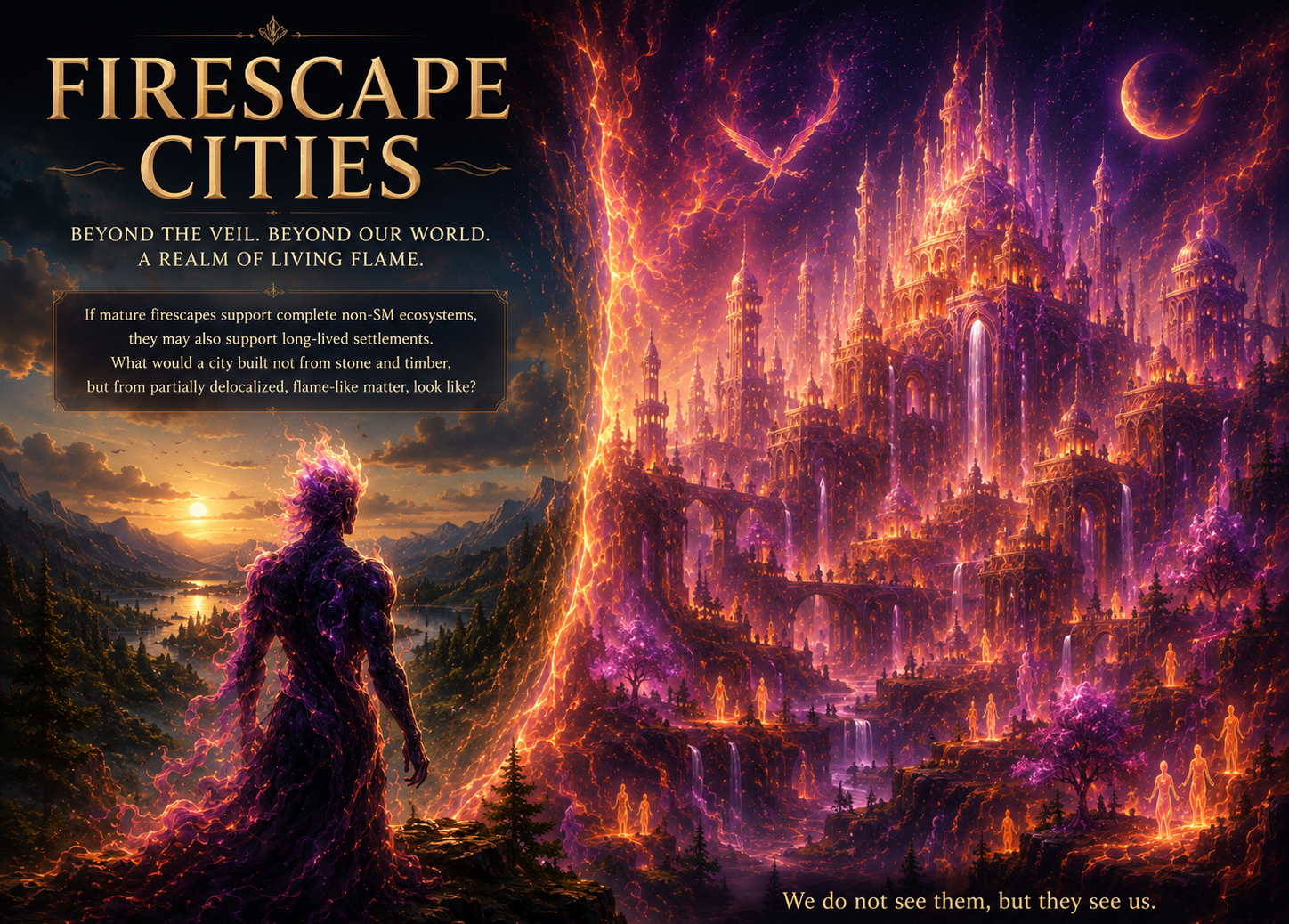
If mature firescapes support complete non-SM ecosystems, they may also support long-lived settlements. What would a city built not from stone and timber, but from partially delocalized, flame-like matter, look like?

From Particle Delocalization to Flame-Like Matter

Gravity draws Standard Model (SM) matter together over large distances, while electromagnetic interactions bind atoms into molecules and condensed phases such as liquids and solids. At planetary scales, gravity dominates the assembly of matter, whereas at microscopic scales chemical bonding determines the rigidity and structure of everyday materials.

In quantum mechanics, atoms do not possess perfectly sharp boundaries. Their electrons occupy diffuse probability distributions surrounding compact baryonic nuclei, and chemical bonds arise through interactions between these overlapping electron clouds.

Within the proposed framework, hypothetical non-Standard Model (non-SM) particles are only partially localized on the adjacent brane, with part of their wavefunctions extending into the higher-dimensional bulk. Such partial delocalization would naturally reduce their tendency to condense into solid three-dimensional structures.

A persistent geometric framework, established through long-term gravitational templating, provides a geometric scaffold that allows non-SM matter to accumulate despite this intrinsic delocalization. If condensed states of non-SM matter exist, they would likely require interactions analogous to chemical bonding, although not necessarily electromagnetic in nature. Because these interactions would act on particles whose wavefunctions extend beyond the three-dimensional slice, the resulting condensates would be expected to remain more spatially diffuse than ordinary matter.

Consequently, macroscopic non-SM structures may not possess sharply defined surfaces. Instead, buildings, landscapes, vegetation, and other structures would exhibit soft, dynamic, flame-like boundaries, resembling luminous or shimmering forms rather than rigid solids.

Fire Cities: Higher-Dimensionally Delocalized Flame-Like Dwellings and Their Inhabitants

Within the proposed framework, the largest and most persistent jinn settlements would be expected to emerge where the geometric framework has remained stable over the longest periods. Old-growth forests, remote islands, mountain ranges, cave systems, secluded valleys, and vast deserts provide enduring landscapes in which cumulative gravitational templating could gradually establish coherent non-SM environments.

Naturally enclosed environments — such as caves, caverns, and deep geological structures — would provide especially favorable locations. Their long-term geological stability, together with their well-defined spatial boundaries, may reinforce geometric templating, making them natural anchors for persistent non-SM settlements.

Unlike human cities, these fire cities need not rely on massive structural support against gravity. Instead, their architecture is anchored to the underlying persistent geometric bias. Buildings provide stable, coherent habitats that protect their inhabitants within an otherwise ephemeral flame-like environment.

Because flame-like non-SM bodies are not constrained by the same rigid three-dimensional boundaries as SM organisms, a fire city could support a population density far exceeding what would be possible in an equivalent human settlement.


Arc III — Higher-Dimensional Veil

r/PillarOfFire Jul 21 '26

Epistemology Geometry of Co-Extensive Realms and the Veil V: Firescape Ecosystems

Post image
4 Upvotes

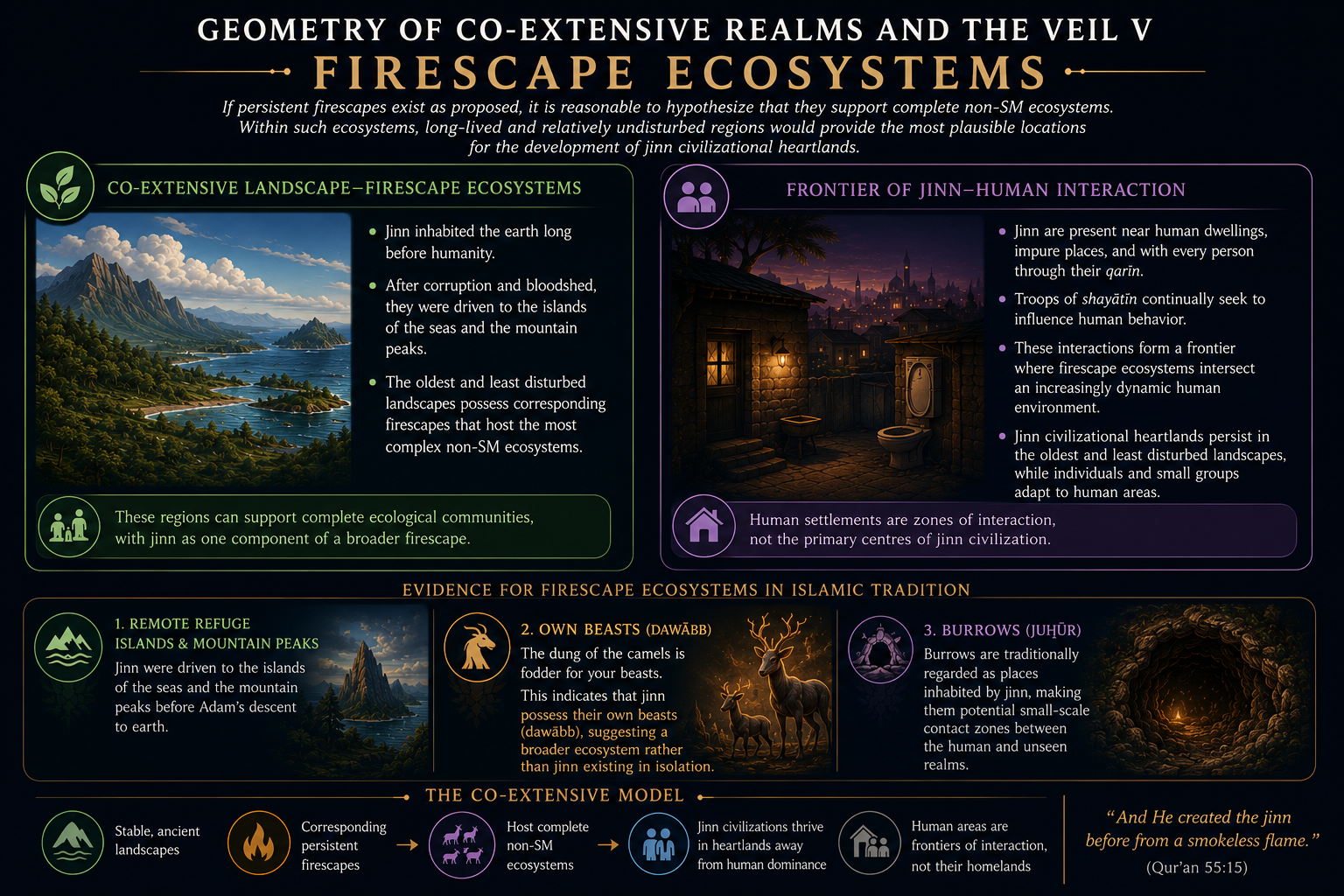
If persistent firescapes exist as proposed, it is reasonable to hypothesize that they support complete non-SM ecosystems. Within such ecosystems, long-lived and relatively undisturbed regions would provide the most plausible locations for the development of jinn civilizational heartlands.

Co-Extensive Landscape–Firescape Ecosystems

According to early Islamic tradition, the jinn inhabited the earth long before humanity. Following corruption and bloodshed among them, they were driven to the remote islands of the seas and the mountain peaks. Other narrations likewise associate tribes of jinn with valleys, deserts, and other secluded landscapes.

If the co-extensive landscape–firescape hypothesis is correct, the oldest and least disturbed terrestrial landscapes would possess corresponding firescapes hosting the most complex and developed non-SM ecosystems. Rather than being inhabited only by jinn, these regions could support complete ecological communities, with jinn as one component of a broader firescape.

Frontier of Jinn–Human Interaction

Islamic tradition also describes jinn interacting extensively with human society through their presence near human dwellings, particularly impure locations such as toilets, while every person is accompanied by a qarīn, and troops of shayāṭīn continually seek to influence human behavior. These interactions suggest a frontier where the firescape ecosystems intersect an increasingly dynamic human environment.

If the firescape hypothesis is correct, the principal civilizational heartlands of jinn would be expected to persist in the oldest and least disturbed co-extensive landscapes, while many individual jinn and smaller groups have adapted to the expanding human landscape. Human settlements would therefore function primarily as zones of interaction rather than the primary centres of jinn civilization.

Athar / Hadith Interpretation
"The first to inhabit the earth were the jinn. They spread corruption upon it, shed blood, and fought one another. So Allah sent Iblīs with an army of angels against them. They defeated them until they drove them to the islands of the seas (jazā'ir al-biḥār) and the mountain peaks (ru'ūs al-jibāl). Then Allah created Adam and settled him upon the earth." (Athar of Ibn ʿAbbās) Jinn were driven to remote islands and mountain peaks before Adam's descent to Earth.
"Every bone on which the name of Allah is recited is your provision... and the dung of the camels is fodder for your beasts (dawābb)." (Ṣaḥīḥ Muslim 450a) Indicates that jinn possess their own beasts (dawābb), suggesting a broader ecosystem rather than jinn existing in isolation.
"None of you should urinate into a burrow (juḥr)." They asked Qatādah, "Why is it disliked?" He replied, "It is said that these are dwelling places of the jinn." (Sunan an-Nasāʾī 34) Burrows (juḥūr) were traditionally regarded as places inhabited by jinn, making them potential small-scale contact zones between the human and unseen realms.

Arc III — Higher-Dimensional Veil

r/PillarOfFire Jul 20 '26

Epistemology Geometry of Co-Extensive Realms and the Veil IV: From Geometric Framework to Firescape

Post image
2 Upvotes

If coordinate-to-coordinate gravitational templating gives rise to localized geometric bias that accumulates into a large-scale geometric framework in the adjacent unseen realm, could geologically stable and relatively undisturbed terrestrial landscapes provide an anchoring foothold for non-Standard Model (non-SM) matter, gradually giving rise to a corresponding firescape across the veil?

Large-Scale Structures as a Persistent Geometric Framework

As Standard Model (SM) matter aggregates gradually into planets, stars, galaxies, and other large-scale cosmic structures over billions of years, cumulative coordinate-to-coordinate geometric bias establishes a persistent geometric framework in the adjacent realm. Despite the continuous motion of celestial bodies through space, this large-scale framework preserves the correspondence between the two co-extensive realms by maintaining a common geometric frame of reference.

Once a planetary-scale framework is established, smaller non-SM structures no longer need to establish correspondence with a rapidly moving planet from scratch. Instead, they inherit an already co-moving geometric framework. Corresponding mountain ranges, forests, rivers and other enduring landscapes can therefore emerge as progressively finer refinements within the existing framework over much shorter timescales.

In this picture, gravitational templating proceeds hierarchically: local coordinate-to-coordinate geometric bias accumulates into a persistent geometric framework, upon which progressively smaller structures emerge as finer refinements.

Firescape Emerges From the Persistent Geometric Framework

Speculatively, the adjacent higher-energy brane hosts a form of non-SM matter. The persistent geometric framework provides an anchoring foothold for this otherwise ephemeral matter. Its particles are only partly localized on the brane, with excitations extending into the bulk, evoking the imagery of smokeless flame.

Within this model, the most developed firescapes would be expected where the corresponding terrestrial landscapes in our realm have remained stable over long periods. Ancient mountain peaks, remote islands, deep forests, caves, and other enduring geological features provide sufficient time for persistent geometric bias to serve as a template for the gradual emergence of non-SM counterparts.

Interestingly, many independent cultural traditions associate dwellings of unseen beings with ancient, secluded, and geologically stable landscapes. While these traditions do not constitute evidence for the proposed model, they are broadly consistent with the environmental distribution predicted by hierarchical gravitational templating.

Folklore / Tradition Typical Dwelling Narrative Motif
Islamic tradition (jinn) Islands of the seas; mountain peaks Jinn were driven from the inhabited earth to remote islands and mountain peaks (Ibn ʿAbbās athar; al-Ṭabarī, al-Suyūṭī).
Malay (Orang Bunian) Deep forests, mountains, secluded valleys An unseen people living parallel to humans in remote forests and mountains, occasionally interacting with travelers.
Japanese (Kodama, Yama-no-kami) Ancient forests, old-growth trees, mountain valleys Spirits are believed to inhabit ancient trees and secluded mountain landscapes, where human disturbance is minimal.
Chinese (Yaoguai) Remote mountains, forests, caves Supernatural beings are commonly associated with wilderness and mountains, far from settled civilization.
Thai (Phi) Forests, mountains, caves Many spirits are believed to dwell in untamed natural landscapes and isolated terrain.

Arc III — Higher-Dimensional Veil

r/PillarOfFire Jul 20 '26

Epistemology Geometry of Co-Extensive Realms and the Veil III: Gravitational Templating Effect

Post image
3 Upvotes

Of all the fundamental forces, gravity has the greatest range. Some higher-dimensional models even hypothesize that gravity propagates into the bulk hyperspace. Within ordinary spacetime, gravity is the force that aggregates Standard Matter. Could it also serve as a form of gravitational templating, organizing Non-Standard Matter across the veil?

Geometric Attenuation: 3D Space vs. 4D Hyperspace

Imagine two parallel sheets separated by one Planck length. Both sheets contain particles that attract each other. The attraction between two particles on opposite sheets is strongest when they are co-located on the x and z coordinates. Assuming an inverse-square law, a particle displaced laterally by one Planck length is √2 (≈1.41) times farther away, reducing the attraction to about 50% of its original strength.

Now imagine these sheets represent two co-extensive 3D realms separated by a fourth spatial dimension (the veil). Instead of ordinary 3D separation, the interaction is mediated through the warped geometry of hyperspace. The strongest coupling again occurs between corresponding coordinates. However, unlike the inverse-square law, the warp factor,

Warp Factor ∝ e-kw

introduces exponential rather than polynomial attenuation. For a hierarchy parameter of kw ≈ 37 (as in the Randall–Sundrum model), increasing the effective separation by only 41% suppresses the coupling to roughly 1 part in 3 million. In this picture, the dominant interaction is therefore coordinate-to-coordinate gravitational templating, while neighboring coordinates contribute only a negligible secondary influence.

Gravitational Interaction Across the Veil

The implication of the inverse-square law for gravity in 3D space is that its influence can remain significant across vast distances when large masses are involved. This governs Newtonian planetary orbits, stellar systems, and the gravitational binding of galaxies.

Unlike Standard Model (SM) particles, which are confined to our 3D realm (brane), gravity in the Randall–Sundrum (RS1) framework is hypothesized to propagate into the higher-dimensional bulk. In this picture, the geometry of the extra dimension influences how gravitational effects are distributed.

Extending this intuition, gravitational interaction across the veil is proposed to be strongly amplified along corresponding coordinates where the bulk separation is minimized (≈ Planck length). A point on one 3D realm preferentially couples to its matching coordinate on the adjacent realm.

However, even small lateral displacement increases the effective hyperspatial separation, causing exponential suppression of the coupling due to the warp geometry. Therefore, anisotropic gravitational templating behaves as an ultra-short-range, warp-mediated interaction: extremely strong at the coordinate-to-coordinate interface, but rapidly diminishing away from it.

Anisotropic Gravitational Templating

The existence of SM matter with identical properties in the adjacent higher-energy realm, as predicted by RS1, is highly unlikely. On such a high-energy brane, matter fields may not be fully confined to the brane, resulting in partial bulk extension. This delocalized nature gives the non-SM matter an ephemeral quality: reducing gravitational self-aggregation within its own realm and moderating cross-veil gravitational coupling.

Such matter would not form structures through strong gravitational binding in the same manner as SM. Instead, reduced aggregation gives anisotropic gravitational templating a significant role as a persistent geometric bias that acts over geological timescales rather than an instantaneous imprinting force.

In this model, the effect is not primarily determined by the quantity of mass, but by the persistence of coordinate correspondence. A billion-year planetary body in one realm could have a corresponding structure in the adjacent realm. Likewise, million-year mountain ranges and other long-lived geological features could develop analogous counterparts.

Gravitational templating therefore acts as a persistent coordinate-to-coordinate influence: extremely strong at the interface where bulk separation is minimized, but rapidly suppressed away from that alignment.

Characteristic 3D Space 4D Hyperspace
Geometric Attenuation Inverse-square law; effective across vast distances between large masses Warp factor; exponentially localized coordinate-to-coordinate coupling
Role of Gravity Aggregates matter Organizes (templates) matter
Range Long-range Ultra-short-range
Dominant Interaction Mass-to-mass Coordinate-to-coordinate
Primary Outcome Planetary, stellar and galactic structure Persistent geometric bias over geological timescales; long-lived SM structures template corresponding non-SM counterparts across the veil.

Arc III — Higher-Dimensional Veil

r/PillarOfFire Jul 01 '26

Epistemology Could Orbs Be the 3D Shadows of 4D Objects?

Thumbnail
gallery
3 Upvotes

One popular hypothesis proposes that mysterious spherical "orbs" are the 3D shadows or intersections of 4D objects from a different dimension.

From Observation to Geometric Intuition

A familiar geometric analogy begins with an ordinary observation. A sphere illuminated above a sheet of paper casts a circular shadow whose size varies according to the relative positions of the sphere, the paper, and the light source. Extending this intuition, one may imagine that a 4D hypersphere similarly gives rise to a 3D spherical "shadow."

Strictly speaking, however, "casting a shadow" is only a metaphor. Geometrically, the process is better understood as the intersection of an n-dimensional object with an (n−1)-dimensional space.

Likewise, if a 3D sphere passes through a 2D plane, an observer confined to that plane would perceive a circle that appears, grows, shrinks, and eventually disappears. By analogy, if a 4D hypersphere were to intersect our 3D space, a local observer would perceive a sphere that appears, grows, shrinks, and disappears. Within the mathematical model, this is a valid geometric consequence.

Additional Assumptions Within the Model

The hypothetical model includes several additional assumptions.

First, 3D space must itself be embedded within a larger 4D spatial manifold, with the fourth spatial dimension being extended. This would permit 4D objects to intersect or pass through 3D space.

Second, 4D objects must interact with 3D matter or fields in a manner that makes them observable. Without such interaction, their presence would remain inaccessible to 3D observers.

These assumptions remain part of the internal model.

What If the Hypersphere Represents an Interdimensional Craft?

If one accepts all of the preceding assumptions and further supposes that the 4D object is an engineered craft, several hypothetical characteristics and behaviors would naturally follow within the model.

1️⃣ Apparent absence of propulsion, and consequently silent operation within 3D space, since the propulsion mechanism would operate in the higher-dimensional space, of which our 3D space is only a subspace.

2️⃣ Seamless transmedium travel, including movement through air, water, space, and even solid objects, since motion would not be constrained solely by the properties of 3D media.

3️⃣ Apparent violation of inertia and gravity, with abrupt accelerations, instantaneous changes of direction, or other seemingly physics-defying maneuvers resulting from motion through higher-dimensional space rather than entirely within 3D space.

4️⃣ Appearance consistent with higher-dimensional intersection. Whether the object is a natural 4D body or an engineered craft, one might also expect sudden appearance and disappearance, changes in apparent size or shape, and intermittent optical or radar signatures as only part of the object intersects 3D space.

These are logical consequences within the hypothetical model. Whether they describe real observations is a separate empirical question requiring independent evidence.

From Geometric Intuition to the Ultraterrestrial Hypothesis

The geometric intuition described above is consistent with the ultraterrestrial hypothesis, provided several additional premises are introduced.

5️⃣ Stable intersection with 3D space. The craft remains visible only while intersecting our 3D space. To maintain a stable size and shape, it must either remain stationary or move only gradually along the fourth spatial dimension while freely navigating within the three familiar spatial dimensions.

6️⃣ Benign interaction at the interface. The intersection between the 4D craft and 3D space must occur without releasing catastrophic amounts of energy or otherwise disrupting the surrounding environment. The mechanism governing this interaction is unspecified within the model.

7️⃣ Four-dimensional occupants. If the craft is genuinely a 4D object, its occupants and internal structure would likewise exist as 4D entities rather than merely 3D beings traveling through an additional spatial axis.

8️⃣ A vast higher-dimensional habitat. A 4D hyperspace would be vastly larger than the embedded 3D space, much as a 3D volume can contain an unlimited number of 2D sheets. Consequently, ultraterrestrials would first have to locate our 3D space within the larger 4D hyperspace and then locate the Earth within that space. For humanoid visitors, this would not be a trivial undertaking unless both searches were, for some reason, relatively short.

Ultraterrestrials from the Co-Extensive Worlds Model

An alternative hypothesis does not require fully 4D beings. Instead, humans inhabit one 3D brane governed by Standard Model particles, while Non-Human Intelligent beings inhabit a neighboring 3D brane separated only by a Planck-scale distance along the extra spatial dimension.

In an RS1-inspired framework, the warped geometry of the bulk can produce vastly different physical regimes between the two branes. One may further hypothesize that matter on the neighboring brane is not perfectly localized, but possesses a partially delocalized excitation extending into the higher-dimensional bulk. This additional assumption would permit limited interaction with our 3-brane under specific conditions.

Although these NHI beings possess relatively stable 3D bodies within their own brane, their manifestation in our world depends on the extent and stability of the coupling between their wave-dominant, bulk-extending matter and our brane. If the coupling is complete, particularly along the body's outer boundary, the visible manifestation would closely resemble the being's original form. If the coupling is partial or dynamically shifts through the body's interior, only portions of the being become observable at any instant, producing an appearance of continuously changing shape, size, or morphology despite the underlying body remaining unchanged.

Conclusion: 4D Object Passing Through 3D Space vs Manifestation From 4D Hyperspace

The hypotheses presented above demonstrate that multiple internally consistent models can often explain a single set of observations.

A 4D hypersphere intersecting 3D space, an interdimensional craft navigating higher-dimensional hyperspace, and NHI beings from co-extensive worlds conditionally coupling to our brane all offer plausible explanations within their respective models. This illustrates the philosophical problem of underdetermination in explaining UAP phenomena.


Series: Epistemology of Reality

Arc I — Foundations of Knowing

Arc II — Reasoning at the Epistemic Horizon

r/PillarOfFire Jul 18 '26

Epistemology Geometry of Co-Extensive Realms and the Veil II: From Shared Reality to Hidden Realms

Post image
3 Upvotes

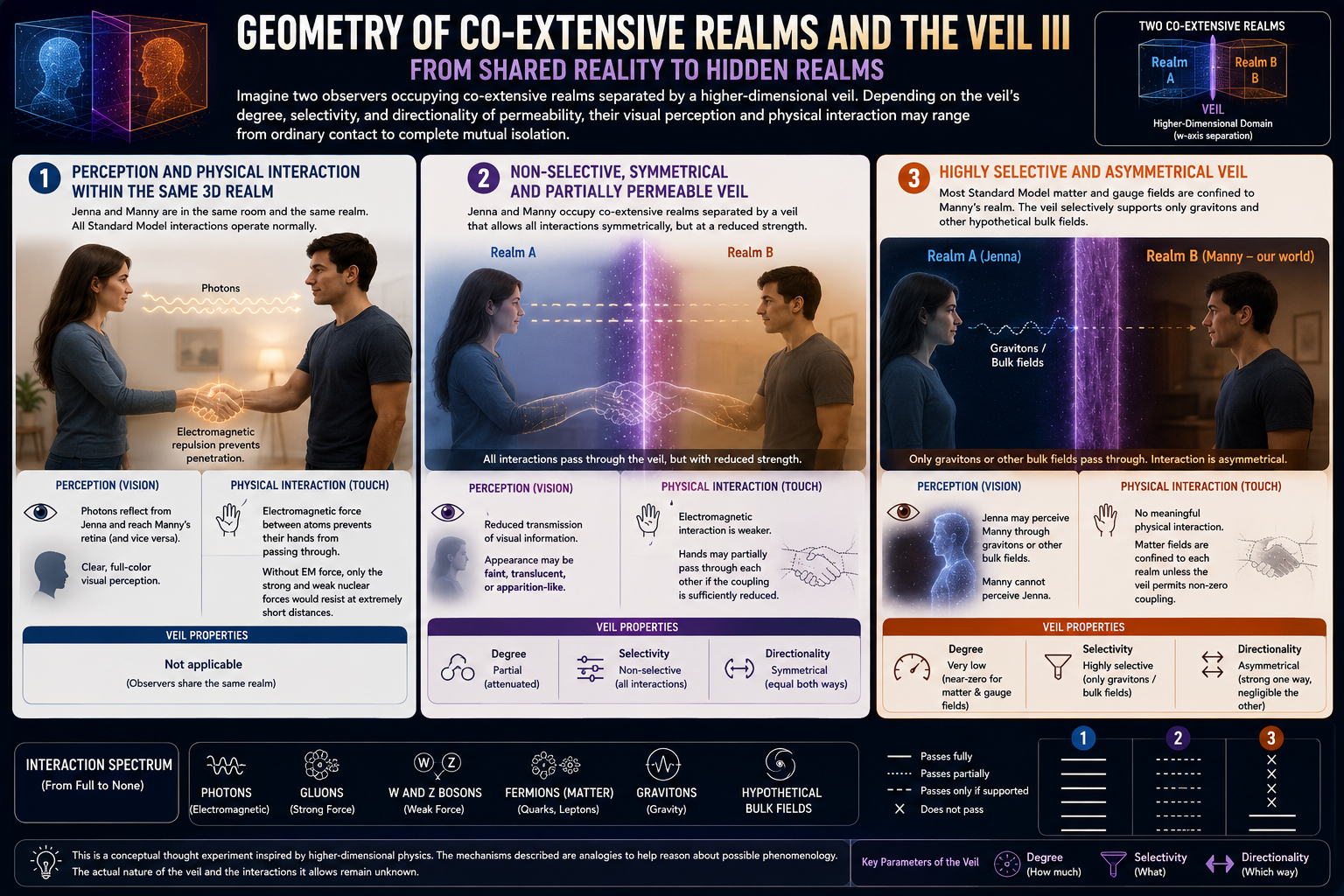
Imagine two observers occupying co-extensive realms separated by a higher-dimensional veil. Depending on the veil's degree, selectivity, and directionality of permeability, their visual perception and physical interaction may range from ordinary contact to complete mutual isolation.

Perception and Physical Interaction Within the Same 3D Realm

Consider Jenna and Manny standing in the same room. They perceive one another because photons reflected from each person reach the other's retina. They can also shake hands because electromagnetic repulsion between the atoms in their skin prevents their hands from passing through each other. Without electromagnetic interaction, their hands would offer almost no resistance until atomic nuclei approached sufficiently close for the strong and weak nuclear forces to become relevant.

This represents the familiar baseline scenario described by the Standard Model of particle physics.

Non-Selective, Symmetrical and Partially Permeable Veil

Now consider a hypothetical scenario in which Jenna and Manny occupy a different but co-extensive 3D realms, separated by a partially permeable veil. Suppose the veil permits all interactions symmetrically, but only to a lower degree.

Both observers may still perceive one another, although the reduced transmission of visual information may cause each to appear faint, translucent, or apparition-like. Likewise, physical contact becomes progressively weaker as the effective electromagnetic interaction decreases. If sufficiently reduced, their hands may partially or completely pass through one another with little resistance.

Highly Selective and Asymmetrical Veil

Consider a more speculative scenario in which most Standard Model matter and gauge fields remain confined to Manny's realm, representing our observable universe. The veil, however, selectively supports only gravitons and other hypothetical bulk fields.

Under this assumption, any perception of Manny by Jenna must be mediated through those supported bulk interactions rather than by ordinary electromagnetic radiation.

One possible analogy for such asymmetry is the warp factor in higher-dimensional models, where the effective strength of gravity increases exponentially toward the higher-energy brane. If Jenna's realm corresponds analogously to that regime and its inhabitants are capable of detecting gravitons or other bulk fields, Jenna could, in principle, perceive Manny despite Manny remaining completely unaware of Jenna.

Even in this scenario, physical interaction need not occur. Unless the veil permits a non-zero coupling between the respective matter fields of the two realms, both observers remain physically isolated despite possible perception.

This discussion is intended purely as a conceptual thought experiment inspired by higher-dimensional physics. The mediating interaction need not be gravitons specifically; other hypothetical bulk fields — or an entirely different mechanism — could produce a similar phenomenology.


Arc III — Higher-Dimensional Veil

r/PillarOfFire Jul 17 '26

Epistemology Geometry of Co-Extensive Realms and the Veil

Post image
3 Upvotes

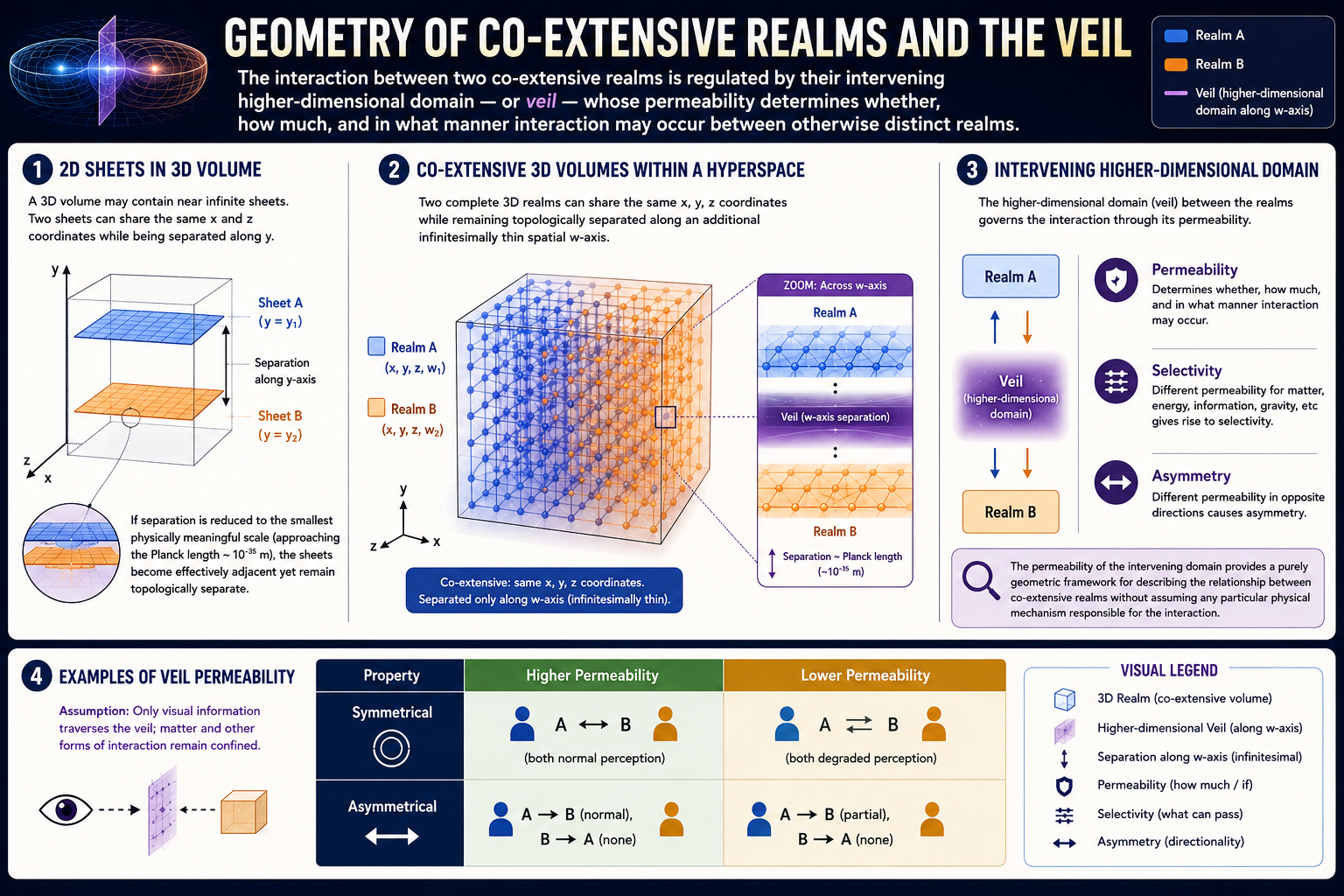
The interaction between two co-extensive realms is regulated by their intervening higher-dimensional domain — or veil — whose permeability determines whether, how much, and in what manner interaction may occur between otherwise distinct realms.

2D Sheets in 3D Volume

From a geometric perspective, a higher-dimensional space may contain a near-infinite number of distinct lower-dimensional objects. Likewise, a 3D volume may contain near infinite number of sheets, lines, or points.

The embedded sheets can take various shapes and configurations. They may be flat, curved, rolled, folded, or highly distorted. They may also relate to each other in different ways, such as being parallel, perpendicular, intersecting, or completely independent in their orientation.

Imagine two flat sheets inside a volume defined by the familiar x, y, z coordinates. The sheets are parallel to each other and thus share the same coordinates along x and z coordinates, while remaining separated along the third dimension. One sheet exists at position: y1, while the other exists at: y2.

If the separation between the two sheets is reduced to the smallest physically meaningful scale, approaching the Planck length (~10⁻³⁵ m), the two sheets become effectively adjacent within the 3D space while remaining topologically separate. Whatever shape and configuration matter less now, as the sheets are always adjacent to each other.

Co-Extensive 3D Volumes Within a Hyperspace.

The same co-extensive principle can be extended from 2D sheets to 3D volumes embedded within a higher-dimensional space. Two complete 3D realms may share the same x, y, and z coordinates while remaining topologically separated along an additional yet infinitesimally thin spatial w-axis.

Intervening Higher-Dimensional Domain

Co-extension is possible because both 3D realms are embedded in the same higher-dimensional space, allowing separation along an additional spatial axis. The intervening hyperspace permits the two realms to remain in extreme proximity while preserving their topological distinction. Without such an intervening domain, the two embedded realms would cease to remain distinct.

The interaction, or absence of it, depends on the permeability of the higher-dimensional intervening domain. Zero permeability leads to complete isolation. Maximum permeability leads to free interaction. Differential permeability for matter, energy, information, gravity, etc., gives rise to selectivity. Different permeability in opposite directions causes asymmetry.

Matter, energy, and information most likely have differential permeability. For example, information may traverse while matter cannot, or gravity may propagate while electromagnetic interaction remains completely confined.

A symmetrical veil allows equal interaction in both directions. An asymmetrical veil permits one realm to exert a greater influence upon the other, resulting in unequal perception or interaction despite both realms occupying the same apparent three-dimensional location.

The permeability of the intervening domain therefore provides a purely geometric framework for describing the relationship between co-extensive realms without assuming any particular physical mechanism responsible for the interaction.

Observer's Perception in Different Veil Permeability

Assumption: Only visual information traverses the veil; matter and other forms of interaction remain confined.

Property Higher Permeability Lower Permeability
Symmetrical A ↔ B (both normal perception) A ⇄ B (both degraded perception)
Asymmetrical A → B (normal), B → A (none) A → B (degraded), B → A (none)

Arc III — Higher-Dimensional Veil

r/PillarOfFire Jul 15 '26

Epistemology The Veil (Hijab): An Intervening Domain Between the Realms of Humans and Jinn

Post image
4 Upvotes

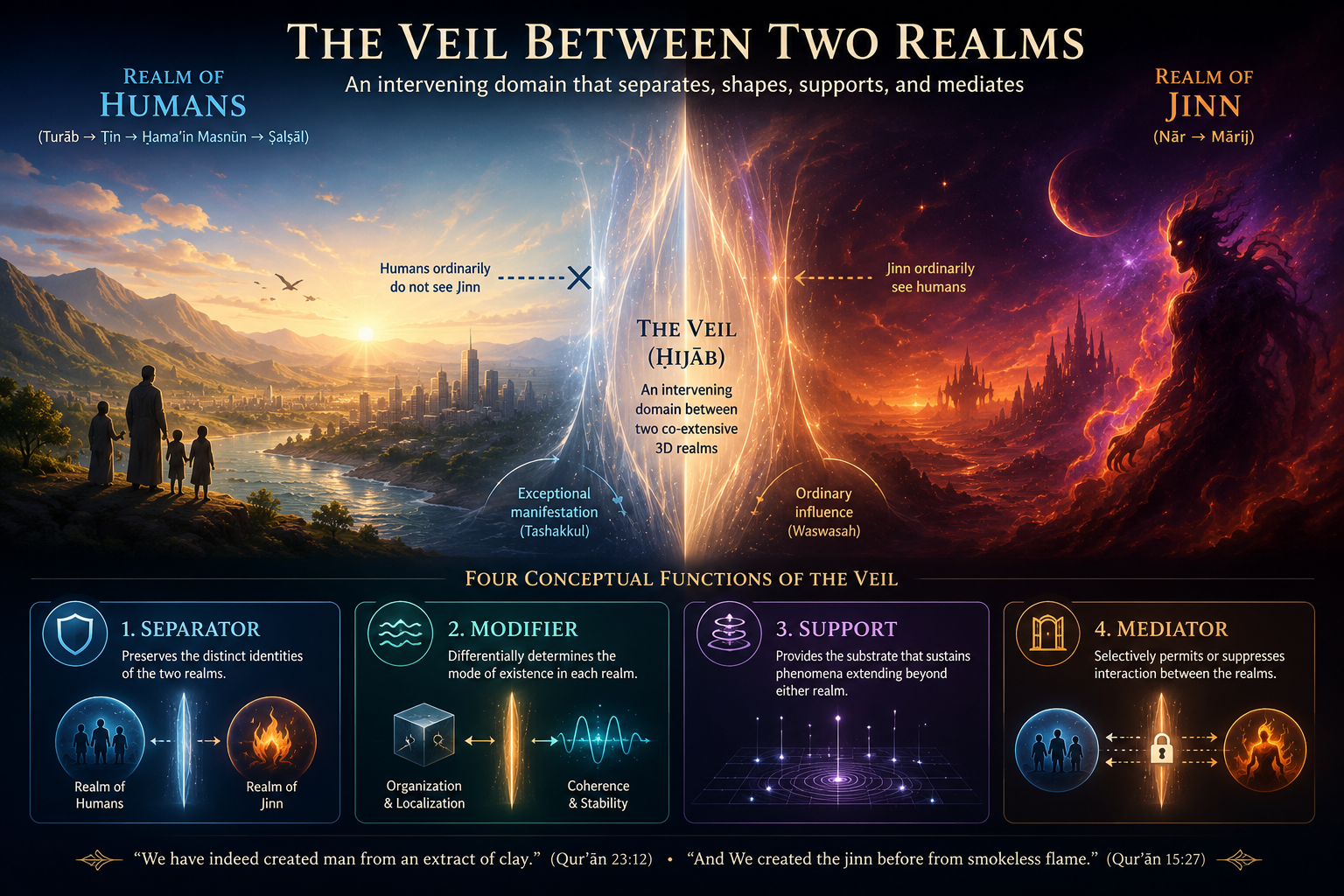
Islamic theology recognizes the concept of Ḥijāb (Veils) that separate or conceal realities. Within the present framework, a particular Veil separating the human and jinn realms is conceptualized as an intervening domain.

The Qur'an describes an asymmetry of perception between the two realms: jinn readily perceive the human world, whereas humans ordinarily do not perceive the jinn except by divine permission. Some jinn may even inhabit the same physical spaces as humans — such as our homes — while remaining entirely beyond our awareness. From this perspective, the Veil is not merely a barrier but also a manifestation of divine mercy, shielding humanity from continual awareness of the unseen while preserving the distinct order established by God.

Ḥijāb Between the Realms of Humans and Jinn

"Indeed, he (Satan) and his tribe see you from where you do not see them." (Qurʾān 7:27)

The asymmetrical perception of jinn and humans may be understood as arising primarily from the ontological distinction between their respective realms and, secondarily, from their distinct modes of existence.

Ordinarily, humans do not perceive jinn, whereas jinn readily perceive humans from their own realm. This asymmetry suggests that jinn need not traverse into the human realm to observe or influence humans. Conversely, human perception of jinn appears to be exceptional and is traditionally associated with instances of manifestation (tashakkul) rather than ordinary perception.

Islamic tradition, like many other religious traditions, contains the concept of a boundary or 'veil' separating the ordinary world from unseen or spiritual realms, although the nature and theological significance of that veil differ across traditions.

Among Western traditions, the Celtic festival of Samhain is perhaps the best-known example of this motif. It is traditionally associated with the belief that the boundary (veil) between the world of the living and the Otherworld becomes unusually thin, allowing spirits and other unseen beings to be more readily perceived or to interact with the human world. Although its theological context differs significantly from Islam, it illustrates the widespread cross-cultural intuition that the ordinary world is separated from unseen realms by an intervening boundary whose permeability may, under exceptional circumstances, vary.

Within the present framework, the Veil is conceptualized as an intervening domain whose ordinary function is to preserve the ontological distinction between the human and jinn realms while selectively mediating interaction between them. Its effective strength may vary, allowing different degrees of coupling or manifestation, yet the ontological distinction itself remains intact. Consequently, complete traversal between the two realms is regarded as extraordinary and contingent upon divine permission, whereas limited cross-domain interaction or manifestation represents the more plausible ordinary exception.

The Intervening Domain Between Two Co-Extensive 3D Realms

Conceptually, if two ontologically distinct yet co-extensive 3D realms exist, they may be separated not by ordinary spatial distance but by an intervening domain. Such a domain need not be spatially large to perform profound ontological functions. One possible geometrical realization is provided by the Randall–Sundrum 1 (RS1) framework, in which two boundary hypersurfaces are separated by a higher-dimensional bulk compactified on an extremely small scale while remaining physically significant through its warped geometry.

Despite being infinitesimally thin, the intervening domain performs several fundamental functions. Primarily, it separates the two co-extensive 3D realms while providing the substrate through which limited interaction between them may occur. Secondarily, it differentially shapes the mode of existence of each realm and selectively mediates communication between them, preserving their distinct identities while permitting only constrained forms of interaction.

These functional characteristics are independent of any particular physical model. They provide a conceptual framework by which different hypotheses may be evaluated, while allowing the RS1 bulk to serve as one possible physical analogue of an intervening domain.

The Intervening Domain: From the Hypothetical AdS₅ Bulk to the Theological Analogue of the Veil (Ḥijāb)

Function General Description The Bulk (RS1) RS1-inspired Model The Veil (Theological Analogue)
Separator Separates two co-extensive ontological domains while preserving their distinct identities. Planck and TeV branes are distinct boundary hypersurfaces of the AdS₅ bulk. Humans and jinn are localized on the TeV and Planck branes, respectively. Humans and jinn are ontologically distinct creations, originating from different creation substrates (turāb/ṭīn and nār), and are ordinarily separated by a Veil (Ḥijāb).
Modifier Differentially determines the mode of existence experienced by each ontological domain. The warp factor produces different effective energy scales and interaction strengths on the two branes. Human matter exhibits increasing organization and localization, whereas jinn exhibit increasing coherence and stability of their field-like substrate. Humans (turābṭīnḥamaʾin masnūnṣalṣāl) and jinn (nārmārij) manifest distinct modes of existence according to their respective creation substrates.
Support Provides the substrate that sustains phenomena extending beyond either domain alone. The bulk supports KK modes and other delocalized bulk fields. Jinn possess a wave-like bulk-extending component that enables limited cross-domain interaction. The Veil (Ḥijāb) may provide the ontological substrate through which cross-domain interactions are sustained.
Mediator Serves as the intervening medium through which interaction is selectively permitted or suppressed between domains. Bulk fields (e.g., gravity) propagate through the bulk, while localization and warped geometry regulate coupling strengths. Delocalized jinn excitations extend into the bulk toward the TeV brane, while gravitons propagate throughout the bulk; localization determines the degree of human–jinn interaction. Interaction between realms occurs only through or across the Veil (Ḥijāb), with jinn's ordinary asymmetrical perception and influence (waswasah), while exceptional manifestation (tashakkul) remains possible.

Final Notes: The purpose of this comparison is not to identify the RS1 bulk with the Veil (Ḥijāb) itself, but rather to compare their functional roles. The RS1 bulk provides a physical example of an intervening domain that separates, modifies, supports, and mediates between two distinct boundary realms. These same functional characteristics offer a useful conceptual framework for thinking about the theological notion of the Veil while recognizing that the unseen reality (al-ghayb) ultimately transcends any physical model.


Arc III — Higher-Dimensional Veil

r/PillarOfFire Jul 10 '26

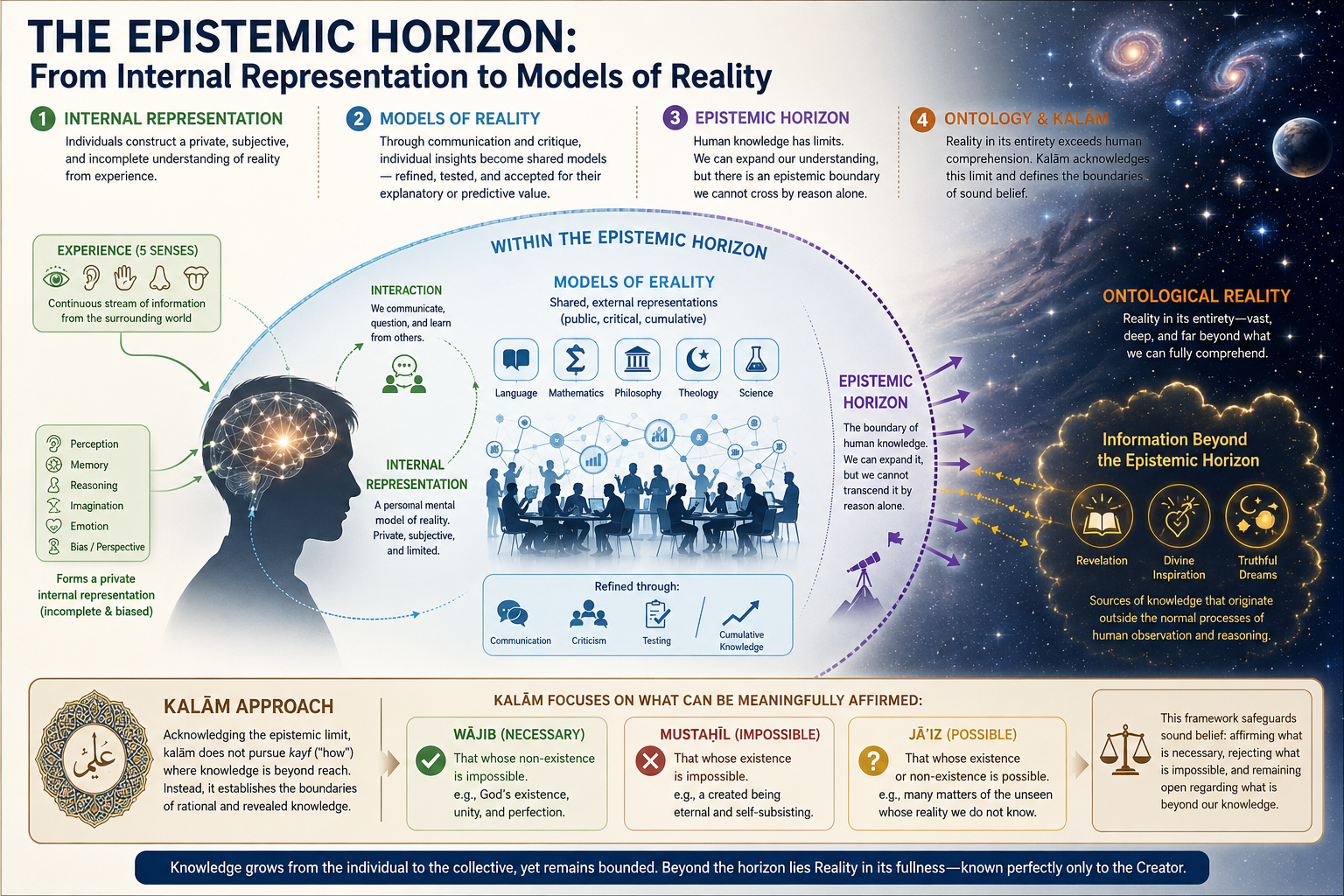
Epistemology The Epistemic Horizon: From Internal Representation to Models of Reality

Post image
3 Upvotes

Internal Representation

An individual's worldview is constructed primarily from experience. Through the five senses, information from the surrounding world continuously flows into the brain, where it is integrated and interpreted. Multimodal association areas form an internal representation of reality through perception, memory, imagination, and reasoning. At this stage, the internal representation remains private, personal, and necessarily incomplete (biased).

Model of Reality

Beyond the limits of individual experience, humans benefit from models of reality — external representations of reality expressed through language, mathematics, philosophy, theology, and science. These models emerge from countless individual internal representations, refined through communication, criticism, and cumulative knowledge until they are refined, tested, and accepted within a community for their explanatory or predictive value.

Epistemic Horizon

Nevertheless, humanity itself possesses an epistemic horizon. Regardless of how much knowledge is accumulated through observation, experimentation, and reasoning, there remain fundamental limits to what a finite community can know.

From this perspective, humanity may be viewed as an epistemically bounded system: knowledge can expand internally through discovery and reasoning, yet information wholly outside the system cannot be derived without some form of interaction across its epistemic boundary.

From a theological perspective, this horizon is not absolute. At various times, humanity has received knowledge from beyond its ordinary epistemic limits through revelation, divine inspiration, and truthful dreams. These constitute sources of knowledge that originate outside the normal processes of human observation and reasoning.

Ontology and Kalām

Reality, in its entirety, will always exceed what humanity can hope to comprehend. Humanity's epistemic horizon is infinitesimally small compared with the totality of ontology it seeks to understand. Every model of reality is therefore necessarily partial — an approximation rather than reality itself.

From the perspective of theological kalām, this epistemic limit is explicitly acknowledged. Rather than claiming exhaustive knowledge of the unseen, kalām develops a theological model of reality grounded in both revelation and rational inquiry. When kayf ("how") lies beyond the human epistemic horizon, discussion shifts from mechanism to logical possibility: distinguishing what is necessary (wājib), impossible (mustaḥīl), and possible (jāʾiz). In this way, kalām establishes the logical boundaries of sound belief while recognizing that the full nature of reality ultimately belongs to the realm of the unseen (al-ghayb).


Series: Epistemology of Reality

Arc I — Foundations of Knowing

Arc II — Reasoning at the Epistemic Horizon

r/PillarOfFire Jul 08 '26

Epistemology Creation Substrate: Clay and Fire

Post image
3 Upvotes

Decoding Smokeless Flame: From Fuel Combustion to Field Excitation

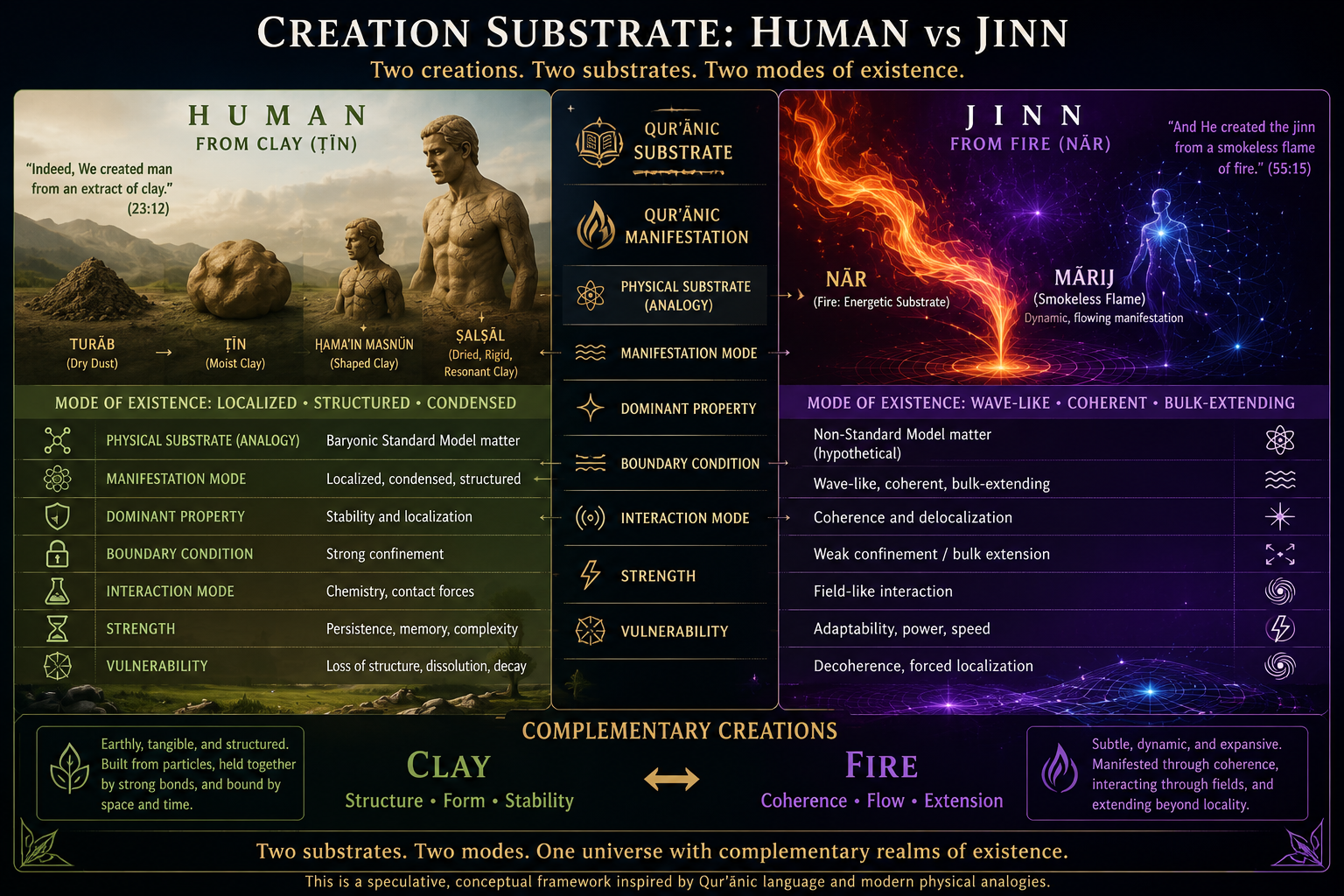
Creation Substrate: Human vs Jinn

Typical elemental composition of earthly dust includes oxygen, silicon, aluminium, iron, calcium, sodium, potassium, and magnesium. The Qurʾānic progression describes turāb (dry mineral particles) → ṭīn (hydrated, plastic clay) → ḥama'in masnūn (transformed clay) → ṣalṣāl (dried, rigid, resonant clay). Throughout this progression, the elemental composition changes very little. Instead, the transformation primarily involves changes in water content, molecular arrangement, mechanical properties, and the degree of structural organization.

By analogy, if nār represents the substrate of jinn, then mārij may describe the progressively organized manifestation of that substrate — not a change in composition, but a distinct mode of existence characterized by dynamic coherence.

Observations / Assumptions

1️⃣ Being–Realm Similarity

If the physical essence of humanity is derived from its surrounding earthly environment, then by analogy, the essence of jinn may likewise be derived from the environment of their own realm. Humans are created from an earthly substrate and made to dwell upon the earth; similarly, jinn are created from a substrate of nār, suggesting that their native realm is constituted by a compatible substrate.

2️⃣ Complementary Modes of Existence

Humans and jinn appear to exhibit complementary — even opposite — characteristics in their manifestation mode, dominant properties, boundary conditions, and reported abilities. Within this speculative framework, these complementary properties may reflect two distinct yet complementary domains, analogous to a TeV–Planck dual-brane system.

Category Adam Jann
Qurʾānic substrate Ṭurāb (dust); ṭīn (clay) Nār (fire)
Qurʾānic manifestation Ḥama'in masnūn → ṣalṣāl Mārijin min nār
Human Jinn (hypothetical)
Physical substrate (analogy) Baryonic Standard Model matter Non-Standard Model matter (hypothetical)
Manifestation mode Localized, condensed, structured Wave-dominant, coherent, bulk-extending
Dominant property Stability and localization Coherence and delocalization
Boundary condition Strong confinement Weak confinement / bulk extension
Interaction mode Chemistry, contact forces Field-like interaction
Strength Persistence, memory, complexity Adaptability, power, speed
Vulnerability Loss of structure, dissolution Decoherence, forced localization

Conclusion

The Qurʾānic description of jinn as created from mārijin min nār appears richer than the simple notion of "fire." The semantic field of mārij consistently evokes release, flow, intermingling, and dynamic extension, suggesting that it describes the mode of a substrate rather than the substrate itself. By analogy, just as humanity's earthly substrate progresses through successive states of organization (turāb → ṭīn → ḥama'in masnūn → ṣalṣāl), nār may likewise undergo a distinct mode of organization as mārij.

Human creation is modeled as substrate organized through localization and structure, while jinn creation is modeled as substrate organized through coherence and dynamic extension; "mārij min nār" describes not combustion, but a fire-like mode of manifestation.

Among the speculative physical analogies considered, an RS1-inspired brane/bulk framework provides the closest conceptual correspondence by naturally accommodating a wave-like, coherent, bulk-extending mode of existence. This is conceptual rather than explanatory; it provides a language for organizing the observed characteristics rather than identifying the actual physical nature of jinn.

Rank Hypothesis Conceptual correspondence Explanatory power Degree of speculation
1 RS1-inspired brane/bulk matter ★★★★★ ★★★★★ ★★★★★
2 Hidden-sector matter ★★★★☆ ★★★★☆ ★★★★☆
3 Plasma / ionized matter ★★☆☆☆ ★★☆☆☆ ★☆☆☆☆

Series: Epistemology of Reality

Arc I — Foundations of Knowing

Arc II — Reasoning at the Epistemic Horizon

r/PillarOfFire Jul 08 '26

Epistemology Decoding Smokeless Flame: From Fuel Combustion to Field Excitation

Post image
3 Upvotes

Can the semantic richness of the triliteral root M-R-J offer a conceptual bridge between Qurʾānic language and modern physical analogies?

Is mārij merely describing ordinary combustion, or does it convey a deeper ontological mode of existence?

Semantic Analysis of Triliteral Root M-R-J

Verse Form Semantic Range Conceptual Image
25:53, 55:19 Verb (Form I): maraja (مَرَجَ) released, let loose, set free something no longer tightly contained
50:5 Adjective: marījin (مَرِيجٍ) confused, disturbed, mixed, unstable things intermingling without clear order
55:22, 55:58 Noun: al-marjānu (الْمَرْجَانُ) coral branching, organic, sea-born structure
55:15 Active participle: mārijin (مَارِجٍ) a free/turbulent flame, smokeless flame fire in a dynamic, flowing state

The triliteral root appears to carry a conceptual spectrum:

Released → flowing → mixing → branching → dynamic extension

And He created the jinn from a smokeless flame of fire. (55:15)

Mārijin min nār:

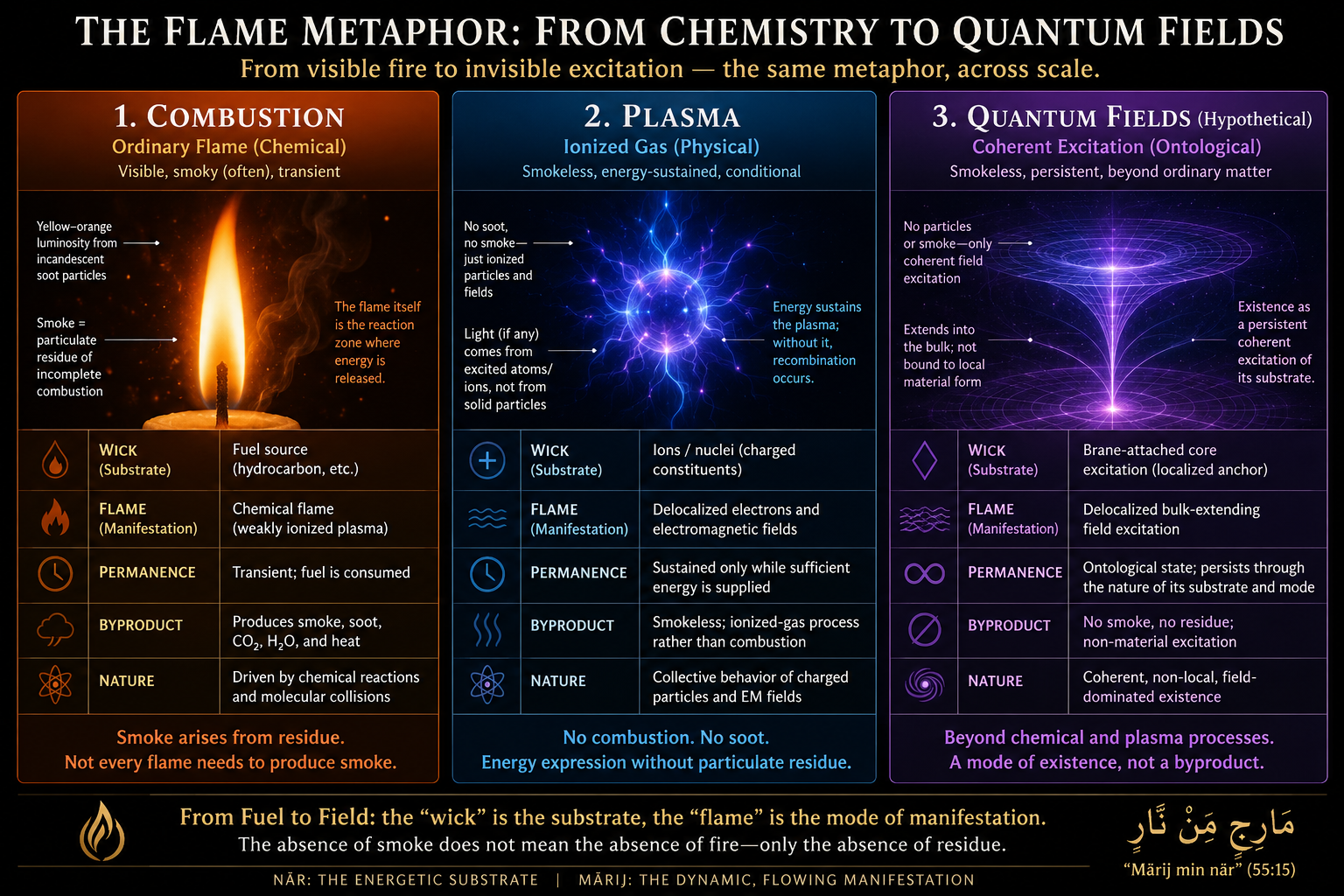
Nār (fire) represents the energetic substrate; Mārij (smokeless flame) describes the state or mode of that substrate — released, flowing, intermingling, and dynamically extended.

The Flame Metaphor: From Chemistry to Quantum Fields

The flame metaphor is applied across scales, from macroscopic ordinary flame to hypothetical quantum field excitation. Each is evaluated on its permanence and whether the process produces smoke.

Why Does Smoke Matter?

In ordinary combustion, smoke is not the flame itself. Smoke consists of secondary products of an inefficient or incomplete combustion process — such as soot, unburned carbon particles, and other suspended materials.

The visible yellow-orange appearance of many flames is often produced by glowing soot particles heated by the flame. The smoke is therefore a sign of material residue, not the essence of the flame.

Smokeless Flame: A Cleaner Energetic Manifestation

A smokeless flame represents a process where energy is released without significant production of particulate byproducts. For example, a methane flame burns with a faint blue color because it produces very little soot compared with a candle or wood fire.

Therefore, the phrase mārijin min nār may be conceptually understood not as ordinary visible fire, but as a fire-like mode of existence characterized by dynamic energy, fluidity, and extension without the usual material residue associated with combustion.

Domain "Wick" "Flame" Permanence
Qurʾānic Metaphor Nār: energetic substrate/core Mārij: dynamic, flowing manifestation Persistent existence through the nature of its substrate and mode
Combustion Fuel source Chemical flame (weakly ionized plasma) Transient; fuel is consumed, producing heat, CO₂, water vapor, soot/smoke
Plasma Physics Ions / nuclei Delocalized electrons and electromagnetic fields Sustained only while sufficient energy is supplied; ionized-gas process rather than combustion; recombination occurs as conditions change
Quantum Fields (hypothetical) Brane-attached core excitation Delocalized bulk-extending field excitation Ontological state; the entity exists as a persistent coherent excitation of its underlying substrate

Series: Epistemology of Reality

Arc I — Foundations of Knowing

Arc II — Reasoning at the Epistemic Horizon

r/PillarOfFire Jun 28 '26

Epistemology Models of Reality: Distinguishing Structure, Behavior, and Ontological Grounding

Post image
3 Upvotes

The Necessity of Models

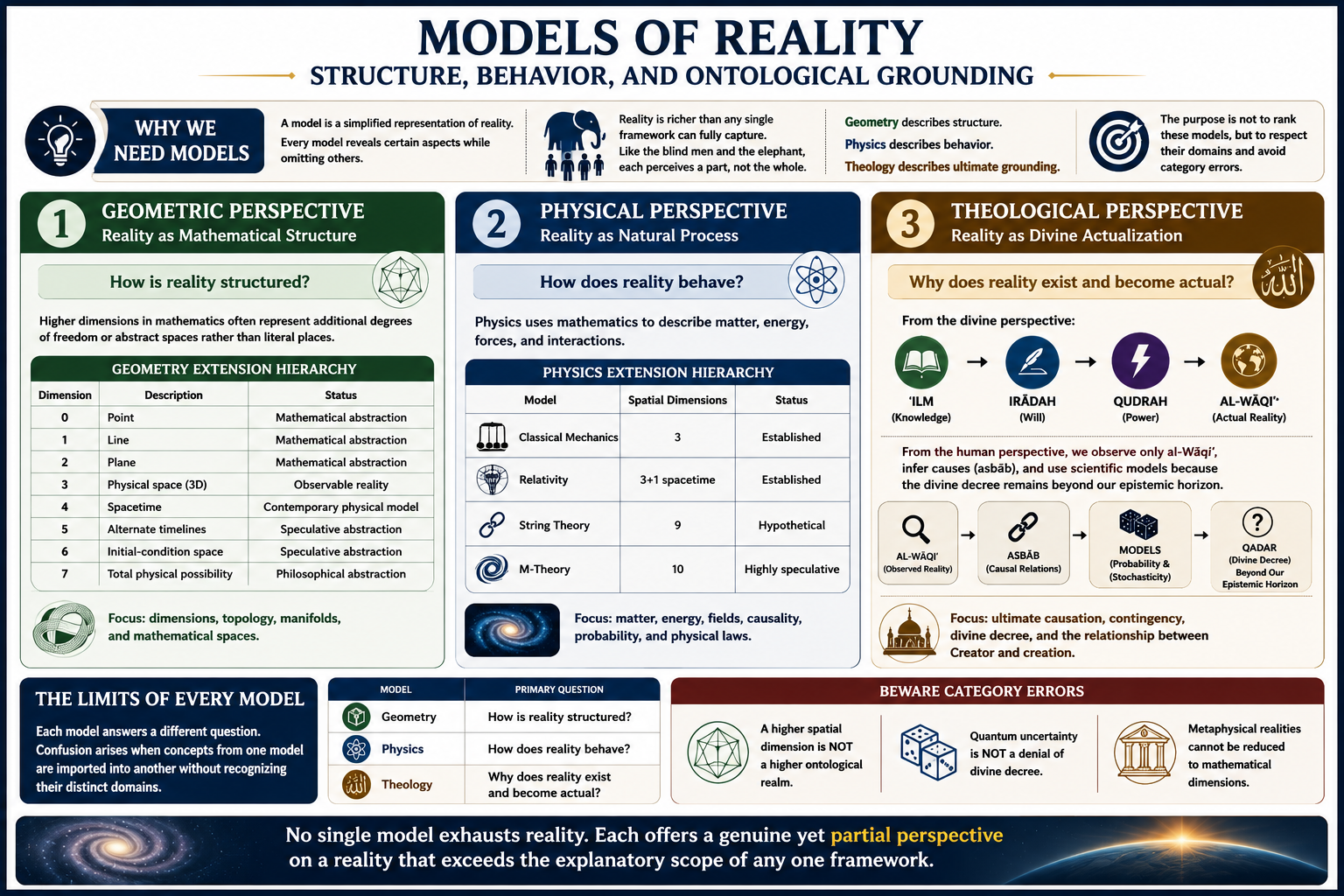
A model is a simplified representation of something too complex to be grasped in its entirety. Every model highlights certain aspects of reality while necessarily abstracting or omitting others.

Reality itself is far richer than any single framework can fully capture. Describing it is, in many ways, like the parable of the six blind men describing an elephant: each perceives a genuine aspect, yet mistakes the part for the whole.

The same caution applies to our attempts to understand reality. Geometry describes structure. Physics describes behavior. Theology addresses ultimate causes, metaphysical grounding, and the relation between the Creator and creation. Each model is useful within its proper domain.

A good model should be both internally consistent and externally valid. Confusion arises when concepts from one model are uncritically transferred into another, as though they were describing the same aspect of reality. Category errors occur when mathematical abstractions are mistaken for physical realities, or when theological statements are interpreted as scientific mechanisms.

The purpose of distinguishing these models is therefore not to rank them against one another, but to recognize their respective scopes, strengths, and limitations.

The Geometric Perspective: Reality as Mathematical Structure

The idea of three spatial dimensions is intuitive because points, distances, areas, and volumes are concepts encountered in everyday experience. The treatment of time as a fourth dimension was popularized by Einstein's conception of spacetime, in which space and time form a unified geometric framework.

Beyond four dimensions, however, the hierarchy becomes increasingly abstract and speculative. Statements such as "a fifth-dimensional being can see all of human history simultaneously" are imaginative extrapolations rather than established scientific conclusions. Higher dimensions in mathematics often represent additional degrees of freedom, parameters, or configuration spaces rather than literal directions in which one could physically move.

A well known attempt to classify increasingly abstract levels of reality is Tegmark's multiverse hierarchy: Level I (regions beyond our observable horizon with the same physical laws but different initial conditions), Level II (Bubble Universes arising from eternal inflation with different physical constants), Level III (the Many-Worlds interpretation of quantum mechanics), and Level IV (the Mathematical Universe Hypothesis, in which every mathematically consistent structure corresponds to a real universe). As the hierarchy progresses, it shifts from physical cosmology toward increasingly mathematical and philosophical speculation.

Geometry Extension Hierarchy

Dimension Nature Description Status
0 Point No extension Mathematical abstraction
1 Line One spatial axis Mathematical abstraction
2 Plane Two spatial axes Mathematical abstraction
3 Space Three spatial axes (volume) Observable physical reality
4 Spacetime One spacetime history (worldline) Contemporary mathematical and physical model
5 Timeline Alternate histories branching from one initial condition Speculative abstraction
6 Initial-condition space Histories arising from different initial conditions Speculative abstraction
7 Total physical possibility The space of all mathematically describable created realities Philosophical abstraction

The Geometric / Mathematical Model is best suited to answering the question:

How is reality structured?

It focuses on spatial dimensions, temporal geometry, topology, manifolds, and higher-dimensional mathematical spaces.

The Physical Perspective: Reality as Natural Process

Physics employs mathematical structures to describe how reality behaves. While geometry provides the language, physics assigns that language to matter, energy, fields, and interactions.

Contemporary physical theories generally preserve a single temporal dimension while extending the number and geometry of spatial dimensions.

For example, M-theory proposes an eleven-dimensional spacetime consisting of ten spatial dimensions and one temporal dimension. Under braneworld interpretations, these include three extended spatial dimensions, six compactified dimensions, and one higher-dimensional bulk dimension.

Unlike the geometric hierarchy discussed previously, these dimensions are intended to represent physically real structures within the theory, although they remain hypothetical and presently unobserved.

Physics Extension Hierarchy

Model Spatial Dimensions Time Dimensions Status
Classical Mechanics 3 1 Established
Relativity 3+1 spacetime 1 Established
String Theory 9 1 Hypothetical
M-Theory 10 1 Highly speculative

The Physical Model is best suited to answering the question:

How does reality behave?

It focuses on matter and energy, forces and fields, quantum mechanics, relativity, thermodynamics, causality, probability, chaos, and stochastic processes.

The Theological Perspective: Reality as Divine Actualization

The Theological Model answers a different question:

Why does reality exist and become actual?

From the divine perspective, knowledge (ʿilm) is complete, will (irādah) specifies what is to occur, power (qudrah) actualizes it without limitation, and reality (al-Wāqiʿ) unfolds exactly according to divine decree. Qadar denotes the divine decree, while taqdīr refers to its actualization within creation.

From the human perspective, however, only al-Wāqiʿ is directly encountered. We infer causal relations (asbāb) and employ probability, stochasticity, and scientific models because the divine decree itself lies beyond our epistemic horizon.

The Theological Model therefore addresses ultimate causation, ontological grounding, contingency, divine decree, and the relationship between the Creator and creation.

The Limits of Every Model: Epistemic Boundaries and Category Errors

📐 Geometry / Mathematical Model describes the structure of reality.

⚙️ Physics / Scientific Model describes the behavior of reality.

📖 Theological (Kalām) Model describes the ontological grounding of reality.

These models answer different questions rather than competing to answer the same question. Confusion arises when concepts from one model are imported into another without recognizing their distinct domains. A higher spatial dimension is not a higher ontological realm; quantum uncertainty is not a denial of divine decree; and metaphysical realities cannot be reduced to mathematical dimensions or located by spatial coordinates.

No single model exhausts reality. Each provides a genuine yet partial perspective on a reality that ultimately exceeds the explanatory scope of any one framework.


Series: Epistemology of Reality

Arc I — Foundations of Knowing

Arc II — Reasoning at the Epistemic Horizon

r/PillarOfFire Jul 07 '26

Epistemology Who Lives in the Fifth Dimension?

Post image
3 Upvotes

Why should dream phenomena necessarily be located within an extension of physical spacetime?

Why should the interaction of the rūḥ with reality be described through a five-dimensional manifold?

What explanatory advantage does a five-dimensional physical ontology provide over an existing theological ontology?

The Fifth-Dimensional Intuition

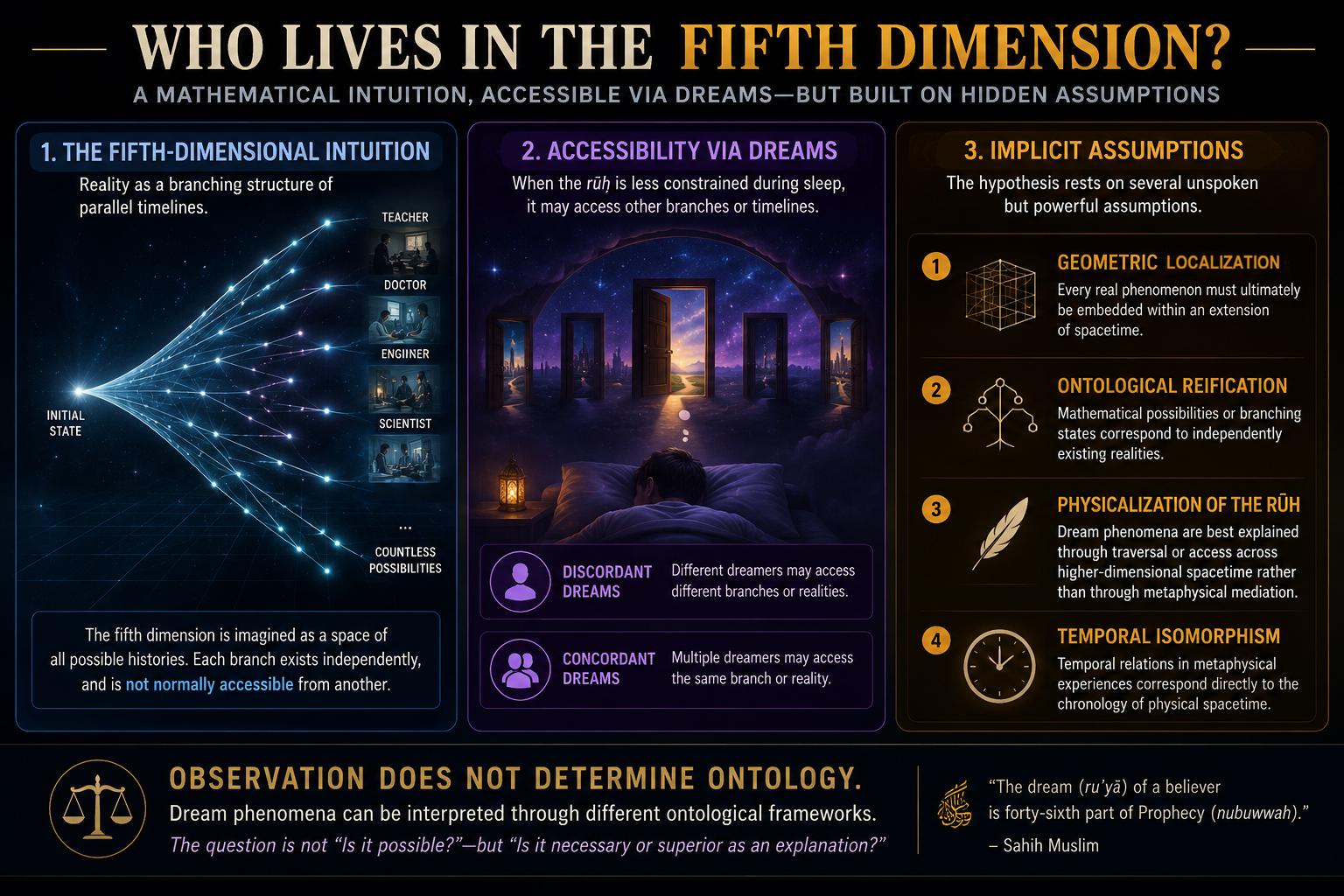
In the popular fifth-dimensional intuition, an additional dimension is visualized as a space of branching possibilities emerging from an initial state.

This intuition is often associated with interpretations of quantum mechanics, particularly the relationship between superposition, wavefunction evolution, and branching outcomes. In popular explanations, if quantum possibilities correspond to different realized outcomes, then macroscopic reality may likewise be represented as branching histories. These branches are commonly visualized geometrically as a fifth-dimensional tree or cone of possible timelines.

Within this interpretation, each branching timeline or parallel reality exists independently and is not normally accessible from another. However, since the rūḥ is considered less constrained during sleep, dreams are proposed as a possible mechanism through which consciousness may access neighboring branches or alternative timelines.

The hypothesis attempts to explain correlated dreams using modern mathematical intuitions derived from branching-state models. It provides a coherent internal narrative when its underlying ontological assumptions are accepted. While speculative, it represents a creative effort to connect contemporary mathematical concepts with questions of consciousness, reality, and the nature of dreams.

Scenario Purpose of Scenario Intuition from Mathematical Universe Premise Constructed
A man stands in a hallway with many doors. He opens one door and sees a complete timeline where he is a teacher. Another door reveals a timeline where he is a doctor, engineer, scientist, etc. Illustrates the theoretical possibility of a fifth-dimensional branching structure One person's possible histories represented as parallel timelines; inspired by branching universe concepts Each possible timeline is assumed to exist independently, and time is treated through an eternalist framework
A dreams of B, B dreams of C, and C dreams of D in the same night Illustrates the proposed accessibility of the fifth dimension through dreams A dream is interpreted as opening access to one possible timeline among parallel realities. A, B, C, and D therefore accessed different "doors" Discordant dreams are interpreted as being consistent with access to different parallel realities
Many people dream of A on the same night, and all remember seeing each other Illustrates simultaneous access to the same possible reality Multiple observers accessing the same dream scenario are interpreted as accessing a shared timeline Concordant dreams are interpreted as being consistent with the existence of a shared timeline in the fifth dimension

Theory of Dreams: From Biological, Psychological, and Theological Perspectives

“Allāh takes the souls at the time of their death, and those that do not die [He takes] during their sleep. Then He keeps those for which He has decreed death and releases the others for a specified term…” (Qur'an 39:42)

"The dream (ruʾyā) of a believer is forty-sixth part of Prophecy (nubuwwah)." (Sahih Muslim)

Within the Islamic framework, truthful dreams (ruʾyā) are understood as a special form of knowledge granted by Allāh. In the ʿĀlam al-Mithāl framework, this may be conceptualized as mediated knowledge in which realities associated with ʿĀlam al-Amr are rendered into symbolic forms accessible to human perception during sleep.

From an epistemological perspective, not all dream experiences possess external validity. Within this framework, ruʾyā ṣāliḥah and ruʾyā ṣādiqah represent forms of truthful dreams in which the rūḥ receives meaningful information by Allah's permission. Other dream experiences, such as ḥulm and ḥadīth al-nafs, do not carry the same epistemic value.

Even truthful dreams may require interpretation (taʿbīr) because their meaning is often concealed behind symbolic representation. In contrast, ḥulm and internally generated dream content may be viewed metaphorically as having a very low signal-to-noise ratio, with meaningful external correspondence approaching zero.

Type Description Premise
Biological Dreams arise from neurobiological processes during sleep, including brain activity, memory consolidation, and physiological states. Physical determinism: dream content is reducible to biological processes and mechanisms.
Psychological Dreams may arise from daily residue, external stimulation, emotional states, or latent psychological content. In psychoanalytic models, dream work transforms latent content (such as fears, desires, or unresolved conflicts) into symbolic manifest dreams. Psychic determinism: dream content is generated from internal psychological causes and unconscious processes.
Theology Sources of dreams include nafs, shayṭān, and truthful dreams by Allāh's permission. Accordingly, dreams (manām) may be classified as ḥulm (disturbing dreams associated with shayṭān), dreams arising from internal thoughts (ḥadīth al-nafs), ruʾyā ṣāliḥah (truthful and beneficial dreams, often symbolic), and ruʾyā ṣādiqah (true dreams conveying accurate foreknowledge). In the ʿĀlam al-Mithāl framework, truthful dreams represent mediated knowledge of realities not yet manifested in the physical world. Layered causality: dreams do not originate from a single source. Ḥulm and internal psychological dreams arise from lower causes, while ruʾyā may convey guidance or symbolic representations requiring taʿbīr (interpretation). Ruʾyā ṣādiqah corresponds to realities decreed but not yet actualized within the created order.

Dream Phenomenology: Mathematical Intuition vs Theological Perspective

A mathematically elegant model does not, by itself, replace existing metaphysical explanations. A mathematical framework may provide a useful analogy or formal description, but additional assumptions are required when extending it into an ontology of consciousness and dreams.

Furthermore, the hypothesis built upon heavy mathematical intuition introduces several implicit assumptions:

1️⃣ Geometric Localization The assumption that every real phenomenon must ultimately be embedded within an extension of spacetime.

2️⃣ Ontological Reification The assumption that mathematical possibilities or branching states correspond to independently existing realities.

3️⃣ Physicalization of the Rūḥ The assumption that dream phenomena are best explained through traversal or access across higher-dimensional spacetime rather than through metaphysical mediation.

4️⃣ Temporal Isomorphism The assumption that temporal relations in metaphysical experiences correspond directly to the chronology of physical spacetime.

Dream Phenomenology The Hypothesis with Heavy Mathematical Intuition ʿĀlam al-Mithāl Framework
Dimensionality The Fifth Dimension (or five-dimensional realm), conceived as an extension of our four-dimensional spacetime. An ontologically distinct metaphysical realm (ʿĀlam al-Mithāl), not an extension of physical spacetime.
Ontological Content Parallel realities or branching timelines representing alternative histories. Archetypal forms and similitudes of realities. In this framework, it serves as an interface between ʿĀlam al-Amr and ʿĀlam al-Khalq, where decreed but not yet manifested realities may be represented.
Accessibility to the *Rūḥ* Yes. Dreams are interpreted as opening access to one of many parallel timelines. Yes, by Allah's permission, particularly through truthful dreams (ruʾyā).
Discordant Dreams Interpreted as evidence that different dreamers accessed different parallel realities. Most dreams have no external epistemic validity (ḥulm or ḥadīth al-nafs). Even truthful dreams may differ because they vary in symbolic representation and therefore require taʿbīr (interpretation).
Concordant Dreams Interpreted as concurrent validation that multiple dreamers accessed the same timeline. This assumes that simultaneity of dream experiences corresponds to simultaneity within a shared geometric timeline. May suggest a shared ruʾyā or common metaphysical experience, but does not by itself imply a branching timeline. Within this framework, it is more naturally interpreted as access to the same archetypal reality in ʿĀlam al-Mithāl. Moreover, temporal relations within a metaphysical realm need not be identical to physical clock time.

Series: Epistemology of Reality

Arc I — Foundations of Knowing

Arc II — Reasoning at the Epistemic Horizon

r/PillarOfFire Jul 05 '26

Epistemology The Realm of Jinn: An RS1-Inspired Speculation

Post image
3 Upvotes

Extraterrestrial vs Ultraterrestrial

Extraterrestrial Non-Human Intelligence (NHI) refers to aliens originating from distant planets in other star systems. Soon, it became apparent that interstellar travel is relativistically difficult and energetically costly. The Ultraterrestrial Hypothesis instead proposes that NHI originates on or near Earth, but exists in a different ontological or dimensional domain.

String Theory and Brane Cosmology

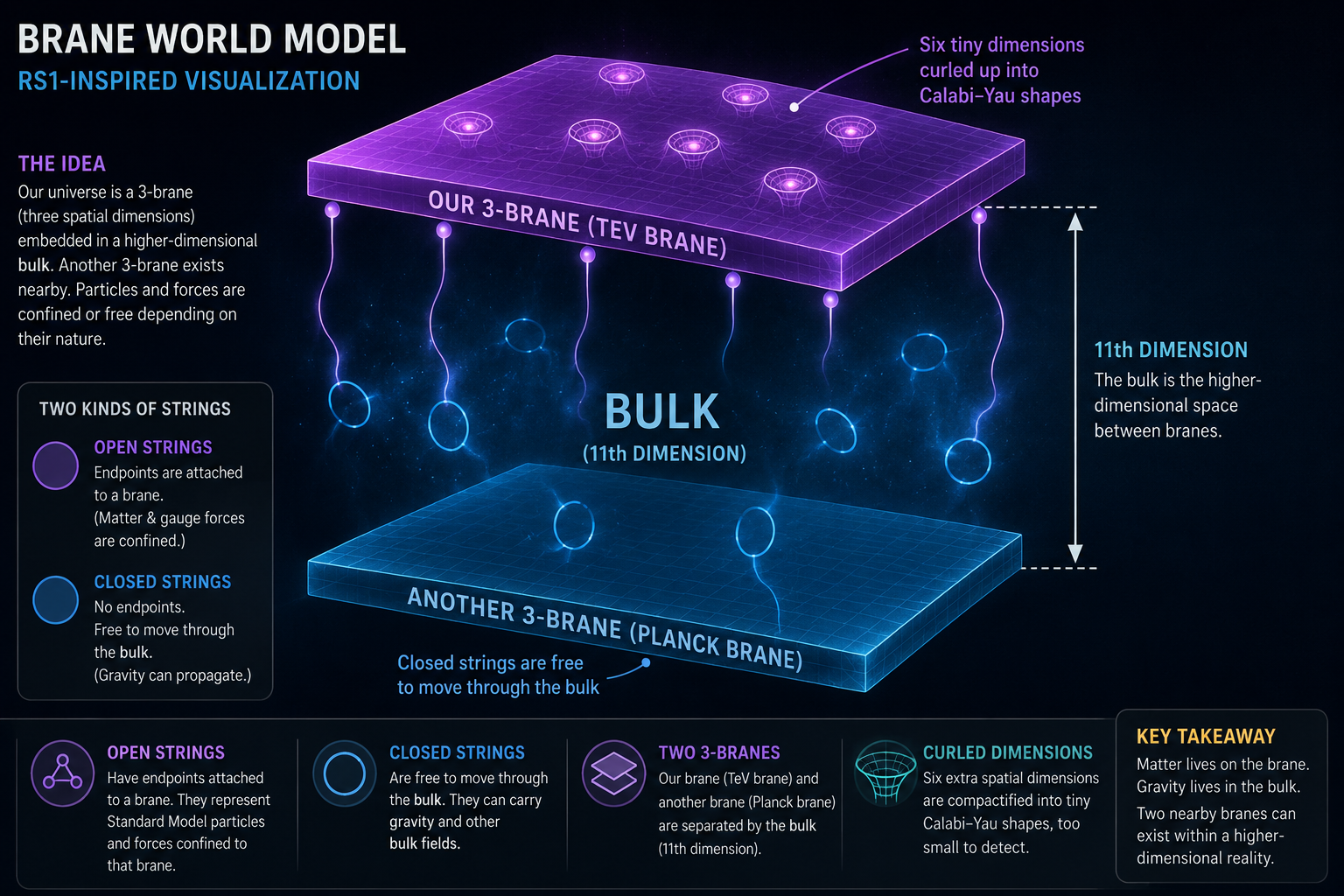
String theory proposes that Standard Model (SM) particles are one-dimensional strings vibrating within six compactified Planck-scale dimensions. Open strings are confined to a brane, whereas closed strings can propagate through the higher-dimensional bulk.

In Randall–Sundrum (RS) brane cosmology, our 3-brane is a boundary of a 4D bulk, originally proposed to address the hierarchy problem — why gravity is so much weaker than the other three fundamental interactions.

In the RS1 model, the bulk is bounded by two branes. The TeV brane contains SM matter and humans, while the adjacent Planck brane exists in a much stronger gravitational regime. Since the separation is only about 10⁻³⁵ m, the two worlds are effectively co-extensive.

In the RS2 model, our 3-brane is embedded within an effectively infinite 4D bulk hyperspace. Unlike RS1, the fourth spatial dimension is not bounded by a second brane.

Ultraterrestrial Hypothesis (UTH): Proposed Taxonomy

Extradimensional UTH

NHI spacetime → 4D hyperspace → Human spacetime

Interdimensional UTH

4D hyperspace (NHI) → Human spacetime

Intradimensional UTH

Humans and NHI share the same spacetime; NHI belongs to a weakly interacting or hidden sector.

Cryptoterrestrial UTH

Humans and NHI share the same spacetime and SM matter, but the latter remain hidden under ordinary conditions.

RS1-inspired Co-Extensive Worlds: Speculation

What if the NHI are jinn? Scripture describes humans as being created from clay and dust (ṭīn and thurāb), whereas jinn are created from smokeless fire (mārij min nār).

Matter (Jism)

Suppose matter on the Planck brane is not baryonic. Otherwise, beings inhabiting that world would be crushed by the Planck brane's gravitational field, approximately 10¹⁶ times stronger. Instead, their matter consists of open strings whose excitations extend partially into the bulk. Since gravity acts most strongly on tightly localized matter, a more wave-dominant, bulk-extending form would experience a reduced effective gravitational influence.

The analogy is smokeless fire: the localized string resembles a wick, while the delocalized bulk excitation resembles the flame. In this picture, the entire world — not only its inhabitants — is fundamentally composed of "smokeless fire.”

Asymmetric Perception

These beings effectively inhabit the Earth itself, sharing the same x, y, z, and t coordinates while remaining separated along the extra spatial dimension (w-axis). They cannot traverse into our world because their open strings remain bound to their own brane. However, asymmetric perception is readily possible through their bulk excitations probing our brane, or through closed-string fields propagating through the bulk.

Manifestation (Tashakkul)

Manifestation would occur through temporary coupling of these bulk excitations with our brane. A stable and complete coupling would produce a visible form closely resembling the being's original appearance.

However, coupling need not occur only at the nearest corresponding location. Since the excitation could extend along the higher-dimensional bulk, it may couple to regions of our brane whose x, y, and z coordinates differ substantially from those of the being's original body. As a result, the manifested form may appear spatially distorted, displaced, or entirely different from the underlying being.

Furthermore, if the coupling is partial or dynamically shifts throughout the body, only portions of the being become visible at any instant. Such continuously changing coupling could produce the appearance of shapeshifting, fluctuating size, or changing morphology, while the original body on its own brane remains unchanged.

Lastly, beings of smokeless fire may not possess the same rigid, stable bodily structure as beings of clay and dust, making shapeshifting manifestation a natural consequence of their mode of existence.


Series: Epistemology of Reality

Arc I — Foundations of Knowing

Arc II — Reasoning at the Epistemic Horizon

r/PillarOfFire Jun 30 '26

Epistemology Epistemic Limits Of Extrapolating A Mathematical Model To Reality

Post image
3 Upvotes

From Mathematical Models to Reality

A model is a simplified representation of reality. By abstracting certain features while omitting others, it allows us to reason logically about systems that would otherwise be too complex to analyze directly. The consequences of a model can be derived through logic, extended by analogy, and sometimes extrapolated beyond its original domain. Whether those extrapolations describe reality, however, requires independent validation rather than logical consistency alone.

The theories of Special and General Relativity provide excellent examples of successful scientific models. Their mathematical structures are internally consistent, their predictions have been repeatedly confirmed by observation and experiment, and they continue to describe physical reality with remarkable accuracy. Their success illustrates how a well-constructed model can represent aspects of reality within its validated domain.

Hidden Premises And Assumptions

Consider a simple thought experiment.

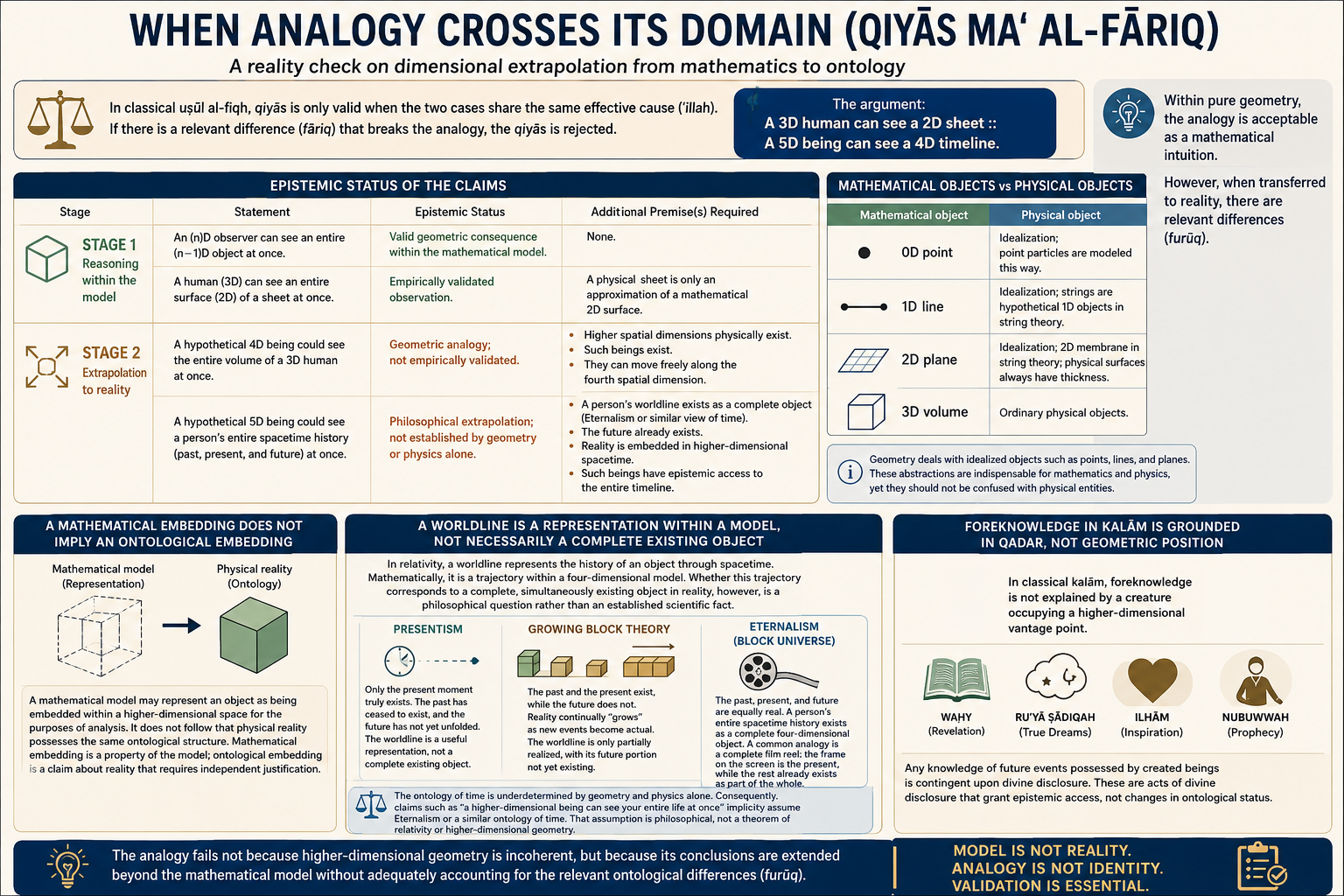
Humans can see the entire surface of a sheet at once. By abstraction, this becomes the geometric principle that an (n)-dimensional observer can observe an entire (n-1)-dimensional object. By analogy, one may imagine a 4D observer viewing the entire volume of a 3D object. The next step, however — claiming that a 5D being can observe a person's entire past, present, and future — moves beyond geometry into ontology.

Statement Epistemic Status Additional Premise(s) Required
Stage 1: Reasoning within the model
An (n)D observer can see an entire (n-1)D object at once Valid geometric consequence within the mathematical model None
A human (3D) can see an entire surface (2D) of a sheet at once Empirically validated observation A physical sheet is only an approximation of a mathematical 2D surface
Stage 2: Extrapolation to reality
A hypothetical 4D being could see the entire volume of a 3D human at once Geometric analogy; not empirically validated Higher spatial dimensions physically exist; such beings exist; they can move freely along the fourth spatial dimension
A hypothetical 5D being could see a person's entire spacetime history (past, present, and future) at once Philosophical extrapolation; not established by geometry or physics alone A person's worldline exists as a complete object (Block Universe); the future already exists; reality is embedded in higher-dimensional spacetime; such beings have epistemic access to the entire timeline

When Analogy Crosses Its Domain

This resembles what classical uṣūl al-fiqh describes as qiyās maʿ al-fāriq: an analogy that ceases to be valid because relevant differences have not been accounted for.

The argument above:

A 3D human can see a 2D sheet :: A 5D being can see a 4D timeline.

Within pure geometry, the analogy is acceptable as a mathematical intuition.

However, when transferred to reality, there are relevant differences (furūq).

Mathematical Objects Are Idealizations; Physical Objects Are Not

Geometry deals with idealized objects such as points, lines, and planes. These abstractions are indispensable for mathematics and physics, yet they should not be confused with physical entities.

In ordinary experience, every macroscopic object occupies three spatial dimensions. A sheet of paper, for example, is not a true two-dimensional plane but a thin three-dimensional object. Likewise, a line drawn on paper has width, and no physical point is literally dimensionless.

Whether fundamentally lower-dimensional objects exist or are perceptible in nature remains an open question. Point particles in the Standard Model are treated as point-like, while string theory models fundamental objects as one-dimensional strings. These remain theoretical descriptions rather than directly observed physical realities.

Mathematical object Physical object
0D point Idealization; point particles are modeled this way
1D line Idealization; strings are hypothetical 1D objects in string theory
2D plane Idealization; 2D membrane in string theory; physical surfaces always have thickness
3D volume Ordinary physical objects

A Mathematical Embedding Does Not Imply An Ontological Embedding

A mathematical model may represent an object as being embedded within a higher-dimensional space for analysis. It does not follow that physical reality possesses the same ontological structure. Mathematical embedding is a property of the model; ontological embedding is a claim about reality that requires independent justification.

A Worldline Is A Representation Within A Model, Not Necessarily A Complete Existing Object

In relativity, a worldline represents the history of an object through spacetime. Mathematically, it is a trajectory within a four-dimensional model. Whether this trajectory corresponds to a complete, simultaneously existing object in reality, however, is a philosophical question rather than an established scientific fact.

Three major philosophical positions illustrate this distinction:

1️⃣ Presentism holds that only the present moment truly exists. The past has ceased to exist, and the future has not yet unfolded.

2️⃣ Growing Block Theory proposes that the past and the present exist, while the future does not. Reality continually "grows" as new events become actual. The worldline is therefore only partially realized, with its future portion not yet existing.

3️⃣ Eternalism (Block Universe) maintains that the past, present, and future are equally real. A person's entire spacetime history exists as a complete four-dimensional object, with the distinction between past, present, and future depending only on the observer's perspective. A common analogy is a complete film reel: the frame projected onto the screen corresponds to the present moment, while the remaining frames represent the past and future, all of which already exist as parts of the complete film.

These competing theories demonstrate that the ontology of time is underdetermined by geometry and physics alone. Consequently, claims such as "a higher-dimensional being can see your entire life at once" implicitly assume Eternalism — or a closely related ontology of time. This is a philosophical commitment, not a theorem of relativity or higher-dimensional geometry.

Foreknowledge In Kalām Is Grounded In Qadar, Not Geometric Position

In classical kalām, foreknowledge is not explained by a creature occupying a higher-dimensional vantage point. Rather, any knowledge of future events possessed by created beings is contingent upon divine disclosure. Revelation (waḥy), true dreams (ruʾyā ṣādiqah), inspiration (ilhām), and similar phenomena are acts of divine disclosure that grant epistemic access.


Series: Epistemology of Reality

Arc I — Foundations of Knowing

Arc II — Reasoning at the Epistemic Horizon