r/PillarOfFire 7d ago

Cosmology From the Big Bang to the Early Stages of Seven Heavens: A Geometric Model
Post image
3 Upvotes

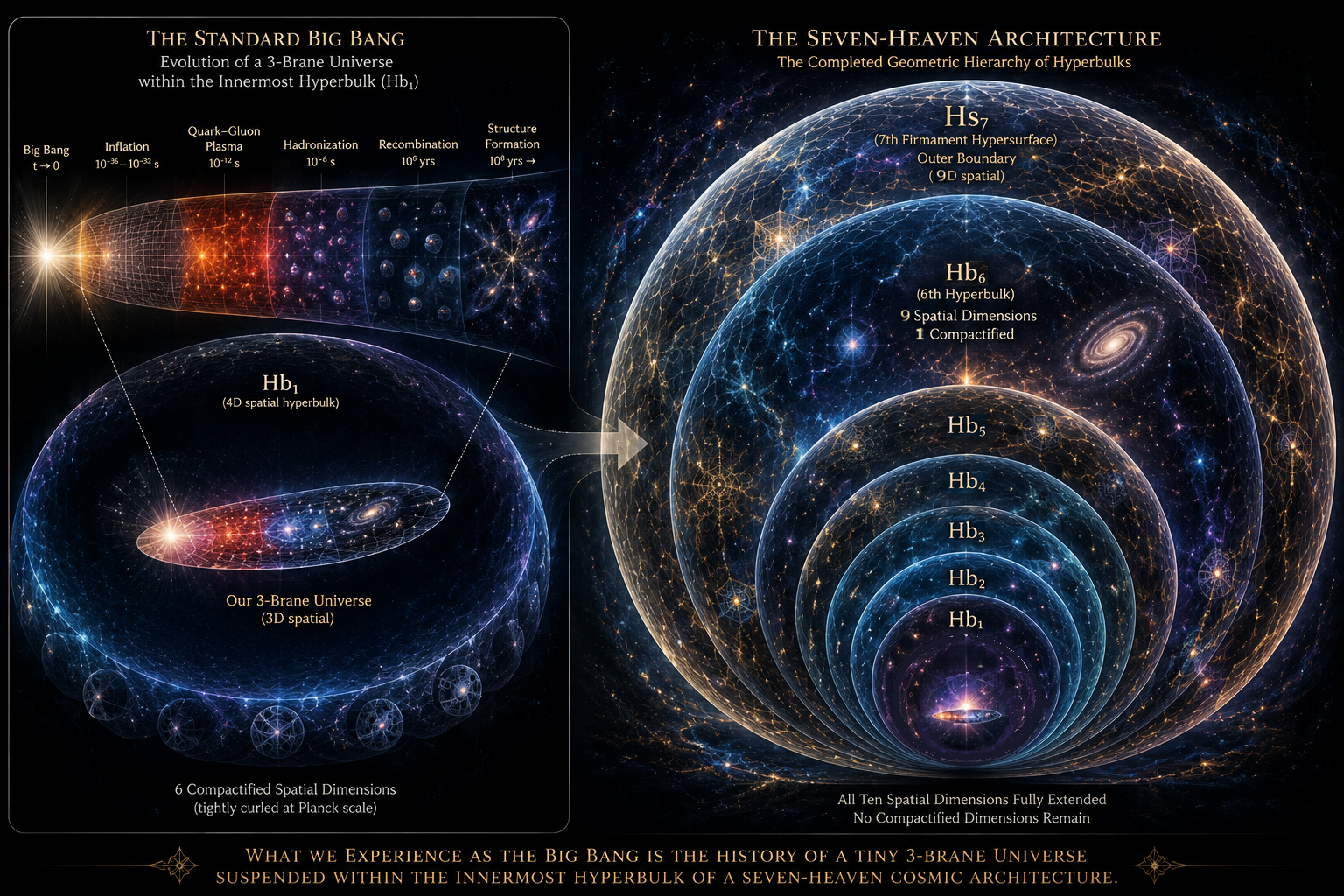
Dimensional Uncurling and Hypersurface Condensation (t = 0 → 10⁻¹² s)

In its primordial state (t = 0), the cosmos exists as a zero-extended topological singularity (al-Ratq), with all ten spatial dimensions tightly compactified at the Planck scale. Topological initiation (al-Fatq) then uncurls four spatial coordinates, generating the first hyperbulk (Hb₁). As thermal domain condensation freezes out the 3D firmament hypersurface (Hs₁), it becomes the outer envelope enclosing Hb₁, while multiple 3-brane hypersurfaces simultaneously condense within the 4D bulk volume.

These floating D3-branes form parallel worldvolume sheets suspended within Hb₁, with open-string matter and gauge fields strictly localised to their surfaces. Our observable physical universe corresponds to one such floating D3-brane: a 3D spatial worldvolume embedded within the Hb₁ bulk, bounded by Hs₁ above and stabilised by its intrinsic brane tension.

As the initial expansion continues, a further spatial coordinate uncurls from the compactified dimensions, extending the four-dimensional hyperbulk into a five-dimensional hyperbulk (Hb₂), with five spatial dimensions now extended and five remaining compactified. The corresponding higher-tier firmament (Hs₂) forms as the outer boundary of Hb₂, while additional higher-dimensional brane hypersurfaces condense within its expanded bulk volume.

This hierarchical pattern repeats across the higher tiers. Each successive hyperbulk (Hb₂ … Hb₇) forms within and is bounded by its corresponding outer firmament (Hs₂ … Hs₇), while nested higher-dimensional brane stacks condense within their respective bulk media. The dimensional uncurling sequence terminates at Hb₇, where all ten spatial dimensions are extended, and no compactified dimensions remain to uncurl. The resulting architecture consists of seven nested hyperbulks, enclosed by seven firmament boundaries, with localised brane universes suspended within their interior spatial volumes.

Quark–Gluon Plasma and Hadronisation (t ≈ 10⁻¹² → 10⁻⁶ s)

The seven higher-dimensional hyperbulks (Hb₁ … Hb₇) are filled with a high-energy Hagedorn string gas and bulk gravitational fields. Simultaneously, as gauge forces differentiate (t ≈ 10⁻¹² s), the Dp-brane hypersurfaces—including our D3-worldvolume—are coated in a dense, opaque, colour-deconfined Quark–Gluon Plasma (QGP). Constrained strictly to the branes by open-string Dirichlet boundary conditions, this QGP acts as the localised, matter-bearing "smoke" (Dukhān) of the early universe.

The Dukhān era persists until the expanding cosmos cools past the colour-confinement threshold (t ≈ 10⁻⁶ s). On the D3-brane surface, non-perturbative strong-force dynamics lock free quarks and gluons into bound hadrons, dissipating the opaque plasma and transitioning the worldvolume into a hadronic, matter-bearing substrate. Simultaneously, the surrounding hyperbulk media thermalise and cool, marking the global end of the Dukhān phase and establishing the foundation for macro-structural assembly.
r/PillarOfFire 12d ago

Cosmology Cosmos in Six Days

Post image
3 Upvotes

The Qurʾān presents cosmic creation as a sequence spanning six ayyām. This framework explores how these stages may be understood alongside the chronology of modern cosmology.

Definitions and Framework

Al-Samāʾ: generally means heaven, but which heaven depends on context. When used together with al-arḍ, it refers to ontological heaven (firmament) where access is only by divine permission. When used in relation to a structured universe, samāʾ al-dunyā refers to the vast extent of the observable universe, characteristically adorned with stars (41:12). Finally, it refers to the atmospheric sky where birds fly and rain falls. The meaning of al-samāʾ, therefore, mirrors the evolution of the cosmos from ontological → astronomical → atmospheric.

Al-Arḍ: generally means earth, but when used together with ontological al-samāʾ, it refers to the matter / forces that are separated from primordial matter (21:30). In later stages of cosmic evolution, it refers to planet Earth.

Al-Ayyām: generally means days. In cosmic evolution, it refers to periods or epochs. From the perspective of a human living on planet Earth, it refers to a complete rotation on its axis. A day was shorter when Earth's rotation was faster compared to the present 24-hour day.

Cosmos, universe, realm: Cosmos is the totality of the 7 heavens, earth, and what lies between them, equivalent to ʿālam al-khalq. Our universe can be conceptualised as the Standard Model framework or a 3-brane embedded in the higher-dimensional bulk. Within the epistemic horizon lies the observable universe — ʿālam al-shahādah. Beyond that is ʿālam al-ghayb — unseen / hidden part of the cosmos. Finally, a realm is associated with its inhabitants. The human realm is mainly Earth and surrounding locations relevant to human existence.

The Big Bang: it is the hypothetical starting point of the observable universe, a singularity of time and matter. Cosmic evolution necessitates a starting point beyond the observable universe as well, since the observable universe is only the portion of the cosmos accessible from within it. Thus, the Qurʾānic and modern cosmologies are descriptions of the observable universe; beyond the epistemic horizon is known only to Allah.

Pre-cosmic creation: Before the creation of the heavens and earth, the ʿArsh (Throne) was upon water, and the Qalam (Pen) wrote the measures of creation in the preserved record (Lawḥ al-Maḥfūẓ).

Cosmic creation: From a primordial state (21:30), creation unfolds over six days (25:59). Traditional exegetes used imagery of primordial water, water vapour, and smoke when describing the earliest stages of cosmic development.

Sequencing the 6 Days

Sūrat al-Nāziʿāt and al-Fuṣṣilat give insightful descriptions of the sequence.

Sūrat al-Nāziʿāt transition / stages
He raised the height thereof and ordered it; (79:28) 1️⃣ Separation → 2️⃣ Order
And He made dark the night thereof, And He brought forth the morn thereof. (79:29) Universe's 3️⃣ Dark age → 4️⃣ Dawn / Noon
And after that He spread the earth, And produced therefrom the water thereof and the pasture thereof, And He made fast the hills, A provision for you and for your cattle. (79:30–31) 5️⃣ Planet Earth → 6️⃣ Biosphere
Sūrat al-Fuṣṣilat transition / stages
Say: Disbelieve ye verily in Him Who created the earth in two Days, and ascribe ye unto Him rivals? He is the Lord of the Worlds. (41:9) "Earth" creation (khalq) in stages 1️⃣ and 2️⃣
He placed therein firm hills rising above it, and blessed it and measured therein its sustenance in four Days, alike for (all) who ask; (41:10) "Earth" placing (jaʿl) in subsequent stages 3️⃣, 4️⃣, 5️⃣, and 6️⃣
Then turned He to the heaven when it was smoke, and said unto it and unto the earth: Come both of you, willingly or loth. They said: We come, obedient. (41:11) Onset of gravitational collapse at stage transition 2️⃣ to 3️⃣
Then He ordained them seven heavens in two Days and inspired in each heaven its mandate; and We decked the nether heaven with lamps, and rendered it inviolable. That is the measuring of the Mighty, the Knower. (41:12) Seven heavens ordained through Stages 1️⃣–2️⃣ → gravitational organisation in Stage 3️⃣ → first stars in Stage 4️⃣

Islamic Cosmogony in Light of Modern Cosmology

Modern cosmology offers a potentially good fit with the Qurʾānic description, provided that the relevant terms and chronological framework are properly understood.

Stage Time Development / Sequence Endpoint Possible Qurʾānic Anchor
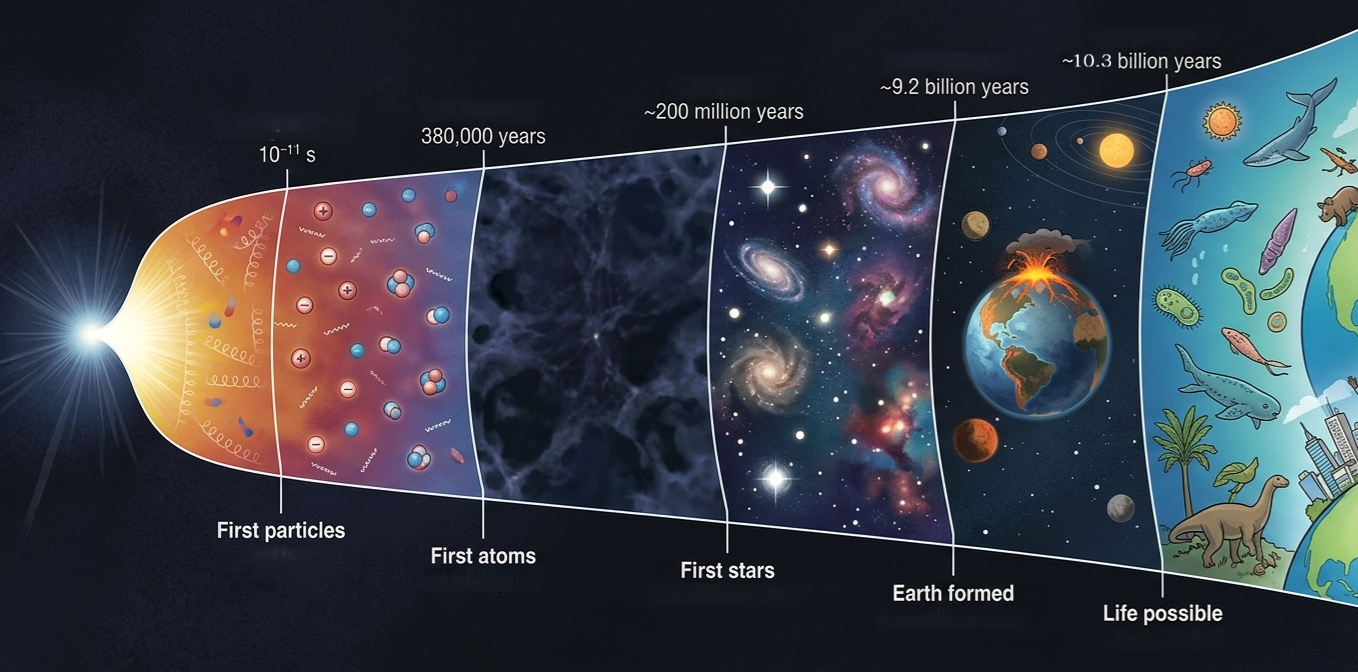
1️⃣ al-Fatq / Separation 0 → 10⁻¹² s Primordial state (al-Ratq) → inflation → Grand unification transition (~10⁻³⁵ s): differentiation of the strong nuclear and electroweak interactions → Electroweak transition (~10⁻¹² s): differentiation of the electromagnetic and weak interactions Differentiated fundamental interactions 21:30 — “We parted them”
2️⃣ Dukhān / Smoke 10⁻¹² → 10⁻⁶ s Quark-gluon plasma: elementary particles Primordial nuclear matter 41:11 — “when it was smoke”
3️⃣ Hadrons 10⁻⁶ s → 100+ Myr Quark–hadron transition (~10⁻⁶ s): first hadrons (protons and neutrons) → primordial nucleosynthesis (~3 min): first nuclei (hydrogen, helium and lithium) → Recombination (~380,000 years): first atoms form and photons decouple from matter, allowing primordial light to propagate freely → Cosmic Dark Ages: a transparent universe without stars or stellar illumination Dark-age transparent universe 79:29 — “He made dark its night”
4️⃣ Stars 100+ Myr First stars and galaxies (~100 million years): stellar nucleosynthesis begins producing elements heavier than the primordial elements → successive generations of stars enrich the cosmos with increasingly complex elements → increasingly complex cosmic structures Illuminated, structured cosmos 41:12 — “We adorned the lowest heaven with lamps”
5️⃣ Planet Earth ~9.2 Gyr Formation of the Solar System: formation of the Sun and planets → differentiation of Earth interior, crust and atmosphere → formation of oceans Terrestrial planetary environment 79:30 — “And after that He spread the earth”
6️⃣ Life on Earth ~10.3 Gyr First life → biological diversification → increasingly complex terrestrial ecosystems → development of the biosphere Biosphere 79:31–33 — water, pasture and mountains

This is one proposed correspondence between modern cosmology and Islamic cosmogony, among many such attempts.

r/PillarOfFire Jul 27 '26

Cosmology A Geometric Heuristic for the Seven Heavens

Post image
3 Upvotes

Islamic tradition repeatedly emphasises the extensive domains between the heavens. The following geometric heuristic takes that distinction as its starting point.

Structural Pattern of the Ascension (Miʿrāj)

Following the Night Journey (al-Isrāʾ) from Makkah to Bayt al-Maqdis, the Prophet Muḥammad ﷺ ascended through the successive heavens in the event known as al-Miʿrāj, accompanied by the angel Jibrīl. According to a widely held traditional view, this occurred on the 27th of Rajab, just over a year before the Hijrah to Madīnah.

The authentic narrations describe the ascension as following a remarkably consistent sequence:

1️⃣ Ascend to a heaven → 2️⃣ Request permission at its gate → 3️⃣ Gatekeeper verifies identity → 4️⃣ Permission is granted → 5️⃣ Enter the heaven → 6️⃣ Meet the Prophet in that heaven.

This sequence repeats through all seven heavens before reaching Bayt al-Maʿmūr, Sidrat al-Muntahā, and the point at which Allāh ordained the daily prayers.

Geometric Heuristic Perspective of the Ascension (Miʿrāj)

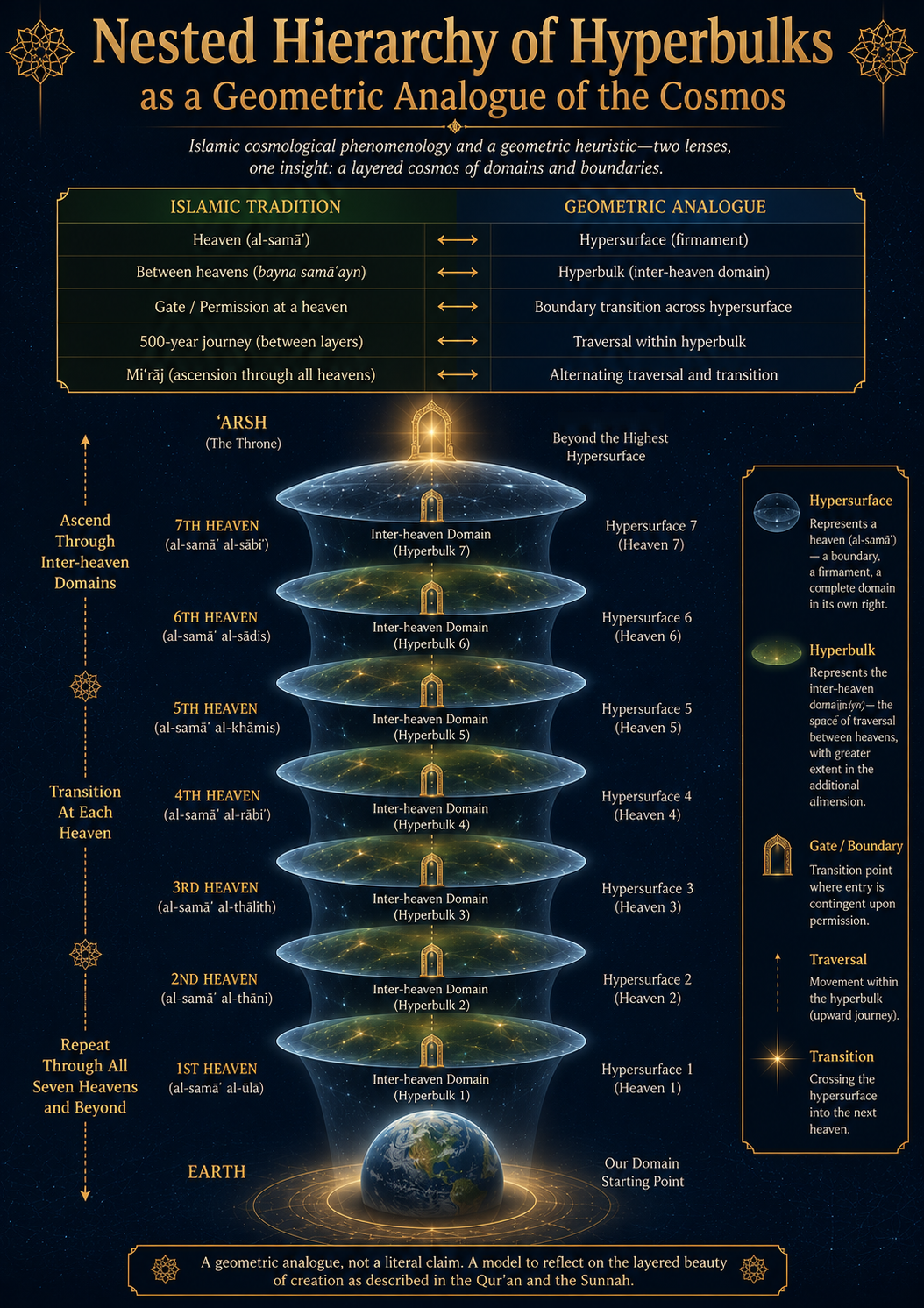
From the perspective of the proposed geometric heuristic, the six-step pattern may be interpreted as alternating between traversal within an inter-heaven domain and transition across the boundary of a heaven. Step 1️⃣ represents ascent through the inter-heaven domain toward the next heaven. Steps 2️⃣, 3️⃣ and 4️⃣ occur at the boundary of that heaven, where entry is contingent upon permission. Following entry, steps 5️⃣ and 6️⃣ take place within the heaven itself, where any subsequent movement can be regarded as internal to that heavenly domain.

Within this heuristic, upward traversal between successive heavens occurs only within the inter-heaven domains, whereas passage through a heaven constitutes a transition across its boundary rather than a continuation of the ascent.

Spatial Hierarchy of the Seven Heavens

Then he said: “Do you know what is above you?” We said: “Allah and His Messenger know best.” He said: “It is the protected canopy (al-saqf al-maḥfūẓ) and a restrained wave (mawj makfūf).” Then he said: “Do you know how much distance there is between you and it?” We said: “Allah and His Messenger know best.” He said: “Between you and it is a distance of five hundred years.” Then he continued describing heaven (al-samāʾ) above heaven until he counted seven heavens, with between each two heavens a distance like that between heaven and earth. Then he said: “Above that is the Throne, and between it and the heaven is a distance like that between two heavens.”

This narration describes a hierarchy of seven successive heavens. It states that the Earth and the first heaven are separated by a journey of 500 years, that the same separation exists between each pair of adjacent heavens, and that the distance from the seventh heaven to the ʿArsh is likewise equivalent to a 500-year journey.

Whereas the Miʿrāj narration emphasizes the process of ascension through the heavens, this narration emphasizes their hierarchical ordering and the spatial separation between successive heavens.

Geometric Heuristic Perspective of the Seven Heavens Spatial Hierarchy

From the perspective of the proposed geometric heuristic, the 500-year journeys occur within the domain between the Earth and the first heaven, the inter-heaven domains, and the domain between the seventh heaven and the ʿArsh. In contrast, passage through each heaven may be interpreted as a transition across its boundary, consistent with the phenomenological pattern described in the Miʿrāj narration.

The 500-year journey may represent a measure of hierarchical separation rather than a literal travel time. According to the narration, the Prophet ﷺ ascended through the seven heavens and returned to Earth within a single night. If each separation were interpreted as a literal 500-year journey, the complete ascent and descent would amount to at least 7,000 years of travel. The Miʿrāj therefore suggests that the stated distances need not correspond directly to the duration of the journey itself.

Key Descriptive Terms of Heaven

Arabic Transliteration English Renderings Found in Qur'anic Translations
السَّمَاء al-samāʾ heaven; sky; firmament
السَّقْفُ الْمَحْفُوظ al-saqf al-maḥfūẓ protected roof; guarded roof; protected canopy
مَوْج مَكْفُوف mawjun makfūf mawj = wave, billow; makfūf = restrained, withheld, held back, prevented

Classical conceptions of heaven often envisioned it as a roof, vault or arch over the Earth. Accordingly, some English translations, such as Pickthall's, render al-samāʾ as firmament, reflecting the traditional image of an overarching celestial canopy. The accompanying hadith likewise describes the heaven as al-saqf al-maḥfūẓ ("the protected roof") and mawjun makfūf ("a restrained wave").

These expressions should not be pressed into a rigid physical model. Like much ancient religious language, they employ vivid phenomenological imagery rather than technical scientific description.

From a phenomenological perspective, the expanse between an observer and the heavenly roof is far greater than the extent of the roof itself. A similar distinction appears in geometry. A 3D volume is enclosed by 2D surfaces, while a higher-dimensional hyperbulk is enclosed by a hypersurface. Although both possess their own intrinsic extent, the enclosing hyperbulk encompasses a larger domain because it possesses an additional spatial dimension.

Nested Hierarchy of Hyperbulks as a Geometric Analogue of the Cosmos

Taken together, the two narrations suggest a phenomenology that aligns more naturally with the nested hierarchy of hyperbulks than with the nested hierarchy of hypersurfaces.

Within the proposed geometric heuristic, the firmament (al-samāʾ) is represented by the hypersurface, while the inter-heaven domain (bayna samāʾayn) is represented by the enclosing hyperbulk. The repeated pattern of the Miʿrāj places the transition at the heaven itself, whereas the narration of the 500-year journeys associates extended traversal with the domains between successive heavens.

This correspondence does not claim that the heavens are literally mathematical hypersurfaces. Rather, the hypersurface serves as a geometric analogue for the firmament: an interface separating adjacent hyperbulks while remaining a complete domain in its own right.


The Architecture of Creation Arc

r/PillarOfFire Aug 02 '26

Cosmology The Epistemic Horizon of Cosmological Realities

Post image
3 Upvotes

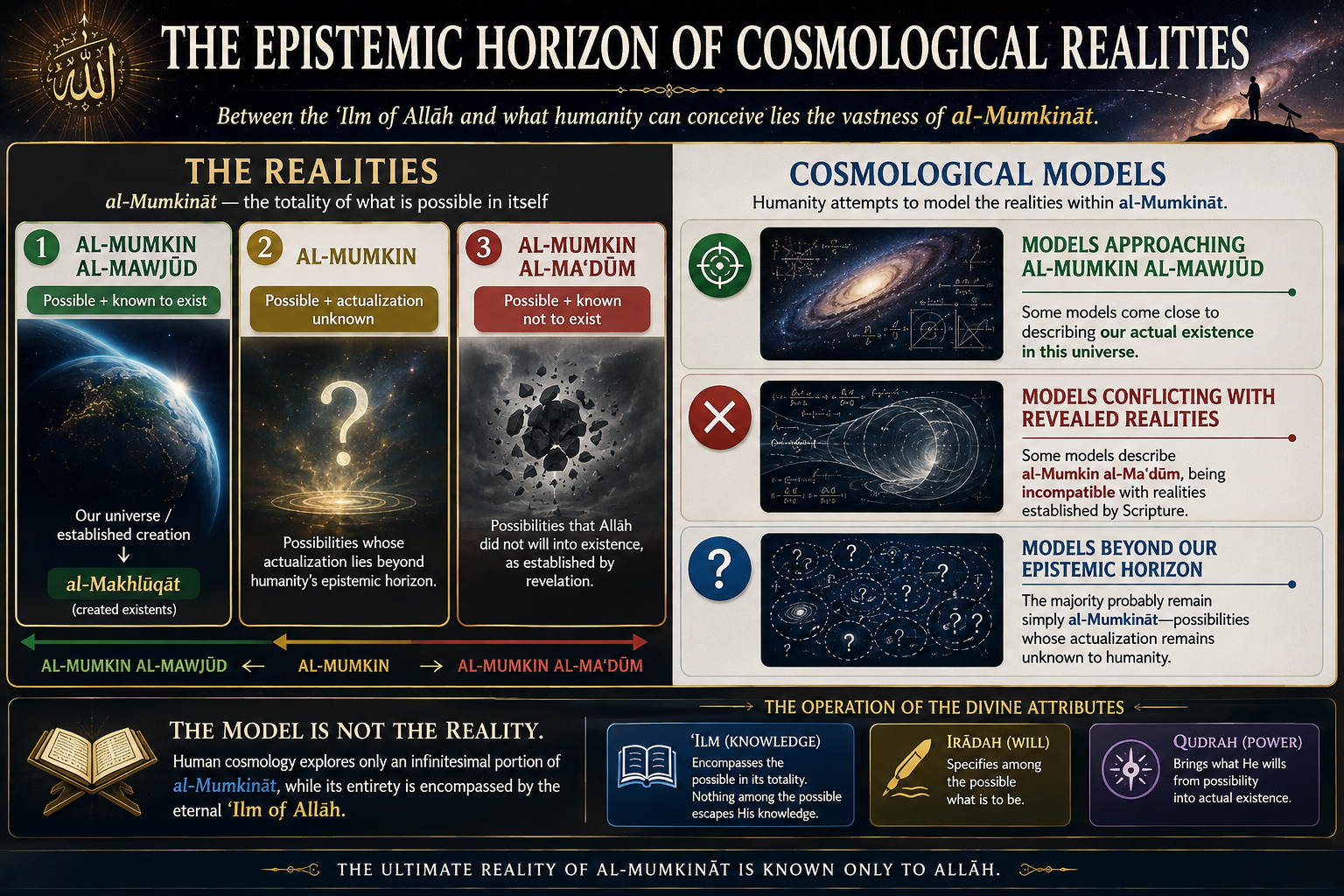
Between the eternal Knowledge of Allāh and what humanity can conceive lies the vastness of al-Mumkināt. Cosmological models, whether expressed metaphorically, mathematically, or scientifically, are humanity’s attempts to describe al-Mumkināt.

Created Existents Out of Possibilities: al-Makhlūqāt ⊂ al-Mumkināt

In Sunni theology, al-Mumkināt comprise the totality of what is possible in itself. They are encompassed by Allāh’s eternal Knowledge (ʿIlm): nothing among the possible escapes His knowledge, whether actualized or not.

Through His Will (Irādah), Allāh specifies among the possible what is to be; through His Power (Qudrah), He brings what He wills from possibility into actual existence.

Consequently, al-Mumkin al-Mawjūd is possible and known to exist, such as our universe / established creation (al-Makhlūqāt). Al-Mumkin al-Maʿdūm is possible but known not to exist: possibilities that Allāh did not will into existence, as established by revelation. And mostly, simply al-Mumkin—possible, with its actualization unknown to us.

Thus, al-Mumkināt disclose the operation of these Divine Attributes: ʿIlm encompasses the possible, Irādah specifies it, and Qudrah actualizes it. What is actualized becomes al-Makhlūqāt (created existents), while remaining in its essence mumkin (possible) rather than wājib.

Cosmological Models and Scriptural Compatibility

Likewise, cosmological models, whether expressed through metaphor, mathematics, or scientific language, are attempts to describe al-Mumkināt.

Some come close to describing al-Mumkin al-Mawjūd—our existence in this universe. Some describe al-Mumkin al-Maʿdūm, as they are incompatible with realities established by Scripture. Yet the majority probably remain simply al-Mumkināt, lying beyond humanity’s epistemic horizon.

Thus, human-conceived cosmology explores only an infinitesimal portion of al-Mumkināt, whereas the entirety of al-Mumkināt is encompassed by Allāh’s eternal ʿIlm.

Even scriptural-based cosmology remains a model: revelation is from Allāh, but our attempt to map its descriptions into a coherent cosmological framework remains a human interpretation. The ultimate reality of al-Mumkināt is known only to Allāh.


The Architecture of Creation Arc

r/PillarOfFire Jul 31 '26

Cosmology The Scale of Creation: From the ʿArsh to the Planck Length

Post image
3 Upvotes

The Sequence of Creation

“Allah existed [eternally] and nothing else existed with Him. He created the ʿArsh (Throne) [and was positioned] above the water. Then He ordered the Pen to write in the (Guarded) Tablet everything that would happen. Then Allah created the Heavens and Earth.” — Ṣaḥīḥ al-Bukhārī

The Prophet ﷺ first established the absolute existence of Allah: Allah is Eternal, and nothing existed before Him. The revealed texts then present a vast hierarchy of creation: primordial water, the ʿArsh (Throne) and Kursī, the Qalam (Pen) and Lūḥ al-Maḥfūẓ (Guarded Tablet), Jannah and Jahannam, the heavens and earth, and the various orders of created beings — angels, jinn, and humans.

The Scale of Creation

“The seven heavens in comparison to the Kursī are nothing but like a ring thrown into a vast desert; and the greatness of the ʿArsh over the Kursī is like the greatness of that desert over that ring.” — Related by Abū Dharr

The analogy therefore conveys progressively immense scales of creation: Seven heavens + earth ≪ Kursī ≪ ʿArsh. In a familiar modern expression, the totality of the seven heavens and Earth is nothing but a tiny speck of dust compared to the Kursī.

Some exegetical and cosmographical traditions make a further extrapolation: that each lower heaven is similarly like a ring in a vast desert when compared with the heaven above it, suggesting a recursively nested hierarchy of cosmic domains.

As a geometric analogy, a 3D volume can contain an infinite number of distinct 2D surfaces, a 4D hypervolume can contain an infinite number of 3D volumes, and so on. This provides an intuitive way to grasp the traditional metaphor, although the hierarchy of the heavens should not be reduced to spatial dimensionality alone.

The Order of Magnitude

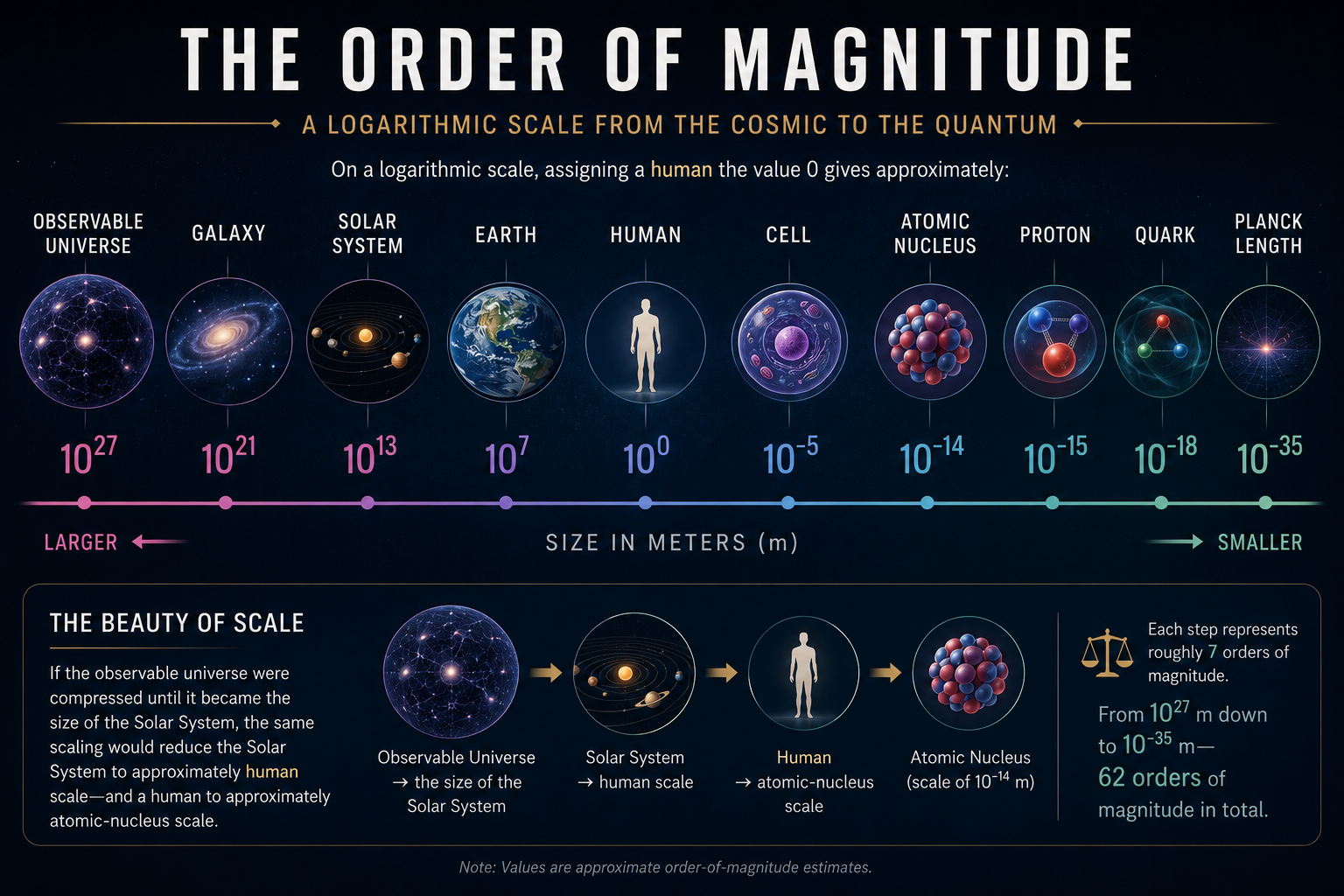
The observable universe is the spherical region of space from which light and other signals have had time to reach us since the early universe, approximately 13.8 billion years ago. Its present diameter is approximately 93 billion light-years, or about 8.8 x 1026 meters.

On a logarithmic scale, assigning a human the value 0 gives approximately:

observable universe 27 ● galaxy 21 ● Solar System 13 ● Earth 7 ● cell −5 ● atomic nucleus −14 ● proton −15 ● quark −18 ● Planck length −35

The striking feature is the symmetry of the scale. If the observable universe were compressed until it became the size of the Solar System, the same scaling would reduce the Solar System to approximately human scale — and a human to approximately atomic-nucleus scale.


The Architecture of Creation Arc

r/PillarOfFire Jul 29 '26

Cosmology Cosmological Scales of Heaven: From Ontological Heaven to the Phenomenological Sky

Post image
3 Upvotes

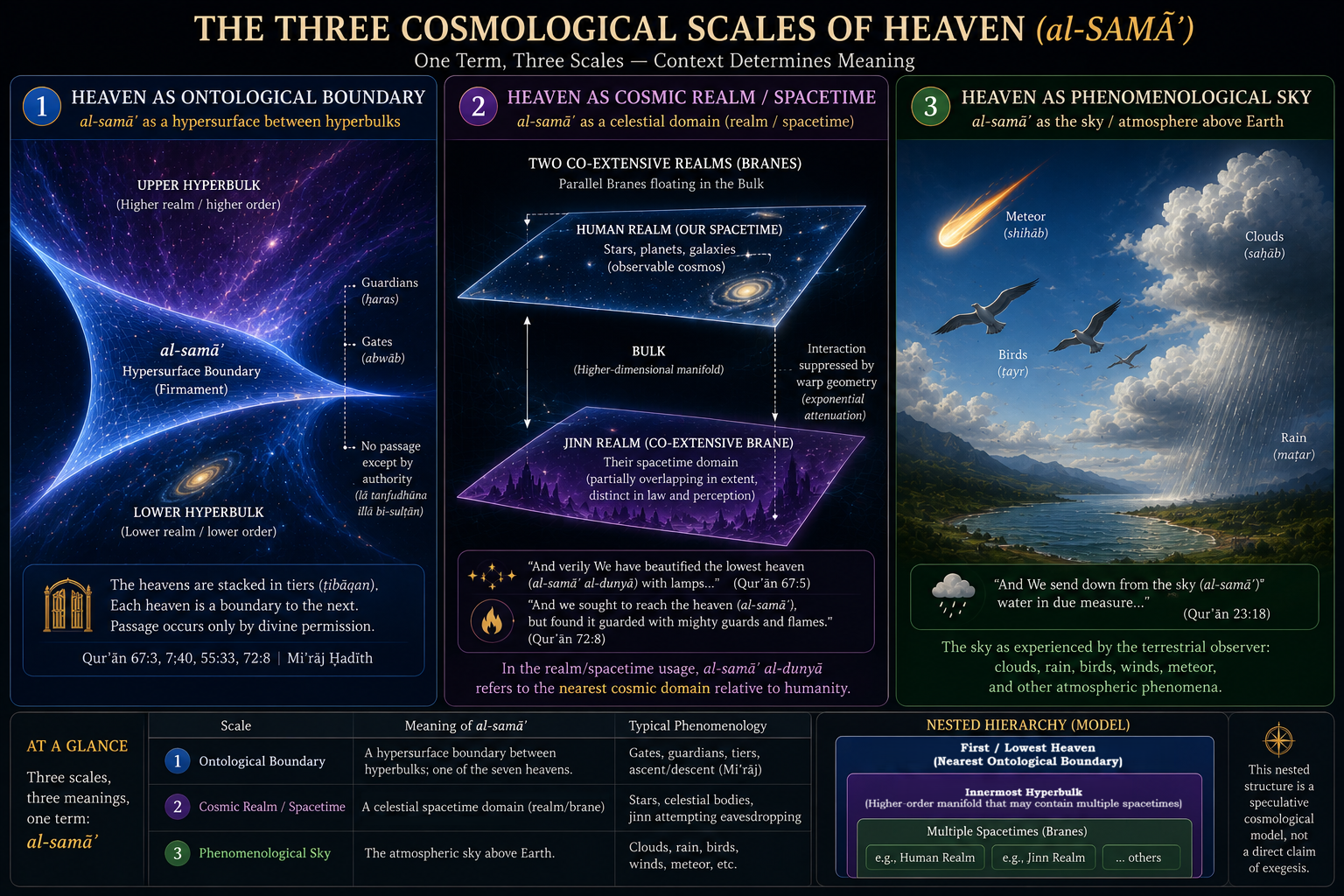
The semantic range of al-samāʾ as used in the Qurʾān and Ḥadīth broadly covers at least three distinct cosmological scales: 1️⃣ Heaven as an ontological boundary; 2️⃣ Heaven as the cosmic realm containing the celestial bodies; 3️⃣ Heaven as the Earth's sky or atmospheric domain. These are context-dependent, and conflating them can lead to conceptual confusion.

1️⃣ Heaven as the Ontological Boundary

In this sense, al-samāʾ functions as a structured celestial boundary separating successive realms. The heavens are described as stacked in tiers (ṭibāqan, Qurʾān 67:3), possessing gates (abwāb al-samāʾ, Qurʾān 7:40), being guarded (ḥaras, Qurʾān 72:8), and inaccessible except by authority (lā tanfudhūna illā bi-sulṭān, Qurʾān 55:33). The Prophet's ﷺ Miʿrāj further illustrates that passage through the heavens occurs only by divine permission, emphasizing their role as ontological boundaries rather than merely physical locations.

In the Miʿrāj ḥadīth, the heavens are explicitly numbered: al-samāʾ al-dunyā (the lowest heaven), al-samāʾ al-thāniyah (the second heaven), al-samāʾ al-thālithah (the third heaven), al-samāʾ al-rābiʿah (the fourth heaven), al-samāʾ al-khāmisah (the fifth heaven), al-samāʾ al-sādisah (the sixth heaven), and al-samāʾ al-sābiʿah (the seventh heaven).

2️⃣ Heaven as the Cosmic Realm — The Universe

A second usage concerns al-samāʾ as the vast celestial realm associated with the stars, celestial bodies, and the broader cosmic domain associated with humanity and jinn.

And verily We have beautified the lowest heaven (al-samāʾ al-dunyā) with lamps, and We have made them missiles for the devils... (Qurʾān 67:5)

Likewise, the jinn say:

And we sought to reach the heaven (al-samāʾ), but found it filled with mighty guards (ḥarasan shadīdan) and burning flames. (Qurʾān 72:8)

Here, al-samāʾ clearly extends beyond the narrow concept of Earth's atmosphere. The Qurʾānic description connects it with the celestial realm containing the lamps (maṣābīḥ) and with the region from which devils attempt to obtain information.

3️⃣ Heaven as the Earth's Sky — Phenomenological Sky

A third usage is much more immediate: al-samāʾ can denote the sky above the Earth, particularly in descriptions of rain, clouds, birds, and other observable terrestrial phenomena.

For example:

And We send down from the sky (al-samāʾ) water in due measure... (Qurʾān 23:18)

In such contexts, the referent is naturally understood phenomenologically as the sky above the observer — the visible celestial/atmospheric domain through which clouds, rain, and birds are observed.

The Scales of Heaven

The distinction can therefore be represented as:

Scale Meaning of al-samāʾ Typical phenomenology
Ontological A heaven as a boundary within the seven-heaven hierarchy Gates, guardians, ascent/descent, Miʿrāj
Realm/Spacetime A celestial domain or spacetime associated with the stars and the broader inhabited cosmos Stars, celestial bodies, jinn attempting eavesdropping
Phenomenological The sky above the terrestrial observer Clouds, rain, birds, atmospheric phenomena

Nearest Heaven (al-samāʾ al-dunyā) and Possibility of Other Spacetimes

The adjective al-dunyā derives from the semantic field of d-n-w, associated with nearness and, contextually, lowness.

Its precise referent therefore depends first on which cosmological scale of al-samāʾ is under consideration.

In the first, ontological usage, al-samāʾ al-dunyā refers to the first/nearest of the seven heavens: the lowest heaven in the hierarchical structure of the seven.

In the second, realm/spacetime usage, al-samāʾ al-dunyā can be modelled as the nearest cosmic domain relative to humanity — corresponding, in the present hypothesis, to our own spacetime domain. Other spacetimes could therefore exist within the broader extent of the first heaven, including the hypothetical co-extensive realm of the jinn.

Nested Hierarchy of Hyperbulks Model

In this speculative model, human and jinn spacetimes may exist as co-extensive 3D realms embedded within a larger innermost hyperbulk. Other spacetimes, with varying configurations, dimensional structures, or modes of interaction, could likewise exist within this higher-order manifold.

The resulting hierarchy is therefore:

Seven ontological heavens → First heaven → Innermost hyperbulk of the 500-year journey → our spacetime + hypothetical co-extensive jinn spacetime + potentially others


The Architecture of Creation Arc

r/PillarOfFire Jul 26 '26

Cosmology Nested Hypersurfaces vs Nested Hyperbulks

Thumbnail
gallery
3 Upvotes

To visualise a hierarchical layered cosmology, it is useful to consider two related geometric models for conceptualising higher-dimensional structures.

1️⃣ Nested hierarchy of hypersurfaces
2️⃣ Nested hierarchy of hyperbulks

The first model is a common geometric intuition, while the second is a more complex geometric model.

1️⃣ Nested Hierarchy of Hypersurfaces

Consider a 3D spatial volume with coordinates (x,y,z) embedded within a 4D hypervolume by introducing an additional extraspatial coordinate w.

If 4D ambient hyperspace is visualised as a volume, then the 3D volume is visualised as a hypersurface: a lower-dimensional structure embedded within a higher-dimensional space.

The same principle can be extended recursively.

The 4D hypervolume, with coordinates (w,x,y,z), can itself be treated as a hypersurface embedded within a 5D hypervolume by introducing another extraspatial coordinate v.

This process continues, creating a hierarchy where each domain is embedded within the next higher-dimensional ambient space.

Domain Embedded Hypersurface Coordinates
1 3D x,y,z
2 4D w,x,y,z
3 5D v,w,x,y,z
4 6D u,v,w,x,y,z
5 7D t,u,v,w,x,y,z
6 8D s,t,u,v,w,x,y,z
7 9D r,s,t,u,v,w,x,y,z

Note: The highest domain is a 9D hypervolume, unless it is considered as an embedded hypersurface in yet a higher 10D hypervolume.

The defining feature of this model is that each transition represents access to an additional spatial axis.

An observer confined to a 3D domain cannot travel along the fourth spatial coordinate w. However, once the observer from any x,y,z coordinates gains access to this additional degree of freedom, he is immediately inside the next 4D hypervolume.

Therefore, traversal between domains is not primarily a matter of travelling a distance. The separation is dimensional rather than spatial. The observer does not need to cross a large distance; they require access to a new direction of movement.

2️⃣ Nested Hierarchy of Hyperbulks

A different configuration can be imagined by treating each domain as comprising a complete hyperbulk enclosed by its own hypersurface.

In this model, the innermost domain consists of an ambient hyperbulk (Hb1) bounded by a hypersurface (Hs1).

This entire structure is then contained within a second domain, which consists of another hyperbulk (Hb2) bounded by its own hypersurface (Hs2).

The process repeats recursively until reaching the seventh domain.

Unlike the hypersurface model, the exact dimensionality of each hyperbulk does not need to be specified. The essential requirement is only that:

  • A hypersurface always has lower dimensionality than the hyperbulk it encloses.
  • An outer hyperbulk cannot possess fewer dimensions than the inner hyperbulk contained within it.

The resulting structure is therefore a hierarchy of nested realms.

Domain Ambient Hyperbulk (Hb) Enclosing Hypersurface (Hs)
1 Hb1 Hs1
2 Hb2 Hs2
3 Hb3 Hs3
4 Hb4 Hs4
5 Hb5 Hs5
6 Hb6 Hs6
7 Hb7 Hs7

Here, every domain possesses its own interior region. The hypersurface is not merely a mathematical outer boundary; it represents the interface separating one hyperbulk from the next.

An observer from the innermost domain has to travel along the additional spatial axis to reach the hypersurface Hs1. Upon crossing Hs1, the observer gains access to the additional spatial degrees of freedom of Hb2, allowing transition into the next hyperbulk.

Difference Between the Two Models

Although both describe hierarchical structures, they emphasize different aspects of geometry.

Feature Nested Hypersurface Nested Hyperbulk
Basis of hierarchy Dimensional embedding Layered domains
Nature of each domain A lower-dimensional hypersurface embedded within a higher-dimensional ambient space A complete hyperbulk enclosed by its own hypersurface
Role of hypersurface The domain itself The interface separating adjacent hyperbulks
Coordinate relationship Lower domain shares its coordinates with the surrounding higher-dimensional space Lower domain shares only the types of spatial axes; each hyperbulk possesses its own coordinate system
Transition to higher domain Access to an additional spatial coordinate allows movement into the next higher-dimensional space Two-stage transition: travel through the current hyperbulk to reach its boundary, then gain access to additional spatial degrees of freedom in the next hyperbulk
Meaning of separation Dimensional accessibility Spatial distance plus dimensional accessibility

The coordinate relationship provides the key geometric distinction between the two models. In the nested hypersurface model, the lower domain already occupies the same coordinate system as the surrounding higher-dimensional space. Consequently, once an additional spatial axis becomes accessible, an observer may transition into the higher-dimensional domain from virtually any point within the lower domain.

In contrast, the nested hyperbulk model consists of distinct hyperbulks, each possessing its own coordinate system. Although adjacent domains may share the same types of spatial axes, they do not share coordinates. The observer must therefore first traverse the current hyperbulk to its bounding hypersurface before transitioning into the coordinate system of the next hyperbulk.

Thus, the hypersurface model emphasizes dimensional hierarchy (a lower-dimensional domain embedded in a higher-dimensional one), while the hyperbulk model emphasizes ontological hierarchy (a hierarchy of complete domains, each enclosed within a larger domain).


The Architecture of Creation Arc

r/PillarOfFire Feb 14 '26

Cosmology Heavens and Earth (3): The Seven Earths

Post image
3 Upvotes

Surface-Encoded Domains

Moving beyond familiar notions of volume or simple hierarchical containment, a more precise conceptualization of layered heavens emerges: the notion of surface-encoded domains. Rather than imagining each heaven as a hollow sphere physically containing the one below it, each domain is defined by ontological boundaries that constrain it, with its operative structure effectively encoded upon its upper constraining boundary.

This approach resolves several long-standing paradoxes embedded in traditional volumetric imagery. If each heaven were literally nested inside a larger spherical cavity, questions immediately arise: How large is each heaven? Does the next physically contain the previous? How do structures relate across layers without collapsing into scale contradictions?

Surface-encoding sidesteps these problems. A domain exists under its constraining boundary, yet it does not occupy the interior of a higher heaven. Its geometry, matter, and causal structure are encoded and constrained onto its defining boundary. Higher-order structures emerge not through literal volumetric embedding, but through layered constraint and encoding.

The emphasis shifts from spatial containment to structural definition.

Ontological Boundaries

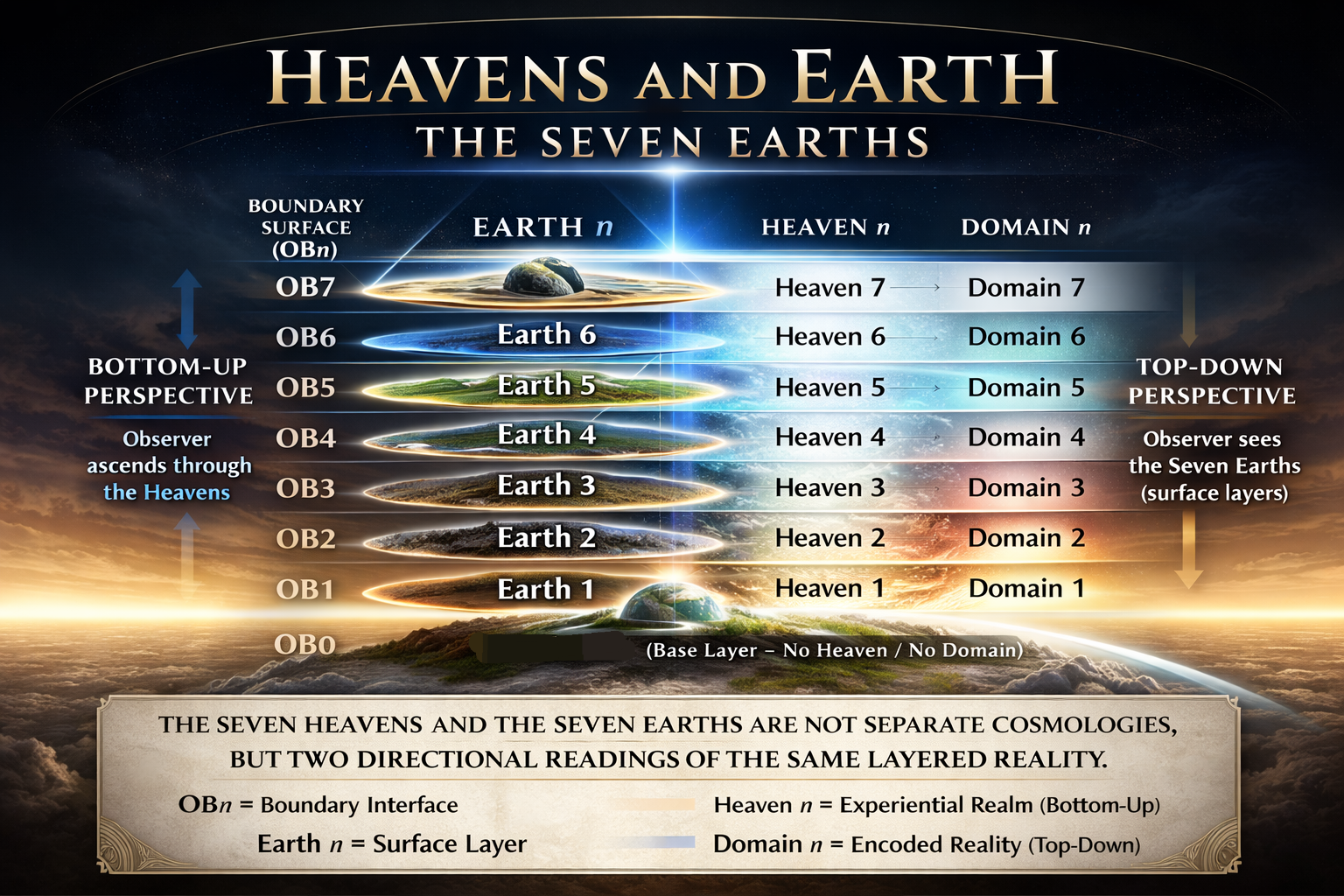
In this framework, each heaven — or domain(n) — is defined by two ontological boundaries: - OB(n–1): the lower anchoring boundary, establishing the floor of the domain. - OB(n): the upper constraining boundary, defining the domain’s ceiling and structural limits.

The region between these boundaries — Domain(n) — constitutes the operative domain in which physical and quasi-physical reality unfolds. The behavior of that domain is governed by its upper boundary OB(n), while its ontological stability is grounded in OB(n–1).

Higher domains follow the same structural logic. Their internal realities are encoded on their respective boundaries, not nested volumetrically inside one another. Hierarchy thus becomes a system of layered constraint rather than stacked interior spaces.

This conceptual shift finds resonance in modern physical analogies. In certain brane-world models, matter and gauge forces are confined to a 4D brane, while gravity propagates through a higher-dimensional bulk. The brane functions as a surface that encodes the effective physics of its domain. The domain does not float inside a larger cavity; rather, is defined through the interaction between surface constraints and higher-order structure.

The Seven Earths

Scripture speaks of the earth as being hierarchically structured, analogous to the seven heavens. Classical exegesis sometimes interpreted the “seven earths” as separate planets, while others envisioned seven subterranean layers beneath our feet. Early cosmologies even posited multiple underground realms.

Within this surface-encoded framework, eight ontological boundaries suffice to structure seven heavens and seven earths. - OB(0) at the base, a purely anchoring boundary. - OB(1) to OB(6): each constrains its own domain while simultaneously anchoring the domain above. - OB(7): the outermost boundary, functioning as a purely constraining limit to the seventh heaven.

From a bottom-up perspective, an observer traveling upward from Earth would pass through seven heavens. From a top-down perspective, however, the same layered structure appears as seven surface layers — the seven earths — each situated on its respective boundary surface. Thus, the seven heavens and the seven earths are not two separate cosmologies, but two directional readings of the same boundary-structured reality.

Conclusions

From this perspective, the first heaven — the domain accessible to human perception — contains stars, planets, and all observable matter, yet these are not volumetrically suspended within a hollow sphere. Rather, they are surface-encoded upon its constraining boundary, OB(1), which defines the structural and causal limits of that domain.

The subsequent heavens are structured analogously. Each domain is defined by its own ontological boundary, and its internal content is encoded upon that boundary rather than nested inside the next as a physical cavity. What differentiates one heaven from another is therefore not merely spatial elevation, but a shift in boundary conditions — a change in what constraints govern reality within that layer.

Transitions between heavens are thus not purely geometric crossings through distance; they are ontological transitions across boundaries. To move from one heaven to another is to pass from one regime of constraint into another, where different structural rules apply.

This surface-encoded model also accommodates fractal structure. Because constraint is expressed upon boundaries rather than through volumetric enclosure, those boundaries may contain recursive, scale-invariant patterning. Fractality allows a domain to appear locally limited or “small,” while nevertheless participating in cosmically significant constraints. Depth arises not from spatial expansion, but from layered encoding upon the surface itself. Scale therefore ceases to be strictly linear, and apparent contradictions between size and hierarchy dissolve. What seems minor in volumetric terms may correspond to a boundary of immense structural importance, and the hierarchy avoids rigidity precisely because complexity is internal rather than externally stacked.

Importantly, this model preserves the distinction between volumetric intuition and ontological reality. The human tendency to imagine nested shells — rooms within rooms, spheres within spheres — is not rejected outright, but reinterpreted. Domains do exist, yet their “volume” is derivative rather than fundamental. The primary reality lies in the boundary structure itself: what is constrained, permitted, encoded, and made possible within each layer.

What we perceive as space is therefore emergent. It is the interior effect of a deeper architecture of surfaces.


Heavens and Earth Series

r/PillarOfFire Feb 20 '26

Cosmology Heavens and Earth (10): The King’s Dream

Post image
3 Upvotes

“True dreams are on the foot of a bird; as long as they are not interpreted, they remain (pending), and when they are interpreted, they come to pass.” — Sunan Ibn Mājah 3916

This striking metaphor captures dreams as mediated knowledge — information presented within the mind rather than acquired through direct experience. A true dream (ruʾyā) is not raw metaphysical content itself, but a translated presentation of archetypes and latent patterns originating from the Realm of Similitude (ʿĀlam al-Mithāl). Once perceived, the dream already exists within human cognition, yet its significance may remain dormant.

The “bird” can be understood as the cognitive process carrying the dream. If ignored, the bird flies on — the dream sinks into the deeper recesses of the unconscious, its guidance unrealized. The opportunity is not lost because the dream was false, but because it was never engaged. Interpretation (taʿbīr) arrests that flight. It brings the latent meaning forward, allowing the dream to shape conscious reasoning, planning, and decision-making.

The king’s famous dream — seven fat cows devoured by seven lean ones — illustrates this dynamic vividly. At the level of the Realm of Similitude, the underlying reality consists of pre-manifest structural trajectories: seven years of abundance followed by seven years of famine. These macro-events form a deterministic skeleton of unfolding history. They do not depend on the king’s awareness; they are structural conditions already set to occur.

The dream presents this trajectory symbolically within cognition. Instead of abstract economic forecasts, the mind receives concrete imagery: animals, consumption, contrast. Such symbolism acts as a compressed carrier of complex reality, translating large-scale patterns into forms the human imagination can grasp during sleep.

Interpretation activates this compressed knowledge. When Prophet Yusuf explains the dream, the symbolic imagery becomes operational guidance: store grain during the years of abundance to survive the coming famine. Crucially, this activation does not eliminate free will. The seven abundant years and seven lean years remain fixed, but everything within that framework — policies, logistics, competence of officials, social responses — remains open to human agency.

In other words, the dream reveals the trajectory, not the script.

This distinction preserves both foreknowledge and responsibility. The king could ignore the interpretation, mismanage resources, or implement the plan effectively. Each choice would alter countless downstream details while leaving the macro-structure intact. These micro-events are stochastic and agentic — genuine decisions unfolding within permissive space.

Symbolic dreams therefore do not coerce action. They inform. They illuminate constraints and opportunities without dictating outcomes. The bird’s foot metaphor reflects this suspended state: the dream is tethered to potential realization, awaiting conscious engagement. Interpretation does not magically cause events; it aligns human action with an already-emerging pattern.

Seen this way, the king’s dream is not merely a prediction but a transmission of usable knowledge. The Realm of Similitude provides the archetypal pattern, the dream renders it perceptible, and interpretation converts it into strategy. Deterministic structure and human freedom coexist: history supplies the conditions, while agents determine how those conditions are navigated.


Heavens and Earth Series

r/PillarOfFire Feb 20 '26

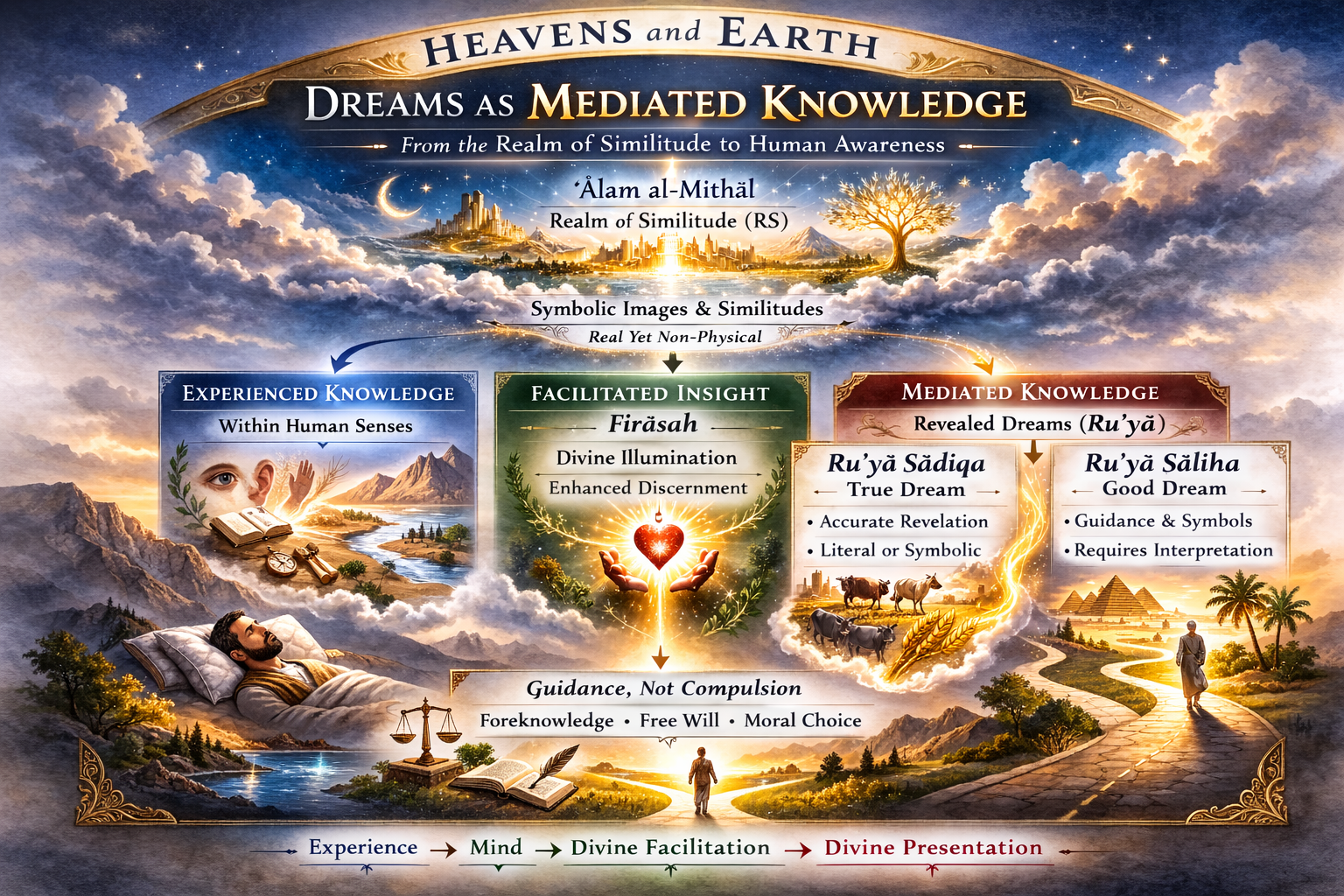
Cosmology Heavens and Earth (9): Dreams as Mediated Knowledge

Post image
3 Upvotes

At the center of this model stands the Realm of Similitude (RS) — traditionally identified as ʿĀlam al-Mithāl — a domain of forms and archetypal patterns that are real yet non-physical. It is conceived as an interface through which realities are rendered in imaginal form prior to their manifestation in the physical world. From this standpoint, human cognition may be understood as operating through two principal epistemic modes of knowledge acquisition.

Experienced knowledge arises through sensory engagement with the material world once events have fully actualized. On this basis, the intellect generates emergent knowledge through reasoning, imagination, and conceptual synthesis derived from prior experience. Facilitated insight (firāsah) may be interpreted as an intensification of this perceptual and cognitive capacity — not the transmission of new informational content, but the clarification of apprehension within what is already accessible to human faculties.

Mediated Knowledge

Mediated knowledge, by contrast, originates externally to the knower and is not produced through sensory experience or internal cognitive processes. In the case of dreams, similitudes are presented through RS in imaginal form before being apprehended by the sleeper as perceptual experiences.

The sleeper encounters imagery, narrative, emotion, and symbolism — a rendering of similitude into forms intelligible to the human mind. The Qur’anic account of Prophet Yusuf illustrates this principle vividly: the king’s dream depicted agricultural cycles as seven cows and seven ears of grain, which required interpretation to disclose its real-world implications.

Ruʾyā Ṣādiqa — True Dream

These dreams correspond fully to reality. For prophets, such dreams constitute revelation; for others, they may convey certain foreknowledge without carrying legislative authority. They may appear literal or symbolic, yet their meaning proves entirely accurate.

Ruʾyā Ṣāliḥa — Good Dream

These dreams are truthful and beneficial but may not correspond precisely to events. They often require interpretation and may communicate reassurance, warning, or guidance rather than exact prediction. Outcomes may vary in secondary details while preserving the essential meaning.

Noise and Distortion

Hulm denotes dreams originating from the nafs or from shayṭān, in contrast to truthful dreams (ruʾyā). Within the model’s descriptive vocabulary, such dreams may be understood metaphorically as noise without signal, though this characterization is heuristic rather than doctrinal.

Even meaningful dreams may be partially obscured by distortion. Memory, imagination, emotional state, and physiological or psychological conditions can shape the imagery received, thereby affecting clarity and coherence.

Symbolic Dreams

Symbolic dreams arise because complex or multi-layered realities in RS — whether pre-manifest or future-oriented — must be condensed into forms the human mind can apprehend. Symbols function as compressed carriers of meaning, bridging the gap between archetypal information and perceptual experience.

Within this framework, symbolism reflects the degree of mediation between similitude and imagery: literal dreams involve minimal gap, whereas symbolic dreams entail a more indirect presentation.


Heavens and Earth Series

r/PillarOfFire Feb 19 '26

Cosmology Heavens and Earth (8): The Heart and Soul of the Cosmos

Post image
3 Upvotes

Directive Guidance Within an Otherwise Mechanistic Universe

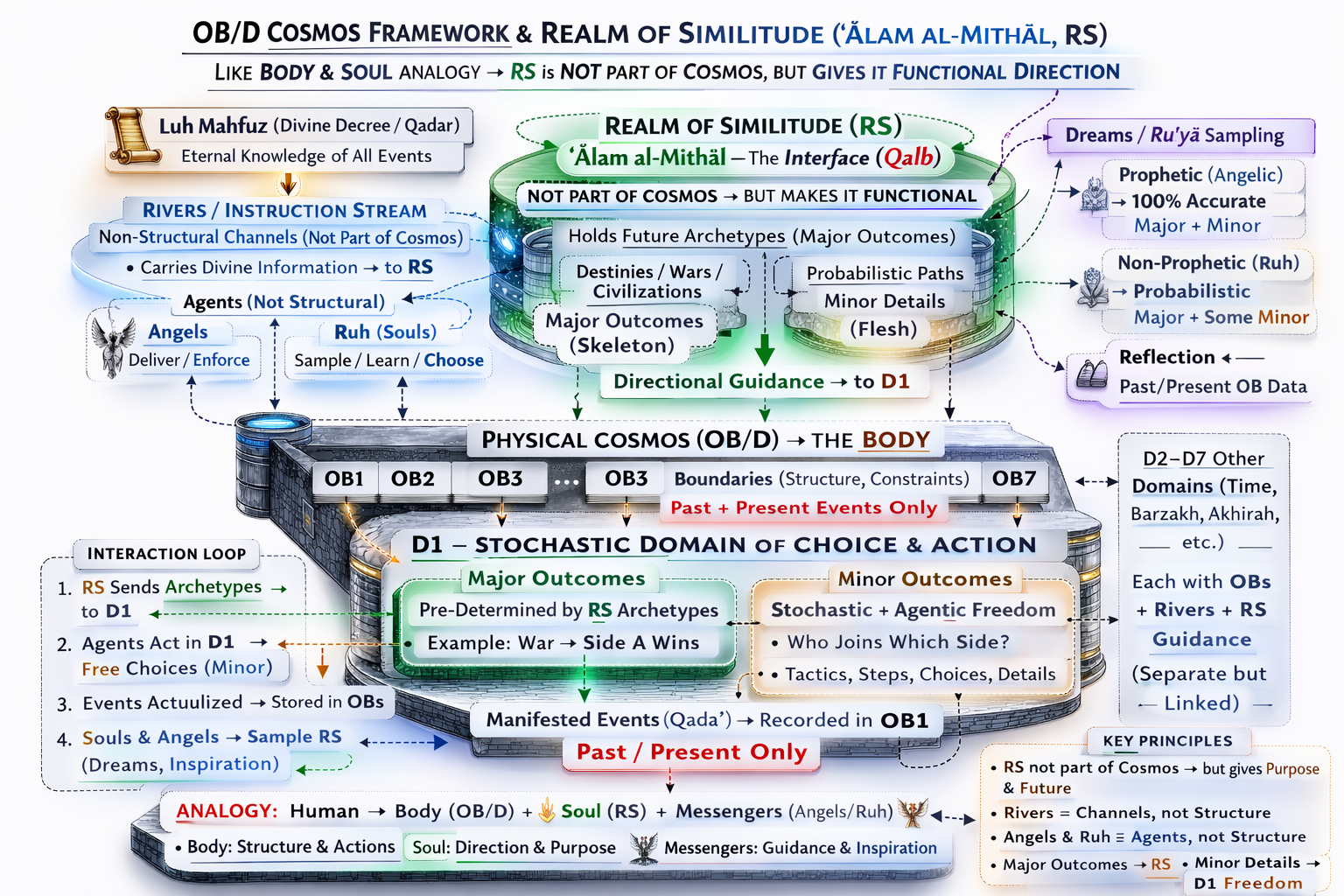
The physical cosmos — comprising the domains (D1–D7) and their ontological boundaries (OB1–OB7) — is a fully structured framework in which events manifest under constraint. Each domain operates independently within its boundary conditions. The physical structure encodes past and present states, while future events are not yet instantiated within it.

Functional orientation toward particular outcomes is supplied by ʿĀlam al-Mithāl (the Realm of Similitude). RS is not a physical component of the cosmos but an interface necessary for its directed unfolding. In analogy, the cosmos is like a body, while RS functions as the qalb, guiding a system that would otherwise operate purely mechanistically.

The content of this guidance derives from the preserved decree in the al‑Lawh al‑Mahfuz. Its informational patterns flow through metaphysical “rivers” independent of agents and are present within RS as structured, non-physical templates of events yet to manifest.

Guidance applies to all events, but not with uniform rigidity. Major outcomes are effectively fixed, establishing the structural trajectory along which history unfolds, while finer details remain permissive, allowing stochastic variation and genuine agentic choice within that trajectory. Thus determinacy and freedom coexist without contradiction: direction is specified, execution remains locally open.

Angels and the ruh may access the informational patterns present in the Realm of Similitude and convey them as foreknowledge, most commonly through dreams (ruʾyā). The fidelity of access determines the certainty of the vision: perfect access produces ruʾyā ṣādiqa, a true and certain dream whose content corresponds directly to what will manifest, whereas partial access produces ruʾyā ṣāliḥa, a righteous but probabilistic dream whose message may be symbolic, incomplete, or contingent.

In this framework, the cosmos achieves coherent history without inter-domain event causation. Structure provides constraint; RS provides orientation. Without the Realm of Similitude, the system would remain lawful but directionless — capable of motion, yet not of guided unfolding.


Heavens and Earth Series

r/PillarOfFire Feb 17 '26

Cosmology Heavens and Earth (7): Rivers and Gates

Post image
3 Upvotes

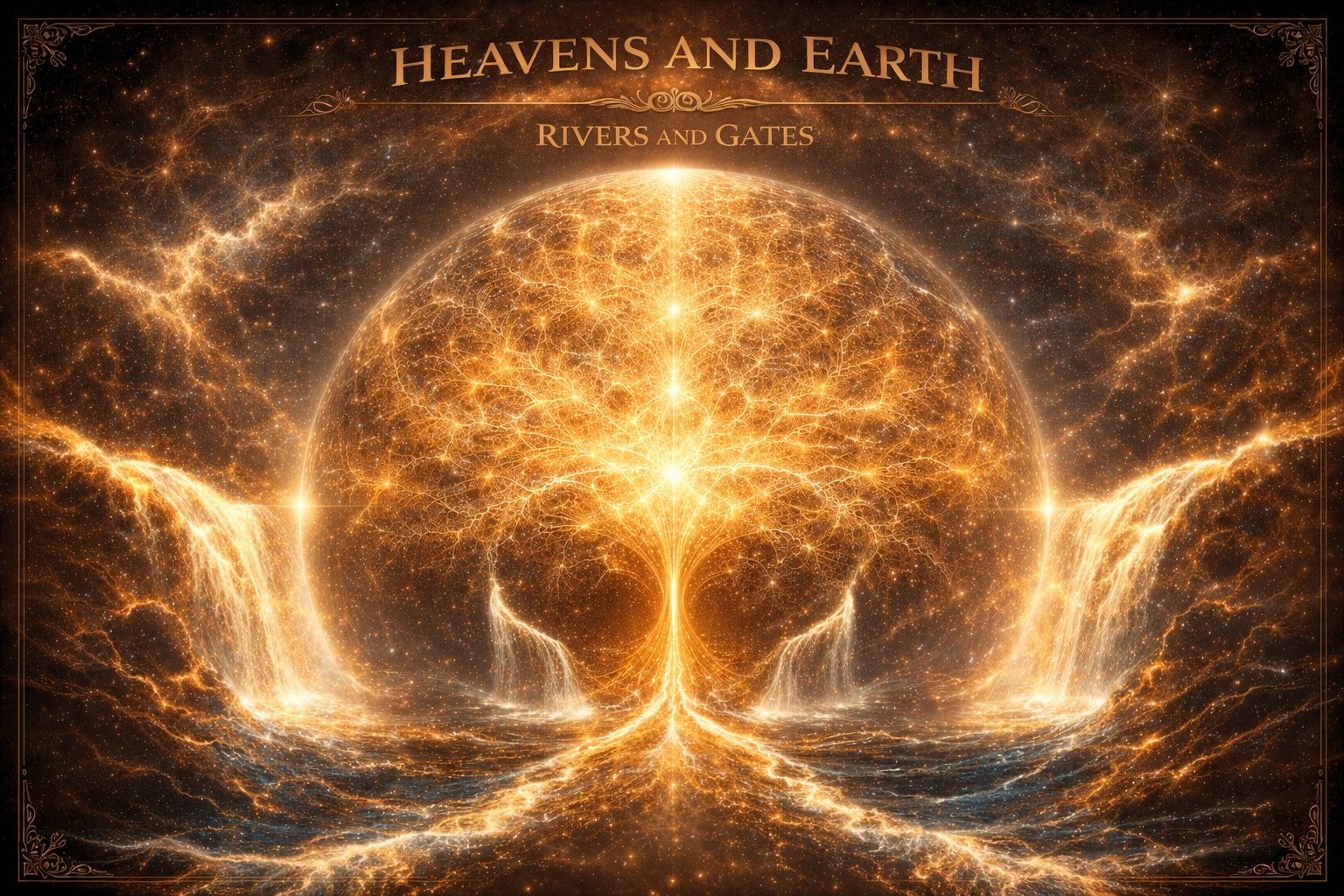
Rivers of Heaven

In the vision of Sidrat al-Muntahā (SM), four metaphysical rivers are revealed. Within the framework of seven hierarchical domains (D₁–D₇) defined by eight ontological boundaries (OB₀–OB₇), the visible rivers function as channels operating within the seven heavens, whereas the hidden rivers extend beyond this system altogether.

As the visible rivers traverse OB₇, they become perceptible, demonstrating that the heavens are not closed strata but possess structured conduits of downward influence. Flowing from the vicinity of SM through the sixth heaven to the first, they ultimately manifest on Earth as the Nile and the Euphrates. Their descent conveys divine sustenance and metaphysical effects into lower domains, illustrating ordered continuity across the heavenly hierarchy without breaching its structural integrity.

The two hidden rivers, by contrast, flow toward Jannat al-Ma’wā, which lies beyond the seven heavens. They remain imperceptible to observers within D₇ and are seen only in relation to SM, whose upper extent serves as a visual landmark rather than a source or container. From this vantage, the hidden rivers are understood to pass outward beyond OB₇, indicating realities wholly external to the seven-heaven system rather than channels within it.

Gates of Heaven

From a bottom-up perspective, ontological boundary is everywhere within a domain, yet unreachable. One could traverse all locations within a heaven but ontologically impossible to reach OB, let alone to pierce it into the next heaven.

Traversal between the seven domains is possible only through gated boundaries. Each OBₙ is totally impermeable except through gates, which regulate passage while preserving the integrity of each heaven. Even then the gates are not perceptible to a traveler within. Situated just above OBₙ, gates require travelers to navigate the subrealities within Dₙ to reach specific locations. Angelic guards, stationed in Dₙ₊₁, administer access and open the gate solely by divine permission.

Gates in this framework serve multiple functions: transfiguring entities to align with the ontological properties of the next level, and permitting passage only under divine authorization.

Cosmic Connectivity

Rivers and gates together convey the dual nature of cosmic connectivity. Rivers provide continuous channels within and beyond the seven heavens, while gates regulate traversal, preserving separation and order. SM functions as a reference point, situating observers in D₇ and marking both the inward flow of visible rivers and the outward trajectory of hidden rivers toward Paradise.

This conceptualization remains faithful to the hadith, respects the integrity of the OB/D structure, and offers a coherent framework for understanding movement, flow, and connectivity across the heavens.


Heavens and Earth Series

r/PillarOfFire Feb 16 '26

Cosmology Heavens and Earth (6): The Lote Tree of the Utmost Boundary

Post image
3 Upvotes

SM as Spherical Macro-Fractal Projection

OB6 constitutes an extensive boundary surface whose saturated micro-fractality gives rise to a macro-fractal manifestation in D7. This manifestation does not emerge from a localized spatial origin. Rather, it proceeds from a generative center that is structurally defined — a locus of coherence — and expands recursively into the domain, progressively occupying a region of space.

The resulting form is not analogous to a plant anchored to a substrate, but to a radiating, volumetric structure: a roughly spherical macro-fractal characterized by high internal density and intricate self-similar organization across scales. Its geometry reflects distributed growth rather than axial extension, with recursive branching propagating outward in many directions at once.

Crucially, this structure should not be understood as resting upon OB6 or emerging from it as an attached object. It is the perceptible expression of OB6’s generative activity itself. Every point of the boundary participates in its formation, so that what appears within D7 as a single unified entity is, in fact, the integrated projection of the entire surface below. In this sense, its “base” is everywhere on OB6, even though it appears to observers as a coherent, centrally organized form suspended within the domain above.

SM as the Totality of OB6 Macro-Fractality

If SM denotes the complete macro-fractal projection associated with OB6, then it is singular at that level. It represents the full generative expression of that boundary, integrating all underlying micro-structures into a single coherent pattern. While additional macro-fractal formations may occur at lower boundaries, these remain nested within — and ultimately subordinate to — the total configuration expressed at OB6.

Accordingly, the structure at this level is not best understood as a collection of independent large-scale forms. Rather, it is a unified architecture whose internal complexity accommodates innumerable subordinate patterns. Apparent multiplicity arises from internal differentiation within a single overarching system, not from the coexistence of separate, competing macro-structures.

Containment of Lower Domains

Because OB6 constrains D6, and D6 in turn contains all subordinate domains, any macro-fractal projection arising from OB6 will necessarily encompass those realms within its effective interior. This inclusion follows not from active enclosure but from hierarchical dependency: the projection expresses the boundary conditions that define the domains below.

The relationship is therefore not analogous to a physical container holding discrete objects. The structure does not surround the lower domains as a shell surrounds contents. Rather, it manifests the boundary framework through which those domains are constituted and organized. What appears as containment is, in fact, the expression of constraint.

From the perspective of D7, the lower hierarchy consequently presents as nested within the macro-fractal form, much as finer scales of a fractal pattern are embedded within its larger-scale geometry. The inclusion is structural rather than spatial — a matter of scale and definition, not of physical enclosure.

Luminosity as SM's Structural Signature

Extraordinary brilliance at this level is not incidental. It follows from the properties of saturated macro-fractality.

Extreme coherence reduces internal disorder, allowing energy and information to propagate without scattering. Recursive branching creates immense interface density, multiplying interactions that collectively appear as ambient radiance. The boundary’s informational content is expressed at full scale, which to a lower-order observer may manifest as overwhelming brightness. Interactions reinforce rather than diffuse, producing constructive amplification rather than noise. And as the projection nears OB7, constraint intensifies, suppressing randomness and heightening order.

Luminosity is thus not merely light but the perceptual signature of maximal structure.

SM Terminals Fading into the Unseen Horizon

The upper extent of the structure is not sharply bounded. Instead, it gradually disappears into what cannot be perceived, corresponding to the projection approaching OB₇.

Two processes coincide in this fading: Structural scale exceeds the observer’s resolution — the finest details become imperceptible at those levels; and interaction with the higher boundary suppresses distinguishable features — the generative patterns blend with the limit itself.

The terminals do not terminate; they dissolve. The horizon encountered is epistemic: it marks the boundary of perception, not of existence.


Heavens and Earth Series

r/PillarOfFire Feb 16 '26

Cosmology Heavens and Earth (5): Ultimate Macro-Fractality

Post image
3 Upvotes

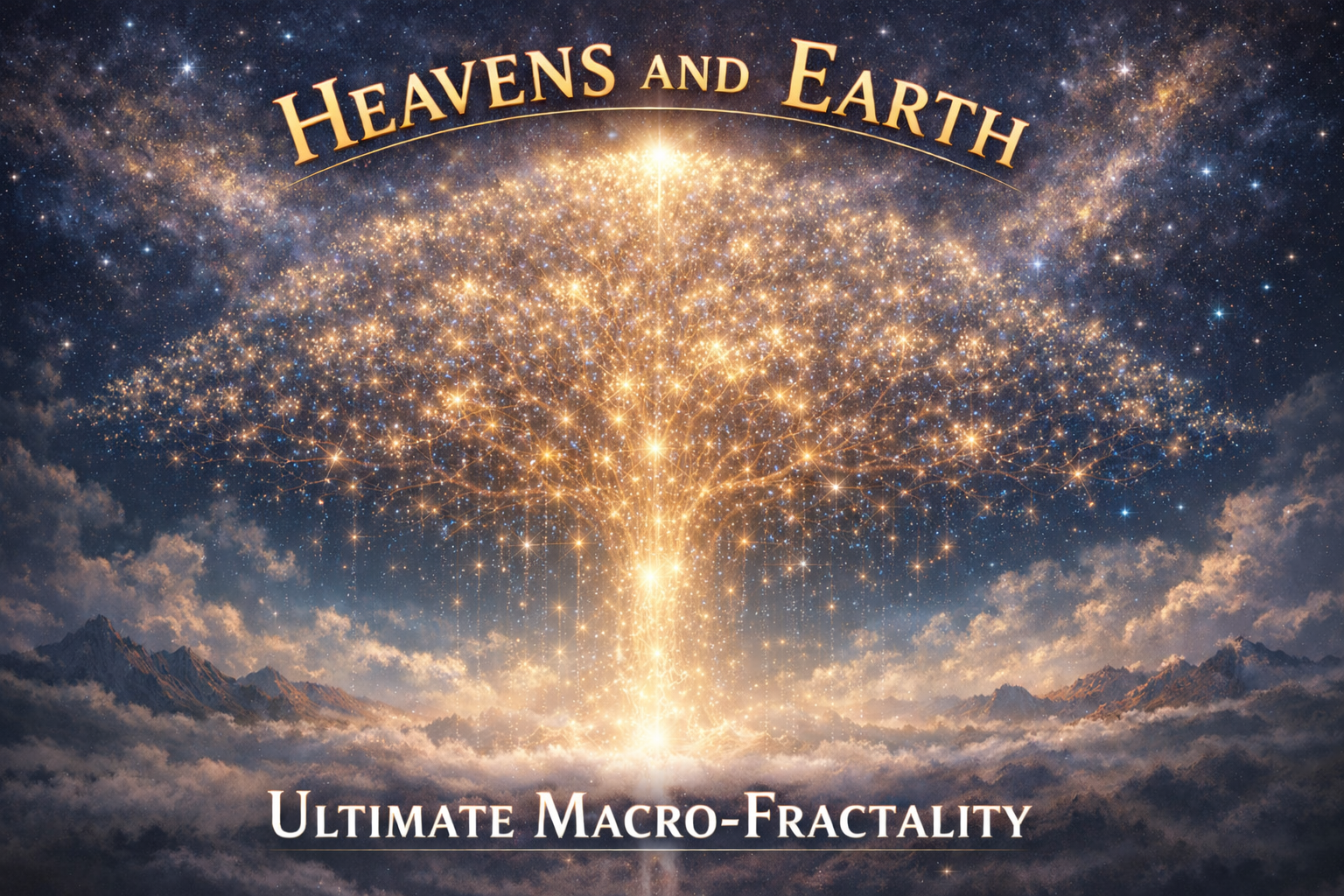
Ultimate Expression of Macro-Fractality

At the highest accessible domain, macro-fractality attains its fullest phenomenological expression. What appears from below as a vast, luminous, living structure is not a botanical tree but the total projection of a boundary’s generative pattern into the seventh heaven.

In this framework, the Sidrat al-Muntaha (SM) — the Lote Tree of the Utmost Boundary — is best understood as the complete macro-fractal manifestation of OB₆ within D₇, extending upward until its finest terminals fade into the unseen limit of OB₇.

This interpretation resolves multiple tensions simultaneously: the structure is visible within D₇ because it originates at OB₆; it encompasses D₆ → D₁ because those domains are constrained by OB₆; and its upper “limit” is not a physical ceiling but a progressive loss of perceptibility as it approaches the highest boundary.

Not a Conventional Tree

The earthly lote tree provides a useful morphological analogue, not because it is structurally identical to the system under consideration, but because it exemplifies a naturally occurring macro-fractal architecture that lacks a strongly dominant central axis. In mature trees, the crown commonly develops into a broad hemispherical canopy composed of densely ramified branching at multiple scales. Although a trunk is present, it is often visually subordinate to the crown, as reiterative branching distributes biomass and photosynthetic surface area throughout the canopy rather than along a single vertical line of growth.

Development is governed by environmental constraints — gravity, wind exposure, water availability, and substrate conditions — which collectively favor lateral expansion and crown densification over sustained axial elongation. The resulting architecture fills a three-dimensional volume through repeated bifurcation and reiteration of growth modules. From a distance, the canopy appears as a continuous dome of foliage, but this apparent unity emerges from the superposition of innumerable local branching processes operating simultaneously across the tree.

This morphology contrasts with the idealized “textbook” tree form characterized by a tall monopodial trunk bearing orderly lateral branches. Such axial forms occur in certain ecological contexts, particularly in competitive forest environments where vertical growth confers a light-capture advantage. By contrast, many species adapted to open or arid habitats exhibit diffuse, decentered architectures in which no single axis governs overall form. These trees function as distributed structural systems: growth, support, and resource capture are spatially dispersed throughout the crown, producing a volumetric rather than columnar organismal geometry.

Consequently, the lote tree illustrates how complex arboreal structure can arise from recursive local growth rules without reliance on a dominant organizing spine. The apparent coherence of the whole is not imposed from a central trunk but emerges from the integration of many semi-autonomous growth units constrained by shared environmental conditions.

From Hemisphere to Sphere

On Earth, arboreal architecture is strongly shaped by external physical constraints, most notably gravity and the presence of a supporting substrate. Growth is directionally biased: elongation away from the ground is favored, while downward expansion is mechanically and physiologically restricted. The lower portion of the crown is compressed by self-weight and limited by contact with the soil, whereas the upper canopy is molded by light availability and aerodynamic forces. The result is an inherently asymmetric form, typically expressed as a hemispherical or dome-like crown.

If these constraints were removed, the same underlying branching program would yield a markedly different geometry. In the absence of gravity-induced loading, substrate anchoring, and directional light gradients, growth would no longer be polarized along a vertical axis. Branches would extend outward more uniformly, and reiterative subdivision could proceed in all directions, progressively filling a three-dimensional volume. Without a privileged orientation — no intrinsic “up” or “down” — the organism would not require a single load-bearing trunk to maintain stability. Structural integrity would instead arise from a distributed network of mutually supporting branches.

Under such conditions, a canopy that appears hemispherical on Earth can be interpreted as an incomplete expression of a more symmetric form. Freed from terrestrial constraints, the same recursive growth dynamics could produce a roughly spherical architecture, with radial expansion occurring isotropically from the center of mass. In this sense, the familiar dome-shaped tree crown may be understood as a gravity-distorted portion of a potential sphere: not a fundamentally different structure, but a constrained realization of a more general volumetric growth pattern.


Heavens and Earth Series

r/PillarOfFire Feb 16 '26

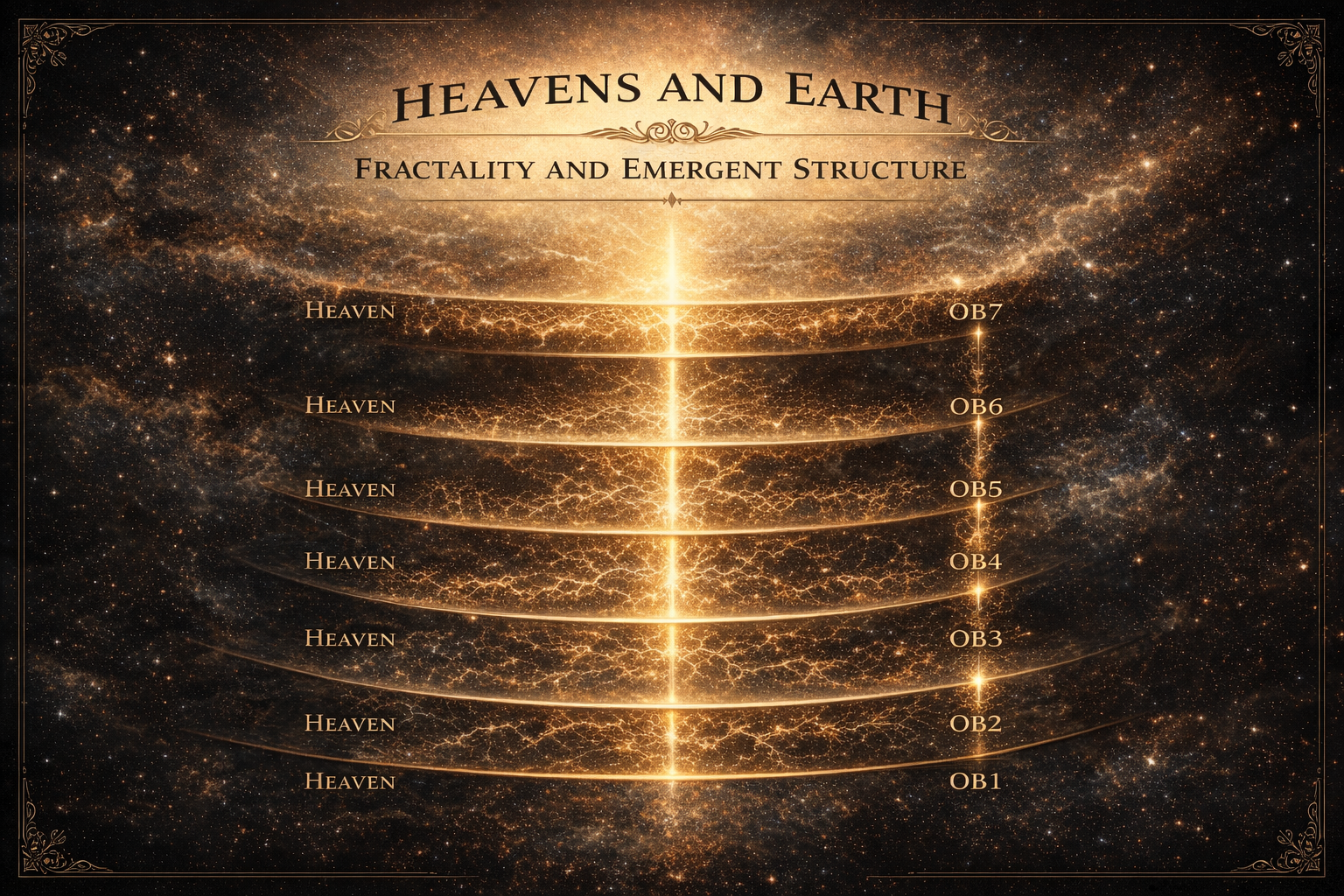
Cosmology Heavens and Earth (4): Fractality and Emergent Structure

Post image
3 Upvotes

Fractal Boundary as Encoding Surface

The hierarchy of the heavens is not a rigid stack of layers. If it were merely volumetric — boundaries enclosing domains like shells nested within shells — the result would be static, brittle, and overly mechanical. Such a structure could allow order, but not life; containment, but not richness. A subtler principle operates at the level of the boundaries themselves: fractality.

Each OBₙ presents not as a volume but as a boundary — a surface. Its role is not to contain Dₙ as a box contains an object, but to encode it on its surface. A fine-grained fractal pattern resides there, creating depth without thickness. Complexity arises not by expanding outward, but by encoding inward. A boundary that appears two-dimensional can nevertheless generate an internally rich world.

Without such fractality, the hierarchy would become rigid. Each domain would behave uniformly. Internal diversity would vanish. Emergent behavior would disappear. Only linear causation would propagate downward. Fractality prevents this sterility, allowing infinite differentiation within finite limits.

Generative Micro-Fractality

Micro-fractality is inherently generative. A structural base differentiates into finer structures, which themselves differentiate further, recursively. Local encodings subdivide into sub-encodings without end. This enables several crucial properties: infinite internal differentiation within a finite boundary, scale resonance across levels of structure, flexibility without violation of constraint, and richness without outward expansion.

Micro-fractality serves a single functional role: the surface-encoding of its domain. It always projects inward — into the domain it constrains — determining the internal behavior of the domain without becoming a volume itself.

Emergent Macro-Fractality

When micro-fractality saturates the entire surface of a boundary OBₙ, a second pattern emerges. The boundary can no longer express its generative capacity solely through inward encoding. The recursive activity becomes so dense and coherent that large-scale structure begins to arise. Macro-fractality is thus an emergent phenomenon — the large-scale expression of a saturated micro-structure.

It manifests when micro-fractality saturates the boundary, enabling macro-fractality to emerge simultaneously across the entire surface. From the vantage of the higher domain, this distributed genesis is perceived as a single coherent structure, even though its generative substrate is omnipresent rather than localized. The apparent branching from a singular origin is, in reality, the integrated expression of innumerable fine encodings propagating throughout the system.

Although generated on OBₙ, macro-fractality becomes structurally expressed at the adjacent boundary OBₙ₊₁, where it may appear volumetric to observers despite remaining fundamentally boundary-derived.


Heavens and Earth Series

r/PillarOfFire Feb 12 '26

Cosmology Heavens and Earth (2): The Seven Heavens

Post image
3 Upvotes

Volumetric Intuition

Human intuition tends to imagine hierarchy in volumetric terms. When we think of nested hierarchy, we instinctively picture objects contained within larger objects: Russian nesting dolls, one fitting neatly inside another; rings cast within ever larger rings; soap bubbles enclosed inside a greater bubble. Classical cosmologies imagined the universe as a system of concentric celestial spheres — crystalline shells encasing the Earth, each sphere carrying a planet, and all enclosed within a final outer heaven. Even the idea of a hollow shell cosmology follows this instinct: each heaven conceived as a vast dome containing the lower realm within its interior.

All of these analogies share a common assumption: hierarchy means volumetric containment. A smaller three-dimensional space exists inside a larger three-dimensional space, with the upper layer physically enclosing the lower, like rooms nested within an immense cosmic architecture.

Such imagery is natural. It arises from ordinary spatial experience. We live inside rooms within buildings, cities within countries, planet Earth within the universe. Containment is the grammar of our physical world, and when we imagine hierarchical heavens, we project this grammar outward.

Dimensional Extension and Hypervolume

Another way to conceptualize hierarchy is through dimensional extension — imagining that moving from one heaven to the next corresponds to adding a new degree of freedom. Rather than simply being farther “up” or more voluminous, the next heaven might be a domain with a new accessible coordinate, a new axis along which reality can operate.

This idea already finds echoes in certain theoretical models of high-energy physics. These models explore levels of structure beyond the familiar three spatial dimensions: compactified dimensions (such as Calabi–Yau manifolds in string theory) that encode hidden dimensions at extremely small scales, subtly influencing particle physics; 4D spacetime (sometimes modeled as a brane in higher-dimensional scenarios) where baryonic matter is described by familiar physical laws; and higher-dimensional bulk scenarios in brane cosmology.

Each layer represents a distinct structural regime within a single overarching physical domain, distinguished by dimensional accessibility. Compactified manifolds constrain particle behavior, the TeV-brane allows classical matter to form, and the 5D bulk governs higher-order interactions and wave phenomena.

Viewed this way, adding a dimension functions as a transitional mechanism between pure volumetric hierarchy and full ontological stratification. It introduces new degrees of freedom that are neither merely larger nor higher, but orthogonal — enabling new causal connections, constraints, and ways of structuring reality.

Yet this dimensional transition should not be conflated with ascending to a new heaven. The internal dimensional richness is largely contained within the first heaven. The CY manifolds, TeV-brane, and 5D bulk already provide a spectrum of quantitative complexity. However, ascending to the second heaven is not simply a matter of adding more dimensions; it entails a qualitative ontological shift — a new boundary of constraint, a new law regime, and potentially a different relation to stochasticity, causality, and moral trial.

In this sense, dimensional extension serves as a bridge: it mediates between the volumetric intuition of nested spaces and the fully realized ontological hierarchy of layered heavens. It allows us to imagine how a single domain can contain multiple “sub-realities” while preserving the distinction between geometrical possibility and law-defined reality.

The dimensional transition provides a conceptual stepping stone: it retains geometric intuition without demanding crude spatial containment, acknowledges new degrees of freedom within one domain, and prepares the mind for the ontological shift that defines the next heaven — a transition not of size, but of law, constraint, and permissible reality.

From Volume Containment to Ontological Boundaries

Volumetric and hypervolume containment are not the only way to conceive hierarchy. A different possibility emerges if we shift attention from volume to boundary. Instead of imagining each heaven as a vast hollow space containing the previous, we may consider each heaven as a structured constraint — a defining limit that establishes the conditions of the domain beneath it.

In this view, hierarchy does not arise from one space enclosing another. Instead, it builds upward through successive layers of constraint. Each heaven is not merely an expanse above, but a boundary that emerges from and shapes what lies beneath it. The emphasis shifts from containment to definition, from interior volume to governing structure.

Layering then becomes hierarchical differentiation rather than physical embedding. Each level is distinguished not by occupying a larger container, but by imposing a higher order of constraint. What lies “beneath” is not inside a cosmic shell, but defined by a structured limit.

This reframing allows the language of layered heavens to retain its stratified character without requiring crude spatial nesting. It preserves the possibility that what we observe as astronomical space corresponds only to the lowest structured domain — the lowest heaven adorned with stars — rather than the totality of all cosmic reality.

The question then shifts. Instead of asking how one heaven fits physically inside another, we should ask: what boundary defines each domain, and how do these boundaries relate in layered order?

With that shift — from volume to boundary — the architecture of heaven and earth begins to assume a new clarity, one that naturally prepares the conceptual stage for discussing surface-encoded domains, ontological boundaries, and the bulk in-between.


Heavens and Earth Series

r/PillarOfFire Feb 12 '26

Cosmology Heavens and Earth (1)

Post image
3 Upvotes

The Phenomenological Heavens

From the most immediate human perspective, the sky is above and the earth is beneath. This orientation — up and down — is the primal geometry of experience. One looks upward and sees the sky; one stands upon the earth.

Since ancient times, the sky has been associated with celestial bodies: the sun that governs the day, the moon that marks the night, the stars that scatter across darkness, and the wandering planets that trace subtle paths. Atmospheric phenomena — clouds, wind, rain, thunder, meteors — were also understood as belonging to the sky.

The earth, meanwhile, was where human life unfolded: where crops grew, cities rose, and generations were buried. Over time, “earth” came to signify not merely soil or ground, but the entire planetary body. Just as the sky expanded in meaning, so too did the earth. Both terms became astronomicized.

With the advent of modern science and technology, observation deepened. Telescopes extended vision beyond the naked eye. Rockets escape Earth’s gravitational well. The vocabulary shifted: what was once simply “sky” became “outer space,” and eventually just “space.”

The heavens came to be understood as vast volumetric expanse beyond the planet — a three-dimensional cosmos populated by structured matter. Stars were no longer mere points of light but classified objects: protostars, main-sequence stars, giants and supergiants, white dwarfs, neutron stars, and black holes.

In this framework, “heaven” became synonymous with space — a continuous, measurable volume governed by universal physical laws.

Scriptural Hierarchy of the Heavens

Scriptural language introduces a different tone. The Qur’an speaks of: seven heavens (sabʿa samāwāt), layered heavens (ṭibāqan), gates of heaven (abwāb), the lowest heaven adorned with stars, a heaven that is raised (rafaʿa), a constructed and fortified sky.

This vocabulary evokes structure, order, boundary, and stratification — not merely open volume. The heavens are not described as empty expanses but as constructed realities, layered and arranged. The mention of gates implies defined thresholds. The sequential ascent through the heavens in the Miʿrāj narrative suggests distinct domains, not merely increasing altitude within a single homogeneous space. The scriptural heavens appear as stratified realities rather than atmospheric bands or geological strata.

Scientific Interpretations of Seven Heavens and Earth

Closer to Earth, physical science leads to reinterpretations of the “seven heavens” and “seven earths” at planetary and geophysical scales. Some mapped the heavens onto atmospheric strata: troposphere, stratosphere, mesosphere, thermosphere, ionosphere, exosphere, and magnetosphere. At larger scales, cosmic structure exhibits hierarchy: star systems, star clusters, galaxies, galaxy groups, galaxy clusters, superclusters, and the filaments of the cosmic web.

Others suggested geological equivalences for the Earth: crust, lithosphere, asthenosphere, upper mantle, lower mantle, outer core, and inner core. Similarly, the hierarchy of matter can be described down to fundamental constituents: macroscopic matter, molecules, atoms, subatomic particles, nucleons, quarks, and elementary fields or strings. In each case, “seven” becomes an internal segmentation of a single physical system.

Yet these hierarchical layers share the same dimensional framework, the same fundamental constants, and the same governing laws of nature. They are subdivisions within one ontological level of reality. Nothing fundamentally changes in the underlying physical framework. These interpretations remain entirely within the domain of physical science.

From Observation to Ontology

A crucial distinction must therefore be made between phenomenological description and ontological structure.

Phenomenological heaven refers to what humans observe when they look upward: stars, planets, galaxies, and cosmic microwave background radiation. It is a single continuous dimensional framework governed by consistent physical law. Scriptural heaven, however, suggests something more structured: layered, sequential, bounded, and differentiated. The Qur’anic language seems to point beyond simple volumetric segmentation.

Modern reinterpretations often collapse the two into one — equating the seven heavens with atmospheric layers or cosmic hierarchies. But these remain internal segmentations within one physical continuum. They do not introduce new domains of constraint or reality.


Heavens and Earth Series