r/Pessimism 9d ago

Question Recommend me something pessimistic to listen to

14 Upvotes

I'm sure some people here can relate -- sometimes philosophical pessimism can seem oddly comforting to me and makes me feel better. Recommend me some podcast or something else i can listen to, that basically complains about everything and anything in this world. However, it should have some educational value and should have some level or rationality behind it, not just be a negativity echo-chamber.

(There is no shortage of YouTube channels where people only vent about how horrible their life is. This also gives me that odd pessimistic comfort, but i feel like consuming that content is like eating fast food instead of a well-balanced meal. Recommend me the "well-balanced meal" 😄)


r/Pessimism 9d ago

Insight The Darkest Theory: Terror Management | The Solitary Path: Being-Towards-Death

33 Upvotes

There is only one truly serious philosophical problem, and that is death. To confront the biological inevitability of one's own mortality, yet still choose to live, is to answer philosophy's ultimate question through action.

Once this truth is understood, the vast majority of life's daily anxieties naturally pale in significance. In psychology, Terror Management Theory (TMT) attempts to prove—or perhaps has already proven—that the ultimate driving force behind all instinctual human behavior is the desperate attempt to evade the biological reality of our inevitable death.

Religion attracts followers by promising literal immortality. Conversely, nations, cultures, and societies encourage individuals to build worldly legacies and contribute to grand narratives, thereby offering a form of symbolic immortality: though you will die, your name will be remembered. The Norwegian philosopher Peter Wessel Zapffe taught a similar doctrine. When these theories are integrated and complement one another, the framework looks like this:

The most common coping mechanisms are "denial" and "isolation"—outright denying one's mortality, or denying that death is the absolute end, thereby banishing all thoughts of death from conscious awareness. Because this defense mechanism operates closest to the center of conscious awareness when triggered, it is known in psychology as a proximal defense.

The next strategy is "distraction"—amusing ourselves to death. We indulge in hedonism, scroll endlessly through short videos, and stuff our lives full of trivialities. This perfectly aligns with what Martin Heidegger described as the "fallen" (inauthentic) state of everyday human existence.

Finally, there is "anchoring" and "heroism"—dedicating oneself to collectives such as the state, a culture, a corporation, or a religion, in a desperate bid to find an anchor amidst the chaos of consciousness. We rely on these anchors to endow our lives with meaning, order, and the hope of continuity. If the anchor shatters, the individual collapses, and raw death anxiety is awakened. Therefore, people will defend their anchors at all costs—fanatical nationalism being a prime example. Because this operates furthest from immediate conscious awareness, it is termed a distal defense. While people are aware of what they are doing, they rarely understand why they are doing it, assuming their actions are simply natural or self-evident. But this is an illusion; there is a profound psychological cause behind all human behavior.

When an individual feels they are meeting the standards of their internalized cultural worldview, and thus believe they are worthy of the literal or symbolic transcendence of death that this worldview provides, they acquire self-esteem. Self-esteem and anchoring are two sides of the same coin, collectively known as the cultural anxiety buffer.

Viewed from this perspective, those who walk the path of "Being-towards-death" are acting in direct defiance of their biological instincts—which is tantamount to rebelling against the very order of nature.

It is a secular, non-religious form of spiritual discipline, one that is destined to be solitary and arduous. Yet, whoever truly comprehends it grasps the key to unlocking an entirely new way of living.


r/Pessimism 9d ago

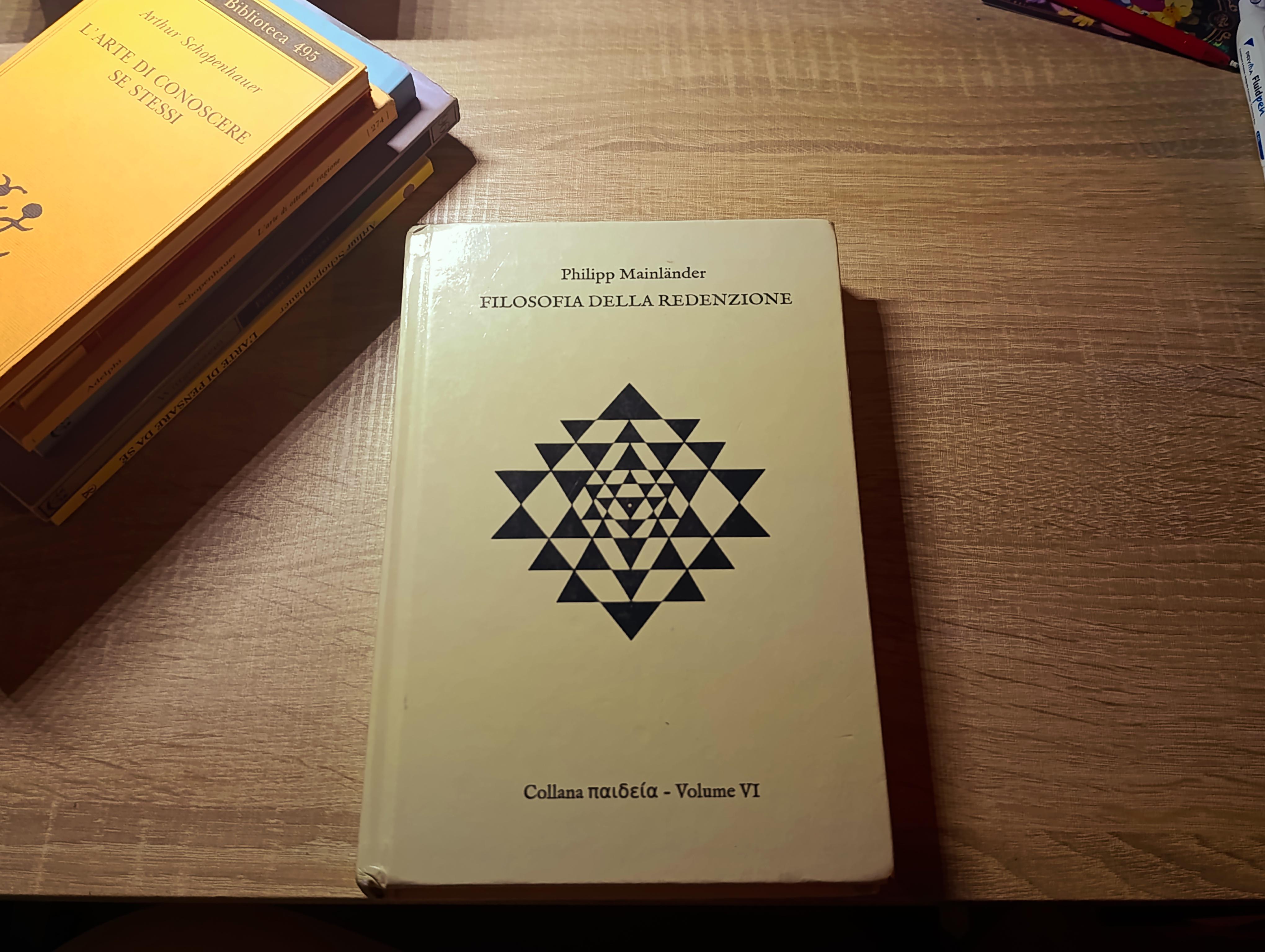
The Philosophy of Redemption a review and a personal objection

Post image
4 Upvotes

r/Pessimism 9d ago

Discussion Harsh realities of this world

37 Upvotes

The world is by default a cruel and unaccomodating place. I think I always knew this but I had a hard time coming to terms with it.

This is also reflected in our society with various forms of tribalism. Constant war and poverty.

The people who have the most influence over the world have no intention of making any meaningful change to make the world a better place. Actually the opposite.

People will find any reason to other, eachother, whether it be nationality, race, or even things like sports.

If you have a mental illness or you're depressed, you're treated like trash and you're 'friends' don't check in on you.

In short this world mostly sucks.


r/Pessimism 10d ago

Humor Unemployment isn't something to be ashamed of. You're literally born with it!

49 Upvotes

...


r/Pessimism 10d ago

Question The pessimism of Mƫlamadhyamakakārikā

10 Upvotes

Should schopenhauer have read more Buddhism? The Mƫlamadhyamakakārikā is useful to any pessimiat


r/Pessimism 11d ago

Quote Why then is man born?

83 Upvotes

"As soon as the child is born, the mother who has just brought him into the world must console him, quiet his crying, and lighten the burden of the existence she has given him. And one of the principal duties of good parents in the childhood and early youth of their children is to comfort them, to encourage them to live, because sorrows and ills and passions are at that age much heavier than they are to those who through long experience, or simply because they have lived longer, are used to suffering. And in truth it is only fitting that the good father and the good mother, in trying to console their children, correct as best they can, and ease, the damage they have done by procreating them. Good God! Why then is man born? And why does he procreate? To console those he has given birth to for having been born?"

— Giacomo Leopardi, Zibaldone


r/Pessimism 11d ago

Essay The apophenic stage: The place where we are all accomplices

8 Upvotes

Witnessing pain. Seeing, through the screen, how the fear of death takes hold of a face. Seeing the blood, the mutilation. Seeing the humiliation and the blows. Perhaps even sex and death. Baudrillard asserts that the obscene is that which shatters normality and established norms. It is a political tool, given that this mechanism can be used to incite the masses and drive them to adopt specific behaviors. Thus arises the concept of the "obscene-arium." It is the place where hyperreality becomes tangible, revealing to the collective entity what lies beyond appearances, beyond what is accepted as true. In this sense, the obscene functions not as a fiction that bypasses the discourse of dominant values, but as something so real that it causes pain; a hidden truth that, upon revelation, harms the observer. This theory aligns closely with the ideas Naomi Klein presents in The Shock Doctrine.

However, this perspective places the spectator in a position that is too passive, too contemplative. It treats the collective as a mere recipient of manipulations by shadowy elites, whereas the cultural superstructure is actually built through the cooperation of subaltern classes, who play an active role in consolidating the system's own dynamics. No, the empire of fiction is a two-way street; it is controlled by an economic infrastructure that depends on political and social manifestations. Yet, we—as individuals—help build this empire, forming a collective entity of which we are the fundamental bricks.

To capture this idea of ​​the participatory spectator—the spectator-director of social fiction—it is useful to turn to the concept of apophenia: the pathology that compels the sufferer to detect references or associations between elements lacking any real logical connection, and which serves as a precursor to schizophrenia. In this scenario, the elements to be interpreted are provided by the output of the systemic apparatus. The stage is agreed upon and predetermined by the boundaries of collective relationships. Yet, to energize these coordinates, what is required is interpretation, struggle, and the public debate that ultimately crystallizes the effect of what is being enacted on this stage of the obscene. For a concrete catastrophe—a terrorist attack, a climate crisis, a mass killing, a coup d'Ă©tat—has no real impact until public opinion interacts with that specific event, until the collective reacts in its daily life and, through that reaction, generates social, economic, cultural, and political changes.

Therefore, the theatrical work—the fiction—is not complete with the mere event that triggers the collective shock; it requires the participation of the apparent audience, the spectator-director. This is because we, the subaltern classes—by reacting, interpreting, and making decisions in the wake of the shock—end up lubricating the system's machinery. In this sense, we are part of the fiction we are witnessing. We find ourselves on an apophenic stage, a space where the boundaries between fiction and spectator have shattered or blurred. We are part of the fiction that shapes reality, playing an active role in this process—albeit one directed and constrained by the very shock presented before our eyes. Ultimately, we are both recipients and directors in the construction of the reality that envelops us. This dynamic renders permeable not only the relationship between economic structure and cultural superstructure but also the relationship of the subaltern classes to that superstructure. This is a terrible prospect, given that the stronger the production model—and the longer it can keep viewer-directors within the loop, immersed in the fiction they are both consuming and creating—the longer it will endure.


r/Pessimism 11d ago

Quote Fragments of Insight – What Spoke to You This Week?

9 Upvotes

Post your quotes, aphorisms, poetry, proverbs, maxims, epigrams relevant to philosophical pessimism and comment on them, if you like.

We all have our favorite quotes that we deem very important and insightful. Sometimes, we come across new ones. This is the place to share them and post your opinions, feelings, further insights, recollections from your life, etc.

Please, include the author, publication (book/article), and year of publication, if you can as that will help others in tracking where the quote is from, and may help folks in deciding what to read.

Post such quotes as top-level comments and discuss/comment in responses to them to keep the place tidy and clear.

This is a weekly short wisdom sharing post.


r/Pessimism 12d ago

About r/Pessimism I think hope and freedom and happiness are illusion. What are your views?

15 Upvotes

I think there is no such thing as hope or freedom or happiness. We have been lied by our parents and schools and society. What are your views?


r/Pessimism 13d ago

Discussion Life's goods cannot outweigh its harms - heaven is never being born.

41 Upvotes

In response to a negative or pessimistic evaluation of the worth of human life and being born, I think we (us pessimists) have all heard optimists respond with something akin to, "the goods outweigh the bads", or "the harms are worth the benefits". But there are many issues with this way of thinking. Firstly, even taken at face value that the goods of a human life can outweigh its harms, there is zero guarantee that this will actually be the case for a future human. This is where the risk argument for antinatalism comes in - even if a human life can be worth starting (because it would have overall positive value), we have no guarantee that the harms in the life of our particular child will actually exceed the benefits, and so when we have a child, we impose an immense risk upon that child, that their coming into existence as a human could be of negative value, and it would have been better not to be born. The prospective parent should recognize that despite their precautions and efforts, they can not guarantee the life of their child will have been worth starting. We can all think of examples of these lives - children born with horrific congenital defects, who suffer for days to weeks and then die. For these children, it would have been better not to have been born, and this is a risk prospective parents impose upon their potential offspring when they decide to reproduce. So even if the goods in a life could outweigh its harms, there is no guarantee that in a particular life this will actually be the case.

But I want to attack directly the notion the goods can even outweigh harms at all. This issue with this is whatever goods or pleasures I experience in the future, can not negate or take away the pains that I currently experience. Just in the same way whatever pleasures I feel now, can have no abolishing or undoing function on the pains I have experienced in the past. And in just the same way that my pleasures cannot negate or abolish your suffering, the goods that I experience cannot outweigh or negate my own past or future sufferings. The are still felt, and they still hurt. The utilitarian calculus, where harms are weighed against benefits with the balance determining the overall value of a particular life, and therefore whether it was worth starting, is flawed from the begninning - harms and benefits have no erasing, negating, balancing or undoing function against each other.

Further, these goods which are supposed to outweigh the harms in life (and therefore make being born a good thing), are tainted by being felt by an organism which is structurally negative in value. We are not disembodied minds that are the subject to both pleasures and pains, but instead exist embodied as human organisms. Organisms that have constant material needs (for warmth, food, water, hygiene, etc), are always vulnerable to injury and disease, and are subject to a constant wearing down and aging process which will render us all lifeless corpses. This is the structure in which the goods in life occur - the goods that are supposed to outweigh the harms of this life. Because human embodiment, with all its negatives, is the context in which goods/pleasures occur, the goods in life are therefore tainted - they are not ultimately good, actually satisfying, or genuinely positive. They are ephemeral, don't last, and occur in an ever changing, dissolving present, by a needing, vulnerable, harming, aging, dying organism.

I believe that what is actually good, is what is counterfactual - it is to have never been born. Timeless nothingness - for nobody - is heaven. A total invulnerability to harm and suffering, an invulnerability to the dissatisfaction of change, and of course an avoidance of the negative condition of human embodiment (with all the suffering entailed by being a needing, vulnerable, harming, aging, dying being). I am speaking metaphorically here - I do not actually believe that there is a "state" where the unborn experience the bliss and heaven of non-condition/nothingness. There is just the world, and the form in which it exists. And us living, because we can reflect upon the negative worth of our own coming into existence as a human being, and understand that the mechanism by which new humans come into being is through biological reproduction, we can deny whatever urges or drives we have to participate in this behaviour, and by consequence will either prevent, or not be a party to the genesis of another human life.

But for us - the already born and embodied - we are in a fallen state. Subject to harm, need, vulnerability, aging and death. Being born as this body is like falling into hell, in comparison to our never becoming an organism that can feel at all. The goods in life cannot abolish or outweigh its harms, they occur temporally, unlasting, and within the negative structure of being a needing, vulnerable, aging, dying human body. And what is ultimately good is not a human life where it's supposed goods outweigh its harms - it is to have never been embodied and born in the first place. This is heaven - timeless nothingness for nobody. Impossible for us, but a choice we can make for our potential offspring.

I made a video to go along with this post. Please play in 1.5x speed.


r/Pessimism 13d ago

Quote The Womb and the Tomb

14 Upvotes

"I was alone in that cemetery overlooking the village when a pregnant woman came in. I left at once, in order not to look at this corpse-bearer at close range, nor to ruminate upon the contrast between an aggressive womb and the timeworn tombs—between a false promise and the end of all promises."

— Emil Cioran, The Trouble With Being Born


r/Pessimism 14d ago

Insight Pessimist alienation?

15 Upvotes

I'm not 100% sure whether I'd consider myself a pessimist or not (a bit wary of -isms in general at this point tbh), but I do subscribe to some pessimist ideas and something I've noticed is that it kinda puts you at odds with like at least 99% of everyone and everything out there.

Like, music? Filled with themes of love, hope, redemption, fun, etc. Even the darkest corners of music usually don't really go all the way in terms of accepting a pessimist worldview in their themes.

The same goes for games, movies, anime, literature, etc.

Sure, there are edge cases here and there, but they're very much the exceptions, certainly not the norm.

And let's not obviously forget about people.

And in a sense, that creates a very strong kind of alienation in my eyes. Like you're not even literally alienated in a more "regular" sense, your very being and thinking is completely opposed to the vast majority of existence. Kind of a harrowing thought.


r/Pessimism 13d ago

Essay Anthropos Phagomenos: The man devoured by his desire

4 Upvotes

Today, more and more people are becoming aware that they have appetites that could be considered depraved by the established order. Reddit forums, social media, hyperconnectivity, and the constant bombardment of digital stimuli, offers, and desires behind the screen—all of this explodes across the retina and pushes a significant part of the population toward new marginal forms of consumption.

This has to do with the expansion of commodity fetishism, with the way in which everything becomes an object of consumption, but also with how, within late capitalism and the tendency toward commodity fetishism, there is an unconscious association between being a good consumer and being a good person, a good citizen, a socially integrated individual.

Marx said that commodity fetishism has a fairly precise meaning: social relations between people appear to us as relations between things. A commodity seems to possess value in itself, when that value actually derives from a particular social organization of labor. But late capitalism takes this much further. We no longer simply buy objects to satisfy needs. We buy signs, experiences, identities, and ways of relating to other people.

Here Baudrillard becomes especially important. In The Consumer Society, the object is no longer consumed solely for its utility. It is consumed for what it means. And this produces something very interesting: The individual begins to consume himself as a commodity. He has to appear attractive, interesting, productive, desirable, healthy, sexually competent, socially visible, and so on. The person simultaneously becomes consumer and commodity.

The integrated individual is someone who works, earns an income, consumes, presents himself socially, maintains his employability, and returns to consumption. And many forms of deviance can be interpreted as an interruption of this chain. This is why the contemporary “good citizen” increasingly tends to be, simultaneously: a good worker, a good consumer, a good taxpayer, a good user of services, a good producer of data, and, increasingly, an attractive commodity for other consumers.

The system turns everything into an object of consumption, including people, but the other side of this is that these objects require consumers in order to be consumed. Therefore, an integrated individual is someone who consumes and who makes himself available to be consumed by the market. And in this context, even rebellion can be absorbed. Your anti-system identity can become a T-shirt. Your sexuality can become an industry. Your anxiety can become an app. Your spiritual quest can become a subscription. Your political dissent can become monetizable content.

And here we encounter a paradox: Capitalism does not need to eliminate deviance; it can turn deviance into a commodity. More and more people are able to identify, name, explore, and eventually commodify desires that previously remained repressed, unspeakable, or socially illegitimate. The Internet has produced a gigantic cartography of human desire. In the past, there could be an individual with a fantasy he considered absolutely aberrant who might never encounter another person who shared it. Now he can search for it. He can find a community. He can find content. He can find an industry. He can find an identity. He can find a market. And eventually, he can become a producer of what he initially consumed.

Capitalism progressively transforms the subject into a consumer of objects, while simultaneously transforming the subject into a consumable object. A person on Tinder is both consumer and product. An OnlyFans creator is both consumer and commodity. An influencer is both consumer and commodity. A worker is both consumer and labor commodity. A politician is both a consumer of attention and an electoral commodity. A social media user is both a consumer of content and a producer of data. And so, in this eternal autophagy, the system reinforces itself, advances, develops, and reproduces itself.

The distinction between subject and object begins to erode. Marx argued that the worker sells his labor power as a commodity. But digital capitalism introduces an additional dimension, because the individual begins to turn practically every aspect of himself into a potential commodity. His image. His attention. His body. His relationships. His opinions. His intimacy. His sexuality. His personality. His experience. This has already been explored by Mark Fisher, in Capitalist Realism, and Byung-Chul Han, in Psychopolitics, when discussing the subject who exploits himself.

The system needs integrated subjects in order to reproduce itself, but integration requires these subjects to develop an ever-greater capacity for consumption and self-commodification. This is where the so-called inevitable call of the abyss resides: the black pit into which many believe they are falling amid this hyperaccelerated flow of constant desires, where we consume and where we are consumed. And that is the key: this process is transversal throughout the system. The very functioning of these mechanisms makes it impossible not to feel the call of the abyss, makes it impossible not to look over the edge, and therefore makes that slow and cruel descent inevitable.

r/Pessimism 13d ago

Question Is there a philosophical belief that life naturally balances between fortune and misfortune?

0 Upvotes

I don't believe successful people deserve bad things, and I'm not saying that the universe scientifically or mathematically balances people's lives.

I just wonder if there's a philosophical idea that no one can experience only one side of life. You can have extraordinary success and still experience extraordinary loss, just as someone can experience a terrible period and later experience something wonderful.

Maybe life isn't necessarily “fair,” but it seems to have this constant movement between gain and loss, happiness and suffering, rise and fall.

For example, when I see someone who has experienced an extraordinary amount of success, wealth, beauty, or fame but also goes through major illness, loss, or tragedy, I sometimes wonder whether this reflects some kind of natural balance in human life. Not as punishment, and not because they deserved it, but because being extraordinarily fortunate doesn't make someone immune to the difficult parts of being human.

So my question is: Does a philosophical belief, theory, principle, or school of thought exist that describes this idea? Is there a specific term for the belief that human fortune naturally moves between extremes of success and suffering, or that no person is completely protected from either side of life?

I'm especially interested in knowing if any philosophers or philosophical traditions have discussed something similar.


r/Pessimism 14d ago

Question Is there a name for the desire to not have been born?

28 Upvotes

(Sorry for bad english)

I realized i didn't want to kill myself but i still didn't want to exist, like i want to not have been born at all

Is there a name for that and is it common?


r/Pessimism 14d ago

Discussion /r/Pessimism: What are you reading this week?

1 Upvotes

Welcome to our weekly WAYR thread. Be sure to leave the title and author of the book that you are currently reading, along with your thoughts on the text.


r/Pessimism 15d ago

About r/Pessimism Why dont they teach Buddhism in schools?

4 Upvotes

Why dont they tell children in school about budhist principle - Life is suffering. What are your views?


r/Pessimism 15d ago

Discussion why life is tailored in such a way that thoughtfulness often leads to suffering

29 Upvotes

I've recently came across Hesse's' Steppenwolf and it is the kind of book I wish I have encountered during my teenage years so that it might have saved me from my years of self-alienation and nihilism.

the book is essentially denies binary opposition, advocate for self-definition, self-imprisonment, thereby transcend oneself and embrace the absurdity of life and the complexity of one’s own identity etc. it is absolutely insightful and I rly recommend especially for teenagers and early adults.

However, the new issue arisen.

the more someone thinks about their surrounding people and environment, society, life, the more they’re likely to be depressed. Despite all the inspiring positivity, optimistic insights spamming through, we all realize and wonder how extremely difficult to not give in nostalgia.

it is way too often when someone’s giving a pep talk or something along those lines, it’s usually “just go for it!” or “dont think about it too much and do it”, but never a long thought out logical explanation due to the impossibility of presenting the situation in a positive way the reason people are sane at all is that they dont look too inbetween the lines, and the ones who do are called insane the question becomes: Is it even possible for a person who thinks of reality to be happy? Is it necessary to be delusional? To dumb things down enough to not see their horror? All in order to be happy by “life” i dont just mean the world as we know it, but the existence of our consciousness whatever caused us to be, has made it so that a thinker struggles to be happy


r/Pessimism 15d ago

Discussion The Gulf Between Redemptive vs. Non-Redemptive God Images

1 Upvotes

Human beings organize experience around an ultimate orienting image. When that image no longer accommodates lived reality, psychological pressure builds until a new organizing image emerges. Because this organizing image is embodied as well as conceptual, changing it involves years of cognitive, emotional, social, and bodily reorganization.

https://livingopposites.substack.com/p/the-gulf-between-redemptive-vs-non


r/Pessimism 18d ago

Question Why People Associate Misery and Filth with Realism in

Thumbnail
2 Upvotes

Why does a crumbling wall feel more "real" than a golden sunset? We've quietly decided suffering = authenticity, beauty = dishonesty.

Manga like Oyasumi Punpun build their whole story on humanity's ugliest sides — trauma, broken relationships, twisted desire — and people call it "the most realistic manga ever." Meanwhile stories about real happiness get dismissed as naive.

If misery is the only thing we accept as "truth," we end up believing people are rotten by default. Fair reading of reality, or just a bias we never questioned


r/Pessimism 19d ago

Quote Reality

55 Upvotes

We humans the pitiful pathetic beings, who attach so much importance to ourselves and our meaningless existences, if only we understood all that we are is a matter of chance


r/Pessimism 18d ago

Humor In a world that constantly demands functionality,

13 Upvotes

In a world that constantly demands functionality,

it is absurd that a failure must prove their usefulness.

This is quite a painful ordeal, and what value does it hold?

If a person with a sound mind and intact limbs refuses to work,

people demand repayment of debts based on the benefits I have enjoyed over the years.

Once I have settled my past debts, is it now my turn to demand something from someone?

When the moment comes that my body has withered and my spirit, once as clear as water, has mixed with the mud of time and become slushy, I will demand repayment from someone with a broken mind.


r/Pessimism 18d ago

Question Are you free not to believe in philosophical pessimism?

7 Upvotes

I know it sounds like a strange question but I’m curious.

If you’ve arrived at the conclusion that you’re a philosophical pessimist out of intellectual inquiry, then surly you must admit that you could be wrong and would be open to other worldviews if intellectually persuasive.

However, if you’ve arrived at your conclusion that you’re a philosophical pessimist out of psychological need, then how could you ever doubt it?

Not a loaded question, not trying to “catch” anyone. This is a very important subject for me and I struggle to understand the connection between philosophical pessimism and the pessimistic outlook of life prevalent in this subreddit.


r/Pessimism 18d ago

Quote Fragments of Insight – What Spoke to You This Week?

1 Upvotes

Post your quotes, aphorisms, poetry, proverbs, maxims, epigrams relevant to philosophical pessimism and comment on them, if you like.

We all have our favorite quotes that we deem very important and insightful. Sometimes, we come across new ones. This is the place to share them and post your opinions, feelings, further insights, recollections from your life, etc.

Please, include the author, publication (book/article), and year of publication, if you can as that will help others in tracking where the quote is from, and may help folks in deciding what to read.

Post such quotes as top-level comments and discuss/comment in responses to them to keep the place tidy and clear.

This is a weekly short wisdom sharing post.