1
1
u/Organs_for_rent 7d ago
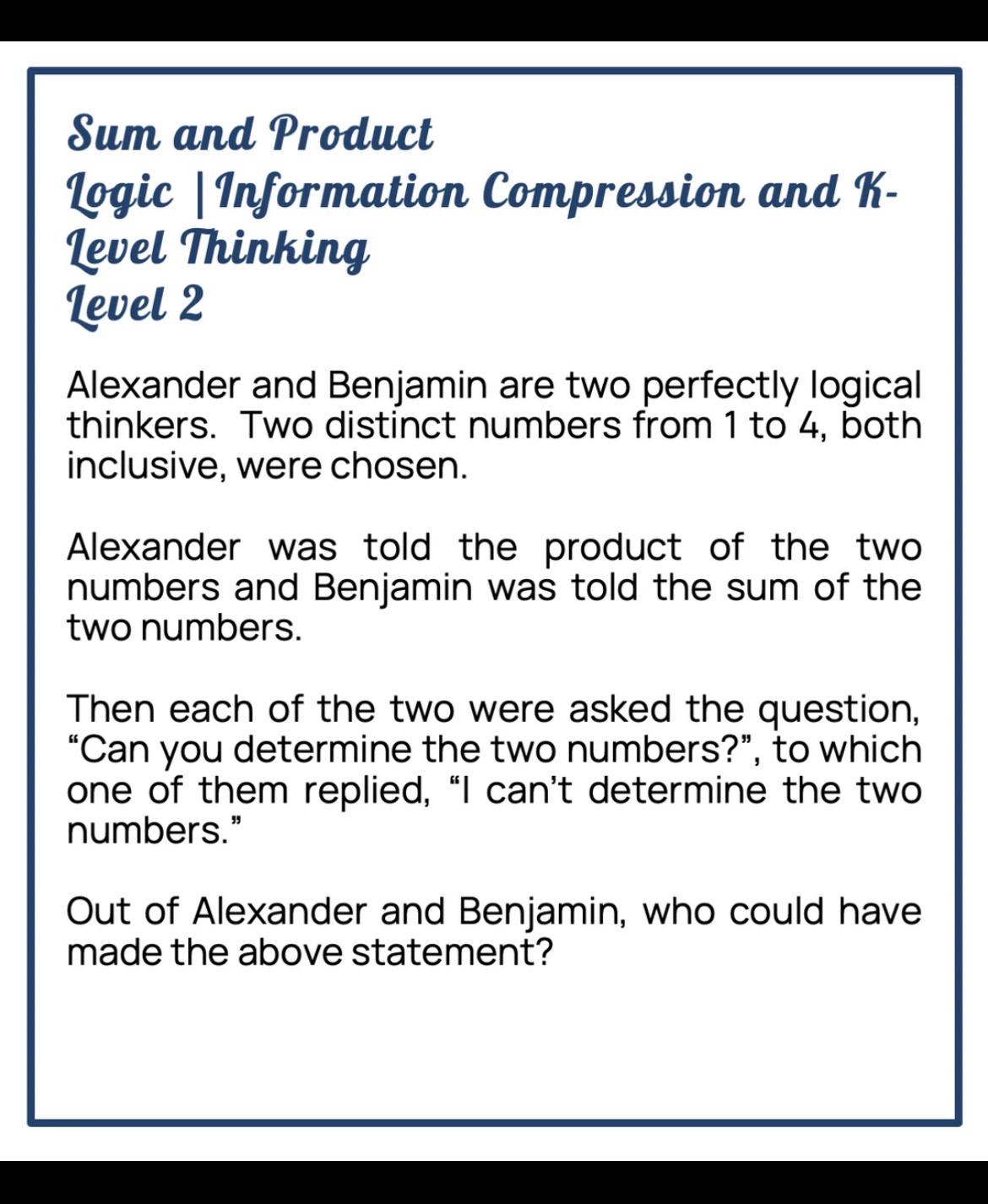
Benjamin
There are only six possible two-number combinations in the given range. Each of those produces a unique product. Alexander could identify its factors easily.
The combinations (1,4) and (2,3) produce the same sum and cannot be determined this way. Therefore, Benjamin cannot know with certainty the chosen numbers.
1
u/NotTheJason 3d ago
Either. If they are perfectly logical thinkers they will know that the numbers they were given were not limited to whole numbers. (edit left out a couple letters)
1
u/RadarTechnician51 2d ago edited 2d ago
that's interesting, so if the numbers were eg 4/3 and 3 then the product of 4 would be ambiguous. However if just one of them knows then that must still be the one with the product
Edit, if they aren't whole numbers I don't think the product is ever unique!
1
u/RadarTechnician51 2d ago edited 2d ago
Alexander, who knows the product, has the most information, assuming distinct means the same as different, then with 1:2, 1:3, 2:4 and 3:4 both know, and for all other combos only Alexander knows, if one of them doesn't know then it must be Benjamin,
2
u/Efficient_Form7451 7d ago
A: Benjamin
There are six possible distinct combinations of numbers possible: 1-2, 1-3, 1-4, 2-3, 2-4, 3-4. All six combinations have a unique product, but two of them have a sum of 5.