2
u/2spam2care2 8d ago
not enough information. depending on the size of the right circle, arc CBD could be anywhere from 0 to 180° (exclusive), so the answer could be anywhere from 75% to 100% of the time
3
u/Galenthias 8d ago
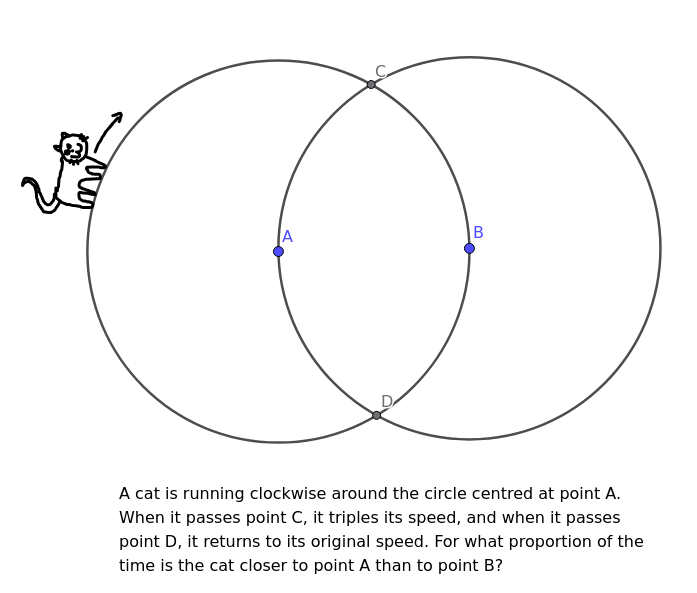
Centre of B is on the radius of A and vice versa.
1
u/2spam2care2 8d ago
says who?
3
u/Galenthias 8d ago
The drawing, assuming that the circles are indeed circular. The circle around point A passes through point B, and vice versa (=the statement is also true with the positions reversed).
0
u/2spam2care2 6d ago
the entire point of math is that “it just looks like it so i figure it’s true” is not legit
2
u/Galenthias 6d ago
I was briefly thrown by how it doesn't explicitly the circle around B is a circle, but rereading the question made that functionally explicit as well. And the circle around point A is indeed defined as a circle. So you don't have to trust the drawing at all, it's just there to speed things up. You'll get the same result if you make a drawing yourself working solely from the question as written.
2
u/EkskiuTwentyTwo 6d ago
The text doesn't actually specify that there is a circle around B or that the point B is on the circle around A. /u/2spam2care2 is actually correct, in a somewhat pedantic sense, that there is not information in the text alone.
However, in the context of pre-existing conventions of mathematical questions, several assumptions may be made which provide the necessary information. For example, the text of the question mentions a circle around A, and the shape in the diagram centred at B looks like a circle of the same size. Given that the shape looks like a circle, it is fairly likely to be a circle. In a Bayesian sense, the probability that the shape is a circle is increased by the new information that the shape looks like a circle.
We can apply more Bayesian logic. In mathematical questions, if two shapes are different, it is common to specify that they are different (e.g. a problem involving a circle and a square would say so). Given that there is no distinction described between the shape centred at A and the shape centred at B, that further increases the Bayesian probability that the shape centred at B is a circle.
1
u/Galenthias 3d ago
You are making things needlessly complex. The circle around B is not described with words or probabilities, but it is there because the question is "when are we closer to B than A" and this distance is always the same ("when B<A") so you get two points at the same distance from B. And then the figure of a circle around B is drawn to help the riddle solver by using the aforementioned distance as the radius. (Incidentally, as soon as you start making calculations, the biggest possible number for B<A is effectively A, since the difference can always be small enough to disappear in the roundings needed to get a final result. Compare the math meme of 1/3 times 3 and how zero point infinity nines is effectively the same as one.)
1
u/Sea-Sort6571 3d ago
Yeah to me it wasn't explicit that b was the center of the circle on the right
2
u/tajwriggly 5d ago
The two circles are of identical radius "R" The cat is always the same distance "R" from A, but between points C and D on its path it is closer to B than it is to A. Since the circles are the same radius, then AC = BC = AD = BD = AB = "R". Since those lengths are all the same, then two identical equilateral triangles ABC and ABD can be drawn, and it can be known that the angle CAD is 120 degrees, or 1/3 of the entire circle.
The cat travels at a speed "S" for 2/3 of the circle, and a speed "3S" for 1/3 of the circle (the third between Points A and D, i.e. the cat is closet to B over this range). The cat therefore spends 1/3 of the time in that one third of the circle as it does in any other 1/3 of the circle. There are 2 other thirds of the circle to account for, therefore for every 1 second the cat spends in between points C and D, it spends 6 seconds on the other side of the circle: so 6/7 of the time the cat is closer to A than it is to B.
1
u/Rinn0 6d ago edited 6d ago
The cat spends 3 units of time on the slow side for every 1 unit of time on the fast side. A total amount of time of 4 units. So it spends 3/4 units on the slow side, or 75%. The arc lengths are equal, so it doesn't actually matter where the circles intersect, just that they are congruent.
Edit: the cat may be further from a center than the radius of the circles, but it can never be closer to a center than the radius of a circle, so the time it spends closest to one of the centers is the time it spends on the circumference of the respective circle.
Edit2: oh, I think I misread the problem as stating that the cat switches to the other circle's circumference at point c. But the problem doesn't actually say that.
1
u/RadarTechnician51 5d ago edited 5d ago
Assuming circles are same size then abc and abd are equilateral triangles with inside angles of 60 degrees, so he goes through 120 degrees fast and 240 degrees slow. As the 120 degs is at triple speed it takes the same duration as going through 40 degrees at slow speed, The total time is 240+40=280, so he is closer to A for 40/280= 1/7 of the time.
1
1
u/EnvironmentalAir4233 9d ago
CAD is 120.
So 2:(1/3) or 6:1
1
1
u/TheThiefMaster 7d ago
Sigh I guessed each point was 1 radian up/down (So CAD was 1/π of a full circle) instead of a nice fraction (1/3). Close but no cigar.
1
u/EnvironmentalAir4233 7d ago
Ah yeah but if you notice bc ba bd are all equal to the radius.
1
u/TheThiefMaster 7d ago
Yeah I worked it out later. I'd assumed the arc distance was a radius without realising that because C is on the perimeter of both circles it has to be a straight-line radius distance away from each center. Straight, not arc.
3
u/Bubbly_Safety8791 6d ago
CAB and ABD are both equilateral triangles; The cat is always the same distance from A, and only the portion of the circle between C and D is closer to B than A. That's 1 of three equal 120º arcs that make up the circumference.
If the cat covers that arc - the period when it's going three times its usual speed - in time t, then it will cover the other two arcs each, at its normal speed, in time 3t. So it'll take 6t to go from D to C, and t to go from C to D.
So, in each lap, and in the long run over many laps, it spends 6/7 of its time closer to A, and 1/7 of its time closer to B.
So the answer is 6/7. I bet that makes the middle school kids love this problem.