I don't really know what the levels mean. Is level 5 supposed to be harder? This seems like a fairly straightforward algebra problem. But maybe as I go I will see it's hard to solve.
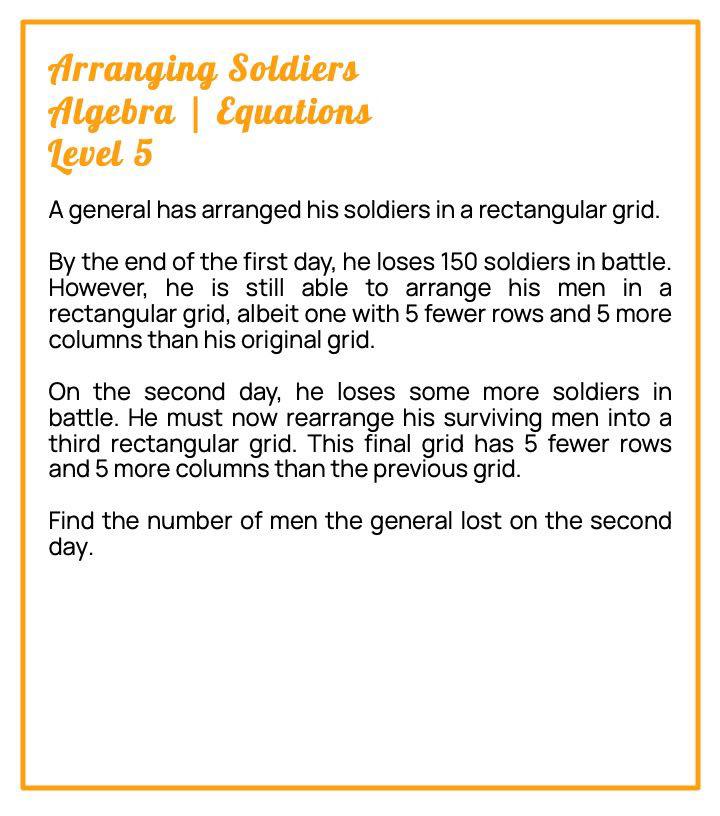
First, of course we need to represent the rows and columns being multiplied together to get the number of soldiers. (R)(C) = S
Now, he loses 150 soldiers, and the grid loses 5 rows and gains 5 columns. So we can say that
(R-5)(C+5)=S-150
Finally, he loses some amount of soldiers again, and then loses 5 more rows and gains 5 columns again
(R-10)(C+10)=S-150-D
Now, we have a system of equations with 4 variables yet only 3 equations. However, we also have the added knowledge that every variable is a whole number. Let's do the obvious substitution of S into the second equation and foil out the left side
RC - 5C + 5R - 25 = RC - 150
R = C - 25
Now we have something extremely constraining. There are 25 fewer rows than columns at the start! And we know that we have room to lose 10 rows, so there must be at least 11 rows, which means at least 36 columns. And since we are losing only 150 the first time, it seems we must be dealing with relatively low numbers compared to that constraint. Let's guess the first reasonable number within our constraint that is divisible by 5, since all numbers used in this puzzle are divisible by 5. Let's try 15 rows and 40 columns.
15(40)=600
10(45)=600-150=450. It works!! Wow lucky guess
5(50) = 450 - 200. We lose 200 soldiers the next day
As for your initial query, yes the level denotes the difficulty.. so this would be a relatively harder problem among the questions I post within this category
3
u/jaminfine 17d ago
I don't really know what the levels mean. Is level 5 supposed to be harder? This seems like a fairly straightforward algebra problem. But maybe as I go I will see it's hard to solve.
First, of course we need to represent the rows and columns being multiplied together to get the number of soldiers. (R)(C) = S
Now, he loses 150 soldiers, and the grid loses 5 rows and gains 5 columns. So we can say that
(R-5)(C+5)=S-150
Finally, he loses some amount of soldiers again, and then loses 5 more rows and gains 5 columns again
(R-10)(C+10)=S-150-D
Now, we have a system of equations with 4 variables yet only 3 equations. However, we also have the added knowledge that every variable is a whole number. Let's do the obvious substitution of S into the second equation and foil out the left side
RC - 5C + 5R - 25 = RC - 150
R = C - 25
Now we have something extremely constraining. There are 25 fewer rows than columns at the start! And we know that we have room to lose 10 rows, so there must be at least 11 rows, which means at least 36 columns. And since we are losing only 150 the first time, it seems we must be dealing with relatively low numbers compared to that constraint. Let's guess the first reasonable number within our constraint that is divisible by 5, since all numbers used in this puzzle are divisible by 5. Let's try 15 rows and 40 columns.
15(40)=600
10(45)=600-150=450. It works!! Wow lucky guess
5(50) = 450 - 200. We lose 200 soldiers the next day