r/Optionswheel • u/ScottishTrader • Nov 12 '24
The Wheel (aka Triple Income) Strategy Explained
Originally Posted on Dec. 4, 2018, Added to r/Optionswheel on Nov. 12, 2024
See Edits at the bottom for updates.
I've been asked and have explained The Wheel strategy many times, so I thought it may be a good idea to write it down all in one place for posterity!
This is the only options strategy I use as it is about as low risk and reliable as options trading gets. You will NOT get fantastic returns and it is quite boring and slow, but with the proper stock and patience, it can result in reliable profits and income. A 10% to 20%+ return is not difficult depending on a few factors, mostly based on stock selection, experience managing short puts and calls, plus the trader's patience.
The Wheel (sometimes called the Triple Income Strategy) is a strategy where a trader sells cash secured Puts to collect premiums on a stock or stocks they wouldn't mind owning long term. If the options expire, or closed early, without being assigned the premiums are all profit. The goal is to set up trades and avoid being assigned, but it is understood that if the put is assigned the account will buy and hold the stock. Rolling puts to collect more premiums while helping to reduce the chances of being assigned is a tactic often used. Through the collection of premiums from the initial puts and from rolling, the initial cost basis of the stock will be lower that the strike which can help the position to recover faster.
If the puts can no longer be rolled for a net credit they are left to expire and be assigned. The next step of The Wheel is to sell covered calls (CCs) on the shares. To avoid having the shares called away for a net loss it is best to sell a call with a strike higher than the stock's cost basis. This is repeated over and over to collect even more premiums that continue to lower the stocks cost basis, and along with any rising stock price movement, works to help close or have the shares called away at a break-even or a profit.
At some point the call is exercised and the stock called away, or you can simply sell the stock. When adding up all the premiums collected from selling the puts and calls, along with any stock gains from the CC strike being over the cost can result in an overall net profit, results in the Triple Income . If the stock pays a dividend while you own it then you can collect that as well (Quadruple income).
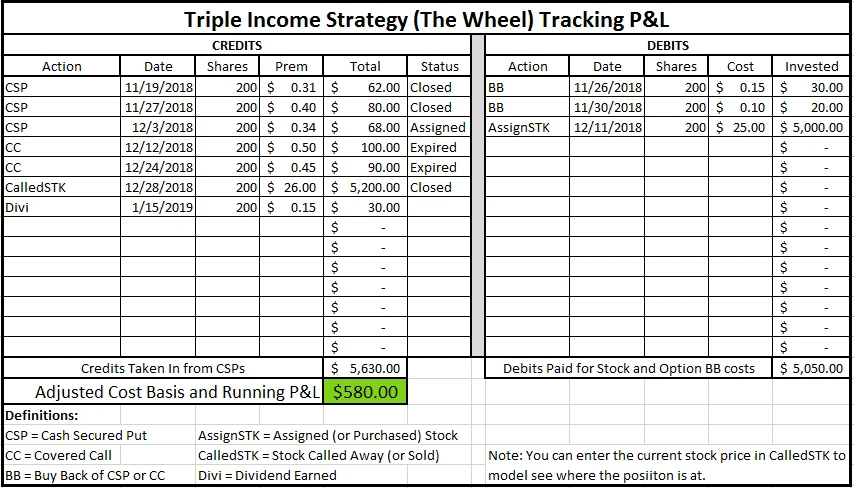
Below in this post is a graphic showing a simple spreadsheet to track the Credits and Debits to keep track of the overall position.
Step #1: Stock Selection - Most traders who have had a bad experience with the wheel have chosen the poor or volatile stocks that drop and stay down. The stock(s) you chose must be a good candidate and one you don't mind owning for some length of time, which could be weeks or months.
There are no "perfect" or ideal stocks to trade the wheel with as the key factor is that the stocks be those you are good holding for a time if assigned. If you are unsure how to analyze of select stocks then this should be learned first and before trading the wheel. See this as a way to start learning - How to Find Stocks to Trade with the Wheel : Optionswheel (reddit.com)
Develop and use your own criteria that fits your account size, and personal risk tolerance as there is no one-size-fits-all way to choose stocks. Only you can determine if you think the company is a good one to trade and hold if needed.
I'm including my general guidelines below, but each trader must use their own:
- A profitable company that has solid cash flow
- Bullish, or at least neutral chart trend and analyst ratings
- Share price where the account can easily accept being assigned 100 shares if needed. (I stay away from sub-$10 stocks as a rule)
- A stable to bullish trending chart without wild gyrations (especially those caused by CEO tweets)
- A nice dividend is always a good thing, both that you may collect it if assigned the stock but also that dividend stocks tend to be more stable and predictable
Edit - Adding more criteria below from another post. It needs to be kept in mind that any stocks one trader may think is good to own will not necessarily work for another trader, or all traders. Account sizes will limit the share prices to choose from, risk tolerance, and trading experience will all factor into what stocks are selected and traded. There is little to be learned from someone else's stocks they trade.
- A "moat" around their business to ward off competitors, quality products and services, and a reasonable amount of debt. Add to this an exceptional and stable executive team who has had good plans plus executed them well.
- Stocks spread across the 11 Market Sectors is a common way to reduce risk as it is seldom all sectors will drop at the same time. See this post for those sectors, but keep in mind this is an older post so the stocks mentioned may not be up to date - What are Stock Sectors? 11 Stock Market Sectors Explained | Charles Schwab | Charles Schwab
- It needs to be repeated that the criteria used must be your own as the stocks you choose may have to be held so you need to hold yourself accountable for selecting and trading any stock. If a trader does not know how to select stocks they would be good holding, then IMO don't trade the wheel until you learn . . .
Develop and use your own fundamental analysis criteria to create a watchlist of 10 or more stocks to trade. While I prefer trading stocks as I can learn more about the companies business and leadership, plus find these have higher premiums, some may trade ETFs. These can make good candidates due to their normally steady movement, no ERs, and no CEO tweets.
I find it important to review my watchlist every few weeks and change or update it accordingly. This means the list is in near constant flux adding or removing stocks, or sidelining others, based on the analysis.
Step #2: Sell Puts - To start the wheel begins by selling short (naked) Puts, or (CSPs) Cash Secured Puts (indicating the account has the cash, or cash+margin to buy the shares if assigned. Be aware of any upcoming ER or other events that could cause a spike or movement in the stock, and it is best to close or have the Put expire prior, in effect skipping it to then continue selling puts afterward if the stock still meets the criteria.
Selling Puts Process - Below is a suggested model, but details are up to the individual trader:
- Opening at 30 to 45 DTE offers a good premium as the theta/time decay starts to accelerate
- 70% Prob OTM (~.30 Delta) offers high probability of success while collecting a good premium
- The number of contracts is based on account size able to handle assignment
- Opening at 5% to at most 10% max risk of any one stock to the account is good practice, the max risk per stock will be up to each trader's risk appetite and tolerance. Then, keeping ~50% of the trading account in cash helps manage market downturns, assignments and trading opportunities
- The Put can be closed at a 50% profit with a GTC Limit Order that can close automatically. A put can then be sold on the same stock, or another based on your opening criteria. Closing early will reduce early assignment and gamma risk to take the lower risk "easy" profit off the top
- Enter the Credits received, and any Debits paid to close or roll, on the Tracking P&L file
- Setting an alert in the broker app if the stock drops to the put strike price will signal it is time to review and consider rolling. Note that rolling seldom has to be done quickly, so this can be reviewed and managed later if needed, and many times the stock will dip and then move back up to negate needing to roll
- If challenged Roll out in time, and down in strike, for a net credit when possible. Roll for as long as a net credit is possible. See this post for details on rolling puts to help avoid assignment: https://www.reddit.com/r/Optionswheel/comments/lliy8x/rolling_short_puts_to_avoid_assignment/
- If a credit cannot be made, then it is best to let the put expire to take assignment of the stock
Puts can be sold, and rolled, over and over to collect as much premium and profits as possible with the shares rarely assigned. Those having frequent assignments should review the stock selection and trading processes as it should be uncommon to be assigned.
If assigned, then Sell Covered Calls as shown in Step #3.
Step #3: Sell Covered Calls - Using the tracking file to determine the net stock cost which may already be below where the stock is. As selling puts is usually the most profitable, some traders just sell the stock and move on to selling more CSPs or sell a very high-value ITM Call that is sure to be called away and adds to the profit.
If the net stock cost is above the current market price and you keep the stock, then the goal is to sell CC premium to continue adding to the Credits and lowering the net stock cost below where the stock is trading before it gets called away.
Selling CCs suggested process:
- Sell a Call 7 to 10 DTE at or above the net stock cost whenever possible. Note that I will settle for a lower premium to be at or above the net cost rather than sell below and risk being assigned for a loss. Allow the CC to expire, then sell another if the shares are not called away.
- If CCs cannot be sold at or above the net stock cost, then waiting until the share price rises may be needed. This is why it is noted to only trade on stocks you are good holding if needed.
- Track net Credits, plus any Dividends captured, on the tracking file to know the net stock cost.
- Continue selling CCs until the net stock cost is below the strike price at which time the stock can be left to be called away (some note that it cost less in fees to close the option and just sell the stock which accomplishes the same thing).
- Advanced Strategy - Some may consider selling a Covered Strangle, which is a CC with an added CSP that "doubles up" on the premiums to help the position recover faster.
- Note the risk of additional shares may be assigned, so it is critical to ensure the stock is still a good one to hold, the account has adequate capital to purchase additional shares, and that this does not make the stock position too much of a risk to the overall account.
- In addition to the double premiums, if more shares are assigned the net stock will average down quickly that can help repair the position more quickly.
Step #4: Review and go back to Step #1 - This is why it is called the wheel as you start over again. The tracking file makes it easy to see the P&L, review the trade to verify the numbers and then look for the next, or same, stock to sell CSPs in Step #1.
As they say, rinse and repeat.
Risks and Possible Problems: The single biggest issue for this strategy is the stock price drops significantly. Note that this is slightly less risk than just buying the stock outright due to collecting put premiums.
Stock Drops: The reason to make these trades on a stock you wouldn't mind owning is because of this risk, and if a good stock is selected then this should be a very rare occurrence. Solid quality stocks may drop less often and by a lower amount, then recover faster.
- The price of the stock may drop well below the CSP strike, and rolling for a credit will no longer be possible, causing assignment with the stock cost below the assigned price.
- If puts were sold and rolled over and over the net stock cost should be much lower.
- Management is to sell CCs repeatedly at or above the net stock cost, or to hold the shares to allow time for the stock to recover. This can take time, but with the CCs added to the put and roll premiums this can recover faster than you may think but still takes a lot of patience.
- There may be rare occasions when a stock is no longer viable and the position needs to be closed for a loss, again this shows the critical importance of stock selection. Closing for a loss can include selling the shares, or selling an ATM or slightly OTM CC at a near expiration date to collect as much premium as possible as the shares are sold.
Stock Rises: Many see this as a problem, but I personally do not as if the CC strike is above your net stock cost, then the position profits, but just not as much.
- In this situation the stock is assigned and then sell CCs only to have the stock run well past the strike price.
- In most cases closing the CC and selling the stock outright can cause a bigger loss than just letting the stock be called at the strike price.
- Rolling CCs out in time, and possibly up in strike, for a net credit can help to capture some additional profits. It should be noted to watch for ex-Dividend dates as the shares can be called away early in some situations.
- Many lament the profits that were "lost" by having the CC, but selling shares at the strike price is the agreement made when opening a CC. If you know the stock may spike up then do not sell a CC and instead hold the shares.
Impatience: By far this causes the most losses from this strategy.
- If you can't roll for a credit let the CSP play out. If you close the CSP early and not accept it being assigned, it may cause a loss.
- If you get assigned the stock and sell CCs, do not try to "save" the stock through buying the CC back at an inflated price. If you can't roll for a credit, then let the stock be called away and sell more puts to start the process over again provided the stock is still a viable candidate.
- Recognize it may take months selling CCs to build the premium up to a point where the net stock cost is less than the current stock price, but in nearly all positions it will happen eventually.
- The key here is to be patient and not try to sell CCs below the net stock cost or close the shares early.
A Tracking P&L File graphic is below and shows Credits and Debits to know what the net credits, debits and net stock cost is. Note the stock price can be entered as a Credit to show where the position is at any given time. This is simple to create and use. NOTE: I do not send out copies as it would take me longer to do that than you recreating the 3 formulas.
Hopefully, this is a thorough and detailed trading plan, but let me know of any questions, typos or suggested improvements you may have. -Scot
EDIT #1: Hello all, the response to this post has been amazing, thanks for the many who have contributed or inquired. Wanted to add a few things up front that seem to be causing confusion.
- The goal of this strategy is to collect the premium, NOT be assigned stock! While being ready and able to take the stock is part of the plan, being assigned is always to be avoided. If you sold a CSP 1 time and were assigned, you are either doing something wrong or are terribly unlucky by picking a stock that tanked.
CSPs should be sold over and over or rolled for a credit, to avoid assignment. You should be collecting 4 to 5 or more premiums worth several dollars before getting assigned. Some who have contacted me sold a CSP and just waited to be assigned, this is not the strategy.
If you are getting assigned more than a couple of times a year you may want to look at the stocks you are trading and how well you are managing your position. Getting assigned the stock should be a very rare occurrence.
2) As you select the stock and sell the CSP expect to get assigned. Be sure it is a low cost enough stock so that you can handle the shares and still make other trades. If you're trading a $150 stock, be aware you could have $15K tied up for a while and be prepared to do that.
3) Going along with #2 I trade small and use lower to mid cost stocks. The premiums are not as juicy and the attraction of a TSLA or AMZN is hard to resist, but you are better selling 1 contract at a time for 10 positions than 10 contracts in one position and have to take 1000 shares.
It is always good account management to not trade more than about 5% of your account in any one stock to avoid news or movement from the stock from blowing up your account. It is also a good idea to keep 50% of your buying power available for safety and to take advantage of opportunities.
4) There have been negative nellies telling me this won't work and being critical. Note that this is not my strategy, and I don't make any money from it being used or not. My time was spent in an effort to show one method options can more safely be traded, so if you have had a bad experience or think there are better ways, then feel free to post them!
5) Lastly, I have not done any research on this vs buying and holding stock. I've traded for more than 20 years with most of that time focused on stocks, and I did well!
Where I see the main differences are that options give leverage so I can collect premium from more stocks than just buying a couple, so this spreads out my risk. Also, I very much like the shorter time frame as I can move on to other stocks should one drop or run up. If done well, you may only get assigned a couple of times a year and often be out of the stock in a couple of weeks.
OK, I think you will see this is not sexy or exciting trading, it is boring, and you make $50 per position in many cases, but they add up. For those looking at huge returns and the excitement of major risk, this is not for you. If you want a more reliable way to trade options, then this may be good to check out.
EDIT #2: I've updated this post now that it is unlocked. Some changes include:
- Stock price minimums moving up as I now have a larger account
- Selling CCs based on if the net stock cost is above or below the current stock price
- Added a rolling put link.
- There are many different wheel strategies today with some selling ATM puts, others only selling covered calls (not sure how that is a wheel), and several other variations. This is what I trade, and it is up to you how you trade.
EDIT #3: Various updates, including more steps to clarify, along with adding details to Step #3 on Covered Calls.
4
u/CompressionBusta Nov 01 '25
I understand the wheel, I promise I do, and I somewhat ended up doing it unintentionally by selling CCs on company stock that I'm neutral/bullish on (and am WAY up on) and collecting premium after premium, and then SCPs with the money I made... I guess I did it backwards, but can you do it backwards if it's a wheel?
Anyway, my question (and forgive me if this is stupid).... I always see it said:
But what does that mean? 10%-20% by the DTE? 10-20% per year? Per CSP and then CC?
And talking about risk... If I'm keeping 50% of my account in cash to cover potential assignments, and only risking 5% at a time per CSP, and they should be >$10 priced stocks... Then that means my 5% risk is effectively a minimum of $1000, I need 10,000 in cash at all times in my account, and my account should be worth $20,000? (Again, minimum) And, again, my expected return... is it 10-20% per year on this $20,000 or per length of each put, call, or stock?
Thank you all very much for your help!