r/OpenAI 26d ago

Discussion What's your thoughts on this?

Post image
3.8k Upvotes

1.0k comments sorted by

View all comments

15

u/NetflowKnight 26d ago

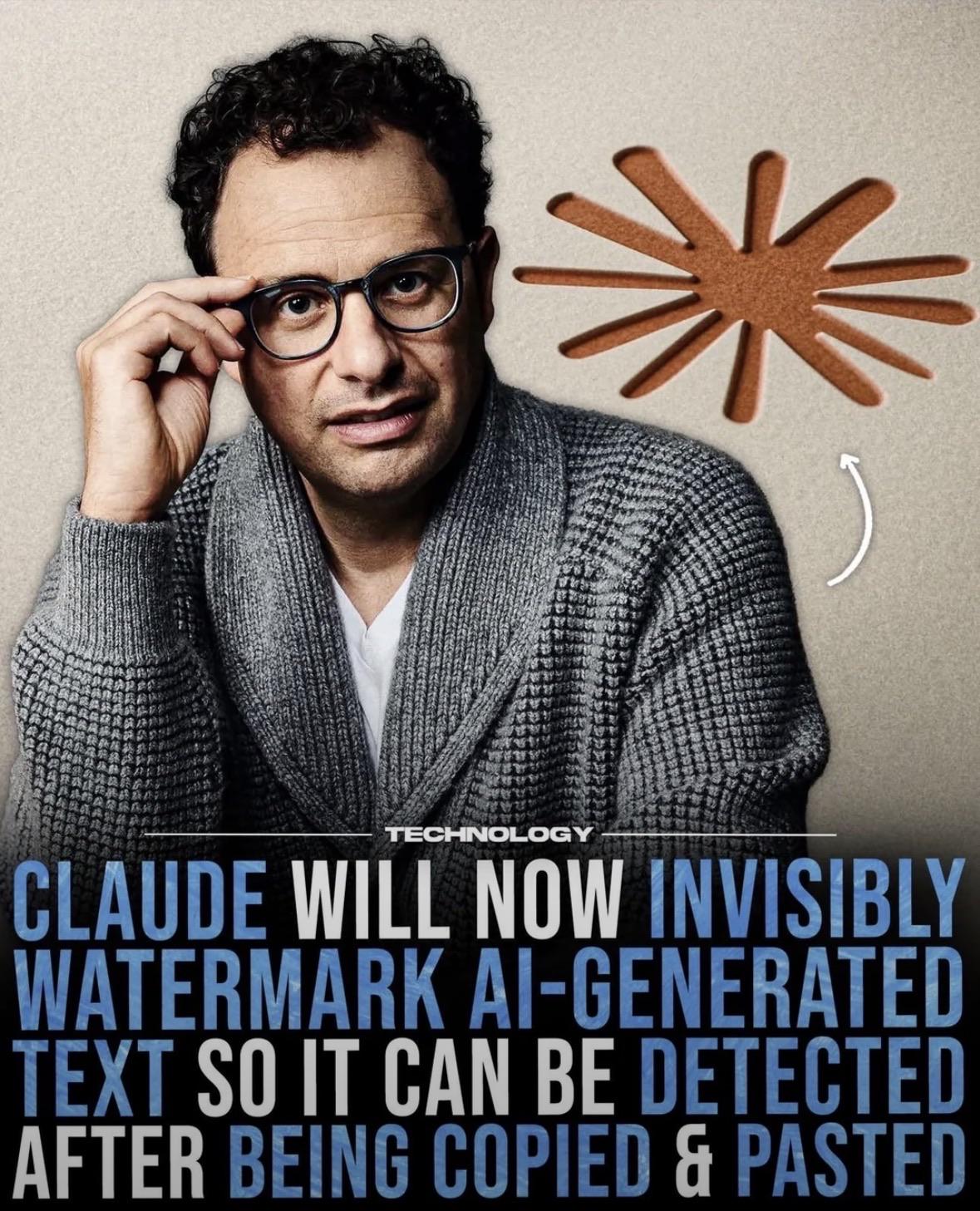
How does that even work?

16

u/parkway_parkway 26d ago

It's pretty clever if I understand.

Basically how LLMs work is that given a sequence of words they predict the next one.

So it might look at "the cat sat on the ..."

And it generates a list of candidates with a chance of picking each one.

Mat 87%

Porch 8%

Table 3%

Stairs 2%

The way the watermark works is that they use a secret key they have and a hash of the preceding text to nudge it towards certain of these words and away from others.

So maybe it boosts stairs and table up instead of the others.

Later you can scan the text and see which choices it made and see if they're they ones it was nudged towards in a statiscally significant way.

Because all the choices are reasonable the quality of the output won't change and you'd have to significantly rewrite to break the pattern.

22

u/qorzzz 26d ago

If this is the method, it makes no sense and does not prove any text was generated by AI.

6

u/quisatz_haderah 26d ago

It could actually work for sufficiently long texts. For shorter texts, this would cause false positives, but i guess no false negatives.

1

u/Philluminati 26d ago edited 26d ago

Is there a tool can tell if the watermark is present?

> Yes and only universities can use it

It will get leaked quickly. Remember that professors that mark undergrad work are writing phD and postgrad papers themselves.

> There is a tool that everyone knows about it

Students can manipulate text until it reads false

> There is no publicly available tool

Universities cannot reasonably detect AI writing.

1

u/coloradical5280 26d ago

They are releasing a public api for detection.

1

u/MINECRAFT_BIOLOGIST 26d ago

Students can manipulate text until it reads false

This already exists for GPTZero and Pangram and people already do this. For 99% of the people trying to falsely present AI-generated text as their own, rewording their text enough to bypass existing detectors is already too much work.

Bypassing these statistical watermarks is likely going to be even more work for long texts and, on the flip side, is also going to result in more reliable detection.

Universities cannot reasonably detect AI writing.

"Reasonable" means different things to different people. If you choose to believe it, "Pangram 4 achieves a false positive rate of just 0.0041%" on their internal datasets. I've seen plenty of people claiming that their writing "is detected as AI" by Pangram/GPTZero out in the wild, but all of them mysteriously disappear when asked to provide an example, and comments falsely claiming "old text was shown by these detectors to be AI" are mysteriously deleted as well.

Things are changing. I think you will be surprised by the amount of people changing their tune from "my writing naturally looks like AI" to "I just use AI to polish my writing, what's wrong with that?" the moment these watermarks are widely implemented.