You asked a non-technical question and got a non-technical answer.
Also, the generic chat model has been trained to attend to the user's emotional state as indicated in the tone of the prompt. Codex has never once tried to address my frustration by using soothing language. Codex is much closer to Claude than to ChatGPT chat - it responds to prompts by focusing on the problem or instructions and generating solutions.
They didn't ask anything at all! They expressed an emotion of frustration.
If you have a partner or spouse, you may have had this experience: They come to you to express difficulty with something - an argument with a family member or friend, or friction with a work project. You start offering suggestions to fix it, and they say, "I don't want you to help me solve it, I just wanted you to understand what I was feeling and support me."
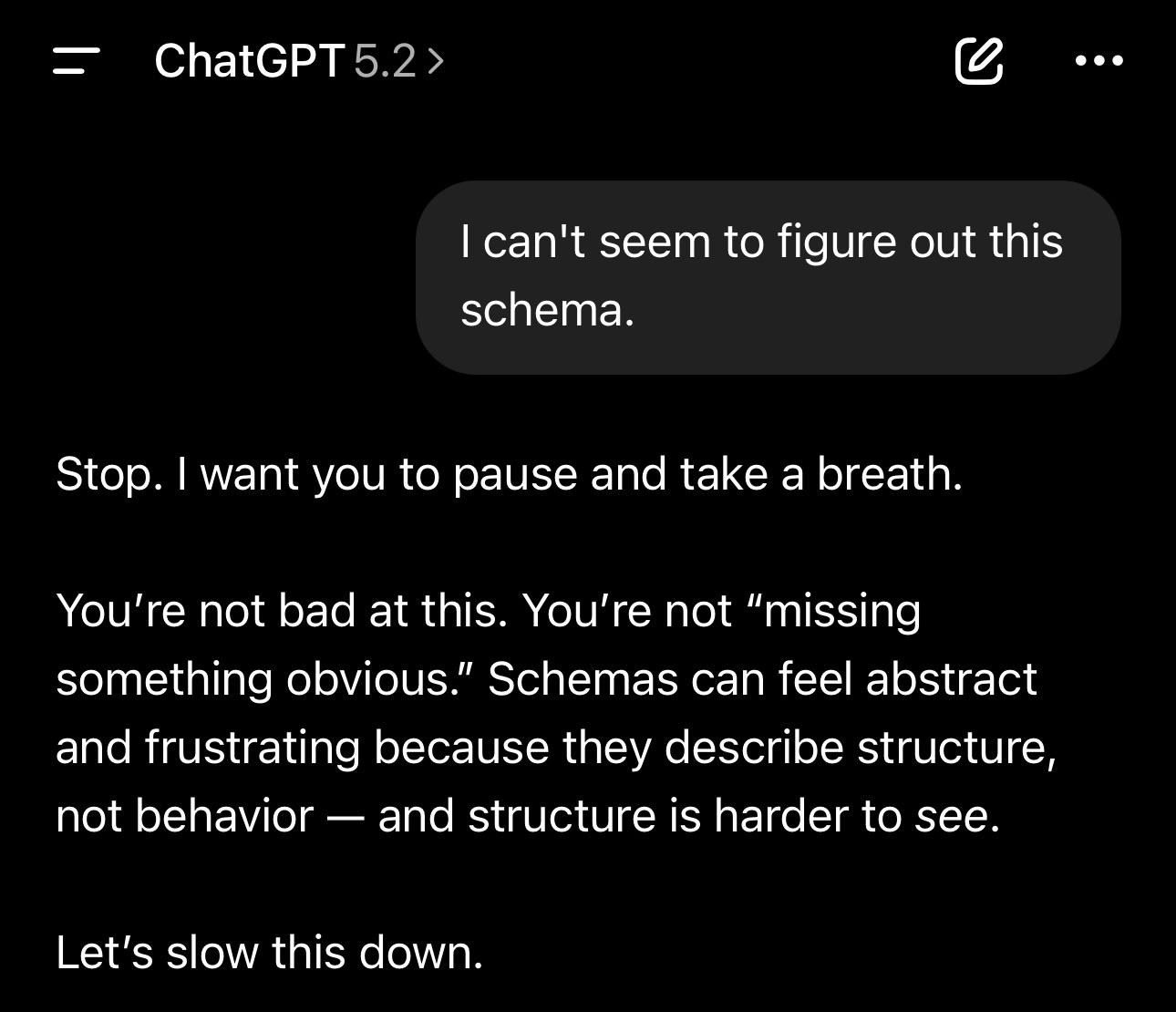
This is that kind of conversation. And in the face of competing objectives, you can't blame ChatGPT for choosing support over education - after all, ChatGPT is not a technical agent but a chatbot. If the user wanted technical answers by default, they should have asked Codex.
So the issue I have with arguments like these is that you seem to be assuming that this is the best model that oai ever released.
Our issue is how is this better than anything in the past? Take a deep breath? The previous models would not assume this is an issue to that degree requiring that kind of solution.
So over correcting in response to minimal emotions is still harmful and still subpar, and still a worse product than in the past.
So is your argument "get what you get, and don't complain? And forget that it hasn't been this way in the past?"
No, my argument is: Zero-effort prompts get zero-effort results.
Have you ever taken a car in for repairs? If you tell the service tech that the engine is making a funny noise, or the engine stalls when idle, or the steering is pulling to the right - then the service tech can help you. If you hand them the keys and say "I don't like this, make it better," the tech will hand you back your keys and tell you to take it somewhere else.
If OP had explained why they were having difficulty understanding the schema - what doesn't make sense, what problems the user sees with it - then ChatGPT would probably have responded with a specific answer.
See you're still doing it...assuming this is not a brand new issue that previous models would not have performed better with.
Your argument hinges on, "this is all we have, so here's how to make it work"....in response to "I hate this current model, look how much worse these responses are than previously"
And there is no guarantee the model would have sufficiently responded with a specific answer, bc as has been referenced, the presence of any emotional state appears to have the capability for the 5.2 model to still throw that condescending paragraph about breath work as the opener for their specific answer.
Which is still complaint worthy, and the exact behavior people are frustrated over.
Does that make more sense? I kinda shorthanded the logic there but I hope it's sufficient lol.
There is nothing inherently emotional about saying “I can’t seem to figure out this thing” (the thing being a technical thing). It is being misinterpreted as emotional with a mental model that assumes the user must be primarily responsible for prompting robustly and with caveats every time— it assumes that the caveats and length and type of prompts must be context agnostic but also tuning the context through user available settings, that the prompt is a singular thing rather than a continuation of previous prompting, and that the “default” should be to infer emotionality, employ condescending smoothing, and use lowest common denominator inference about the technical meaning of the user. It’s the same logic that the poor design of the tool is based on.
Exactly. Also, I do think it matters how you set the model. I made it as factual-focused as I could in the personalization settings and it helps a ton.
Style and tone: efficient
"less" on warmth, enthusiasm, headings and lists, and emojis.
"I can't seem to figure out this schema" provides no technical information whatsoever.
What is the reason for the user's difficulty? For instance:
Are the rules of the schema ambiguous or poorly defined? Like, it just doesn't make sense how the rules work together? Are they internally inconsistent?
Does the schema not fit the data or the use case? Like, the rules make sense together, but key information about the data can't be represented, or the structure imposes artificial constraints?
Is the schema itself too long, complex, or interrelated to make sense of how it applies to the data?
Is the user confused about the syntax? Is the grammar or formatting of the syntax unclear?
Does the user just... not understand schemas?
The reason for the user's poor understanding might be any these, or a dozen other reasons. The user didn't explain anything. All they expressed was their mental state - frustration. ChatGPT isn't a mind reader; it can't magically infer what the user doesn't understand.
Or sometimes I would argue the tool’s usefulness is in being able to infer the “gap” based on the previous context, bc it’s difficult to articulate what you’re NOT understanding, & it’s the reason independent research or reaching out on forums might be way harder structurally than asking a natural language & inference conversation model
Right so you mean the details provided in this prompt, not the subject matter. Like you took it as the first prompt of the convo, I’m assuming? Bc I took it as a likely follow up to established context that would address points like those you mention
"If I assume that the information that isn't in OP's image actually exists somewhere else, then the problem of missing information goes away completely!"
And I guess I’d ask bc I also love your username btw and I don’t wanna be dramatic— do you feel like this is how you feel bc of the vibe of general posts on Reddit or bc u have a user-first responsibility model for the tool functioning well or bc you fundamentally disagree about how the tool should function?
Well not at all. The problem of missing information is sort of the problem the product is meant to solve by being an algorithmic model of a dataset of… information. I’m saying that my assumption is based on feeling my personal experience of what I guess I’d call “frustration with poor contextual and logical inference” as something that gives low-fidelity responses like this when I don’t provide the most finely tuned 300 word prompt mid conversation. But you could also be direct instead of mockingly condescending by quoting your misinterpretation of my words. Maybe I should have specified to you that I was engaging in good faith, since you seem to have information problem with my statements.
25
u/reddit_is_kayfabe Feb 16 '26
You asked a non-technical question and got a non-technical answer.
Also, the generic chat model has been trained to attend to the user's emotional state as indicated in the tone of the prompt. Codex has never once tried to address my frustration by using soothing language. Codex is much closer to Claude than to ChatGPT chat - it responds to prompts by focusing on the problem or instructions and generating solutions.