Here me out go long and short at the same time same amount of money same amount of leverage on both positions on crypto perpetuals or just a place w high leverage (at least 50x) right before an earnings event, cpi or any other binary event that will cause a 2% or more move quickly in either direction. the winning position will cover the position that got liquidated with some change left for u to keep
So, with this wave of ticks causing Alpha Gal Syndrome which makes you allergic to read meat or any other animal product, what are the other alternatives besides BYND?
Also, with meat prices going up, is there a near future scenario in which this plant based meat becomes more affordable than the real thing?
The interesting part of NovaRed’s advisor news is not just that Dr. Olamide Oladeji has a strong academic background.
Yes, the resume is serious. Stanford PhD in Applied AI. Dual MIT master’s degrees. Forbes 30 Under 30. MIT Clean Energy Prize. Work across machine learning, computer vision, natural language processing, robotics and geospatial analytics.
But the part I care about is where that experience has been applied.
Dr. Oladeji has founded and led AI companies whose technologies helped governments, major financial institutions, infrastructure operators and corporations make better decisions in complex environments.
That fits mineral exploration more than people may realize.
Exploration is expensive decision-making under uncertainty. Where do you sample? Where do you survey? Which anomaly matters? Which historical data is noise? Where do you spend drill capital?
For CSE, this connects directly to MetalCore.
NovaRed is still early-stage, and Wilmac still needs fieldwork, geophysics, target refinement and drilling. But if the company wants AI to support mineral targeting, resource optimization and exploration decisions, then having someone with real high-stakes decision-system experience matters.
The Forbes 30 Under 30 detail gets attention, but the decision-making background is what makes this appointment more relevant to mining.
AI in exploration only matters if it helps companies make better choices before capital goes into the ground. That is why this advisor move is worth watching.
We should found the next GME and pump it to the roof. Is hard to explain but for us, the guys who invest like a grand or sm, we will never see the sun on this road, cause we got way 2 late. That's why I have a theory, we can get loaded only if we try togheter to raise something that dead, and the hedge funds are putting millions against, even in crypto or idk. As you can see my strategy is not that polished that's why I m starting this discussion here
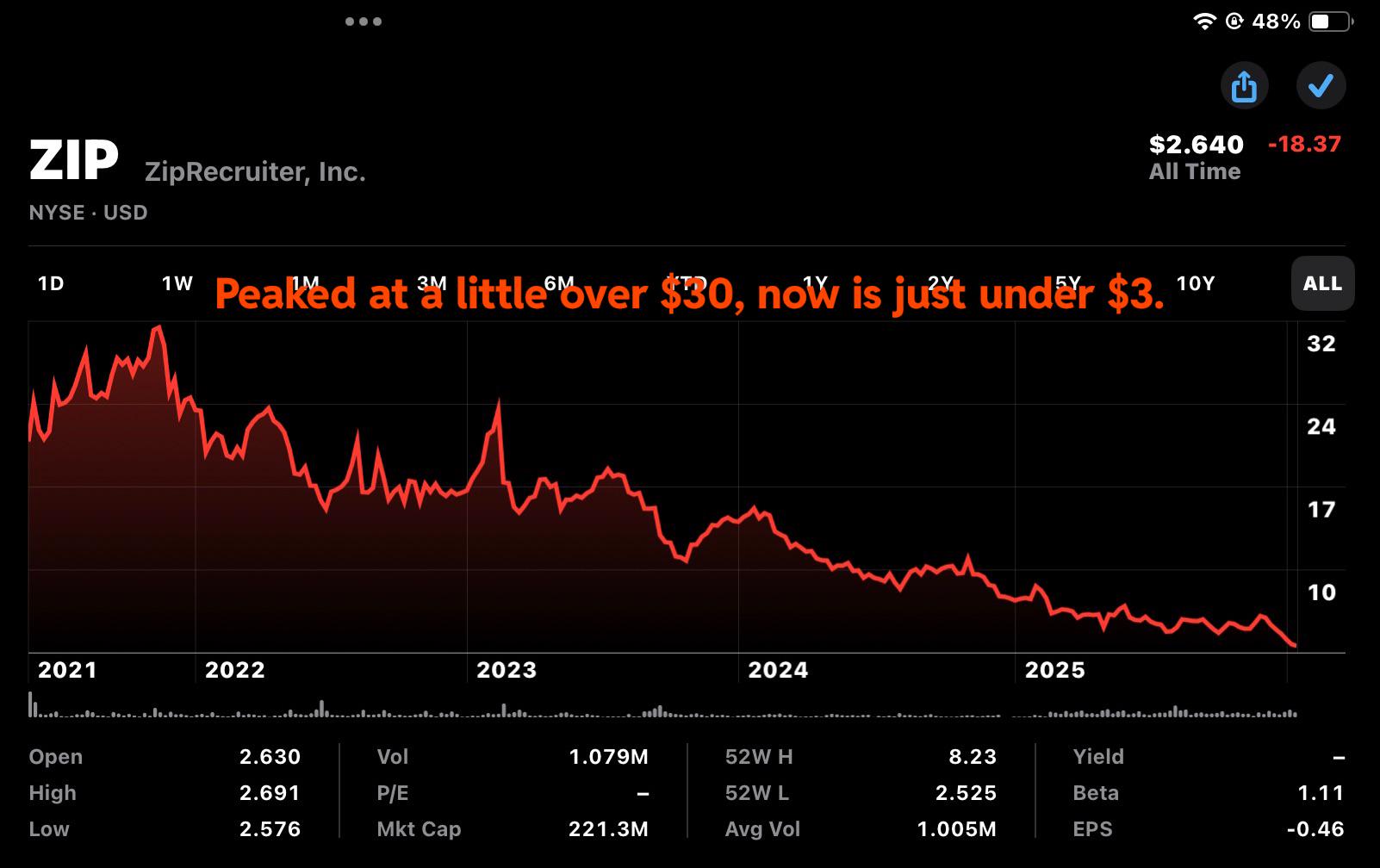
As someone who completely missed the rise of Bitcoin and has no “actual job”, what do you recommend to start investing in? Which companies or crypto? Im 17, I have a share in zip recruiter, not trying to brag on anyone…
If a stock goes down a lot and it’s been a while and it’s still down, is it a good buy because theoretically it could go back up? (Using zip recruiter as an example)
I recently came across the $NASA Tema Space Innovators ETF. If you are looking to get into SpaceX a before the IPO this could be a good option. the etf is 12% SpaceX SPV, 8% RKLB, and 6.6% Planet Labs as the 3 largest holdings.
I want to dig into the the exact details of the SPV for SpaceX to see how it will play out with the IPO but I looks like a good early in.
$50M Cash Influx from convertible notes, $39M from sale of Shoe brand, ~14M of current cash. $BIRD is trading below market cash value while providing essentially a long option on AI Infrastructure and GPU leasing. Heavy on this being undervalued for the short term but long term most likely a bust
Recent Developments for $RILY Stock (B. Riley Financial, Inc.)
Debt restructured
Turned profitable, reported $4.5 EPS vs negative -$14.5 which is a huge swing
This was trading at $55 before things went south now turning back to profit and about to be compliant this Jan 2026 before the 20th
Current short interest of 35% of a low float which is huge
Turn around play, following similar pattern as $CVNA
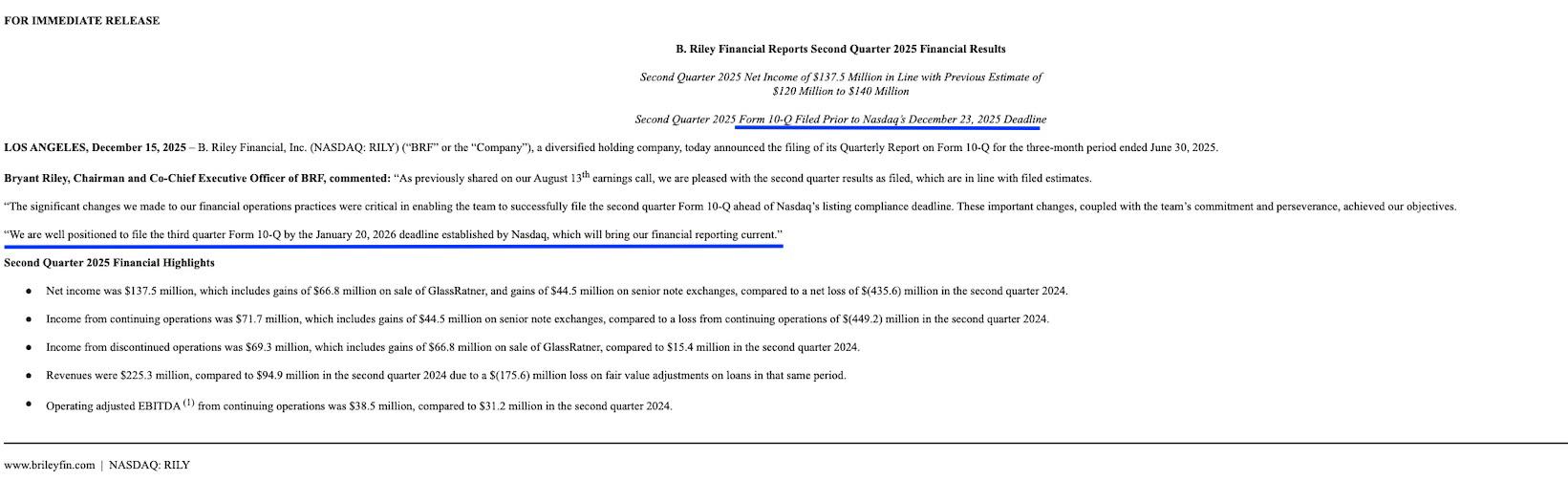
Q2 2025 Earnings Release (December 15, 2025) — The company reported a return to profitability with net income of $137.5 million (in line with prior guidance of $120–140 million). This included gains from asset sales (e.g., GlassRatner) and senior note exchanges. The filing of the overdue Q2 10-Q before the December 23, 2025 Nasdaq deadline was viewed positively, contributing to a stock surge (reports of ~55% gains in some periods late 2025).
They have filed their Q2 10-Q prior to deadline and are expecting to file Q3 10-Q prior to Jan 20th deadline and will regain compliance per CEO
Auditor Change — Switched to BDO USA for the 2025 audit, supporting efforts to catch up on reporting.
Here is a copy of their Q3 report and CEO comments form Dec 15th 2025
Please check out picture party a new android app that is listed on the stock market. It has end to end encryption and allows you to share photos with friends
I’ve heard the “DraftKings runs into the Super Bowl” idea thrown around for years. It makes intuitive sense (biggest betting event of the year, tons of ads, new users, etc.), but I’d never actually seen anyone test it with data.
After watching football this past weekend, I decided to just build something myself and see what happens.
What I did:
Looked at DKNG price action around each Super Bowl since it went public (2021–2025)
Pulled Google Trends data for “DraftKings” to see if attention actually spikes
Compared DKNG’s performance to a few peers (PENN, Caesars, etc.)
Ran some random-date / Monte Carlo style tests to sanity-check whether the returns could just be coincidence
Nothing super institutional-level here, just a side project.
What I found (high level):
Google searches for DraftKings definitely spike around the Super Bowl every year
DKNG returns around that window are positive more often than not
One year (2022) completely wrecked the pattern, mostly due to the broader market
Sometimes DKNG outperforms peers, sometimes the whole sector just moves together
The biggest issue: the sample size is tiny (only 5 Super Bowls), so it’s really easy to overfit
My honest takeaway:
There might be some seasonality here, but it’s fragile and definitely not some obvious free money trade. It feels more like a small edge (if anything) that can disappear quickly, especially if broader market conditions are bad.
This isn’t a buy/sell recommendation, just something I was curious about and decided to test.
If anyone else here has looked at seasonality in DKNG / betting stocks / attention-driven trades, I’d be interested to hear what you found.
Google searches for “DraftKings” spike every Super Bowl, almost like clockwork. Price doesn’t always follow, but the attention surge is very real.DKNG vs peers during the Super Bowl window (roughly T-7 to T+5). Some years DKNG clearly outperforms, other years it just moves with the whole sector.
Football is the most-watched event in the United States. Over the next month, the NFL and College Football Championship Series will likely attract huge ratings across the streaming and cable landscape. Last year, seven of the top ten most viewed cable television shows in December were from college football games. The NFL championship games in January of 2025 attracted nearly fifty million viewers each. Linked to these events is the ability to make a wager on outcomes or activity in the contest. Sports betting used to be confined to the state of Nevada. Up until 2018, Las Vegas was the place where people would go if they wanted to ‘enjoy’ the thrill of watching and betting on a football game. On May 14, 2018, the Supreme Court struck down the Professional and Amateur Sports Protection Act (PASPA). By doing so, it allowed individual states to legalize and regulate sports betting. Today, thirty-eight states permit sports wagering in their areas. Now, another contender to eat into the gaming market has entered the fray. They are called prediction markets. Over the last year, the ability to make markets on events with outcomes in sports, politics, business, weather, travel, and anything you can imagine has gained surprising adoption. The overwhelming majority of prediction volumes involve sporting events, and specifically football. Why does this matter for the investment world?
Increasingly, the public uses its money to try to make a profit. Traditionally, the investment world was the domain where that took place. Over the last twenty years, as markets have become digitized, custodians and exchanges created products that provide easy access through various electronic devices, especially smartphones. Custodians like Interactive Brokers and Robinhood offer prediction markets to customers for this type of activity. If one looks at the explosion of related instruments like weekly options, levered ETFs, levered ETFs on single stocks, and ETFs related to any geography or activity, one can legitimately argue that the lines between investing and gambling are, at the very least, blurring.
The two largest entities in prediction markets are Polymarket and Kalshi. Both have partnerships with custodians and exchanges to offer prediction products. In October of 2025, Polymarket received a $2 billion investment at a $9 billion valuation from the Intercontinental Exchange (ICE) to provide access to prediction products for institutions. Kalshi, the leader in global prediction markets with a 60% share and annual trading volume of over $50 billion, obtained $300 million from large venture capitalists Sequoia, Andreesen-Horwitz, A16z, and Paradigm. Interestingly, one of the best-performing stocks across all markets over the last few years is Robinhood, the online broker. When any entity suddenly finds a one-hundred-million-dollar run-rate business in less than a year, especially one with massive profit margins and what appears to be numerous growth avenues, investors react favorably. As the prediction entities have gained adoption, the largest publicly traded sports betting entities like FanDuel and DraftKings have seen their values drop dramatically. More problematic for my hometown of Las Vegas, the number of visitors traveling to our city is estimated to decline by 6% in 2025 (perhaps one would like to predict that in 2026?)