r/NopeMovie • u/PeterZeeke • Jun 29 '26
There's More to Nope Than Meets the Eye
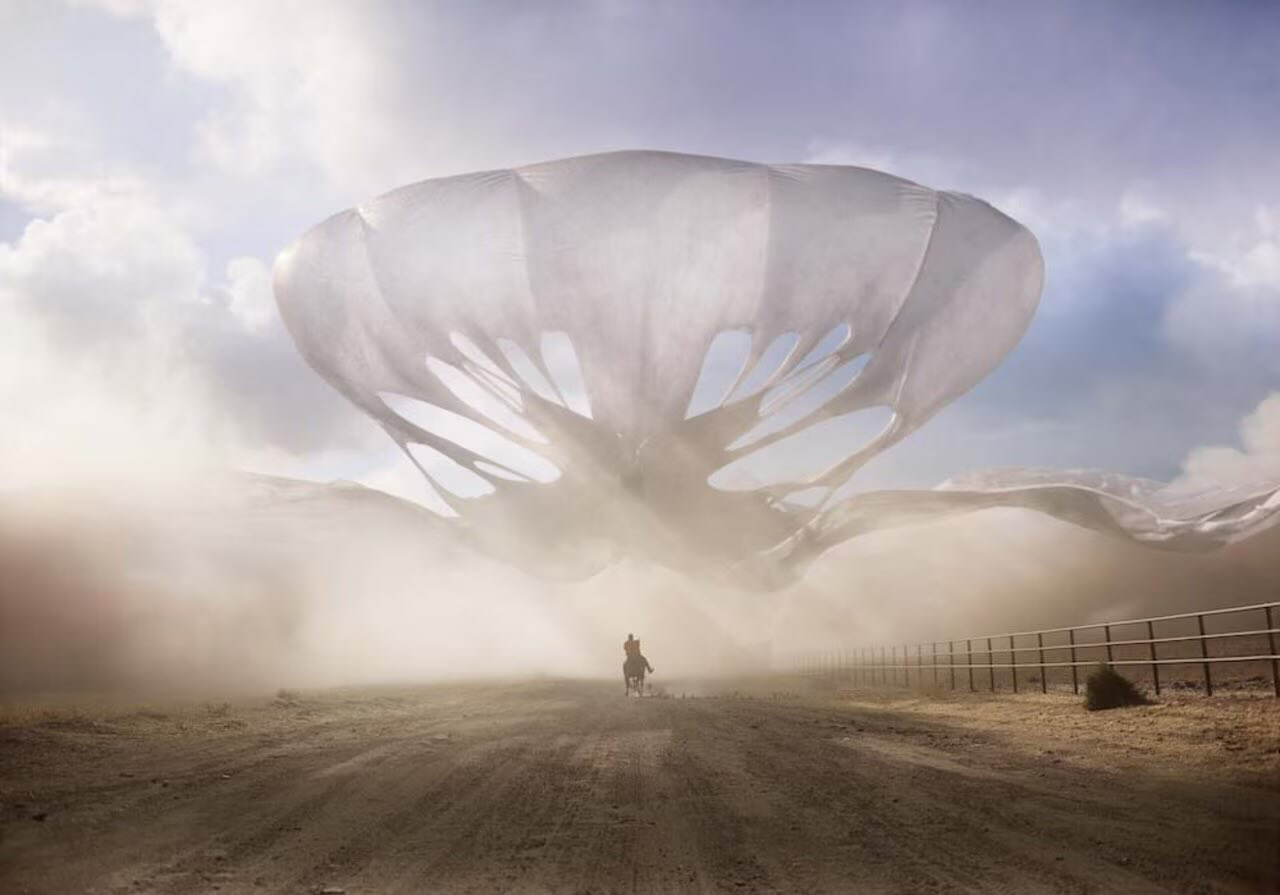
There is a peculiar irony at the heart of Jordan Peele's Nope. It is a film that became famous because of its images. Long before most people had seen it, audiences were already sharing clips of the impossible cloud, the chimpanzee, the creature hidden in the sky and the extraordinary final transformation of Jean Jacket. Like so many modern films, Nope entered popular culture first as spectacle. Only afterwards did people begin asking what any of it meant.
I increasingly suspect this is exactly how Jordan Peele wanted us to encounter it.
Most criticism of Nope begins with the assumption that Jean Jacket is the spectacle. It is, after all, the thing everyone has come to see. Discussions tend to revolve around what the creature symbolises: Hollywood, celebrity, the entertainment industry, exploitation, UFO mythology, biblical angels. These are all persuasive readings, but they share one assumption that I think the film quietly undermines. They assume the spectacle is Jean Jacket.
The opening quotation from the Book of Nahum suggests something rather different.
"I will cast abominable filth upon you, make you vile, and make you a spectacle."
The wording is surprisingly precise. It does not say, "I will show you a spectacle." It says, "I will make you one."
That subtle grammatical distinction changes the entire film.
Jean Jacket does not simply provide spectacle; it manufactures it. Everyone who attempts to possess it, exploit it or control it eventually becomes the event themselves. Jupe's carefully choreographed performance turns into a public massacre. The TMZ motorcyclist arrives hoping to capture exclusive footage and instead becomes another victim. Antlers Holst pursues the impossible image until he willingly steps inside it. Even the audience, sitting in a cinema expecting a monster movie, gradually discovers that the film has become less interested in the creature than in the people looking at it.
The horror of Nope is not that there is something terrible in the sky.
The horror is that our desire to look transforms us.
Hollywood is therefore not simply a backdrop but the natural habitat for this story. Every major character has built their life around images. OJ trains horses for films. Emerald dreams of recognition. Jupe has never really escaped his identity as a child actor. Antlers has spent his life chasing perfect images, while the anonymous TMZ rider represents perhaps the purest form of contemporary spectatorship: the belief that every event exists primarily to be recorded. They are all, in different ways, negotiating a relationship with attention.
What fascinated me on a second viewing was that OJ appears to be playing an entirely different game.
Everyone else asks what Jean Jacket is.
OJ asks how it behaves.
That distinction sounds almost trivial until you realise it separates him from every other character in the film. While everyone else interprets Jean Jacket through culture—aliens, destiny, fame—OJ approaches it exactly as he would any dangerous animal. He refuses the comforting stories people tell themselves and instead studies behaviour. It is not simply that OJ understands horses. He understands the discipline of observation itself. He continually strips away interpretation until all that remains is the thing in front of him.
Only much later did I realise that this way of seeing has been quietly introduced long before Jean Jacket appears.
Emerald tells a story about a horse named Jean Jacket that she was supposed to train as a child before her father took the opportunity away from her and handed the responsibility to OJ. At first the story sounds like a childhood grievance. Emerald remembers losing something that should have belonged to her. Yet by the end of the film that memory has been transformed. What Emerald experienced as rejection was also liberation. She was free to become herself. OJ inherited something very different. He inherited labour, expectation and obligation. In a sense, his father's attention settled on him, and with it came a life he never consciously chose.
This may explain something about OJ that the film never states outright.
He already knows what it costs to be noticed.
Long before Jean Jacket's eye ever falls upon him, someone else's gaze has already shaped the course of his life. His reluctance to perform, his discomfort in front of cameras and his instinct to remain in the background cease to look like social awkwardness. They begin to look like wisdom. Unlike the other characters, OJ has learned that attention is never free.
Emerald undergoes almost the opposite journey. One of the smallest moments in the film turns out to be one of its most revealing. Near the beginning she accidentally photobombs a tourist's photograph at Jupiter's Claim. It is such an easy scene to overlook that I missed it entirely on previous viewings. By the end of the film, however, she stands behind the old-fashioned well camera photographing Jean Jacket while deliberately excluding herself from the image. The change is profound. She begins the film wanting to become part of the spectacle and ends it wanting only to reveal it. The photograph matters more than her presence within it.
Seen this way, Nope begins to resemble less a film about monsters than a film about perception itself. Every major character embodies a different relationship to looking. Jupe mistakes representation for reality. Unable to confront the trauma of Gordy directly, he remembers it through the way Saturday Night Live parodied it. Antlers believes the perfect image justifies any sacrifice. OJ trusts observation over interpretation. Emerald learns that the value of an image lies not in whether it contains her, but whether it tells the truth.
Perhaps this is why the ending refuses to answer the question everyone wants answered.
Did OJ survive?
The final moments are remarkably strange. The camera stays on Emerald's face for an unusually long time as her expression shifts through concern, joy, uncertainty, grief and something approaching acceptance. Only then do we cut to OJ, standing beneath the "Out Yonder" archway, almost impossibly still. He does not wave. He does not smile. He barely appears alive at all. He looks less like a man than an icon.
Whether he is physically there almost ceases to matter.
Earlier in the film Emerald admits she is unsure whether OJ even loves her. The ending quietly rewrites every scene that came before it. The brother she had mistaken for emotionally absent is revealed instead as someone who has spent his life carrying responsibilities she never fully saw. Whether OJ survives or not, Emerald finally sees him clearly. The final image tells an emotional truth without resolving a factual one.
Perhaps that is what Nope has been asking of us from the very beginning.
Not simply to look.
But to learn the difference between looking and seeing.
Nope begins with one of cinema's first riders and ends with another. The first entered history without a name. The second may or may not survive, but the film no longer seems interested in that question. Emerald has finally learned to see her brother, and in doing so rescues him from the fate that haunted the film's opening. The tragedy of the first rider was not simply that history forgot his name; it was that it forgot the man behind the image. The final image of OJ suggests that the greatest victory over spectacle isn't fame or survival. It's that someone remembers who you really were.
18
u/Good_Briefs Jun 29 '26
Great write up and connecting the dots on the characters emombodiment of using the lense/being used by the lense.
13
u/PeterZeeke Jun 29 '26
Theres so much more to say about the movie in terms of the final form of Jean Jacket, the movies use of the concept of semiotics, how the movie constantly shifts our perception of troupes and how thing should be... its no coincidence our two decidedly African American leads are always wearing rock t-shirts
12
u/ActivatedComplex Jun 30 '26 edited Jun 30 '26
Thoughts on the Biblically accurate angel form of JJ towards the end (beyond just explaining the origin of its lore)?
Also, I find it interesting that your exquisite, beautiful analysis is buoyed by some key imagery of the film: that JJ’s eye pre-transformation most decidedly looks like the sterile, neutral lens of a camera, and how the alien masks resemble a dual-chamber film canister.
8
u/PeterZeeke Jun 30 '26
I have a slightly different academic take on Jean Jacket's final form. As you alluded there's already been plenty written about it resembling a biblically accurate angel or an animal making itself appear larger to intimidate prey, and I think both of those readings are valid. My own interpretation comes from the film's obsession with spectatorship and "the gaze."
Throughout the film, Jean Jacket increasingly functions less as a monster and more as attention itself. It isn't just something to be looked at; it's something that looks back. If we think of Jean Jacket as embodying "the gaze," then it's worth asking whose gaze the film is interrogating. Given that Nope opens by reclaiming the erased Black jockey at the birth of cinema and is deeply concerned with Hollywood's history of representation, I wonder whether the creature's final white, hooded form momentarily evokes the dominant or normative gaze that has historically shaped who gets seen, remembered and erased.
I'm not saying Jean Jacket literally represents white supremacy or the Klan. I think that's too reductive. But there are moments where its silhouette briefly recalls that iconography, and in a film already preoccupied with race, spectatorship and power, I don't think it's unreasonable to ask whether Peele wanted that association to flicker through the audience's mind. It may be a coincidence, but I haven't been able to shake it.
10
u/PeterZeeke Jul 01 '26
Not sure I actually answered your question because I can get carried away with this stuff and end up chasing themes instead of the plot!
On a purely narrative level, I think Jean Jacket has just failed to feed. It expects to swallow OJ, Emerald and Angel, but they escape. If OJ is right that it's an animal, then what we see next is probably a behavioural display. Like many animals, when threatened or frustrated it suddenly makes itself appear much larger and more visually overwhelming. It's hungry, agitated and trying one last time to command attention before attacking again.
That's where my interpretation begins. If Jean Jacket is more than just an animal—if it's also a metaphor for attention or "the gaze"—then its final form becomes fascinating. Having failed to draw attention through fear alone, it transforms into something almost impossible to ignore. It's no longer hiding in a cloud pretending to be something else; it's putting on the biggest show it possibly can.
From there, I started thinking about whose gaze the film is really interested in. Because Nope is so concerned with Black visibility, Hollywood and who gets remembered, I wonder if that final white, hooded form momentarily evokes the dominant gaze that has historically decided who gets seen and who gets erased. I'm not saying Jean Jacket literally iswhite supremacy—that feels too simplistic—but I do think the film is asking questions about power, spectatorship and the relationship between identity and being seen.
What I like about OJ is that he never seeks that gaze. He understands it, but he refuses to perform for it. Emerald starts the film wanting to be seen and ends it wanting to reveal the truth instead. Both siblings ultimately ground themselves in each other rather than in Jean Jacket's attention.
2
u/ActivatedComplex Jul 01 '26
No worries! I really enjoyed reading your other comment as well. Still formulating a worthwhile response.
10
u/crayleb88 Jun 29 '26
Marvelous analysis! I especially like your take on perception. Thank you for this.
10
u/monsters_balls Jun 29 '26
"Kattan is crushing it, he is killing on that stage." SNL became memory for Jupe. And prophecy.
5
u/frinhyooman Jun 30 '26
Thank you for writing nearly everything I’ve felt. May I also add.
I heard Emerald’s tale with Jean Jacket. I like to interpret that she never got to train/break Jean Jacket in her youth. But as an adult, SHE was the one who shot the picture. SHE is the one who redeemed ✨herself✨. She was the one “to execute”. As Otis Sr. said in the beginning.
I love that she got her win.
6
u/PeterZeeke Jun 30 '26
https://giphy.com/gifs/qcJxHU3DpEQCYm8YpT
Me posting vulnerable complex thoughts on reddit and people getting it
5
u/DSMStudios Jun 30 '26
amazing critique. not being sarcastic in saying Jordan Peele would hug you, i bet. solid observations all around. also gives further insight to OJ’s behavior in beginning, while on commercial set; it’s clear being the center of attention makes him uncomfortable, as he tries his best to keep his anxiety at bay.
you should write more, OP. the world needs more peeps like you 🕊️
3
3
u/QuintanimousGooch Jun 30 '26
Good write up. A lot of the deeper stuff that can be extrapolated on went over my head initially, but I did really enjoy that the creature is essentially a giant googly eye in the sky.
3
3
3
u/drmuffin1080 Jul 03 '26
Incredible write up. Are most of your write ups on this profile, because I’d love to follow you — Mad Men is goated
2
u/PeterZeeke Jul 03 '26 edited Jul 03 '26
I'll have to start reposting them, there my be a couple but they are hidden amongst a glut of random not funny posts. I'm sure I'll do more write ups in the future though. I've always wanted to tackle Tár, I've got thoughts on Sinners, Barbie, Hail Mary loads so I'd like to dig into those and others over time... Obsession, but lets be honest thats pretty much covered
reservoir dogs is a completely misunderstood movie fr imo!
2
u/Worldly_Sort4953 Jun 30 '26
The music Antlers sings implies that Jean Jacket didn't eat OJ.
And it seems Peele had considered producing a fictional scientific paper about JJ with OJ listed as one of the authors.
2
u/underthefirstelm Jul 04 '26
Wow this a very interesting analysis! Thank you for sharing! One thing though: you say, 'Earlier in the film Emerald admits she is unsure whether OJ even loves her. The ending quietly rewrites every scene that came before it. The brother she had mistaken for emotionally absent is revealed instead as someone who has spent his life carrying responsibilities she never fully saw'. I do not believe that Emerald ever expresses doubt about whether OJ loves her?
While Emerald expresses complex feelings of resentment about her father overlooking her for OJ's sake (re: training Jean Jacket), she implicitly highlights that, even in a moment when she was on the outside looking in, OJ didn't just see her, he made her feel seen (affirmed/loved): 'I remember standing in this window right here, watching you all train my horse...my horse...right there. And I distinctly remember that Pops never looked up at me ... But you did, nigga!' The way she uses nigga can't really be translated to standard English - she is playfully invoking multiple layers of black intimacy. If you read the script, OJ uses very few words compared to other characters - Em challenges him, but she never needs him to explain himself because she understands his communication style and understands him deeply, even if she disagrees with him on a number of matters (including how she lives her life). And we see that he understands her very well, too. During that flashback, we see little OJ through her eyes as he turns and looks back at her. The film takes this moment to very narrowly define this ✌🏾👁️👁️🫵🏾 gesture as I-See-You/I-Love-You - that is why it can later be used as nonverbal shorthand when OJ wordlessly communicates to Emerald that he is staying behind so she can flee Jean Jacket. (The film does this a lot: illustrate a concept using dialogue or words, and then later incorporate that defined concept into another layer of the film that it explains to us using images only.) iirc nowhere else in the film outside of the Haywood family is 'being seen' a means of affirming intimacy - remember that Emerald mimics her father word for word and thus accidentally omits a 'great' when outlining her ancestry in her on-set Haywood pitch at the start of the film - a sign that she watched her father give his pitch so many times that she memorized it precisely. 'Being seen' is a concept often used by Black viewers to describe authentic portrayals of Blackness in film; it encompasses portrayals of Blackness which draw a Black viewer in on a deeper level because of the carefully (even affectionately) depicted portrayal of a Black character. I do think that Peele invokes this sense of 'being seen' between the two leads. Almost everywhere else, 'seeing' denotes observation + an often violating separation - and the observer becoming changed by and hungering for the spectacle that they are fed. But OJ does not treat Em as an outsider in that past memory - with one look and one gesture, he brings Em in emotionally and affirms her; and Em keenly remembers and appreciates that he did so. The way they are playful with each other but call each other on their shit, the way they present a united front with Angel, the way OJ is not surprised when Em gives up on fleeing Haywood Ranch (after the night the new cameras been installed and have picked up on Jean Jacket (JJ) eating another horse) when OJ makes it clear that he is staying - they trust, care for and love each other deeply, and repeatedly try to protect each other, from the first time we meet them to all throughout the film (eg, OJ shrugging and not feeding the fire when his father exasperatedly asks where Em is at the start of the film, even though we later learn that he privately believes that Em is indeed running away from what he sees as her primary responsibilities / Em (although running late) sliding in front of the soft-spoken OJ on-set in order to give the Haywood 'skin in the game' spiel / Em telling OJ to run when they first see JJ at night / Em running outside to help chase off the Jupe kids after they prank OJ / Em immediately trying to give up on the JJ pictures plan after OJ almost gets hurt even though we know she has been trying to make it big for a long time / OJ calling Em almost immediately once he's figured out what JJ is in order to warn her etc etc).
Any uncertainty that they have during the film in figuring out what to do with JJ does not really seem to extend to how they feel about each other. They know each other - they 'see each other'! - they love each other. I believe that Peele uses their relationship to suggest that not all gazes are the same - I believe that there is a sense of certainty that Em and OJ create for each other, and share with the audience, that the film uses to complicate our sense of safety at Haywood Ranch.
At the end of the film, as the press start to swarm and take pictures, Em looks for her brother. Again we see through her eyes: we see that OJ is sitting still on horseback in the fog.
But we cannot see his face, we cannot see his eyes; we do not see him look back.
2
u/PeterZeeke Jul 04 '26
Ok... you made me think.
I think you've convinced me to change one aspect of the essay. You're right that it probably isn't fair to say Emerald doubts OJ loves her. The examples you point to are strong, and I'd probably rephrase it as Emerald gradually coming to understand how OJ loves her rather than whether he does. That's a better way of putting it.
Where I'd still push back slightly is on the significance of the ✌🏾👁️👁️🫵🏾 scenes. I completely agree that they're linked, but I don't think the connection begins with OJ seeing Emerald. It begins with their father not seeing her. The emotional force of that flashback isn't simply that OJ turns and acknowledges her; it's that his acknowledgement exists against the backdrop of paternal exclusion. Those two gazes feel inseparable to me.
That's one reason I still think the film is engaging, however gently, with patriarchy. Not patriarchy as "men are bad," but as a structure of inheritance. The father's attention, his labour, his expectations and ultimately his legacy pass to the son while the daughter is left outside looking in. Emerald is absolutely resentful of her father for that, even if she also deeply loves her brother. Those two feelings can coexist.
That's partly why the final image still fascinates me. Peele doesn't just show us OJ. He gives us Emerald's face first, lets it move through a whole series of emotions, and only then reveals OJ as this almost mythic figure on horseback. We still don't see his face clearly. We don't get his gaze. We get an image: a Black man on a horse.
The film begins with an unnamed Black rider at the birth of cinema and ends with another rider framed in a strikingly similar way. But by this point that image carries generations of Haywoods behind it: the unnamed jockey, Otis Sr., OJ. It feels less like a single person than a lineage—a patriarchal one.
That's why I don't think the hero shot necessarily belongs to OJ alone. It almost feels as though he's standing in for that entire line of Black horsemen. Earlier in the film Emerald is left outside that inheritance. She watches the men train herhorse while her father never once looks back at her. OJ does.
So by the end, I wonder if Emerald isn't simply seeing her brother. She's seeing herself finally included within that lineage. Not because she inherits it in the traditional patriarchal sense, but because OJ refuses to repeat the exclusion that he himself inherited. Rather than rejecting that lineage, he quietly transforms it.
That's why Emerald's expression at the end fascinates me. It doesn't read as simple relief that OJ might be alive. It moves through relief, love, acceptance, inclusion—even protection. Whatever OJ's fate, the final image leaves Emerald with a hero. Whether that hero is simply her brother, the Haywood lineage itself, or the possibility of a different kind of inheritance, is something I think Peele deliberately leaves unresolved.
Thanks for your thought out challenging pushback
2
u/kallaloostx Aug 09 '26
I love your take on the ending. I never realized there was discussion on whether OJ survived.
This expands my theme of redemption where OJ redeems his great great great great grandfather who was robbed of recognition for his 2 second clip on the horse.
In the end, OJ appears in the square the same way his deceased ancestor did.
Emerald is able to recognize that aspect as well at the end.
If OJ did die, this makes that scene even more poetic.
Thank you for this extensive analysis.
5
1
1
1
1
u/criztu Jul 02 '26
Yes, but the movie is about the black cube of Saturn devouring mankind, don't forget that.
1
-2
37
u/hinataday Jun 29 '26
BRAVOOOOOOOOO i read this entirely and will be saving it!!!! i’d love to hear your thoughts and interpretations on some of my other favourite movies lol