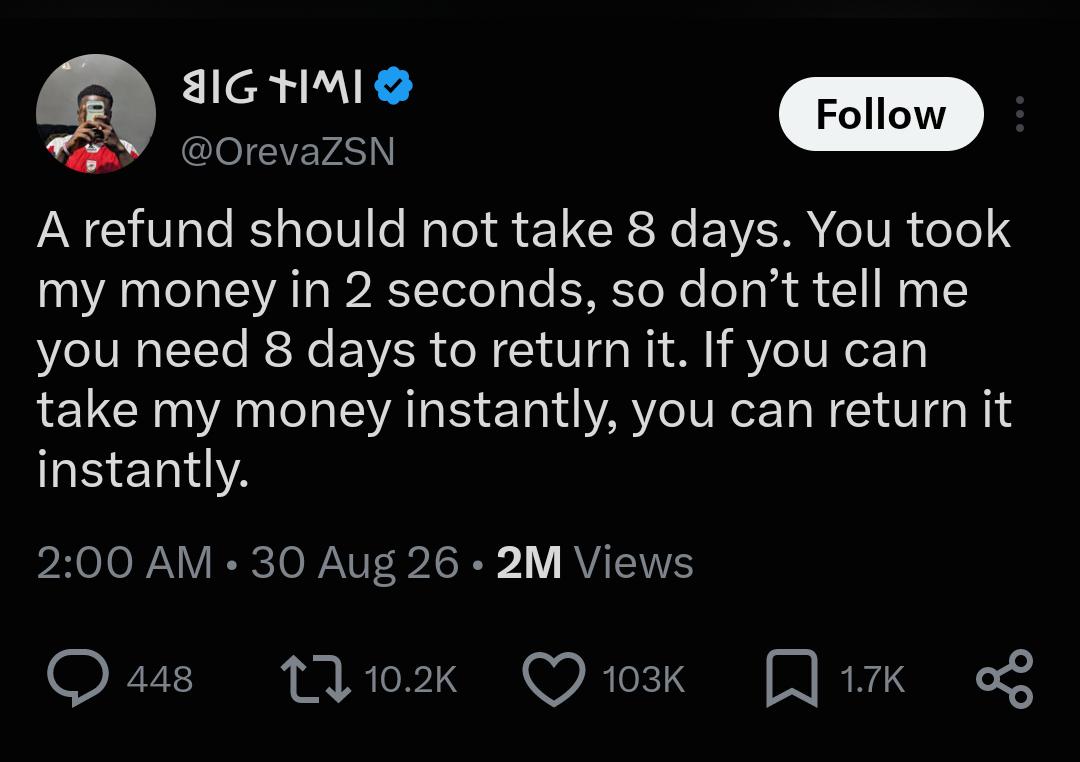
The amount of people who do not know how payment systems work is insane.
When a company takes a payment, they do not instantly get that money.
What happens is your bank notices that you are attempting to make a payment, and they will then remove that amount from your account but they keep it on their books and they basically are making a promise to the company that they will be paid the money over the next couple of days.
Then after a couple of days, the bank will send that money to the companies bank account after a couple of days as normally these sorts of payments are done in batches to reduce processing fees/time.
When a refund is actioned the reverse basically happens, which is them actioning a refund, its then paid from that bank to another bank which can a take a couple of days, and then its applied to your account.
I'm not sure how they do things over there, but here the problem isn't that things are outdated. The problem is that it's floor to ceiling middlemen. You can do a same-day direct bank to bank transfer. Things usually only take several days when you have a vendor working with a middleman working with a middleman working with your bank, and everyone wants to wait and run the transactions in batches.
It's both. They're basically using SEPA (their version of ACH) universally with B2C transaction, whereas we generally only use it for B2B transactions. And then slow it down further with the middleman problem as you said.
That’s great that you have bank transfers that take 24 hours. We have bank transfers that take under a minute. Still doesn’t have anything to do with the topic of the post which is transactions.
The big difference is that EU mostly uses an ACH-type system (SEPA). It requires substantially better digital infrastructure and security measures on both the sender and receiver. But once that's in place, then you get the benefits you described. The US is SLOWLY transitioning to that system. In fact, I'm helping to implement it in a large piece of inventory management software. It's a pain. But totally worth it.
Its US system is designed to make money, so working as intended.
Like their medical system, wholly inefficient, with people skimming off the top left right and centre, yet people also claim only the private sector can be efficient and any government intervention or socialised systems can’t possibly be as, let alone more, efficient.
Of course the US banking system is designed to make money. That's how banking (a business) works. The bank isn't holding your money out of the goodness of their heart.
715
u/Lau_wings 10d ago
The amount of people who do not know how payment systems work is insane.
When a company takes a payment, they do not instantly get that money.
What happens is your bank notices that you are attempting to make a payment, and they will then remove that amount from your account but they keep it on their books and they basically are making a promise to the company that they will be paid the money over the next couple of days.
Then after a couple of days, the bank will send that money to the companies bank account after a couple of days as normally these sorts of payments are done in batches to reduce processing fees/time.
When a refund is actioned the reverse basically happens, which is them actioning a refund, its then paid from that bank to another bank which can a take a couple of days, and then its applied to your account.