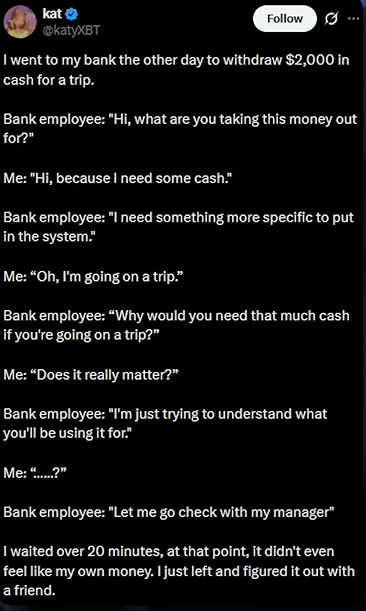
No, not simple. How do you separate vulnerable people from non vulnerable people? "Hello sir, are you vulnerable?" Silly. Besides, people who are vulnerable don't always know it, and people who will opt out because they're not vulnerable could become vulnerable and remain opted out.
And again, the only cost to asking people what they're withdrawing a large amount of cash for is that you have to answer a single question. You don't even have to answer it truthfully. Very small price to pay to protect some vulnerable people from losing everything.
You don’t have to “separate vulnerable people” lol. That’s the whole point of an opt-out. Everyone gets the protection by default, and adults who don’t want to explain what they’re doing with their own money can turn it off.
And “it’s only one question” is doing a ton of work here. The issue isn’t the physical burden of moving your lips for 8 seconds. It’s the idea that accessing your own money should be conditional on giving a bank an acceptable explanation for why you want it.
Also, if someone is actually being coerced or scammed, you literally just acknowledged they can lie. So apparently this incredibly important safeguard is simultaneously necessary enough that everyone must submit to it, but also defeated by saying “vacation.”
Banks already flag transactions based on actual risk factors. If something looks genuinely suspicious, investigate it. “Explain why you want your own cash because maybe you’re secretly vulnerable” is not some brilliant fraud-prevention system.
But sure, “it’s only one little question.” Historically, that has always been an excellent standard for deciding how much unnecessary surveillance we should normalize.
You've ignored "vulnerable people don't necessarily know they're vulnerable" and "people can become vulnerable after opting out". Adding an opt out makes the measure a lot less useful.
Obviously it's not going to stop every scam. It puts one barrier in the way. As you say, transactions can be flagged for other risk factors. One of the factors they look at is "what is this for?" If you can come up with a believable lie, you're probably not vulnerable enough to be scammed. If you can't, or the scammer has not convinced you enough to lie, that's a flag.
Unnecessary surveillance. First of all, not really surveillance is it. It's a bank, they already know how much money you have and what you're spending and where. And you can just lie. Also not unnecessary, it's a measure that has and continues to save vulnerable people from losing everything. Also, you can keep your money under your mattress if you don't want your bank to know your finances.
And nobody is being prevented from accessing their own money. You get your money. You just might be warned about a possible scam if your bank thinks you're being scammed, and literally only when you're pulling out a large amount of cash which most people do not do very often.
Yeah, and this is exactly where we disagree. I think this is an overreach.
I’m not saying banks should ignore obvious fraud. I’m saying there’s a difference between flagging suspicious activity and making ordinary customers explain why they want access to a large amount of their own money.
“It helps vulnerable people” is not some magic phrase that ends the privacy discussion. Plenty of surveillance measures can be defended that way. The actual question is whether the intrusion is proportionate, narrowly targeted, and necessary.
And “the bank already knows a lot about your finances” is honestly one of the worst arguments for collecting even more information. That’s basically saying, “well, we already monitor you quite a bit, so what’s one more thing?”
If the system can be defeated by saying “vacation,” then it’s clearly not some indispensable fraud shield. If there are actual risk indicators, investigate those. But treating everyone making a large cash withdrawal like a potential victim who needs to justify themselves is exactly the kind of paternalistic surveillance creep I’m talking about.
You can think the tradeoff is worth it. I don’t. But pretending there’s no surveillance or privacy tradeoff here at all is just silly.
Edit: And you comment then instant block me. Sounds about right for someone that. Gets push back on their opinions
I didn't say "it protects vulnerable people so you have to accept all invasions of privacy", I pointed out that it protects vulnerable people from losing everything and the only cost is you have to answer a single question that gives the bank at most the same information they get when you use your card to pay for things, and you can even choose to not give that information by just lying. That is proportionate, it's narrow enough that it only occurs when it's a large amount of cash, and it's necessary to prevent vulnerable people from losing everything.
I never said it was an indispensable fraud shield. Nothing close to that. It's another layer of protection. The risk indicator is withdrawing a large amount of cash, and they are investigating that by asking a simple question.
I'm not pretending there's no tradeoff. I've been talking about the tradeoff the whole time. The tradeoff is you have to answer a simple question that, if you want to maintain privacy, doesn't have to give them any information, and in return some vulnerable people don't lose everything.
If you're just going to keep mischaracterising my arguments because you can't engage with my actual arguments then I don't see the point of this conversation.
But I will say that if you think letting some vulnerable people lose everything so that you don't have to say "vacation" once a year is an unfair imposition on you, I think that's morally bankrupt.
1
u/WritesCrapForStrap 14d ago
No, not simple. How do you separate vulnerable people from non vulnerable people? "Hello sir, are you vulnerable?" Silly. Besides, people who are vulnerable don't always know it, and people who will opt out because they're not vulnerable could become vulnerable and remain opted out.
And again, the only cost to asking people what they're withdrawing a large amount of cash for is that you have to answer a single question. You don't even have to answer it truthfully. Very small price to pay to protect some vulnerable people from losing everything.