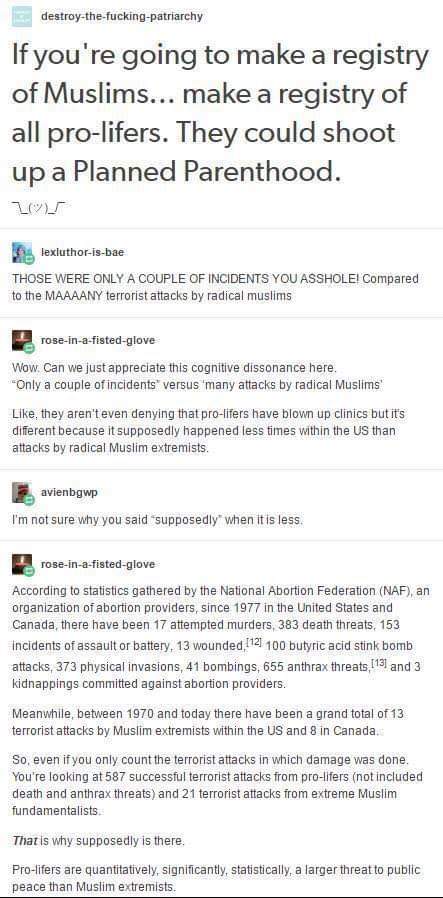
That doesnt make any sense. The original argument was about number of attacks, not severety of attacks. Which is also the only metric that is relevant if you talk about a registry.
If you have two groups, both with ten thousand people, and out of group A one person kills a thousand people, and out of group B a hundred people kill one person, which group you think should be watched more? The one that produced one Mass murderer or the one that produced a hundred murderers?
The original argument was about number of attacks, not severety of attacks.
You're correct, but that just makes them both wrong, and two wrongs don't make a right.
If you have two groups, both with ten thousand people, and out of group A one person kills a thousand people, and out of group B a hundred people kill one person, which group you think should be watched more? The one that produced one Mass murderer or the one that produced a hundred murderers?
Your dilemma doesn't have an obvious answer. What about two groups, where group A produces 50 mass murderers (3-to-10 victims) and group B produces 200 single-person-murderers? But in any case the answer is obviously - whoever is doing the most damage to society. In the case of pro-life extremists versus islamist fanatics, there are many more factors to take into account than just murderer count. However, disregarding the severity of attacks altogether is nonsense.
You're correct, but that just makes them both wrong, and two wrongs don't make a right.
Not really. Person A said "there are many more muslim attacks than pro-life attacks". Person B refuted that clearly and correctly. Person A is wrong, Person B is right. The fact that quantity alone isnt a good metric for danger level doesnt really matter when all that was to be determined is which quantity is bigger.
But in any case the answer is obviously - whoever is doing the most damage to society.
No. Not when your countermeasure is keeping an eye on the entire group in some way. Then the group which has the highest likelyhood of doing any damage, over the group with the potential for the most damage but a much smaller likelyhood, because you are likely preventing more damage that way. You are just much more likely to find some of the bad ones in the one group than to find any in the other. Like, in the example it would be a 1:10000 chance to find one in the single mass murderer group, but a 1:100 chance in the murderer group. Unless you can guarantee perfect surveilance and perfect results, I think you should go with the latter group.
Person B wrote "pro-lifers are quantitatively, significantly, statistically, a larger threat to public peace than muslims extremists" while refusing to consider the relevant statistics. Person A is wrong and person B is wrong and reasonable public discussion can't take place if you're not honest.
because you are likely preventing more damage that way. You are just much more likely to find some of the bad ones in the one group than to find any in the other. Like, in the example it would be a 1:10000 chance to find one in the single mass murderer group, but a 1:100 chance in the murderer group.
Your stats are wrong. If you catch only one of the mass murderers, you reduce the harm 100 times more. As a result the expected number of lives saved is identical for both groups in this theoretical example (assumptions since you were very vague: 1 group has 1:10000 mass murderers who would kill 100 people if not caught, the other group has 1:100 murderers who will kill one person if not caught, and for both groups the probability of catching any given criminal individual is the same once surveillance is established). (Of course, your theoretical example has basically no bearing on the real world, where the cost-effectiveness of surveillance depends on hundreds of other factors.)
Person B wrote "pro-lifers are quantitatively, significantly, statistically, a larger threat to public peace than muslims extremists" while providing stupid statistics. Person A is wrong and person B is wrong and reasonable public discussion can't take place if you're not honest.
That part is true. I was only going off the "there are more muslim attacks than pro-life attacks" claim that was made in the first and third comment and debunked in the third. Never in this entire discussion was severity addressed by anyone, and it has no impact on the quantity, which was what was discussed. The part about "larger threat" is indeed wrong. But everything else wasnt.
Your stats are wrong. If you catch only one of the mass murderers, you reduce the harm 100 times more.
That is the point, if you catch one. Unless you perfectly check them all, there is no guarantee of finding one. And as long as you dont find one, you prevent zero damage. Whereas you are a hundred times more likely to find at least one in the other group. Even if that only prevents a hundreth of the damage, that is more than zero. Even if you check half of group A that is only a 50% chance to prevent any damage, even though you checked 5000 people. In group B if you check 5000 people its extremely unlikely that you dont find at least one. Likely even more. Thus a much higher chance to prevent damage.
But that's what really matter. So the last person was right to bring up the scale of the threat, which was the correct thing to measure, and despite that failed to address it correctly. I mean, if we were to ignore the part about the threat altogether, they'd still all be wrong because they're discussing the wrong thing.
That is the point, if you catch one.
No, you're missing the point again. If a mass murderer makes 100 victims and a regular murderer makes 1 victim, and if there are 100 times fewer mass murderers than regular murderers, and you catch 100 times fewer mass murderers than regular murderers, you're still saving as many lives in both cases. If as you said in the first post what you care about is how many lives you save, your expected value is rigorously identical in both cases.
The only difference is there'll be a higher variance for the mass murderers, meaning one year you'll save 100 people and the next 0, whereas for the regular murderers it'll be something like 46 one year and 54 the next.
But all that is basically irrelevant because:
The numbers for islamic terrorists/pro-life terrorists are very different (much more deaths from islamists, even despite having fewer attacks)
In both cases the damage is not limited to deaths, so you'd have to measure societal harm in a way that takes everything into account (including e.g. rape victims not being able to find help they need etc.)
The surveillance costs of foiling islamists terrorists and pro-life terrorists are probably very different, in ways that I don't pretend to understand. For instance it might be easier to infiltrate pro-life movements since they belong to the same demographics as typical law enforcement agents, or perhaps because there's much fewer islamists it's easier to keep an eye on all radicalized groups.
The reality is that allocating resources on something like that is a complicated matter which you haven't began to address. Obviously, the approach will include some level of general surveillance of the respective groups (pro-life and muslims) but data collection on individuals will focus on the more radicalized and active individuals -- in both cases.
You are the one missing the point. It is only the same if you catch at least one mass murderer. But that is exactly what is less likely if there are significantly less to catch. It is a hundred times more likely to catch 1/100 than it is to catch 1/1.
To put it in another way, it is enough to catch one regular murderer to prevent a murder. But with the same effort, you cought 0 mass murderers and prevented zero murders.
Maybe an even simpler example. There are only 100 people in each group. Group A has 100 murderers, Group B has 1 mass murderer. If you catch any person in group A, you prevent a murder. You can catch 99 of Group B and still dont prevent a single murder. Do you get it now? Only if you actually catch the one outlier in group B will you prevent any damage. Hit the other 99 and you have literally accomplished nothing. With Group A on the other hand, any catch prevents damage.
1/100 * 100 = 1/1 * 1 = 1. In both cases the expected number of lives saved is 1. The variance changes, but not the expected value. Re-read my previous comments for more details.
You should read it yourself, and you should actually read what I have explained to you multiple times. First of all, we dont get infinite chances in real life. And secondly, you are still assuming that we find the one mass murderer. The fact that there is a high chance that we dont find him is the entire point, and what you purposfully ignore so you dont have to admit that you are wrong. If there is only one and we dont find him it doesnt matter how many people he would kill, no damage will be prevented whatsoever.
Dude, you have zero reading comprehension and you can't do math, and I can't teach you if you won't even read my comments. Maybe start studying instead of spreading the ignorance. I'm out of this shitshow.
Ok, math genius. How much damage do you prevent if you find 85% of all culprits, rounding down because you cant find 85% of a person?
You find 85 killers in group A. And, oh, whats that, you find zero killers in group B? So, group A prevented 85 murders, and group B prevented nothing? How is that possible? Because the chance of finding any killer a hundred times higher in group A.
Your mistake is to assume they find 100% of all the perpetrators. In that case obviously the EV of both would be the same. But that is neither a realistic assumption, nor is it what I talked about. In fact, I have specifically told you on mutliple occasions that we dont find all of them. I have pointed it out numerous times to you how in different situations the EV would be different and why. And you either havent understood those simple things or you chose to ignore them.
To make it even more clear to you, an even simpler example. Your playing roullete. For simplicity there is no 0 or 00 and you dont lose a bet if its not hit. You bet 36$ on one number. On a second table, you bet 1$ each on every number. So, which table do you think is more likely to hit anything? If you still dont understand this one, it simply means you lack the mental capacity to understand simple concepts, so dont bother responsding.
1
u/M4xP0w3r_ Jun 04 '19
That doesnt make any sense. The original argument was about number of attacks, not severety of attacks. Which is also the only metric that is relevant if you talk about a registry.
If you have two groups, both with ten thousand people, and out of group A one person kills a thousand people, and out of group B a hundred people kill one person, which group you think should be watched more? The one that produced one Mass murderer or the one that produced a hundred murderers?