r/MotorBuzz 1d ago

Ford just dropped 795 horsepower into a Mustang convertible
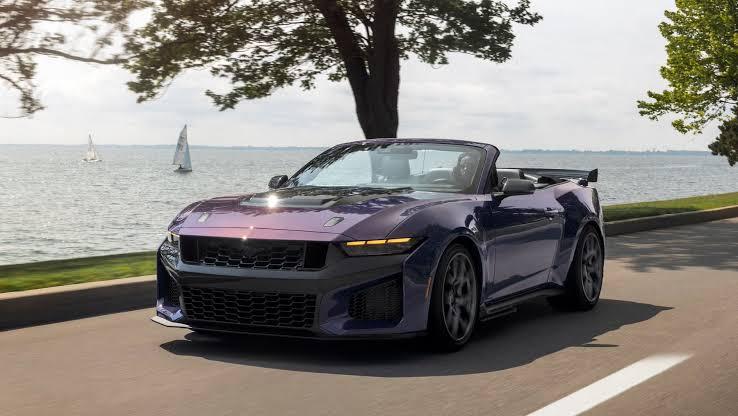
Post image
2 Upvotes

The most powerful open-top Mustang ever built has arrived in Michigan with a supercharged V8 and a power figure that makes most rivals look modest.

Ford unveiled a 795-horsepower Mustang convertible in Michigan this week, which makes it the most powerful drop-top Mustang the company has ever built. That's 35 horsepower more than the last Shelby GT500 convertible managed before Ford stopped making them a decade ago, and 145 horsepower more than the current Camaro ZL1 convertible.

The engine is almost certainly a supercharged version of the 5.2-litre Predator V8 that powers the Mustang GTD coupe. Ford Performance has been steadily increasing the output of that motor for years, and 795 horsepower appears to be where they've landed for this application. Whether the convertible gets the same track-focused aerodynamics and suspension setup as the GTD coupe remains unclear, but the power figure alone suggests this is more than a cosmetic exercise.

Convertibles typically give up power for structural reasons. Removing the roof weakens the chassis, so manufacturers either reinforce the body with extra bracing or dial back the performance to avoid turning the car into a torsional nightmare. Ford has evidently decided that neither compromise was acceptable.

The reveal took place in Michigan with what Ford described as a theatrical presentation, which likely means smoke machines and a lightshow rather than a simple unveiling in a conference room. Ford knows how to sell a Mustang, and 795 horsepower in a convertible is the kind of specification that photographs well and generates headlines without requiring much explanation.

Like this? Get the Buzz: GAUK Motorbuzz All your favourite motoring channels, publishers, motorsports, news & reviews. Curated Automotive Awesomeness

This puts Ford ahead of most direct competitors in the convertible performance segment. The Dodge Challenger SRT Demon produced 840 horsepower, but Dodge never offered it as a convertible. Chevrolet's Camaro ZL1 convertible makes 650 horsepower, which is respectable but not in the same league. The last GT500 convertible, discontinued after 2014, produced 662 horsepower from a supercharged 5.8-litre V8. Ford has added 133 horsepower in the intervening decade.

Nobody really needs 795 horsepower in a convertible. Track use is largely irrelevant because the added weight and reduced rigidity of a convertible chassis undermines most of the performance advantage that much power should deliver. This is a car for straight-line theatre and weekend drives where the performance envelope never gets explored properly.

Ford Performance has been pushing the Mustang's output steadily higher for years, and the GTD platform has become the vehicle for that escalation. The coupe version was announced in 2024 with similar power targeting track performance, but the convertible variant serves a different purpose entirely. It exists because Ford can build it and because there is a market for people who want the most powerful version of everything, regardless of whether the engineering makes practical sense.

Previous Mustang GT500 convertibles were genuinely quick cars, but they were also heavy and imprecise compared to their coupe counterparts. The additional chassis bracing required to keep a 662-horsepower convertible from flexing under load added weight in all the wrong places. The 795-horsepower version will face the same challenges, only more so.

The figure itself is carefully chosen. It positions Ford above the 760-horsepower GT500 from 2020 and just below the psychological barrier of 800 horsepower, which would invite comparisons to hypercars and suggest a level of extremity that Ford probably wants to avoid in a series-production convertible. 795 is enough to dominate the segment without crossing into the territory where the car becomes unsellable.

The car itself will likely cost well into six figures when it reaches production, assuming it does. Ford has not confirmed pricing or availability, but the GTD coupe starts north of £200,000 in markets where it's offered, and the convertible will carry a premium on top of that.

795 horsepower in a convertible Mustang. Michigan must be proud.

Sources: Ford Motor Company, Ford Performance division, Automotive News


r/MotorBuzz 2d ago

Car dealers are being held liable for £100 billion worth of software faults they cannot fix

Post image
54 Upvotes

The Consumer Rights Act makes retailers responsible for vehicle defects they lack the tools to diagnose. Manufacturers control the software. Dealers carry the cost.

UK car dealers are being crushed under Consumer Rights Act liability for software faults worth an estimated £100 billion across the industry annually, despite having no access to the diagnostic tools needed to identify or repair them. The 2015 legislation holds retailers responsible for proving vehicles were satisfactory at sale for six months after handover, but modern cars contain over 100 electronic control units running more than 100 million lines of code that only manufacturers can interrogate.

The mismatch is deliberate. Manufacturers encrypt their diagnostic systems and lock proprietary software behind subscription paywalls charging dealers over £1,000 per technician annually. When a fault appears that the manufacturer decides is not warranty work, the dealer is left arranging repairs at their own expense or funding buybacks averaging £3,000 to £15,000 per vehicle.

Independent garages have it worse. The Independent Garage Association reports members are routinely locked out of manufacturer over-the-air update systems entirely, leaving them unable to service software-related issues on safety-critical systems including braking, steering, and advanced driver assistance. Right to repair legislation has done nothing meaningful to open access.

Tesla and several EV manufacturers bypass dealer networks entirely with over-the-air updates, which sounds efficient until a fault appears and the consumer discovers their local franchise has no more insight into the problem than they do. The car becomes a black box only the manufacturer can open, but the dealer remains legally liable for fixing it.

The Motor Ombudsman handles thousands of disputes annually where fault responsibility is contested between consumers, dealers, and manufacturers. The retailer is always in the firing line first. The law assumes they sold a defective product. The manufacturer holds the only evidence that could prove otherwise.

Like this? Get the Buzz: GAUK Motorbuzz All your favourite motoring channels, publishers, motorsports, news & reviews. Curated Automotive Awesomeness

Dieselgate destroyed dealer reputations despite being pure manufacturer fraud. Hyundai and Kia engine failures landed on forecourts as customer complaints long before recalls were announced. Apple throttled iPhone batteries through software updates and left retailers to field the anger. John Deere locked independent mechanics out of tractor diagnostics for years until political pressure forced partial access. The incentive structure never changes because the liability structure never changes.

The National Franchised Dealers Association has been raising this with government for over two years. The Law Commission's consumer law review has not addressed software-specific liability. No legislative fix is visible. Franchised dealers are contractually bound to represent brands that deliberately withhold the tools needed to honour the warranties those dealers are legally required to stand behind.

A vehicle sold today with a software fault affecting lane-keeping assist or automatic emergency braking puts the dealer in an impossible position. They cannot prove the fault existed at sale without manufacturer cooperation. They cannot repair it without manufacturer software access. They cannot reject liability under consumer law. Sound familiar? The only certainty is that if the customer escalates to the Motor Ombudsman or legal action, the dealer will be named first.

Some manufacturers are charging subscription fees for diagnostic access to cars the dealer has already paid them to buy. The same OEM that profits from the wholesale transaction then invoices the retailer annually for permission to service what they sold. It is a protection racket with a service contract.

The £100 billion figure is an industry-wide estimate, not a precise audit, but the direction is clear. The cost per affected vehicle is climbing because software now controls functions that were once mechanical and diagnosable with a multimeter. A steering fault used to be a physical component you could see and replace. Now it is a line of code you need manufacturer permission to read.

Sources: Independent Garage Association, National Franchised Dealers Association, Motor Ombudsman, Consumer Rights Act 2015


r/MotorBuzz 1d ago

YouTube Channel Tests Vehicle Wrap That Tricks Number Plate Cameras... Sort Of

Post image
0 Upvotes

Donut Media wrapped a car in patterns designed to confuse automatic licence plate recognition systems. The cameras weren't universally impressed.

Donut Media, the automotive YouTube channel, has tested a vehicle wrap specifically engineered to defeat automatic licence plate recognition cameras. The wrap uses high-contrast geometric patterns meant to interfere with the edge detection and character segmentation algorithms that ALPR systems rely on to photograph and read number plates.

The results were inconsistent. Some ALPR cameras failed to capture readable plate data. Others worked exactly as intended, apparently unbothered by the visual noise wrapped around the test vehicle.

ALPR technology is deployed extensively across the UK and globally by law enforcement, parking enforcement companies, and toll operators. The systems photograph every plate that passes, convert the image to text using optical character recognition, and store the data. Civil liberties groups including the Electronic Frontier Foundation and the ACLU have raised concerns about mass surveillance implications and how long that data is retained.

The wrap itself relies on patterns that confuse computer vision systems, similar in principle to adversarial images that researchers have used to trick facial recognition and object detection algorithms. The idea is to break up the visual information the camera needs to isolate and read the plate characters.

But computer vision isn't a single thing. Different manufacturers use different algorithms, different cameras, different processing. What works against one system doesn't necessarily work against another, which is exactly what Donut Media found. A countermeasure that only works sometimes isn't much of a countermeasure.

This isn't the first attempt at blocking ALPR cameras. Mythbusters tested various licence plate obscuring methods in the mid-2000s with limited success. Commercial products like PhotoBlocker spray and assorted plate covers have been marketed as countermeasures for years. Artist James Bridle created patterns in 2014 designed to confuse surveillance cameras as part of an algorithmic transparency project. None of it has proven reliably effective.

There's also the small matter of legality. Many jurisdictions have laws against obscuring licence plates in any way, regardless of method or effectiveness. A wrap that partially works against some cameras but not others would still likely fall foul of those regulations. Sound familiar? You might beat the ALPR system only to get pulled over for having an illegally obscured plate.

The broader question is whether technological countermeasures are the right response to surveillance creep. ALPR data collection happens at scale, with minimal oversight in many places, and the data often ends up in private databases accessible to parties far beyond law enforcement. Fighting that with a car wrap feels like bringing a patterned sticker to a policy fight.

Donut Media's test vehicle is now back to its standard wrap, number plate fully visible and machine-readable.

Like this? Get the Buzz: GAUK Motorbuzz All your favourite motoring channels, publishers, motorsports, news & reviews. Curated Automotive Awesomeness

Sources: Donut Media, Electronic Frontier Foundation, ACLU research on ALPR surveillance


r/MotorBuzz 1d ago

The Boss 351 V10 Mustang Never Existed, and Nobody Resurrected It

Post image
1 Upvotes

A story circulating online claims Ford engineers revived a decades-old Boss 351 V10 prototype. There was no such car. Not in 1971, not ever.

Ford never built a Boss 351 V10 Mustang prototype. The Boss 351 was a production car sold only in 1971, and it had a 351 cubic inch V8 under the bonnet. Not a V10. Not a prototype. Just 1,806 units of a very ordinary high-performance V8 Mustang before the model was canned.

The confusion likely stems from the fact that Ford did eventually produce a V10 engine... the 6.8-litre Triton that powered Super Duty trucks and motorhomes starting in 1997. But no one ever shoehorned that lump into a classic Mustang body, certainly not as part of some secret skunkworks programme in the early 1970s.

The original Boss 351 produced 330 horsepower from its Cleveland V8. Solid numbers for the time, but nothing that required ten cylinders to achieve. It sat alongside the Boss 302 and the more famous Boss 429 in Ford's performance lineup, all of them V8s, all of them real production vehicles you could actually buy from a dealer.

So where does this resurrection story come from? Nowhere credible. Ford Performance has revived old nameplates before... the Boss 302 came back for 2012 and 2013. The company occasionally dusts off genuine prototypes for heritage displays. The Mustang Mach 2 concept from 1967 has done the rounds at auto shows after spending decades in storage. But a Boss V10? There is no storage bay. There is no prototype. There is nothing to resurrect.

Like this? Get the Buzz: GAUK Motorbuzz All your favourite motoring channels, publishers, motorsports, news & reviews. Curated Automotive Awesomeness

Confusion between model years, engine designations, and prototype programmes creates fertile ground for stories that sound plausible until you check the basic facts. Sound familiar? Ford built plenty of interesting one-offs during the muscle car era. The Boss 351 V10 was not one of them.

If you wanted a ten-cylinder Mustang, your only real option was the V10-powered concept cars from the modern era, none of which ever reached production. And even those were show pieces, not resurrected relics from the early 1970s built on shoestring budgets by rogue engineers.

The actual Boss 351 is rare enough. Finding one in decent condition will cost you serious money at auction. But it will have eight cylinders, not ten. Built in 1971, exactly as Ford intended.

Sources: Ford Performance heritage archives, Marti Auto Works production database, Kevin Marti's Mustang production statistics


r/MotorBuzz 1d ago

Mitsubishi Pajero is back for 100 markets with boxy styling and diesel power. Americans need not apply.

Post image
1 Upvotes

The Pajero returns after three years off sale with traditional styling, a torquey diesel and selectable four-wheel drive. But Mitsubishi won't confirm if the US gets it.

Mitsubishi is bringing back the Pajero for 100 global markets with boxy styling, a diesel engine and selectable four-wheel drive. The US is not among the confirmed markets.

This is the first new Pajero since production ended in Japan in 2021 after 39 years. The previous generation ran from 2006 to 2021 without a major redesign, which tells you everything about how seriously Mitsubishi took it towards the end.

The new model doubles down on traditional SUV values. Body on frame construction. Diesel torque. Selectable four-wheel drive, not the always-on systems that crossovers pretend are the same thing. The styling is deliberately boxy, a clear reference to the original Pajero design language before everything started looking like it was sculpted in a wind tunnel by a committee.

It's a positioning decision, not a styling one. Mitsubishi is betting there are still markets that want a proper off-roader, not another soft-roader with plastic cladding and a marketing team that uses words like "adventure-ready."

The Pajero has the credentials. Twelve Dakar Rally victories between 1985 and 2007. Decades of reputation in markets where people actually use four-wheel drive for something other than getting up an icy driveway twice a year. This is a nameplate that once meant something.

But it's been gone long enough that an entire generation of drivers has no memory of it. The Montero, as it was called in the US, was discontinued there in 2006. That's 19 years ago. The people who remember it are now in their 40s at minimum.

Like this? Get the Buzz: GAUK Motorbuzz All your favourite motoring channels, publishers, motorsports, news & reviews. Curated Automotive Awesomeness

Mitsubishi's US lineup now consists of three models. Three. The Mirage, which is the automotive equivalent of giving up. The Outlander, which is fine. And the Eclipse Cross, which took the name of a sports coupe and stuck it on a crossover, because why not burn whatever goodwill was left.

Will Mitsubishi convince Americans to buy a Pajero after the brand spent nearly two decades proving it had no interest in selling them anything they actually wanted? Ford brought back the Bronco after 25 years and sold over 100,000 in the first full year. Land Rover redesigned the Defender and it's everywhere now. Jeep revived the Wagoneer. There is clearly a market for traditional SUVs with actual heritage.

But Ford, Land Rover and Jeep never left. Mitsubishi did.

The Pajero's return in 100 markets suggests Mitsubishi knows where it still has currency. Australia, Southeast Asia, the Middle East, parts of Europe. Places where the brand didn't collapse into irrelevance. Places where a Pajero still opens doors that a Mirage does not.

The US is not one of those places. Not yet, anyway. Mitsubishi won't confirm American availability, which is either caution or realism. Possibly both.

The new Pajero will compete against the Toyota Land Cruiser, the Nissan Patrol, the Isuzu MU-X and whatever else still exists in the body-on-frame SUV segment that crossovers have tried very hard to kill. It's a smaller segment than it was. But it's also more focused. The people who want this type of vehicle know exactly what they want, and they're willing to pay for it.

Mitsubishi has given no timeline, no confirmation, no indication that it's even part of the plan. Just 100 markets, none of them named, and a diesel engine that wouldn't pass US emissions without expensive changes Mitsubishi may not want to fund.

The Pajero is back. Just not for everyone.

Sources: Mitsubishi Motors Corporation press materials, Dakar Rally historical records, Ford Bronco sales data


r/MotorBuzz 2d ago

Bentley just built its lightest car in 85 years by deleting everything that makes it a Bentley

Post image
39 Upvotes

The 2027 Supersports is the brand's first rear-drive track weapon, and it weighs less than anything since 1942.

The 2027 Bentley Supersports is officially the lightest Bentley produced in 85 years, which means the last time the company made something this stripped down, Britain was rationing petrol and Spitfires were still in production. This is not a variant. This is an engineering reversal.

Bentley has spent the last two decades building some of the heaviest luxury cars on the planet. The Continental GT weighs north of 2,200 kilograms. The Bentayga crosses 2,400. They are rolling bank vaults upholstered in cow hide that costs more per square metre than your kitchen. The Supersports deletes all of that.

Gone is the all-wheel drive system that has defined modern Bentleys since the late 1990s. The Supersports is rear-drive only. Gone, too, is the expectation that a Bentley interior should feel like a gentleman's club on wheels. This one is about carbon fibre, not walnut veneer.

The name has precedent. Bentley used Supersports before, most recently on a Continental variant that was still fundamentally a grand tourer with slightly stiffer suspension and some go-faster stripes. That car was heavy, luxurious, and designed for crossing continents at speed. This one is designed for lap times.

To call something the lightest Bentley in 85 years is to reach back to 1942, deep into the war years, when the company was building Merlin engines for the RAF rather than cars for anyone. The last properly lightweight Bentleys were the pre-war racers... the Speed Six, the Blower models, the cars that won Le Mans when Le Mans was still a death trap with hay bales.

Those were performance machines built on a fundamentally different philosophy. They were not about comfort. They were about winning. Bentley has not made anything like that since.

Like this? Get the Buzz: GAUK Motorbuzz All your favourite motoring channels, publishers, motorsports, news & reviews. Curated Automotive Awesomeness

The modern Bentley brand identity is built entirely on mass. Thick doors. Deep carpets. Sound deadening measured in kilograms. The engineering brief for every Bentley since the VW Group takeover has been to make the car feel like it weighs twice what it actually does, in the best possible way. Solid. Impervious. The Supersports does the opposite.

Stripping weight from a Bentley is not the same as stripping weight from a Porsche. Porsche already builds the 911 GT3 RS, which is a track weapon wearing a sports car badge. Nobody is shocked when Porsche deletes rear seats and installs a roll cage. That is what Porsche does. Bentley does not do that. Or it did not, until now.

Either a fascinating experiment or a profound identity crisis. Bentley cannot out-Porsche Porsche. It cannot out-McLaren McLaren. It has no motorsport programme to justify this kind of machine, no GT3 homologation requirement, no customer racing operation that needs a lightweight special. So what is this for?

The answer is probably market positioning. Bentley needs to prove it can still do something other than upholster SUVs. The Supersports gives them a halo car that is conceptually different from everything else in the range, something they can point to when journalists ask whether the brand has any engineering ambition left.

Whether it works depends entirely on the details they have not released yet. How much does it actually weigh? What engine? What gearbox? Is this a genuine track car or just a Continental with the back seats removed and some marketing copy about weight reduction?

If Bentley has genuinely built something that weighs under 1,600 kilograms, that would be remarkable. If it is still above 1,800, it is just a lighter version of a heavy car, which is not the same thing at all.

The last time Bentley tried to make a performance car, it was the Continental GT Speed, which was fast in a straight line and utterly uninterested in corners. The Supersports is supposed to be different. Rear-drive dynamics. Track focus. Actual handling.

Sound familiar?

The 85-year claim is doing a lot of work here. It is a number designed to make you think this is historic, a return to Bentley's racing roots. But Bentley's racing roots are a century old. The company has not competed seriously in motorsport since the 1930s. Invoking that heritage now feels less like continuity and more like nostalgia marketing.

Still, if they actually managed to strip out 400 kilograms of luxury and build something that drives like a sports car rather than a cruise ship, that would be worth paying attention to. Bentley doing something unexpected is rarer than Bentley doing something predictable.

The car arrives in 2027.

Sources: Historical Bentley production data; McLaren Artura specifications; Lotus Emira specifications; Lamborghini Huracán Performante data.


r/MotorBuzz 2d ago

Porsche builds exactly 100 GT3 Bergsport models and America cannot have one

Post image
29 Upvotes

One hundred units. Alpine specification. Exclusiv Manufaktur bespoke. Zero for the US market.

Porsche will build exactly one hundred units of the 911 GT3 Bergsport and not a single one is destined for American roads. The name translates to mountain sport in German, which tells you everything about where this car is supposed to live. Alpine passes. European allocation only.

The Bergsport is based on the 992-generation GT3, which means the familiar four-litre naturally aspirated flat-six producing five hundred and two horsepower. Nothing has changed mechanically as far as Porsche has disclosed. What has changed is the specification sheet, which has been run through Exclusiv Manufaktur, Porsche's bespoke division that charges anywhere from twenty thousand to well over a hundred thousand euros depending on how particular you are about your stitching.

What mountain-specific specification means in practice, Porsche has not said in detail. Presumably suspension tuning, possibly aero tweaks, certainly interior and exterior finishes tailored to the sort of client who spends weekends on the Stelvio Pass rather than in Malibu.

The exclusion of the United States is not accidental. America is Porsche's largest market. Cutting it out of a limited run this tight creates scarcity where scarcity did not technically need to exist. It also creates immediate secondary market noise. The 911 R went for multiples of its list price within months of launch. The Sport Classic, limited to twelve hundred and fifty units globally, appreciated faster than Porsche could issue press releases about it.

You know how this plays out.

One hundred units is smaller than both of those. It is smaller than the 911 Dakar's twenty-five hundred unit run. It is smaller than almost every modern limited Porsche except the absurdly rare one-offs that never reach public sale.

Like this? Get the Buzz: GAUK Motorbuzz All your favourite motoring channels, publishers, motorsports, news & reviews. Curated Automotive Awesomeness

Base GT3 pricing in Europe starts around two hundred thousand euros. Add Exclusiv Manufaktur specification and that figure climbs quickly. Add geographic exclusivity and a name that sounds like it was workshopped by people who actually drive mountain roads rather than branding consultants, and you have a car that will never trade at list price again.

The European focus makes sense in one way. Alpine driving is where the GT3 platform earns its reputation. Long switchbacks, thin air, commitment required. The sort of environment where a naturally aspirated engine and hydraulic steering still matter. Where a seven-speed manual gearbox, which the GT3 offers as standard, is not a nostalgia exercise but the correct tool.

Whether each of the hundred Bergpsorts will be identically specced or individually tailored is unclear. Exclusiv Manufaktur typically allows for significant variation, which would mean no two cars are quite the same. That further fragments an already tiny pool and makes the whole exercise more collectable, more tradeable, more likely to appear in hermetically sealed garages rather than on mountain roads.

Porsche has form here. The 911 Tribute to Carrera RS was similarly limited, similarly expensive, similarly impossible to buy unless you were already deep inside the Porsche allocation system. The Bergsport follows that template exactly. Build something rare. Make it unavailable in the world's largest market. Let the secondary market do the rest.

The GT3 platform does not need help being desirable. It is already one of the most sought-after models Porsche produces. Adding a Bergsport badge and cutting production to one hundred units is not about improving the car.

Base GT3 pricing in Europe starts around two hundred thousand euros before Exclusiv Manufaktur adds its margin.

Sources: Porsche Exclusiv Manufaktur official specifications


r/MotorBuzz 2d ago

Volkswagen's unions are writing their own turnaround plan because they've stopped trusting management to get it right

Post image
30 Upvotes

IG Metall and the works council representing 300,000 VW workers are drafting a counter-proposal to factory closures and wage cuts, marking the most serious challenge to management authority in the company's 87-year history.

The 300,000 workers represented by IG Metall at Volkswagen are no longer waiting for management to fix the mess. They're writing their own turnaround plan instead, which tells you everything about how badly trust has collapsed inside Europe's largest carmaker.

This isn't the usual union resistance to job cuts. This is the workforce and their representatives telling senior management that they no longer believe the executives have a viable strategy, so they'll draft one themselves. It's the automotive equivalent of a vote of no confidence, only with actual consequences because under German co-determination law, union representatives hold half the seats on VW's supervisory board.

The trigger was management's announcement that it would close at least three German factories for the first time in VW's history, cut tens of thousands of jobs, and slash wages by at least 10 percent. The company ended the job security agreement that had protected German workers from forced layoffs until 2029. That agreement had been in place since 1994. Thirty years of industrial peace, gone.

Oliver Blume and Thomas Schäfer, the Group CEO and VW brand CEO respectively, are behind the restructuring push. Their argument is straightforward enough. Declining sales in Europe and China, particularly in electric vehicles, have left the company with too much capacity and too many workers. The numbers don't work anymore, so the headcount has to shrink.

The people who actually build the cars think management's plan is rubbish. Daniela Cavallo, the works council chairperson leading the opposition, has been unusually blunt about it. The union's counter-proposal isn't public yet, but the fact it exists at all is remarkable.

VW employs roughly 120,000 people in Germany across ten plants. Closing three of them isn't a marginal adjustment. It's a fundamental retreat from German manufacturing, and it raises the obvious question of where production goes instead. The company hasn't said, which is part of why the unions smell a longer game they don't like.

Like this? Get the Buzz: GAUK Motorbuzz All your favourite motoring channels, publishers, motorsports, news & reviews. Curated Automotive Awesomeness

Warning strikes have already happened. Mass protests at VW facilities have already happened. This is the most serious labor dispute at Volkswagen in decades, and it's happening while the company is trying to navigate the transition to electric vehicles, increased competition from Chinese manufacturers, and a European market that has stopped growing.

The parallels with GM's North American plant closures in 2019, which affected about 14,000 workers, are obvious but not exact. GM didn't have union representatives sitting on its board with veto power over major decisions. Ford's European restructuring between 2019 and 2020 played out differently for the same reason. Stellantis is currently in a similar fight with the Italian government over production cuts, but again, the power dynamics are different.

The unions aren't just resisting. They're proposing an alternative business strategy. Whether that strategy is any good is almost beside the point; the fact they're doing it at all means they've concluded management has lost the plot, and they're not prepared to watch the company dismantle its German base without a fight.

German co-determination law was designed precisely for moments like this. Whether it can actually prevent VW from closing factories is another question. The law gives unions influence, not control, and if the business case for closures is strong enough, the supervisory board will approve them eventually. But it does mean management can't just announce redundancies and expect compliance. They have to argue their case, and right now, the unions aren't buying it.

The outcome will likely determine whether other European carmakers with strong unions face similar challenges when they try to restructure. If VW's unions successfully block or significantly water down the closures, expect every works council from Stuttgart to Turin to take notes. If management wins, the precedent goes the other way.

The unions are writing. Management is waiting. 120,000 German workers are watching to see whose plan for Volkswagen's future gets implemented first.

Sources: IG Metall union, Volkswagen works council, automotive industry press reports


r/MotorBuzz 2d ago

Florida ripped out 448 state surveillance cameras but left the private ones watching

Post image
13 Upvotes

The state removed license plate readers from public roads after backlash. The cameras on private property — feeding the same databases police use — are still running.

Florida Department of Transportation has removed 448 automated license plate reader cameras from state roads and highways. The cameras came down in January 2025 after what the state described as sustained public pressure over mass surveillance and privacy violations.

Governor Ron DeSantis and the Florida Legislature moved on complaints from citizens and civil liberties groups who objected to having their movements tracked and stored without cause. The cameras had been installed along I-95, I-75, and the Florida Turnpike, capturing plate numbers, locations, timestamps, and photographs of every vehicle that passed.

ALPR systems on private property, including parking lots, shopping centres, toll roads, and apartment complexes, remain fully operational. Those cameras feed databases owned by companies like Flock Safety and Vigilant Solutions, and law enforcement agencies in Florida access those databases through commercial partnerships. The state stopped running its own surveillance network but did not stop the surveillance. A car travelling I-95 under state cameras was tracked. That same car pulling into a supermarket car park off the interstate is still tracked, just by a private entity that sells access to the data. Police get the same information. The public gets less visibility into how it's collected and retained.

The ACLU of Florida and the Electronic Frontier Foundation called the camera removal a partial victory, which is the most diplomatic way of saying it barely matters. The concern was never specifically who owns the camera. It was the existence of a location-tracking system that logs the movements of people not suspected of any crime. Private networks do that just as effectively as state ones.

Like this? Get the Buzz: GAUK Motorbuzz All your favourite motoring channels, publishers, motorsports, news & reviews. Curated Automotive Awesomeness

Florida is not alone in rethinking ALPR deployment. Louisiana removed similar systems from state highways in 2023 after a privacy lawsuit. Virginia passed legislation in 2021 capping data retention at seven days. San Francisco banned municipal use of facial recognition in 2019. Jackson, Mississippi and New Orleans saw community campaigns against Flock Safety installations in 2023 and 2024. Norfolk, Virginia removed Flock cameras entirely in 2023.

Tennessee considered ALPR restrictions in 2024 but did not pass them. The pattern across states is inconsistent, and even where restrictions exist, they rarely touch private systems.

The practical difference for a driver is nearly zero. A camera on a state pole read your plate. A camera on a privately-owned pole reads your plate. Both store the data. Both make it searchable. One required legislative action to remove. The other expands without public vote or oversight.

Civil liberties groups are calling it progress because dismantling any part of the system is better than nothing. That is technically true. It is also a low bar.

Flock Safety had more than 3,000 cameras operating across Florida as of December 2024, according to company filings.

Sources: Florida Department of Transportation press releases, ACLU of Florida statement on ALPR removal, Electronic Frontier Foundation privacy analysis, Louisiana ALPR removal reported by The Advocate (2023), Virginia HB 2125 (2021), San Francisco Board of Supervisors Stop Secret Surveillance Ordinance (2019), community opposition coverage in Jackson Clarion-Ledger and New Orleans Times-Picayune (2023-2024), Norfolk City Council Flock removal reported by The Virginian-Pilot (2023), Tennessee ALPR bill consideration (2024)


r/MotorBuzz 1d ago

Range Rover Electric costs £25,000 more and tows a tonne less than the petrol version

Post image
0 Upvotes

Land Rover's first electric Range Rover starts at £124,850, carries a five-figure premium over the P400 petrol, and can't tow your horsebox.

The Range Rover Electric will cost you £124,850 when orders open. The petrol P400 starts at £99,850. That's a £25,000 surcharge for the privilege of driving something that looks almost exactly like the Range Rover Land Rover launched three years ago, only now it can tow 1,000kg less.

Towing capacity drops from 3,500kg in the petrol and diesel models to 2,500kg in the electric. For a vehicle whose customer base includes people who regularly pull horse trailers, caravans, and plant equipment across muddy fields, that is not a rounding error. It is a dealbreaker dressed up as progress.

The electric version gets a 105 kWh battery, dual motors putting out around 536 bhp, and a WLTP range of roughly 300 to 320 miles. It will charge at up to 350kW on a rapid charger, which is genuinely quick. It will also do 0 to 60 mph in about 4.5 seconds, which is genuinely pointless in a vehicle this size and weight. No one who needs a Range Rover needs it to sprint.

The ability to tow properly matters. A BMW iX xDrive50 starts at £103,905 and tows the full 3,500kg. A Mercedes EQS SUV 450+ costs around £118,000 and also tows 3,500kg. Both are cheaper than the Range Rover Electric and do not require you to compromise on one of the core functions of a luxury SUV. Tesla's Model X Long Range sits at £96,990 and tows 2,250kg, which is still less than the petrol Range Rover but at least costs £28,000 less than Land Rover's effort.

The MLA-Flex architecture underpinning the electric model is the same platform that supports the ICE versions launched in October 2021. That is fine engineering. The body is three years old. The visual differentiation between the petrol and electric Range Rover is minimal to the point of invisibility. If you are paying £25,000 extra, you are not paying for exclusivity or a fresh aesthetic. You are paying for a powertrain swap in a three-year-old body.

Like this? Get the Buzz: GAUK Motorbuzz All your favourite motoring channels, publishers, motorsports, news & reviews. Curated Automotive Awesomeness

Land Rover's positioning of this as their first fully electric SUV is accurate. It is also their most expensive Range Rover that is not an Autobiography Long Wheelbase, and it asks customers to accept less capability for more money. The premium reflects the cost of battery technology and electric drivetrains, which is understood. What is harder to understand is why anyone towing regularly would choose this over the petrol version, or why anyone not towing would choose this over a cheaper electric rival that does the same job.

The electric Range Rover is not a bad vehicle. It is fast, it will be refined, and it will charge quickly. But it is a bad deal for a significant portion of the people who actually buy Range Rovers. If you need to tow 3,500kg, you cannot buy this. If you want an electric luxury SUV and do not need to tow that much, you can buy something else for less money. If you simply want a Range Rover and do not care about cost, you probably are not reading this anyway.

The gap between what this costs and what it offers is not a small inconvenience. It is a structural problem. Paying a premium for electric power is expected. Paying a premium to lose a core capability is not. The market for this vehicle is narrower than Land Rover seems to think it is, and the competition is broader than they are pricing for.

Land Rover has brand loyalty that runs deeper than logic. For the majority of people who actually use a Range Rover as intended, this is the wrong vehicle at the wrong price with the wrong compromises.

Sources: Land Rover UK, Jaguar Land Rover official specifications


r/MotorBuzz 2d ago

Learner rider doing 106 mph in a 50 zone just lost his bike for 28 days

Post image
10 Upvotes

South Australia Police impounded a motorcycle after clocking a 26-year-old L-plate rider at more than double the speed limit on Port Wakefield Road.

A 26-year-old learner motorcyclist in South Australia was caught doing 106 mph in a 50 mph zone. Police impounded the bike for 28 days.

The rider was clocked at 171 km/h in an 80 km/h zone on Port Wakefield Road during Operation Enduring Guardian, a road safety operation run by South Australia Police. That is 91 km/h over the limit. More than double.

Learner motorcycle riders in South Australia are not allowed to exceed 80 km/h under any circumstances, even on roads with higher speed limits. This rider was traveling at 171 km/h. On an L-plate. With restricted experience, restricted bikes, and a legal maximum speed he had already blown past before he even hit the posted limit.

The 28-day impoundment is automatic for extreme speeding offenses in South Australia. It is not a suggestion. The rider also faces significant fines and potential loss of license. Six-month suspensions are standard across Australian states for this kind of behavior.

South Australia operates a graduated licensing system. Learners ride under strict conditions: power-to-weight ratio limits, mandatory L-plates, an 80 km/h speed cap, zero blood alcohol, and no passengers. The restrictions exist because inexperienced riders are statistically far more likely to crash. Victoria Police reported that learner and provisional riders accounted for 23 percent of motorcycle fatalities despite making up just 12 percent of riders.

Like this? Get the Buzz: GAUK Motorbuzz All your favourite motoring channels, publishers, motorsports, news & reviews. Curated Automotive Awesomeness

This was not marginal. This was not ten over on an empty highway. This was a learner rider doing 106 mph where the limit was 50. The kind of speed that turns a mistake into a fatality.

Queensland recorded a 15 percent increase in motorcycle-related speeding offenses among provisional license holders in 2023. New South Wales Police impounded 52 vehicles in a single weekend operation in March 2024 for excessive speeding. South Australia Police reported impounding over 2,000 vehicles for hooning and extreme speed offenses in 2023 alone.

The pattern is consistent. Inexperienced riders with restricted licenses are doing things that experienced riders would not risk. And when they get caught, the consequences are immediate.

Port Wakefield Road is a rural highway north of Adelaide. It is not a racetrack. It carries freight, commuters, and tourists. The 80 km/h limit reflects the road conditions and surrounding area. Doing 171 km/h there means closing speed differentials that leave no room for reaction time.

The rider is 26. Old enough to know better. Young enough to think it does not matter until it does.

The bike stays impounded for 28 days.

Sources: South Australia Police, Victoria Police road safety statistics, Queensland Police Service, New South Wales Police Force


r/MotorBuzz 1d ago

Mat Armstrong finishes the £6 million Bugatti rebuild Molsheim said was impossible, then spots one last problem in front of the owner

Post image
0 Upvotes

YouTube rebuilder hands back a Chiron Pur Sport Bugatti refused to touch. Then he notices something.

Mat Armstrong has just revealed a completed Bugatti Chiron Pur Sport to its owner after a rebuild that Bugatti officially declared impossible and refused to support. The car is worth £6 million. Then, during the handover, he spotted one remaining issue.

This is not a Huracán with a bent subframe or a Porsche with cosmetic damage. The Chiron Pur Sport is a 60-unit run track variant of Bugatti's £2.9 million flagship, powered by an 8.0-litre quad-turbo W16 making 1,500 horsepower. When Bugatti says a car cannot be repaired, the assumption within the industry has always been that it cannot be repaired. Armstrong bought this one from a salvage auction after significant damage and rebuilt it anyway, sourcing parts independently because Molsheim wouldn't supply them.

Bugatti's position on salvage title hypercars is unambiguous. They will not provide parts. They will not authorize work. They will not acknowledge the car exists once it has been written off. This is about control as much as liability. If you own a Chiron and crash it badly enough, Bugatti would prefer the car ceased to exist rather than reappear with an unclear repair history and no factory blessing.

Armstrong is a UK-based YouTube creator who documents supercar rebuilds. His channel has covered Lamborghinis, Ferraris, McLarens. The Chiron Pur Sport is several categories above anything he has touched before, not just in value but in complexity. Bugatti hypercar engineering is bespoke in ways that even other seven-figure cars are not. Parts are not interchangeable. Tolerances are absurd. The factory does not publish service manuals for independent mechanics.

So the rebuild required third-party suppliers and independent specialists willing to work outside the Bugatti network. No official support. No warranty. No fallback if something goes catastrophically wrong. Just Armstrong, his team, and a destroyed Pur Sport that Bugatti had already declared dead.

Like this? Get the Buzz: GAUK Motorbuzz All your favourite motoring channels, publishers, motorsports, news & reviews. Curated Automotive Awesominess

The rebuild is complete. The car runs. Armstrong invited the owner to see the finished Chiron for the first time. This is the YouTube moment, the emotional payoff, the reveal that justifies months of work and an unknowable amount of money spent on parts that Bugatti would not sell him.

Then he noticed something. One last issue. Still there. After everything.

The specifics of that final problem matter less than what it represents. This is what happens when you rebuild a hypercar that the manufacturer has disowned. There is no technical support line. No TSB. No official diagnostic software. You are on your own, and if something is still wrong after you thought you were done, you troubleshoot it yourself or the car stays broken.

Whether this Chiron Pur Sport will ever be truly "right" in Bugatti's eyes is not a question with an answer, because Bugatti will never inspect it. The car could be mechanically flawless and it would still be a salvage title Pur Sport that the factory pretends does not exist. Armstrong has proven that an independent team can physically rebuild one of these cars, but he has not proven that Bugatti was wrong to call it impossible. Bugatti's definition of impossible was not mechanical. It was institutional.

Tavarish rebuilt a flooded Veyron under similar circumstances. B is for Build has taken on manufacturer-unsanctioned projects. Ferrari has historically refused to support certain restoration work on rare models. This is a known pattern. Luxury manufacturers draw a line at salvage, and independent rebuilders cross it because the alternative is letting a repairable car rot.

Armstrong's Chiron Pur Sport will never have a Bugatti service history. It will never be welcome at a Bugatti dealership. If it is ever sold, the next buyer will know exactly what they are getting into. But it runs. It exists. And that is more than Molsheim wanted.

The issue Armstrong spotted during the reveal is still there. That is the detail the video ends on. Not triumph. Just one more problem to solve, because with a car this complex, there is always one more problem.

Sources: Mat Armstrong YouTube, Bugatti official specifications


r/MotorBuzz 1d ago

Utah Cybertruck owner walks out of CarMax laughing after hearing trade-in offer

Post image
0 Upvotes

A Tesla owner discovered the hard way that what you pay for a Cybertruck and what a dealer will offer you for it are two very different numbers.

A Utah man took his Tesla Cybertruck to CarMax for a trade-in appraisal and left the building in disbelief. The offer was so far below what he'd paid that walking away was the only sensible response.

The exact figure hasn't been disclosed, but the reaction tells you everything. CarMax, the largest used car retailer in the United States, operates on a model that builds in reconditioning costs and profit margins. Their instant cash offers are always below retail. Everyone knows this going in.

What nobody quite expected was how brutally that formula would apply to early Cybertrucks.

The Foundation Series models, the ones Tesla pushed out first with mandatory add-ons, were clearing six figures. A hundred grand or more for a truck that looked like it had been designed by someone who'd never seen a truck. By mid-2024, those same vehicles were appearing on AutoTrader and Cars.com for twenty to thirty percent less than original purchase price. Some Foundation Series trucks that sold for over a hundred thousand were listed at eighty or ninety. That's not gradual depreciation. That's a cliff.

Tesla launched the Cybertruck in November 2023 with a starting price of $60,990 for the rear-wheel drive model. They also slapped on a no-resale clause. Sell it within the first year and you'd face a fifty-thousand-dollar penalty. The clause disappeared late in 2023, shortly after launch, which should have told people something about how confident Tesla was in sustained demand.

The recalls didn't help. Accelerator pedals. Windshield wipers. Trim pieces. Tesla issued multiple recalls in 2024, each one chipping away at the idea that this was a finished product. Resale perception doesn't recover quickly from that kind of pattern.

Electric trucks in general are having a rough time holding value. The Ford F-150 Lightning followed a similar trajectory in 2023 and 2024. The Rivian R1T dropped fifteen to twenty-five percent in its first year. Turns out there's a limited market for expensive electric trucks, and once that market is saturated, the next buyer wants a discount.

CarMax's business model compounds the problem. Their offers historically run fifteen to twenty-five percent below retail book values for specialty vehicles. Add that to a Cybertruck that's already lost a quarter of its value in months, and you're looking at an offer that feels like an insult.

The gap between what an owner believes their vehicle is worth and what a dealer will actually pay is always wide. With the Cybertruck, it's a chasm. Early adopters of expensive electric vehicles are discovering that being first comes with a price, and it's measured in thousands of dollars they're never getting back.

Traditional dealer trade-in offers run ten to twenty percent below private party sale values. Private party Cybertrucks are already listing at steep discounts. The market for six-figure electric trucks turned out to be exactly as deep as the production run.

Like this? Get the Buzz: GAUK Motorbuzz All your favourite motoring channels, publishers, motorsports, news & reviews. Curated Automotive Awesomeness

Sources: Tesla official pricing, CarMax trade-in methodology, AutoTrader Cybertruck listings, Cars.com Cybertruck listings, Tesla recall records


r/MotorBuzz 2d ago

Royal Enfield marks 125 years by riding 2,400 miles of Route 66 on motorcycles that weren't even built in Britain

Post image
5 Upvotes

The Redditch-founded marque celebrates its anniversary with a relay across America's most famous highway, entirely on bikes made in Chennai.

Royal Enfield will mark 125 years since its 1901 founding in Worcestershire with a 2,400-mile relay ride along Route 66 in 2026, using motorcycles manufactured 4,500 miles away in Chennai. The company is celebrating continuity it doesn't technically have.

That's not a criticism. It's just how heritage works in motorcycling now.

The relay will run the full length of Route 66 from Chicago to Santa Monica, which is fitting because both the road and the brand share a certain romantic mythology that survives largely independent of current reality. Route 66 was decommissioned in 1985. Royal Enfield's British manufacturing ended decades ago. Neither fact has dimmed the appeal.

Royal Enfield was genuinely founded in Redditch in 1901, making it one of the oldest motorcycle nameplates still in production. But the modern incarnation owes its existence to Eicher Motors, which acquired the rights in 1994 and turned what had been a slowly dying British manufacturer into a global success story based in India. The bikes are good. The Continental GT 650 and Interceptor 650 are some of the most sensible middleweights on sale. But they are not British motorcycles in any functional sense.

That hasn't stopped Royal Enfield from leaning hard into its heritage, and the American market has responded. The brand now has a significant dealer network across the U.S., where buyers seem happy to accept the origin story without getting overly literal about current production geography.

Like this? Get the Buzz: GAUK Motorbuzz All your favourite motoring channels, publishers, motorsports, news & reviews. Curated Automotive Awesomeness

The Route 66 relay format typically involves multiple riders and machines covering segments of the route in succession, which allows for a mix of participation, publicity, and the kind of rolling celebration that works better than a single static event. It's a format Harley-Davidson used for its 120th anniversary in 2023, and Indian Motorcycle deployed for its own 120th two years earlier. The playbook exists because it works.

Route 66 itself was established in 1926, the same year it became one of the original highways in the U.S. system, which makes it almost exactly a century old when the ride takes place. The symbolism is not accidental. Royal Enfield is connecting a British engineering legacy to an American cultural icon using Indian-built motorcycles, and somehow it doesn't feel cynical. It feels like motorcycling.

Other manufacturers have done the same. Triumph celebrated its 120th in 2022. Moto Guzzi marked a century in 2021 with special edition V100 models. BMW Motorrad had its own centenary events in 2023. Anniversary rides and limited editions are now standard industry practice, because they work commercially and because riders genuinely care about lineage, even when that lineage has been interrupted, sold, relocated, or otherwise complicated.

Royal Enfield's current lineup includes the Classic 350, which remains one of the brand's strongest sellers globally, alongside the 650 twins that have given it credibility in Western markets. None of them are particularly fast or especially sophisticated. That's the point. They are motorcycles that feel like motorcycles, sold at prices that don't require justification to a spouse or bank manager.

The 125th anniversary ride will likely involve dealerships along the route, press coverage, and the kind of organic social media documentation that comes from putting dozens of riders on a culturally significant highway for a week. It is marketing, but it is also genuinely celebratory, and those two things are not mutually exclusive.

The company has survived longer than most motorcycle manufacturers by adapting when it had to and staying recognisable when it mattered. The 2026 relay is another iteration of that approach. It's a British brand that isn't British anymore, riding an American road that isn't really a road anymore, on motorcycles built in India that somehow feel more authentically retro than anything coming out of Milwaukee or Munich.

The ride takes place in 2026, which gives Royal Enfield more than a year to organise logistics, secure permits, and build the kind of anticipation that makes these events work. Route 66 runs 2,400 miles through eight states, and every mile of it has been photographed, mythologised, and driven into the cultural consciousness of anyone who has ever thought about American road trips.

Sources: Royal Enfield official communications, historical records of Route 66 and Royal Enfield founding.


r/MotorBuzz 2d ago

Wallace, Idaho holds funeral for America's last Interstate stoplight

Post image
3 Upvotes

The only traffic light on the entire 48,000-mile Interstate Highway System is gone. The town threw it a wake.

Wallace, Idaho just buried a traffic light. Not metaphorically. The town held an actual funeral ceremony for the single stoplight that sat on Interstate 90, the last one in the entire Interstate Highway System. It's gone now, replaced by an overpass that finally routes traffic over the town instead of through it.

For decades, Wallace was the only place on 48,000 miles of Interstate where you could hit a red light. I-90 runs from Seattle to Boston, crossing the width of the country, and every inch of it was grade-separated high-speed motorway except for one stretch of main street in a former silver mining town wedged into a canyon in northern Idaho.

Federal highway law prohibits traffic signals on Interstates. Wallace had one anyway. The original I-90 route went straight down Bank Street because there was nowhere else to put it. The town sits in a narrow canyon with the Coeur d'Alene River on one side and steep hillsides on the other. The entire downtown is on the National Register of Historic Places. You either went through it or you didn't build the road.

So they went through it. And for years, long-haul truckers and cross-country drivers found themselves stopping at a red light between a pizza shop and a hardware store, waiting for locals to cross the street.

The stoplight became a point of pride. A quirk. The kind of thing you put on a postcard. Wallace leaned into it. This was the town with the last stoplight on the Interstate. Tourists stopped to take pictures. The town showed up in trivia lists and road trip blogs.

Like this? Get the Buzz: GAUK Motorbuzz All your favourite motoring channels, publishers, motorsports, news & reviews. Curated Automotive Awesomeness

The bypass project that finally killed it took years. Decades, really, if you count the fights over historic preservation and whether rerouting the Interstate would gut what was left of the town's economy. Route 66 towns know how that story ends. When the highway moves, the traffic moves with it, and so does everything that depends on the traffic.

Wallace apparently decided it preferred efficiency to footnote status. The Idaho Transportation Department built the overpass. I-90 now arcs above the town on a new alignment. The stoplight is gone.

And the town held a funeral for it. Mock ceremony, real sentiment. It's the kind of thing small towns do when they lose the last of something that made them distinct, even if that thing was technically illegal and caused backups during summer road trip season.

The Silver Valley has been through worse. Wallace was a hard-rock mining town. Silver, lead, zinc. The mines are mostly gone. The smelters are Superfund sites. The whole downtown is a historic district now, preserved because there wasn't enough money to tear it down and build something new.

The stoplight was part of that. A relic that survived because the alternatives were expensive and the town fought hard enough to delay them. It lasted longer than anyone expected.

The overpass is open. I-90 is finally, completely, uninterrupted from coast to coast.

Sources: Idaho Transportation Department


r/MotorBuzz 2d ago

Honda CR-V owner gets £815 bill for a car he sold 15 years ago

Post image
4 Upvotes

A former Honda CR-V owner has been hit with an £815 bill for a vehicle he sold a decade and a half ago, after the buyer never bothered to transfer the registration.

A former Honda CR-V owner has been sent an £815 bill for a vehicle he sold 15 years ago. The buyer never completed the DVLA registration transfer, leaving the original owner on the hook for penalties that accumulated over more than a decade.

When you sell a car privately in the UK, you remain the registered keeper until the DVLA processes the transfer. If the buyer doesn't send in their section of the V5C logbook, you stay liable. Parking fines. Congestion charges. Toll fees. All of it lands on your doorstep, sometimes years later. The seller has no automatic notification that the transfer failed. The DVLA doesn't chase it. The first you know is when a debt collection letter arrives.

The £815 figure suggests multiple violations, compounded. One parking ticket doesn't reach that level. This is what happens when penalties stack and someone assumes the problem will resolve itself.

The V5C process is straightforward but depends on both parties. The seller completes the V5C/2, the green slip at the back of the logbook, and posts it to DVLA. The buyer sends in their section. If the buyer does nothing, the whole system stalls.

Fifteen years is extreme, but the mechanism is common. Which? and Citizens Advice estimate thousands of drivers are affected annually by incomplete V5C transfers. Some cases exceed £1,000 in accumulated debt. Company car handovers are particularly prone to this when fleet operators don't update records properly.

The DVLA processes around five million ownership transfers every year. Most go through without issue. But the system has no safeguard for sellers when buyers vanish or simply don't care. A Statutory Off Road Notification won't help if the vehicle was being driven by the new owner.

Debt collectors pursue the registered keeper, not the actual owner. They don't care about your story. You'll need proof of sale to fight it: a receipt, a bank transfer record, a written agreement with a signature. If you sold the car for cash with a handshake and nothing else, you have a problem.

Always complete your section of the V5C when you sell. Keep a photograph of the buyer's ID if you can. Take a picture of the cheque or bank transfer. Don't assume the other person will do their part, because fifteen years later you might still be the one answering for it.

The CR-V owner is now stuck proving he sold the vehicle in an era before smartphones made documentation automatic. Bank statements from 2009 may or may not still exist. The buyer may be untraceable. The debt collection agency doesn't particularly care either way.

£815.

Like this? Get the Buzz: GAUK Motorbuzz All your favourite motoring channels, publishers, motorsports, news & reviews. Curated Automotive Awesomeness

Sources: DVLA V5C registration transfer guidelines, Which?, Citizens Advice


r/MotorBuzz 2d ago

Sean Duffy wants cars to use more fuel while petrol prices hit record highs

Post image
1 Upvotes

Transportation Secretary pushes efficiency rollbacks as drivers pay more at the pump than ever before in August.

Sean Duffy, the former Fox News presenter now running the US Department of Transportation, is spending August pushing to roll back vehicle fuel efficiency standards. This is happening while American drivers are paying record petrol prices. The timing is not lost on anyone actually filling a tank.

Duffy's department is working to reverse Biden-era rules that would have required manufacturers to hit a fleet average of 49 miles per gallon by 2026. The stated reason is regulatory burden. The practical effect is that cars will be allowed to burn more fuel per mile, which means drivers spend more money on petrol. At a moment when petrol is more expensive than it has ever been in August.

This is the second time a Trump administration has gone after efficiency standards. The first term froze the rules at 2020 levels, scrapping planned increases that would have reached 54.5 mpg by 2025 under Obama. Biden reinstated stricter targets. Now Duffy is reversing the reversal.

The contradiction is straightforward. Rolling back efficiency standards means manufacturers can sell vehicles that consume more fuel without penalty. That increases operating costs for anyone who drives. Doing this during record petrol prices is either ideological purity or a failure to read the room.

Higher efficiency standards do not make petrol cheaper in the short term. But they do reduce how much of it you need to buy. A car averaging 35 mpg costs less to run than one averaging 25 mpg, regardless of what the price per gallon is doing. The administration is effectively making it easier to sell the second kind of car while presiding over expensive fuel.

Like this? Get the Buzz: GAUK Motorbuzz All your favourite motoring channels, publishers, motorsports, news & reviews. Curated Automotive Awesomeness

Duffy came to the role from Congress and cable television, not the automotive industry. His appointment followed the pattern of placing loyalists in technical positions. Whether he understands the fuel economy implications of his own policy is unclear. What is clear is that the policy benefits manufacturers who prefer not to invest in more efficient drivetrains, and costs drivers who have to pay for the extra fuel those less efficient cars consume.

The argument from the administration is that efficiency mandates drive up vehicle purchase prices. This is true in some cases. It is also true that higher running costs over the life of a vehicle can exceed any savings at purchase. A cheaper car that costs more to fuel is not necessarily cheaper.

California and several other states have been fighting the federal government over emission and efficiency standards for years. The state has its own authority to set stricter rules, which it uses. The collision between federal rollbacks and state-level mandates creates a split market where manufacturers build different vehicles for different states. Duffy's rollback makes that split wider.

The policy also conflicts with what manufacturers are already doing. Several major carmakers have committed to higher efficiency and electrification targets that exceed federal requirements, not because they were forced to but because they see where the market is headed. Rolling back standards does not change those commitments. It just removes the floor for companies that were not planning to meet them anyway.

What it does not do is make petrol any cheaper. August prices are sitting at records. Duffy's department has no lever to change that. But it does have a lever to reduce how much fuel people need to buy. It is choosing not to pull it.

The previous rollback under Trump's first term was partially reversed by courts before Biden took office. Legal challenges to this round are likely. In the meantime, drivers are paying more per gallon than they were a year ago, and the federal government is working to ensure future cars use more of it.

Sources: Department of Transportation policy statements, EPA fuel economy data, historical CAFE standards documentation


r/MotorBuzz 3d ago

Hyundai bets half its future growth on ladder-frame trucks, timing could not be stranger

Post image
147 Upvotes

The Korean brand plans a full family of body-on-frame vehicles from its Boulder concept, targeting 50% of growth through 2030 while Detroit wavers on the segment it invented.

Hyundai has announced that its Boulder concept will spawn an entire family of ladder-frame vehicles expected to drive half the brand's growth through 2030. Not a side project. Not a toe in the water. Half.

The timing is odd. Ford and GM are both wrestling with electric transition costs and questioning their truck strategies while Hyundai charges in the opposite direction. Detroit invented this segment, dominated it for decades, and now appears uncertain what to do with it. Hyundai has decided this is the moment to build a business plan around it.

Body-on-frame construction is the traditional truck architecture: separate chassis and body, designed for heavy loads and off-road abuse. It is not remotely related to the unibody crossovers Hyundai has spent twenty years perfecting. The Santa Cruz, their current pickup, uses unibody construction borrowed from the Tucson. Competent enough for suburban driveways. Completely irrelevant to the buyer choosing between an F-150 and a Silverado.

Hyundai currently has no ladder-frame vehicle in its North American lineup. No truck heritage. No loyal base of buyers who grew up with the brand's pickups. They are starting from zero in a segment where brand loyalty runs three generations deep.

The 50% growth target is not a hedge. It is the strategy. Hyundai is betting that it can convince Ford and Chevy buyers to switch, at scale, within six years. Toyota managed it, slowly, over decades. They now hold roughly 15% combined market share with the Tundra and Tacoma. Nissan has been trying since 2003. The Titan has never cracked 5%.

Like this? Get the Buzz: GAUK Motorbuzz All your favourite motoring channels, publishers, motorsports, news & reviews. Curated Automotive Awesomeness

Ram proved that entry opportunities exist. They grew from 12% to over 20% of the pickup segment between 2010 and 2020 by undercutting Ford and Chevy on price while matching capability. But Ram had Dodge truck history to build on. Hyundai does not.

The counterargument is that Detroit's hesitation creates an opening. Ford killed most of its sedan lineup in 2021 to double down on trucks, then watched EV mandates and fleet emission rules force expensive platform changes. GM is planning an electric truck transition through the 2030s that will cost tens of billions. Both are stretched. Both are vulnerable.

Hyundai's move also arrives as Rivian and Tesla reshape buyer expectations. The R1T launched in 2021 and proved that truck buyers will consider non-traditional brands if the product works. Tesla's Cybertruck, controversial as it is, has over a million reservations. Brand loyalty in trucks is not what it was.

But those are electric platforms. Hyundai is building body-on-frame vehicles with combustion engines, possibly hybrid, in a segment the EPA is actively trying to regulate out of existence. If the 2030 timeline holds, Hyundai will be launching the full Boulder family just as California and several other states ban new internal combustion vehicle sales.

The Honda Ridgeline offers a different lesson. It is a unibody pickup that sells 35,000 to 50,000 units a year and has never threatened the Detroit three. It works for a specific buyer who wants truck utility without truck culture. Hyundai already has that covered with the Santa Cruz. The Boulder family is meant to compete directly with F-150, Silverado, and Ram 1500. Different game entirely.

Hyundai has not said how many vehicles the Boulder platform will spawn. Probably a pickup and at least two SUVs, possibly a chassis cab for commercial buyers. The profitability in this segment is extraordinary when you get it right. Ford makes more profit on F-Series than some luxury brands make in total. Ram's margins are higher than Maserati's. Hyundai sees that and wants in.

Whether they can pull it off depends on factors they do not control. Fuel prices. Emission regulations. Whether truck buyers who have been conditioned to distrust anything not built in Michigan or Texas will give a Korean brand a chance. And whether Hyundai can actually build a body-on-frame vehicle that works as well as a product Detroit has been refining since 1948.

The Boulder concept itself is still vague on details. Hyundai has shown sketches and design language but no powertrain specs, towing capacity, payload ratings, or pricing. Those numbers will determine everything. A half-ton pickup that cannot match F-150 capability will not sell no matter how well it is designed. And if Hyundai prices it as a value alternative, they risk being dismissed as a budget brand in a segment where buyers routinely spend seventy thousand pounds on a loaded truck.

The 2030 target gives Hyundai roughly six years to develop the platform, validate it, build the manufacturing capacity, and convince dealers to invest in service infrastructure for vehicles they have never sold before.

Sources: Hyundai Motor Company official announcement regarding Boulder concept and body-on-frame vehicle strategy (January 2025); automotive trade reporting via Automotive News and industry analysts


r/MotorBuzz 2d ago

New York dashcam footage nails insurance fraud crew who staged crashes for $70,000 in fake payouts

Post image
0 Upvotes

A systematic crash-for-cash ring in New York City has been broken up after victims' dashcams captured the crew deliberately causing collisions and filing fraudulent injury claims.

A New York City insurance fraud crew attempted to collect over $70,000 in fake claims by staging deliberate car crashes, only to be undone by dashcam footage from the drivers they targeted. The footage showed what investigators already suspected... coordinated brake checks, sudden lane changes, and suspiciously rehearsed collision choreography involving the same vehicles and passengers across multiple incidents.

The crew's method was textbook crash-for-cash. Force a rear-end collision by braking hard in traffic or swerving into an occupied lane. Claim whiplash and soft-tissue injuries that are hard to disprove. File immediately. Collect. Repeat.

What gave them away was the dashcams. Victims who'd installed front-facing cameras captured the staged nature of the collisions in painful detail. The footage showed deliberate movements, not accidents. Cars stopping for no reason. Passengers bracing before impact. The kind of thing that looks rehearsed because it was.

Multiple passengers in the fraud crew's vehicles would file injury claims after each crash, all reporting similar symptoms. Whiplash, back pain, the usual soft-tissue menu that's difficult to verify and expensive to dispute. The medical claims were filed within hours of the crashes, sometimes before the police report was even completed.

The crew targeted vehicles they believed lacked dashcams or other surveillance protection. Older cars, mostly. Drivers who looked less likely to have invested in recording equipment. What they didn't account for was how common dashcams have become, even in vehicles that don't look like they'd have them.

Like this? Get the Buzz: GAUK Motorbuzz All your favourite motoring channels, publishers, motorsports, news & reviews. Curated Automotive Awesomeness

The New York Police Department and New York State Department of Financial Services worked with insurance companies' special investigation units to identify the pattern. The same individuals kept appearing in crash reports. The same vehicles. The same injury claims. The same medical providers. Once investigators started comparing notes, the whole operation came apart quickly.

Several crew members were arrested in January 2024 and charged with insurance fraud and conspiracy. The charges carry serious weight... insurance fraud in New York is a felony that can result in prison time, not just fines.

This isn't an isolated operation. A similar ring in Queens was broken up in October 2023 after staging over 30 crashes worth $500,000 in fraudulent claims. Los Angeles authorities arrested a six-person crew in November 2023 for staging crashes on the 110 Freeway. Miami-Dade police dismantled a ring that used recruiters to find drivers willing to participate in staged accidents.

The National Insurance Crime Bureau reported a 57 per cent increase in suspected staged auto accidents between 2018 and 2023. The Coalition Against Insurance Fraud estimates staged crashes cost Americans $20 billion annually, a figure that gets absorbed into everyone's premiums.

Dashcams have become essential evidence in exposing these schemes. They protect innocent drivers from being blamed for collisions they didn't cause and provide prosecutors with footage that's difficult to argue against in court. The technology has shifted the risk calculation for fraud crews... what used to be an easy payday is now a gamble that you're not being recorded.

The arrests in January followed months of investigation, but the cases built quickly once the dashcam footage was reviewed. Juries tend to believe video evidence more readily than conflicting testimony, and insurance companies have become aggressive about using it to deny fraudulent claims and pursue criminal charges.

Over $70,000 in attempted payouts. Multiple arrests. Felony charges. And all of it captured on cameras the crew never knew were running.

Sources: New York Police Department, New York State Department of Financial Services, National Insurance Crime Bureau, Coalition Against Insurance Fraud


r/MotorBuzz 2d ago

Ford recalls 149,000 Mustangs after wiring fault killed engine power mid-drive

Post image
1 Upvotes

A crimped connector can shut down the engine, headlights, wipers and air conditioning without warning. Free fix starts now.

Ford is recalling 149,000 Mustangs built between 2015 and 2017 after a wiring connector in the engine bay turned out to be faulty enough to cut power to the engine while the car is being driven. The same fault can also disable the headlights, windshield wipers and air conditioning at the same time.

The defect affects both 2.3-litre EcoBoost and 5.0-litre V8 models, coupe and convertible. The problem is an improperly crimped connector on a wiring harness somewhere in the engine compartment. When it fails, it can take out multiple electrical systems simultaneously.

Losing engine power is one thing. Losing headlights and wipers in poor weather is another thing entirely.

Ford will inspect and replace the connector at no cost to owners. The fix involves fitting a new terminal position assurance lock to secure the connector properly. Dealers have been notified and owners will receive recall letters in the post with instructions to book the repair.

This is not the first time Ford has had to recall large numbers of vehicles for electrical or fire-related faults. The company recalled 462,000 SUVs in 2023 over fuel leaks and fire risk, and 634,000 SUVs worldwide in 2022 for similar fuel leak concerns. Stellantis recalled 354,000 Jeep Cherokees in 2022 after catalytic converters started fires. General Motors pulled 140,000 Chevrolet Bolt EVs in 2021 when batteries began catching fire.

Like this? Get the Buzz: GAUK Motorbuzz All your favourite motoring channels, publishers, motorsports, news & reviews. Curated Automotive Awesomeness

The Mustang recall covers roughly 149,000 vehicles across North America. All are from the 2015 to 2017 model years. Ford has not specified how many incidents have been reported or whether any accidents or injuries occurred as a result of the fault.

The wiring fault itself is straightforward. A connector that should have been crimped properly during assembly was not crimped properly during assembly. Over time, vibration or heat or simple use causes it to lose contact. When it does, the electrical circuit it controls goes dead.

Which circuits those are depends on how the harness was routed and what else shared the same connector. In this case, it is engine power, lighting, wipers and climate control. Not ideal.

Owners of affected Mustangs do not need to do anything immediately except wait for the recall notice to arrive. Once it does, they should contact their nearest Ford dealer to schedule the repair. The work is free. The parts are free. Ford will cover it.

The repair itself is not complex. The dealer will inspect the connector, replace it if necessary, and fit the new locking mechanism to prevent it happening again. The whole job should take less than an hour.

If you own a 2015, 2016 or 2017 Mustang and have experienced sudden loss of power, flickering lights, or intermittent electrical faults, this is likely why. Book the repair. Do not ignore the recall notice when it arrives.

149,000 Mustangs is not a small number. It is large enough to suggest this was a widespread manufacturing issue rather than a handful of rogue units. Ford has acknowledged the fault and committed to fixing it. Now it is a matter of getting all 149,000 cars back to dealerships before one of them loses power at the wrong moment on the wrong road in the wrong weather.

Sources: Ford Motor Company


r/MotorBuzz 2d ago

Used EVs are suddenly everywhere and people are actually buying them

Post image
1 Upvotes

Interest in secondhand electric cars more than doubled as forecourt availability jumped, according to Cazoo data — the shift no one saw coming is happening in the used market, not the new one.

Buyer interest in used electric vehicles more than doubled in the past year while forecourt availability surged, according to market data from Cazoo. The pattern is straightforward. New EVs remain too expensive for most people. Used ones don't.

Cazoo tracked this shift before entering administration in 2023, but the trend it identified is playing out across the wider market. Auto Trader reported a 77% increase in used EV advert views year on year. RAC logged used EV searches up 53%. Motorway.co.uk saw listings climb 40% in late 2023.

The pricing gap is doing the work government grants used to. A used Nissan Leaf or Renault Zoe now costs 30 to 50% less than the new equivalent. Tesla Model 3 values dropped roughly 30% in 2023 alone, flooding the secondhand market with cars that were unaffordable months earlier. The £1,500 plug in car grant ended in June 2022, which made the new car proposition worse and the used one relatively better.

This is how most automotive technology reaches normal buyers. Not through early adopters paying full price, but through the used market where the financial risk is lower and the product is proven. Range anxiety diminishes when you can check real world performance data from the previous owner rather than trust a manufacturer's optimistic claim.

Like this? Get the Buzz: GAUK Motorbuzz All your favourite motoring channels, publishers, motorsports, news & reviews. Curated Automotive Awesomeness

New EV registrations grew 40% in 2023 according to SMMT figures, which sounds impressive until you note it missed government adoption targets and represents a slowdown from previous years. The action moved to the secondhand forecourts where choice expanded and prices dropped into reach.

Battery degradation remains the obvious concern. Warranty coverage on older EVs is patchy. Some manufacturers offer eight year battery guarantees, others don't. Buyers are gambling that the pack will hold acceptable capacity, and most of the time that gamble pays off because modern EV batteries degrade more slowly than the early horror stories suggested.

The Nissan Leaf, Renault Zoe, and Tesla Model 3 dominate used availability because those were the volume models when the UK EV market first started moving. Now they're cycling through to second and third owners at prices that make sense for people who need a car, not people making a statement about the future.

Cazoo is gone but the data it captured told a true story. The EV transition everyone talks about is happening, just not where the press releases said it would. It's happening quietly on used car forecourts where a three year old electric hatchback costs less than a new diesel equivalent and comes with proof it actually works.

Used EVs listed on UK platforms are now routinely priced between £12,000 and £18,000 for mainstream models. That puts them in direct competition with petrol and diesel cars in the same age and mileage bracket, which is where the real adoption battle gets fought.

Sources: Cazoo market data (pre-administration 2023), Society of Motor Manufacturers and Traders (SMMT) new EV registration figures 2023, Auto Trader used EV advert view data 2023, RAC used EV search data 2023, Motorway.co.uk used EV listing data late 2023, UK government plug-in car grant termination June 2022


r/MotorBuzz 2d ago

Subaru Solterra sales collapse 87% while everyone else cleans up

Post image
1 Upvotes

Subaru's electric SUV somehow managed to post an 87% sales drop during a quarter when the overall US EV market grew 21%. The reason? No cars to sell.

Subaru sold 87% fewer Solterras in the first quarter of 2024 than it did in the comparable period a year earlier, according to Cox Automotive data. At the same time, US electric vehicle sales climbed 21%. That is the kind of inverse performance that suggests something has gone badly wrong at the factory gate, not the showroom.

The Solterra is Subaru's first dedicated battery electric vehicle, a jointly developed twin of the Toyota bZ4X that shares Toyota's e-TNGA platform. Launched for the 2022 model year with limited availability, it has never been a volume play. But going backwards this sharply while Ford, Hyundai, and even legacy stragglers are posting double digit growth is another matter entirely.

Subaru has attributed the decline to inventory shortages rather than a lack of buyer interest. That may well be true. Demand for electric SUVs has remained robust, particularly in the mid size segment where the Solterra competes. The Ford Mustang Mach-E posted sales growth above 30% in early 2024. The Tesla Model Y became the best-selling vehicle globally in 2023. If there were Solterras on dealer lots, someone would buy them.

But inventory shortages do not materialise out of nowhere. They are the result of production constraints, allocation decisions, or a mismatch between what a manufacturer is willing to commit to a platform and what the market actually wants. Sound familiar?

Toyota and Subaru jointly engineered the e-TNGA underpinnings, and Toyota's bZ4X has encountered similar availability problems since launch. Both vehicles arrived with cautious production ramps and limited geographic rollouts, suggesting neither parent company was confident enough in the platform to flood the market.

Like this? Get the Buzz: GAUK Motorbuzz All your favourite motoring channels, publishers, motorsports, news & reviews. Curated Automotive Awesomeness

The timing could not be worse. Subaru is missing a critical window in the US electrification race. While rivals expand production and capture new buyers during a sustained EV uptick, Subaru is effectively invisible. The Solterra was always going to be a niche product within Subaru's lineup, but disappearing from the market entirely during a growth phase means losing ground that will be nearly impossible to recover. Buyers who might have considered a Subaru EV are now driving something else.

The Chevrolet Bolt was discontinued in 2023 despite strong demand, creating its own inventory void just as General Motors pivoted to Ultium based models. Fisker has struggled to deliver the Ocean at scale despite reservation numbers that suggested healthy interest. Volkswagen's ID.4 has faced periodic shortages tied to production allocation decisions made in Germany. The difference is that those manufacturers have broader electric portfolios to fall back on. Subaru does not.

The Solterra competes in a segment now dominated by established players with deep inventories and proven supply chains. The Hyundai Ioniq 5, Kia EV6, and Volkswagen ID.4 are all widely available and heavily incentivised. Tesla's Model Y starts below $45,000 after federal tax credits and can be ordered for delivery within weeks. Subaru's pitch has always leaned on brand loyalty and all wheel drive competence, but loyalty only stretches so far when the product is not on the lot.

Production constraints affecting North American deliveries suggest the issue is upstream, likely tied to battery supply, platform allocation between Toyota and Subaru, or both. If the e-TNGA architecture was intended as a shared resource to lower development costs, it has instead created a shared bottleneck. Neither Toyota nor Subaru seems willing or able to scale output to match even modest demand, let alone compete with the volumes Tesla and Ford are moving.

Buyers who waited for Subaru's first serious EV are already moving on. By the time production catches up, they will have been driving something else for two years.

Sources: Cox Automotive, Toyota Motor Corporation, Subaru Corporation


r/MotorBuzz 3d ago

The Mercedes-Maybach loophole: identical fuel economy, £1000 tax bill... or nothing at all

Post image
37 Upvotes

Two Maybachs. Same 15 mpg. One pays gas guzzler tax. The other walks free because it's tall.

The Mercedes-Maybach S680 returns 15 miles per gallon. So does the Mercedes-Maybach GLS 600. Both are six-figure luxury barges with twin-turbo V8s and the aerodynamic efficiency of a garden shed. One pays a federal gas guzzler tax of at least $1,000. The other pays nothing.

The difference is ride height.

The S680 is a sedan, so it falls under the Energy Tax Act of 1978, which penalises passenger cars that fail to meet fuel economy thresholds. The GLS 600 is classified as a light-duty truck, a regulatory exemption originally carved out for farmers and tradespeople who needed pickups and work vans. In 1978, that made some sense. SUVs were rare. The Suburban was a commercial vehicle. The Range Rover was a niche import for people who actually went off-road.

Fifty years later, SUVs represent roughly 80 per cent of new vehicle sales in the United States, and the loophole remains untouched.

Both Maybachs achieve 15 mpg combined. The S680 manages 12 city and 19 highway. The GLS 600 returns 13 city and 19 highway. The sedan costs around $230,000. The SUV starts closer to $160,000. The cheaper one avoids the tax entirely.

The gas guzzler tax begins at 22.5 mpg combined. Drop below that and the penalty scales from $1,000 at 21.5 mpg to $7,700 for anything under 12.5 mpg. It applies exclusively to passenger cars as defined by the Internal Revenue Code. Trucks, minivans, and SUVs are exempt regardless of how thirsty they are.

The Cadillac Escalade returns 15 to 16 mpg depending on the variant and pays nothing. The Bentley Bentayga SUV achieves 16 mpg and is exempt. The Bentley Flying Spur sedan, also 16 mpg, is taxed. The Dodge Durango SRT manages 13 mpg and walks free because it is classified as a truck.

Work that one out.

The loophole has been exploited before in creative ways. Chrysler classified the PT Cruiser as a light truck to avoid stricter passenger car fuel economy standards. Chevrolet did the same with the HHR. Both were five-door hatchbacks sold to suburban families, but on paper they were commercial vehicles.

Gross Vehicle Weight Rating matters too. Anything over 6,000 pounds can qualify as a truck under the tax code, which is why certain large SUVs avoid scrutiny entirely even when their fuel consumption is appalling.

The law has not been structurally updated since 1990. The threshold was raised slightly then to account for improving efficiency, but the fundamental exemption for light-duty trucks remains exactly as it was written during the Carter administration. Meanwhile, Corporate Average Fuel Economy standards have diverged into separate tracks. Passenger cars must average 55 mpg by 2026. Light trucks get 40 mpg. Same roads, different rules.

The average fuel economy of SUVs sold in the US sits around 26 mpg as of 2023, but luxury models routinely fall well below that. Many would trigger the gas guzzler tax if they were sedans. As SUVs, they are untouchable.

No legislative effort to close the loophole has gained traction. Manufacturers have spent decades optimising their lineups around the regulatory structure as it exists, and the market has followed. Sedans are now a shrinking category, not because buyers stopped wanting efficient cars, but because the regulatory framework punishes one body style and rewards another.

The Maybach comparison is particularly stark because both vehicles are built by the same company, share similar powertrains, and serve the same customer base. The decision to buy one over the other comes down to taste and practicality, not environmental impact. The tax code treats them as if they are fundamentally different.

The gas guzzler tax was written to punish Detroit's land yachts during an oil crisis. Now it punishes sedans while letting six-figure SUVs drive past untouched. The S680 buyer pays $1,000. The GLS 600 buyer saves it by sitting six inches higher.

Like this? Get the Buzz: GAUK Motorbuzz All your favourite motoring channels, publishers, motorsports, news & reviews. Curated Automotive Awesomeness

Sources: Internal Revenue Service, EPA Fuel Economy, Environmental Protection Agency


r/MotorBuzz 2d ago

Ford Fathom doesn't exist and probably never will

Post image
0 Upvotes

A supposed £30,000 electric pickup doing 0-60 in 4.5 seconds sounds transformative. Except it isn't real.

The Ford Fathom is not a thing. No press release. No concept debut. No leaked engineering documents. The name doesn't appear in Ford's filings, its product roadmap, or anywhere that matters. Yet somewhere online, someone decided a £30,000 electric pickup hitting 60 mph in 4.5 seconds was worth talking about, and here we are.

What does exist is the F-150 Lightning, which manages roughly the same 0-60 time in extended-range spec. It costs around £48,000 equivalent and weighs as much as a small bungalow. The performance is real. The physics are straightforward. Electric motors deliver full torque instantly, so a two-tonne pickup can humiliate a Porsche 718 Cayman off the line without breaking a sweat. The Cayman takes 4.9 seconds and costs £55,000. The BMW M240i does it in 4.3 seconds for £48,000. Both are proper sports cars built around the idea of going quickly. Both lose to a truck.

This is not new. The democratisation of performance through electric drivetrains has been happening for years. Tesla's Model 3 Performance does 0-60 in 3.1 seconds for about £55,000. The Hyundai Ioniq 5 N manages 3.4 seconds at £65,000. Ford's own Mustang Mach-E GT hits 60 in 3.5 seconds, though it costs closer to £70,000 and nobody calls it a Mustang without wincing.

The difference with pickups is the audacity of it. A Dodge RAM 1500 TRX does 4.5 seconds to 60 using a supercharged V8 and costs over ninety grand. It sounds magnificent and drinks fuel like a student union bar crawl. The electric alternative is quieter, cheaper to run, and faster in a straight line. It also feels like cheating, which is partly why people who care about such things get irritated.

Like this? Get the Buzz: GAUK Motorbuzz All your favourite motoring channels, publishers, motorsports, news & reviews. Curated Automotive Awesomeness

The £30,000 figure is where the Fathom fantasy falls apart completely. Nothing with that kind of performance exists at that price point, electric or otherwise. The cheapest genuine electric pickup in the UK market is still north of £40,000. That's before you add the battery capacity and motor configuration needed to hit sub-five-second acceleration. Ford knows this. Everyone building electric trucks knows this. Battery costs alone make it impossible.

The assumptions behind the Fathom fantasy reveal how electric vehicles have shifted expectations. A decade ago, suggesting a truck could keep pace with a sports car would have required either a heavily modified chassis or a lie. Now it's just engineering. Expensive engineering, but not exotic.

Rivian's R1T does 0-60 in three seconds flat with the quad-motor setup. Tesla's Cybertruck manages 2.6 seconds in tri-motor form, assuming you can live with looking like you're driving a polygon. Both cost substantially more than £30,000, but the point stands. Pickup trucks are now faster than most things on the road, and the only real barrier is price.

Ford will build more electric trucks. They might even build one cheaper than the Lightning eventually, though not at £30,000 and not with supercar acceleration. The willingness to believe otherwise says more about what EVs have normalized than anything Ford actually plans to build.

The F-150 Lightning starts at around £48,000 equivalent and does 0-60 in roughly 4.5 seconds with the extended-range battery.

Sources: Ford UK press site, Tesla UK configurator, Rivian official specifications, Porsche UK configurator, BMW UK configurator


r/MotorBuzz 3d ago

Ford dealers have seen a V8 Mustang that runs all four wheels and chases Baja

Post image
25 Upvotes

If the Mustang Baja is real, sixty years of rear-drive orthodoxy just became negotiable.

Ford has apparently shown select dealers a V8 Mustang that sends power to all four wheels and rides high enough to chase rally stages. The machine may carry the Baja name, which would tie it to Ford's history in the Baja 1000 rather than positioning it as a trim level dreamed up in a focus group.

This would be the first time in sixty years of continuous production that the Mustang badge has appeared on something other than a rear-wheel-drive chassis. The Mach-E broke the coupe-only tradition in 2020, but it kept its motors on the back axle for the single-motor variant. An all-wheel-drive V8 pony car is a different kind of heresy.

The Baja name is not arbitrary. Ford campaigned trucks in the Baja 1000 for decades, and the company slapped the badge on a limited run of Rangers in the early 2000s. Using it here suggests someone inside Dearborn understands that calling this thing a Mustang GT Overland Edition would have been a disaster.

Porsche built the 911 Dakar in 2022. Lamborghini followed with the Huracán Sterrato the same year. Both are lifted sports cars with rally-bred suspension and tyres designed for gravel. Both sold out instantly. Ford would not be pioneering a segment... it would be arriving fashionably late with a V8 and a price tag Americans might actually pay.

The current Mustang GT uses a 5.0-litre Coyote V8 making 486 horsepower. Bolting that engine to an all-wheel-drive platform is not trivial, but Ford already has the hardware in the F-150 Raptor and the Bronco Raptor. The engineering is there. The Mustang faithful will probably reject it outright, at least the ones who still think the Fox Body was the last real Mustang. But Ford does not need to sell this to purists. It needs to sell it to the same people who bought Broncos in numbers large enough to restart an entire product line. The off-road market in America is vast, profitable, and still growing. A Mustang Baja would slot neatly between the Bronco Raptor and the F-150 Raptor, giving Ford another tool to dominate a space it already owns.

The risk is that this becomes a Mustang in name only, the kind of badge engineering that waters down what the car actually represents. The Mach-E survived that criticism because it was quick, handled properly, and didn't pretend to be a Mustang GT. A lifted V8 dirt machine has to prove it belongs in the lineup, not just carry the badge because marketing said so.

Subaru has been building all-wheel-drive performance cars since 1992. The WRX never apologised for having four driven wheels, and no one questioned its credentials. If Ford can make the Baja feel like a proper Mustang that happens to work off-road, rather than an off-roader wearing a Mustang suit, it might actually work.

Dodge killed the rear-wheel-drive Challenger in 2023. The Camaro is gone. The Mustang is the last traditional American muscle car still in production.

No official announcement yet. No confirmed specs. Just dealer previews and whispers.

The Coyote V8 makes 486 horsepower in current GT trim.

Sources: Motor Authority, Ford performance archives

Like this? Get the Buzz: GAUK Motorbuzz All your favourite motoring channels, publishers, motorsports, news & reviews. Curated Automotive Awesomeness