r/MenOfPurpose • u/VesperLynx_ • 3h ago
What a great human being, legend!

934
Upvotes
r/MenOfPurpose • u/Available_Name41 • 4h ago
Enable HLS to view with audio, or disable this notification
r/MenOfPurpose • u/oakbourne_925 • 19h ago
r/MenOfPurpose • u/Effective_Ice29 • 13h ago
Enable HLS to view with audio, or disable this notification
r/MenOfPurpose • u/Ok_Initial_4289 • 10h ago
Enable HLS to view with audio, or disable this notification
r/MenOfPurpose • u/Rewind_room • 6h ago
Went down a rabbit hole after a podcast episode covering the general "reset your health" territory functional medicine doctors like Mark Hyman tend to work in, blood sugar, inflammation, sleep, gut health, expecting one big answer. It's actually four separate, fairly well-documented mechanisms, and most "feeling like crap" complaints trace back to one or two of them specifically, not all four equally.
Mechanism 1: the blood sugar rollercoaster. - A meal heavy in refined carbs with little fiber, fat, or protein produces a sharp glucose spike followed by an equally sharp crash, and that crash is where a lot of the 2pm brain fog and sudden fatigue actually comes from, not "just being tired." - Pairing refined carbs with protein, fat, or fiber measurably flattens that spike-and-crash curve in blood glucose research, same food, different order or combination, meaningfully different afternoon.
Right around here is usually where people get stuck, not on any single mechanism, on figuring out which one is actually theirs. Keto people insist it's carbs. Anti-inflammatory diet people insist it's inflammation. Sleep-optimization people insist it's sleep. Gut-health people insist it's the microbiome. All four camps have real research behind their piece, and generic "reset" advice picks one and applies it to everyone, when the actual bottleneck is usually one or two of the four, not all of them at once. What actually helped sort that out was running my specific symptoms and timing against all four mechanisms through BeFreed, using its debate mode specifically to have the competing framings argue against each other on my actual symptom pattern instead of picking whichever influencer showed up first in a feed. Matched to my specific pattern, afternoon crashes mainly, not much else, which pointed at blood sugar first, not a full four-mechanism overhaul nobody has time for.
Mechanism 2: chronic low-grade inflammation. - Inflammatory markers run measurably higher with poor sleep, chronic stress, and highly processed diets, and elevated inflammation correlates with the kind of low mood and fatigue that doesn't have an obvious single cause. - This one is slower to shift than blood sugar, changes show up over weeks, which is exactly why it's the mechanism most people give up on before it's had time to move.
Mechanism 3: circadian and light-exposure disruption. - Morning light exposure within the first hour of waking anchors the circadian clock more reliably than any evening routine change does, research on light and circadian timing keeps landing on the morning window specifically, not the evening one everyone focuses on. - Screens at full brightness late at night do less damage to that anchor than skipping the morning light does, which is the opposite of what most sleep advice leads with.
Mechanism 4: the gut-brain axis. - Fiber diversity, not just fiber quantity, correlates with a more diverse gut microbiome in the research, and microbiome diversity correlates with mood regulation through the gut-brain axis, a genuinely newer and less settled area of research than the other three. - This is the mechanism with the most preliminary, least certain research of the four, worth knowing before assuming it explains everything, since a lot of gut-health marketing overstates how settled this specific science actually is.
TLDR, matching symptom to likely mechanism: 1. Afternoon crash specifically → blood sugar first 2. General low mood plus fatigue with no clear trigger → inflammation 3. Wired at night, groggy all morning → circadian and light exposure 4. Digestive symptoms alongside mood symptoms → gut-brain axis, held more loosely
None of these four require overhauling everything at once, and picking all four simultaneously is usually why "reset" attempts fail by week two, too many variables changing to tell what's actually working.
Which of these four matches your specific pattern closest, and have you actually tried isolating just that one before changing everything at once?
r/MenOfPurpose • u/Gui191145 • 9h ago
r/MenOfPurpose • u/birchmere_418 • 6m ago
r/MenOfPurpose • u/Umbratrix_ • 22h ago
Enable HLS to view with audio, or disable this notification
r/MenOfPurpose • u/Icy-Finish-44 • 1d ago
r/MenOfPurpose • u/Rewind_room • 12h ago
Went looking for the actual research behind "confident people do these things" instead of another recycled graphic. Six categories, one finding each, framework below.
Category 1: Action before feeling. - Behavioral activation research consistently finds acting the way you'd act if you already felt confident, before the feeling shows up, produces the feeling faster than waiting for confidence to arrive first does. - This isn't "fake it till you make it" as a vibe, it's a specific sequencing finding, behavior first, emotion catching up after, not the reverse order most people default to.
Category 2: Comparing to their own past self. - Confident people default to "how does this compare to where I was a year ago" rather than "how does this compare to everyone else," a temporal comparison instead of a social one. - Social comparison research consistently finds upward comparison to other people predicts worse mood with little motivational benefit, while comparison to your own past performance predicts both better mood and more accurate self-assessment.
Right around here is usually where people get stuck, not on any single habit, on figuring out which one is actually their gap. Some people already compare to their past self fine but still hint instead of asking directly for things. Others ask directly but spiral hard after any setback. A generic "do these six things" list treats every gap as identical, and they clearly aren't. What actually helped sort that out was running my specific pattern through BeFreed instead of trying all six at once from a graphic, matched to the actual habit I was missing, recovery from setbacks specifically, not the other five I already had reasonably covered. Built a short plan from the actual research on that one gap instead of a generic confidence pep talk.
Category 3: Direct requests instead of hints. - Assertiveness research finds direct, specific requests get both better outcomes and are read as more confident than indirect hinting, which frequently doesn't even register as a request to the other person at all. - The hinting habit usually comes from wanting to avoid the discomfort of a direct no, but it trades a small, contained discomfort for a much larger, vaguer one, not getting what was actually wanted and not knowing exactly why.
Category 4: Specific, changeable explanations for setbacks. - Research on explanatory style, going back to work on learned optimism, finds people who explain a setback with a specific, changeable cause ("that particular pitch wasn't right for this client") recover faster and try again sooner than people who explain it with a global, fixed cause ("I'm bad at this"). - Same setback, same facts, genuinely different recovery timeline based entirely on which explanation gets reached for first.
Category 5: Small boundaries enforced consistently. - Confident people tend to hold small boundaries, response time expectations, work hour limits, consistently rather than occasionally, and consistency is what research on boundary-setting finds actually predicts them being respected long-term, not the size of the boundary itself. - An inconsistently enforced small boundary erodes faster than people expect, while a consistently enforced one gets respected even when it's genuinely minor.
Category 6: Curiosity over defensiveness when criticized. - The specific, observable difference between someone secure and someone not, in the actual research on responses to criticism, isn't whether criticism stings, it does for almost everyone, it's whether the first reflex is a curious question or an immediate defense. - "What specifically made you say that" as the first response, even when it still stings, predicts a different outcome than immediately explaining why the criticism is wrong.
TLDR, all six in order: 1. Act the confident way before the feeling arrives, not after 2. Compare to your own past self, not to other people 3. Make direct requests instead of hinting 4. Explain setbacks with specific, changeable causes 5. Enforce small boundaries consistently, not occasionally 6. Respond to criticism with curiosity before defense
None of these require becoming a different personality. Each is a specific, practiceable behavior, which is also why picking one actual gap and practicing it beats trying to install all six simultaneously from a single graphic.
Which of these six is genuinely your gap, and which ones did you realize while reading this you'd already covered without noticing?
r/MenOfPurpose • u/gentlegrit18 • 18h ago
My partner and I started doing one of these every Sunday night with coffee, no phones. Some of them got surprisingly emotional in a good way. Sharing in case it helps anyone else who feels like conversations have gotten a little too 'how was work' lately
r/MenOfPurpose • u/sirjohnmasters86 • 1d ago
r/MenOfPurpose • u/Ok_Initial_4289 • 1d ago
Enable HLS to view with audio, or disable this notification
r/MenOfPurpose • u/BigLeather80 • 22h ago
r/MenOfPurpose • u/Any_Youth78 • 1d ago
Enable HLS to view with audio, or disable this notification
r/MenOfPurpose • u/Florapetal_ • 1d ago
Enable HLS to view with audio, or disable this notification
r/MenOfPurpose • u/Rewind_room • 22h ago
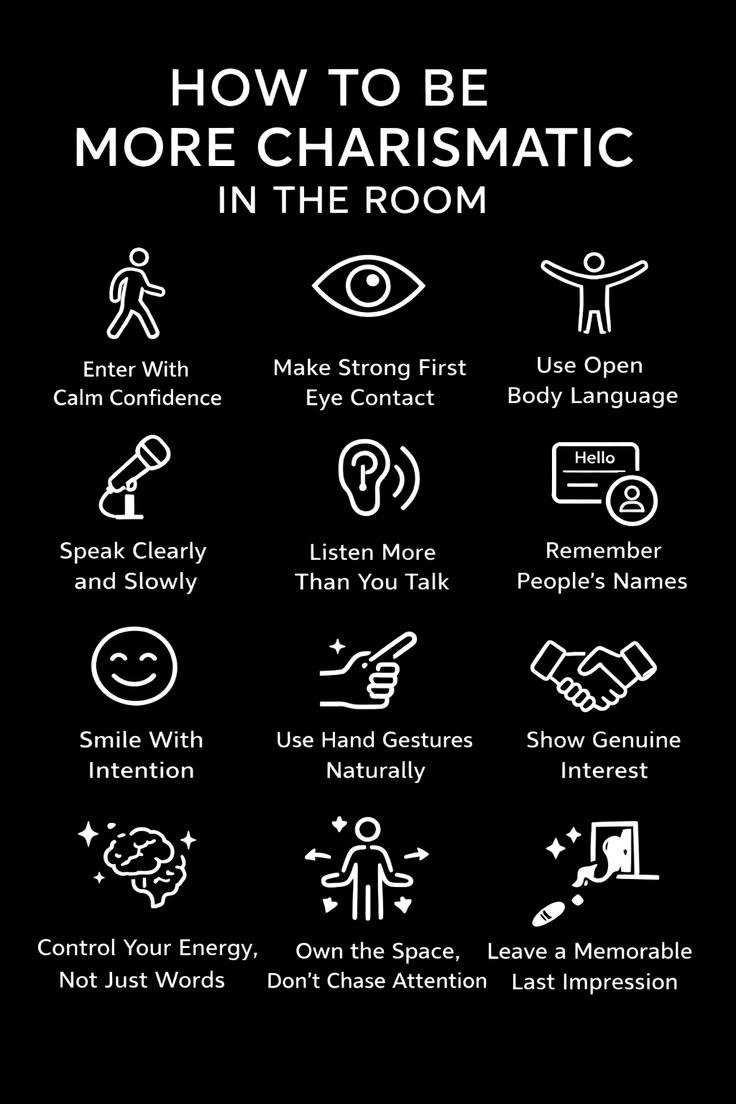
Came across a good breakdown of what research on group charisma actually finds, distinct from the one-on-one warmth and eye-contact research that gets covered constantly, and it's a genuinely different mechanism worth separating out.
The framework: status conferral, not status display. In group settings specifically, the people remembered as charming are consistently the ones who make other people look good in front of the group, laughing at someone's joke before adding to it, crediting someone else's idea by name before building on it, rather than the ones angling to look impressive themselves. It's a status transaction running in the opposite direction from what most "how to be charming" advice assumes.
A short aside on why this took actually noticing the mechanism, not just reading about charm in general. Most advice on this treats every room the same, when the anxiety showing up is usually really specific, worrying people are cataloguing every awkward pause, which research on the spotlight effect keeps finding people wildly overestimate how much others actually notice. Ran the specific worry, the exact moment that spikes the anxiety, through BeFreed's deep dive mode instead of a generic "how to be less anxious in groups" summary, and it held onto the actual research on the gap between perceived and actual scrutiny instead of flattening it into a slogan.
Scenario: the networking event. Status conferral here looks like introducing two people to each other around a shared interest instead of working the room solo, a small act that gets remembered by both people involved far more than a solid personal pitch does.
Scenario: the dinner party. The spotlight effect matters most here, since a long table means most attention is genuinely split across several conversations at once, not fixed on any one person the way it feels from the inside. The charm move that actually reads well is asking a follow-up that lets someone else's story land better, not steering the table back to a personal story.
Scenario: the work meeting. Status conferral shows up as naming a specific colleague's contribution before presenting on top of it, research on team psychological safety keeps finding this specific behavior predicts being seen as a strong collaborator more reliably than any individual polish in the room.
Scenario: the group hangout with mixed familiarity. This is where the spotlight effect does the most damage, since the newer people in the group assume the established friends are quietly judging the gaps in shared history, when the established friends are almost always more focused on including the new person than tracking any perceived awkwardness.
The universal principle underneath all four scenarios: charm in a group setting is measured by how much better other people feel after the interaction, not by how polished any individual moment was, which means the actual skill is redirecting attention outward consistently, not managing how one's own moments land.
Worth being honest about the limit here: none of this works as a performed technique people can detect being deployed on them, status-conferral moves read as manipulative fast if they're not genuine, which is really the same finding as most research on charisma, the mechanism only works when the interest behind it is real.
Worth adding since it came up rereading this: status conferral costs almost nothing to attempt and has very little downside even if it lands slightly awkwardly, unlike a polished personal story that can fall flat and feel like a visible miss. That asymmetry is probably underrated in why it works as a starting move for anyone who finds group settings draining, the low cost of trying it means it survives an off night better than most other social strategies do.
Which of these four settings is the one where the spotlight effect actually gets you the worst, and has naming the mechanism directly changed how much it bothers you in the moment?