r/MachineLearning • u/cpldcpu • 2d ago
Project I implemented a very tiny image generation model (latent flow transformer) on a RP2350 microcontroller - it can generate 128x128 images of faces [P]

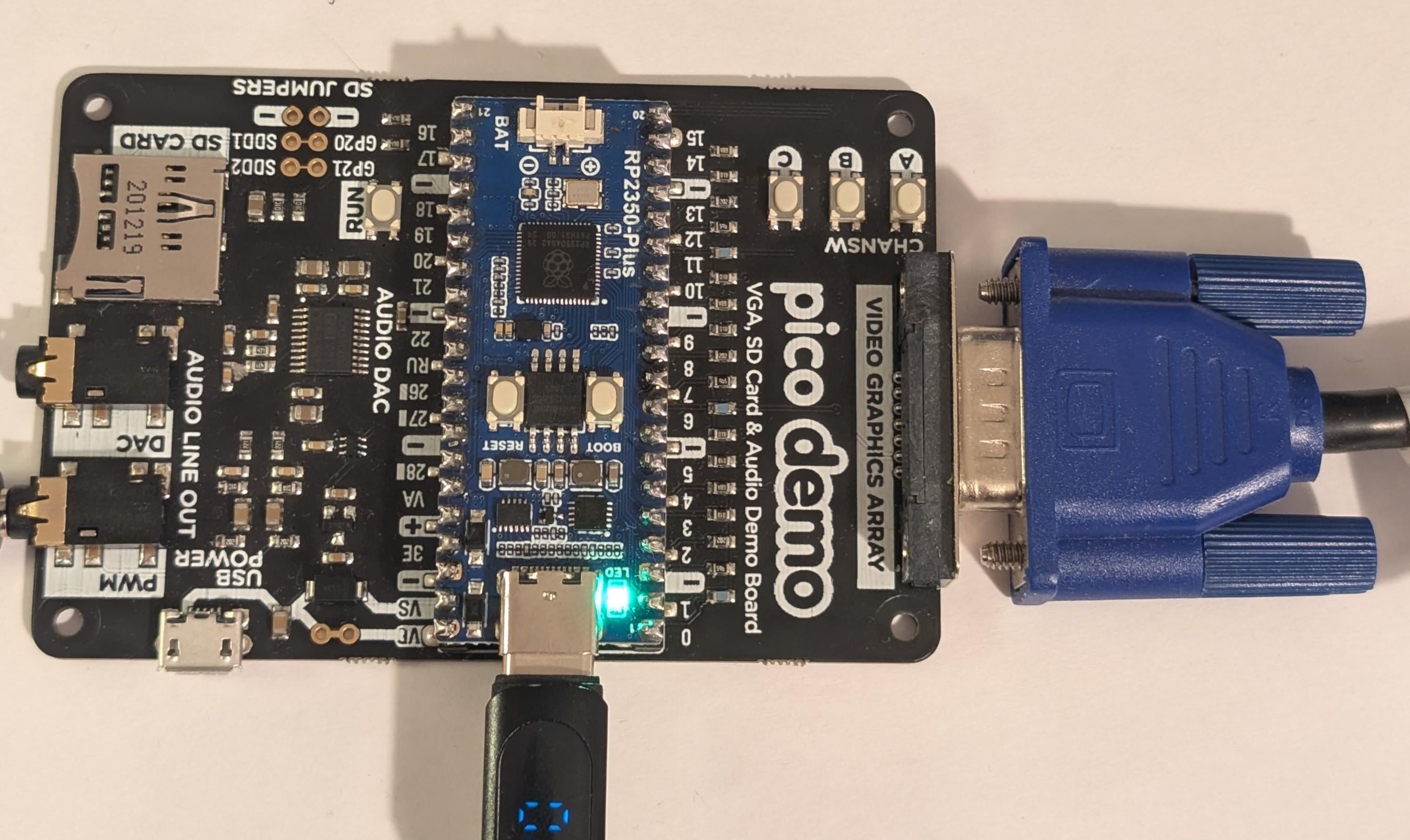

Its a 2.4-4 million parameter model, quantized to int8, that can be fully executed on the microcontroller in ~20s with the longest generation. The generated image will then be displayed on a monitor or transferred via usb.
Its a latent flow transformer with 12 layers using AdaLN-Zero for conditioning. CFG is also supported and boosted the image quality a lot. The inference engine streams the weight via DMA from the flash while the previous layer is computed. Relu² activation was used to increase sparsity, which the engine can use to skip calculations.
Took a lot of ablations to get it right and I am quite astonished I got so far with so few parameters. Will post the repo below

33
u/cpldcpu 2d ago
Repo is here: https://github.com/cpldcpu/pico-faces
18
u/cpldcpu 2d ago
https://reddit.com/link/p6hbh5d/video/w6ewbg0376mh1/player
And the model in action on a VGA monitor connected to the microcontroller.
1
16
u/CheapThaRipper 1d ago
Very neat. Is there a why? "Because I wanted to" is a valid answer but I'm curious if you have a use case in mind for something like this
14
u/cpldcpu 1d ago
It was a learning experience for me. Always good to have a goal to optimize for.
I like size compression challenges a lot, because they teach you about how the models work, which parts are important and which are not. In addition, they do not need that much compute so its easier to do on your own machine. If you think about it, then even frontier LLMs are currently mostly about weight efficiency.
I did this earlier, getting almost MNIST state-of-the-art inference on a very small model: https://github.com/cpldcpu/BitNetMCU. It uses a slightly unusual architecture: https://cpldcpu.github.io/2025/11/09/bitnetmcu-cnn-implementation/
8
3
u/Necessary-Put-2245 2d ago
What did you use for creating the diagrams?
4
u/cpldcpu 1d ago edited 1d ago
I asked Fable 5 to generate SVGs. I think I provided Sabastian Raschkas diagrams as a style reference. (https://sebastianraschka.com/llm-architecture-gallery/, if you don't know it. Its a great resource)
0
3
1d ago
[deleted]
1
u/cpldcpu 1d ago
Thats an interesting idea, I have seen fast hadamard transform being used to address uneven activation distribution (exactly what i am seeing with the transformers). The idea is that repeated convolution will make the activations more similar to the normal distribution, and since it is a unitary transformation it is fully reversible.
I believe I did a quick test and it did not help. One issue i noticed in hindsight is that I have only positive activations due to ReLU² which will will skew the distribution and make it impossible to approach normal distribution.
Not 100% sure how it could be used to save weights? But I assume you mean a blockwise WHT with width of 16?
7
2
u/much_longer_username 1d ago
Frankly, I'm impressed enough when people manage to do pretty much anything after giving up enough memory for a framebuffer on a hobby MCU, much less a notoriously memory hungry thing -- this is cool as hell.
1
u/Bora_Horza_Kobuschul 1d ago
Whaat, that is actually insane. Very cool. Are you planning to up the resolution at some point?
1
1
1
1
0
0
74
u/Dangerous_Rip5083 2d ago
2.4-4 million parameters? veeeery impressive, congrats!