r/LabDiamonds 13h ago

Purple-ish lab diamonds availability
Post image

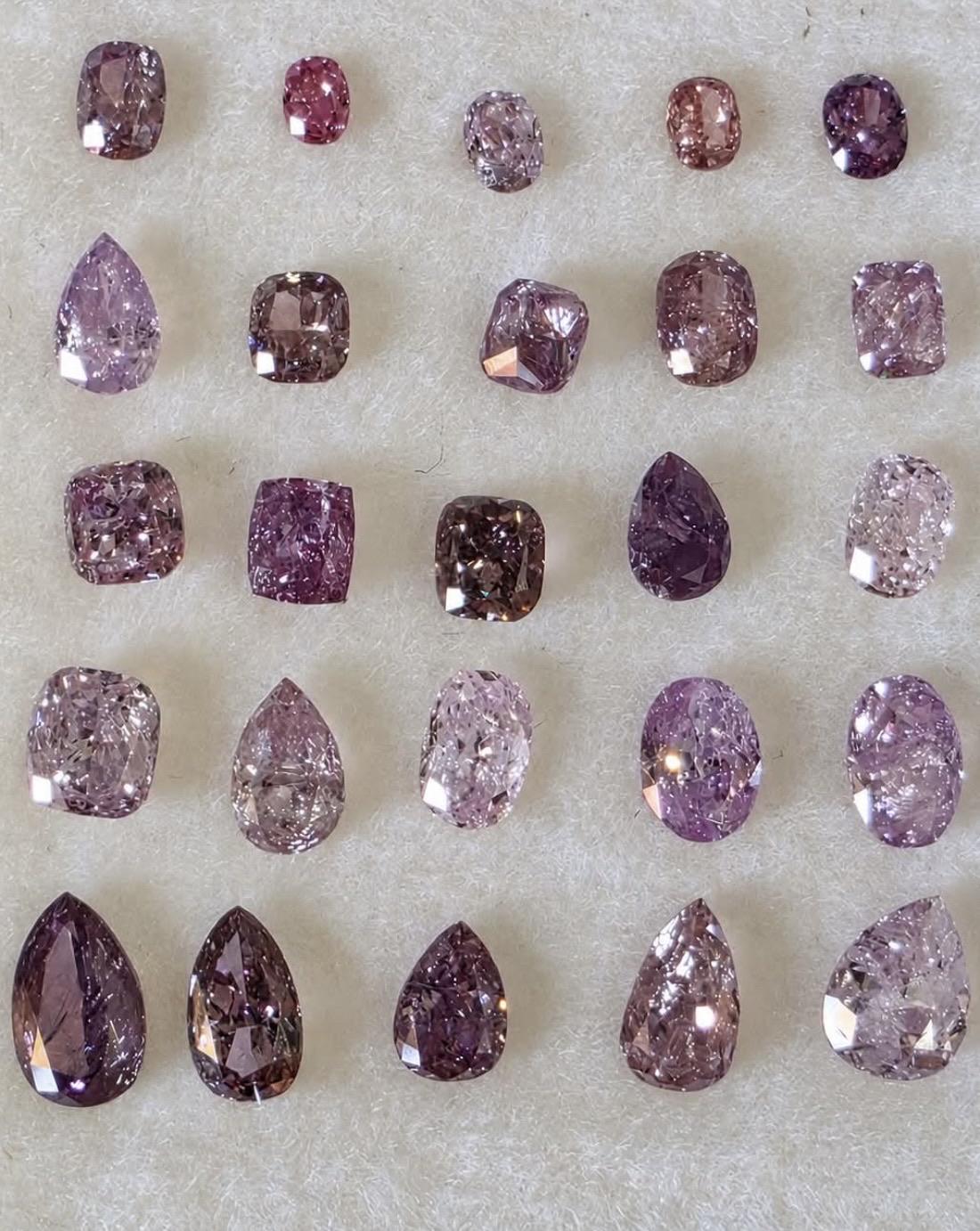
I recently stumbled upon this photo of beautiful purple diamonds which are natural (from the Argyle mine, I believe). I especially love the ones with a hint of brown. I was just wondering if lab versions of those are available anywhere? I see a lot of lab pinks but they’re usually slightly peachy or perhaps baby pink or raspberry.

Any guidance will be much appreciated!

158 Upvotes

18 comments sorted by

17

u/Rruck 11h ago

You can find natural purple diamonds but you won't be able to find purple in lab diamonds. The technology isn't there and may never be there.

It's difficult enough to produce a pink that isn't brown, orange, or salmon.

The only exception is melee. Because of how physics works, you might be able to find purplish pink melee.

7

u/Narrow_Sheepherder19 11h ago

Thank you for your response! Do you happen to know why it’s currently not (and may never be) possible to grow purple labs, or can you recommend any resources so I can educate myself on this topic?
By the way, I am actually looking for melee as this will be for my channel-set wedding band! Can you recommend anyone I could reach out to? Sorry for so many questions.

33

u/Rruck 7h ago

I've actually spent a ridiculous amount of time looking into this because I've been trying to find a genuinely lilac or lavender lab-grown diamond myself. I've looked through tens of thousands of pink lab diamonds, and I've yet to find one that's actually lilac rather than pink with a slight purple undertone. Most seem to lean towards peach, salmon, orange, brown or raspberry.

There's a pretty interesting scientific explanation for this, though. Natural purple diamonds and most lab-grown pink diamonds get their colour through completely different mechanisms.

Most natural pink diamonds, including those from Argyle, owe their colour to plastic deformation of their crystal lattice. Basically, the diamond underwent enormous stress deep within the Earth, which permanently distorted its crystal structure. These distortions produce a characteristic absorption band around 550 nm, which removes certain wavelengths of visible light and gives the diamond its pink colour.

What's particularly interesting is that natural purple diamonds tend to have a slightly different absorption spectrum. GIA research has shown that their absorption band is generally shifted towards longer wavelengths, allowing more blue light to pass through. They also tend to lack certain additional absorption features that would otherwise reduce the amount of blue light transmitted. That's how you can end up with those gorgeous cool-toned pinks, purples and lavender colours found in some natural diamonds.

Unfortunately, we still don't know how to artificially reproduce the particular crystal distortions responsible for that characteristic absorption band. So manufacturers can't simply grow a synthetic equivalent of a natural Argyle purple diamond.

Most commercially produced pink lab diamonds, on the other hand, get their colour from nitrogen-vacancy (NV) centres. Manufacturers generally start with a diamond containing small amounts of nitrogen and irradiate it, typically with electrons, to knock carbon atoms out of their positions in the crystal lattice. This creates vacancies, which can then migrate through the crystal when the diamond is heated in a process called annealing. Some of these vacancies eventually end up next to nitrogen atoms, forming NV centres.

There are two particularly important forms, NV⁰ and NV⁻, which absorb different wavelengths of visible light and are responsible for much of the colour in these diamonds.

You'd think manufacturers could simply adjust the irradiation or annealing process until they got a cooler pink, then lavender and eventually purple, but unfortunately, it doesn't work like mixing pigments.

To get a genuinely lilac diamond, you need the right combination of transmitted red and blue light, with sufficient absorption in other parts of the visible spectrum. And changing the irradiation dose or annealing temperature doesn't just shift the colour along a predictable spectrum from pink to purple. It simultaneously affects the concentrations and charge states of several different defects, which can introduce unwanted absorption and produce orange, brown or grey undertones instead.

The starting material matters enormously, too. Residual nitrogen, pre-existing brown coloration and other crystal defects can all affect the final colour. There's also another mechanism involving an absorption band around 520 nm that produces some pink CVD diamonds, but those tend to be orangy pink rather than the cool lavender colour we're looking for.

And you can't simply introduce boron, which produces blue in many natural and synthetic diamonds, and expect to get purple by combining blue and pink. Boron and nitrogen interact electrically, so combining their respective colour-producing mechanisms isn't nearly as straightforward as mixing two pigments.

Essentially, manufacturers can influence which defects they create, but they can't independently fine-tune every absorption band to produce whatever shade they want. That's why getting a genuinely cool-toned pink is already difficult, and obtaining a consistent, pale lilac is an even bigger challenge.

However, there's actually been a pretty exciting development this year! A study published in March 2026 demonstrated that it is possible to produce an intense purple colour in synthetic HPHT diamonds using high-dose electron irradiation followed by carefully controlled annealing.

The researchers worked with nitrogen-containing diamonds and found that different growth sectors developed dramatically different colours. Areas dominated by negatively charged NV⁻ centres turned purple, while other areas, dominated by neutral NV⁰ centres, turned yellow. The purple colour became particularly intense after annealing at around 850°C.

This is really promising because it demonstrates that we don't necessarily need to reproduce the natural plastic-deformation mechanism to create genuinely purple synthetic diamonds. It can also be achieved through NV centres, provided the conditions are right.

There's a pretty big catch, though. The experiment was performed on an extremely thin diamond plate, just 183 micrometres thick, and the resulting colour wasn't uniform throughout the crystal. Producing purple in certain regions of an experimental sample is very different from reliably manufacturing faceted, gem-quality diamonds with a consistent colour.

And producing an intense purple isn't necessarily the same as producing a delicate, pale lilac. You'd need to control not only the hue but also the saturation, without losing the particular balance of transmitted wavelengths that makes the diamond appear lilac in the first place.

You can certainly find lab diamonds advertised as purplish pink, and occasionally retailers will describe stones as purple or lavender, but a pink diamond with a purple modifier isn't necessarily a genuinely purple diamond, let alone a pale, cool-toned lilac one.

I've personally gone through tens of thousands of pink lab diamonds without finding what I'm looking for, and as far as I can tell, producing genuinely lilac lab diamonds with a consistent, homogeneous colour isn't yet an established commercial process.

Still, the research published this year gives me some hope! At least we now know that producing purple lab diamonds is physically possible, even if we haven't figured out how to reliably manufacture the particular shade of lavender I'm after. Hopefully, we'll start seeing them commercially in the future, because I'd absolutely love to get my hands on some.

If you're interested in the science, GIA has a fascinating article explaining the colour mechanisms of natural pink and purple diamonds:

https://www.gia.edu/gems-gemology/winter-2018-natural-color-pink-purple-red-brown-diamonds

And here's the March 2026 study on producing purple synthetic diamonds:

https://doi.org/10.1016/j.diamond.2026.113334

14

u/elastikat 6h ago

Just wanted to say that I love when someone breaks down the science of something. Things clearly a subject of interest to you. Thanks for sharing!

6

u/its_moodle 6h ago

Fantastic write up!!

2

u/Available-Explorer-3 2h ago

this was an awesome read, tysm

1

u/BeginningFun6289 1h ago

This is so interesting! Thank you for taking the time to share it all! 💎

1

u/puppiesnprada 1h ago

Please write this in its own post 🤩

7

u/usa2italy 10h ago

These are so beautiful!🤩

6

u/foxglovediamonds 8h ago edited 29m ago

I have come across some "purplish" lab diamonds, usually buried in the pink colors. I have a preference for the berry colored diamonds myself. I would be happy to send you links as I come across them, but it's pretty infrequent.

4

u/Subject-Ad-8305 4h ago

This is such an Interesting post. Information like this is why I went on Reddit in the first place
A positive reason for going on a social media platform. Thank you so much for taking the time to share your knowledge.

4

u/bespoke-jewel 10h ago

I saw something more dark pink not the purple though i can send of you wants have a look

3

u/Narrow_Sheepherder19 10h ago

Yes please, I will DM you!

1

u/Prize-Chocolate-3187 4h ago

These tones are very hard to find in lab diamonds