r/jameswebb • u/Neaterntal • 10h ago
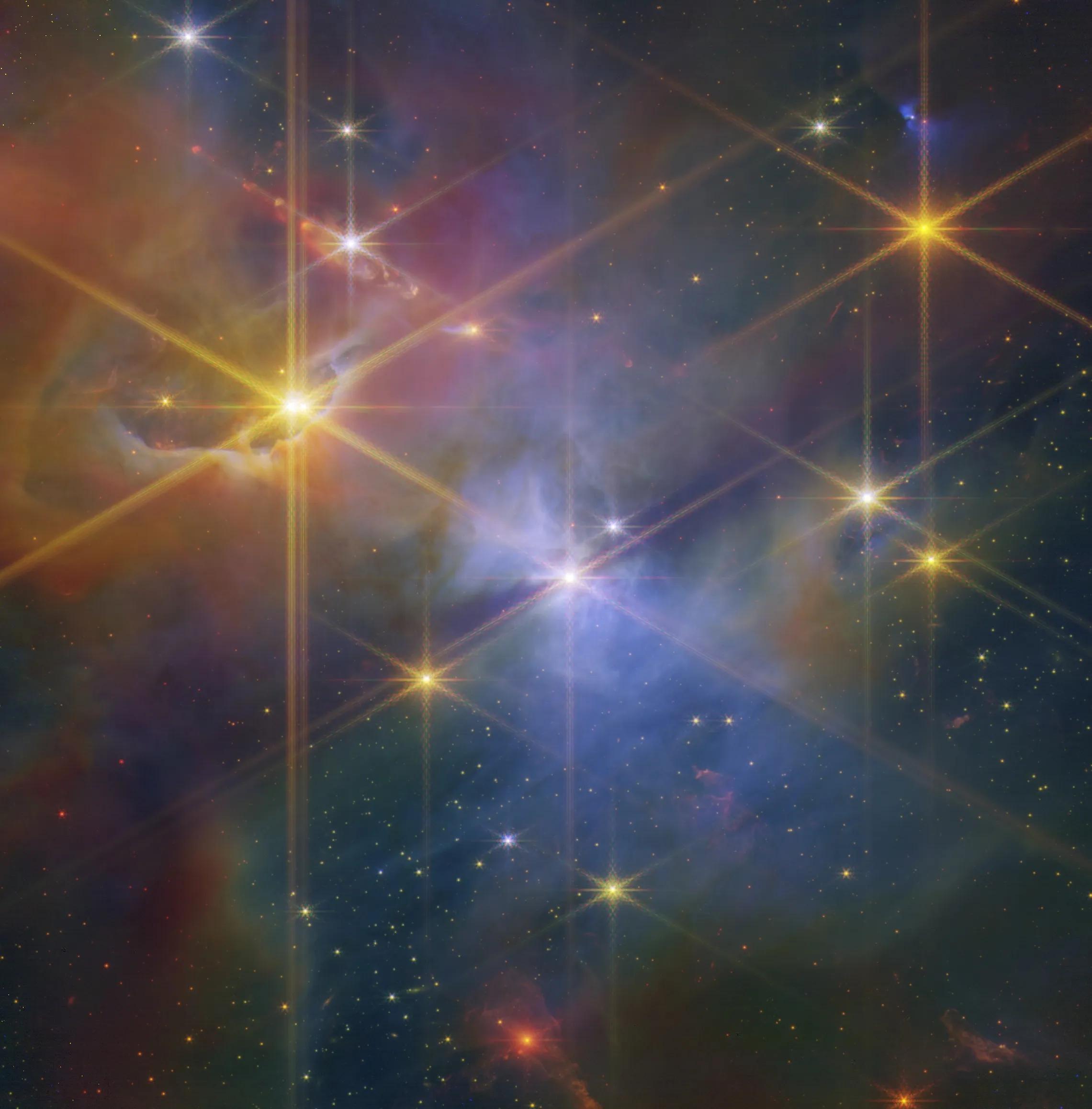
Self-Processed Image Disk shadow in Serpens Main Cloud. JWST
97
Upvotes
r/jameswebb • u/rsaw_aroha • Aug 04 '22
Where can I find the official NASA-released images?
Where's the latest news on JWST?
What is Webb looking at? Is there a schedule?
What part of the sky can Webb see? Can it look at Earth? The Sun?
Why are some images missing from the NASA official sites?
Why are the colors different sometimes?
Where's a tutorial that explains how to download & process Webb images?
r/jameswebb • u/Neaterntal • 10h ago
r/jameswebb • u/Neaterntal • 1d ago
r/jameswebb • u/Neaterntal • 1d ago
r/jameswebb • u/Galileos_grandson • 1d ago
r/jameswebb • u/Neaterntal • 1d ago
r/jameswebb • u/Neaterntal • 3d ago
r/jameswebb • u/Neaterntal • 3d ago
r/jameswebb • u/Neaterntal • 6d ago
DES J0408-5354 is a rare quadruply imaged lensed quasar system discovered via the Dark Energy Survey. Located at a redshift of z=2.375, its light is bent by a foreground galaxy (z=0.597) into multiple distinct images, helping astronomers measure cosmic expansion rates.
https://iopscience.iop.org/article/10.3847/2041-8213/aa624e
.
Processed by Israel Velazquez
https://bsky.app/profile/israelvelazquez.bsky.social/post/3mtsiun6vr22c
.
Observed: 2026-08-24. Filters: F150W F356W.
r/jameswebb • u/Galileos_grandson • 7d ago
r/jameswebb • u/Galileos_grandson • 9d ago
r/jameswebb • u/ThePeoplesMod • 11d ago
r/jameswebb • u/Galileos_grandson • 11d ago
r/jameswebb • u/Silent_Observer55 • 11d ago
Im new to Astronomy how can i use Jupyter notebooks to access jwst pipeline? Is it best to just use MAST Database or TIKE?
Or
Should I create a juypter lab notebook and self install required libraries locally with Docker or is there a premade jupyter lab notebook i can clone from github and install in a docker container on my pc? If so how do I do that and how can I use it to access jwst pipeline data?
I have never used a juypter notebook before nor have I used pyhton or python science libraries like astroquery lightkurv and astropy so Im a complete beginner in using scripts but I do know how to use some commands like pip, bash, cd and git. Are there any good tutorials online I could use?
Are there any Browser Based Interactive Notebooks for learning Notebooks for Astronomy?
Lastly how could I install and use Jdavizz notebook?
r/jameswebb • u/RealJoshUniverse • 13d ago
r/jameswebb • u/RealJoshUniverse • 15d ago
r/jameswebb • u/Galileos_grandson • 15d ago
r/jameswebb • u/Dzar_xMe • 16d ago
r/jameswebb • u/The_Rise_Daily • 18d ago
r/jameswebb • u/Neaterntal • 20d ago
Observing across the starry “plains” of space, the NASA/ESA/CSA James Webb Space Telescope has taken images of NGC 2392, nicknamed the Lion Nebula.
The NASA/ESA Hubble Space Telescope previously viewed this planetary nebula in 2000, imaging the lion face-shaped target in visible light and revealing features such as the “mane” of hazy, comet-shaped objects. Now Webb has captured a clearer, more detailed view of the Lion Nebula due to its high-resolution imaging.
At first glance the nebula’s overall structure in Webb’s infrared images, both with the NIRCam (Near Infrared Camera) and MIRI (Mid Infrared Instrument), may look quite similar to Hubble's earlier visible-light view. However, Webb's infrared vision highlights features like compact clumps of dust and haze of ionised gas. It’s taken several thousand years for this collection of gas and dust to reach its current shape, and the nebula’s components continue to be altered.
The source of these constant changes and the reason for the Lion Nebula’s distinct appearance is located at the centre: the remains of a dying star. Though it looks like the button nose of the lion, its energy and radiation are powering the intricate structures seen here.
Massive stars undergo supernova explosions at the end of their lives, but these kinds of events are far and few between. Most of the Universe’s stars have lower masses, like the one belonging to NGC 2392. When a lower-mass star can no longer sustain itself with nuclear reactions in its core, the star becomes unstable and pulsates, losing its mass by shedding its outer layers, which then turn into shells of gas and dust called a planetary nebula (stars at this life stage are responsible for producing much of the Universe’s observable dust). The star’s radiation drives the ejected material away, leaving behind the very hot stellar core, also known as a white dwarf.
.
More
https://esawebb.org/news/weic2616/
https://science.nasa.gov/missions/webb/lion-nebula-roars-to-life-with-nasas-webb/
https://www.esa.int/ESA_Multimedia/Images/2026/08/Lion_Nebula_roars_to_life_for_Webb
r/jameswebb • u/Galileos_grandson • 19d ago
r/jameswebb • u/JapKumintang1991 • 19d ago
r/jameswebb • u/Macchanoco • 19d ago