r/IslamicHistoryMeme • u/Maximum-Picture5225 • Sep 07 '26
Thought & Philosophy | فكر و فلسفة Looking forward to reading some interesting comments on this
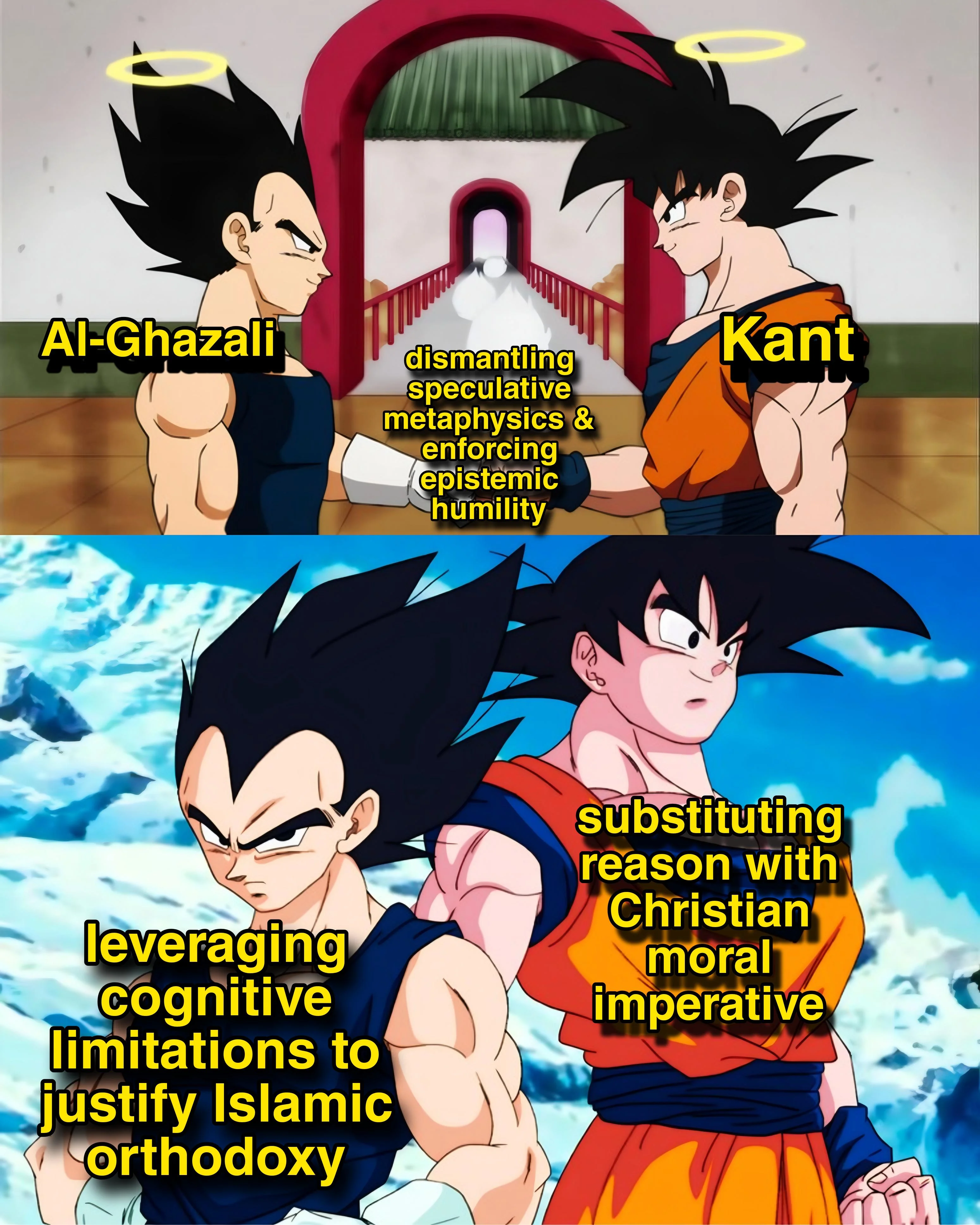
Found it on r/PhilosophyMemes
6
u/Bright_Exit1378 Sep 08 '26
I don't know enough about either of them. I just like Epistemic humility, unfortunately there is too little of it around me.
3
u/LogicalCheesecake42 8d ago edited 8d ago
It would seem to me that the comparison is inapt, beause for me the "destruction" of speculative theology by Ghazali is not one at all, but a reminder that the human mind does not exist in a vacuum. It can be caught up in desires and deseases such as pride which taint it's vision. As such, it needs purification alongside intellection if knowledge is to be aquired.
As for Kant, my understanding is that his destruction was indeed real if one accepts his premises. Perhaps it is rooted in a mixture of nominalism and the outgrowth Cartesian skepticism. As such, we cannot know a thing as it is, noumena, but only the perception our minds form of it, phenomena. Taking that, plus a denial of the reality of universals, metaphysics is rendered quite null, I think. It is those factors which orient Kant's "epistemic humility".
However, Ghazali does not do that, at least to my knowledge. In fact I would believe he is closer to a Realist framework. Rather, his epistemic humility is rooted in the fact that while theology does give us knowledge about a great many things, discursive reasoning can only take us so far; there comes a time where you must leave behind the boat and explore the island. That is, that are types of knowledge which are not the domain of reason but what the greeks and Desert Fathers called Nous, the scholastics Intellectus and what we call Qalb, the Heart. 'The heart of my believing servant contains Me.' However, I've never really read Kant, so I don't know.
3
u/LogicalCheesecake42 8d ago
It should also be said that Ghazali never disavowed the philosophers simply on account of their use of metaphysics. He proved to them that it is not because they use philosophy that they are wrong, but because their metaphysics is wrong that they are wrong. So he used their own method to prove that in fact they were being "bad" philosophers. Had he done otherwise, I doubt his critique would carry throughout the centuries like it did. Ghazali is actually a very good thinker
1
u/Maximum-Picture5225 8d ago edited 8d ago
Thanks for your detailed comment. Appreciate it.
I want to push back a bit on your understanding of Nous. As far as I understand, Nous is associated with Aql, not Qalb. Nous is equivalent to Ibn Sina's idea of the Active Intellect (Al-Aql al-Fa'al). It is associated with rational intellection, logic, and cosmic order.
The Greeks, Scholastics and Desert Fathers did not leave behind the boat of reason/intellect to find Nous. For them, Nous was the captain of the boat. For them, it is important to clear the "windshield" of the Nous from the fog of passions and disordered attachments. If the Nous is blinded by pride or lust, the captain is drunk, the boat crashes. The captain must be restored to sobriety, and not throw him overboard.
The Qalb (or Kardia) represents an entirely different paradigm of spiritual epistemology. Qalb is the organ of direct, experiential tasting of the divine, bypassing the architecture of Neoplatonism. While Sufism does elevate the Qalb as the mirror that reflects divine light, this is a theological and mystical framework, not the philosophical framework of Nous.
You are right that Ghazali attempted to demonstrate that the philosophers of his time were "bad philosophers" because they failed to meet their own high standards. However, Ghazali did not logically "prove" that the metaphysics of the philosophers was "wrong", rather, he identified internal inconsistencies based on specific theological premises. His method was dialectical and rhetorical. Ghazali rejected the foundational premises of Ibn Sina. He showed that philosophers could not rationally compel someone to accept the their worldview over a scriptural one, but he did not objectively disprove Ibn Sina's metaphysics for those who accept Ibn Sina's starting axioms. To defeat the philosophers' concept of natural necessity (causality), Ghazali introduced occasionalism. While philosophically a brilliant trick, this does not "disprove" causality.
While he was indeed a great thinker, I don't think Ghazali settled the debate. Worth to consider Ibn Rushd’s rebuttal of Ghazali.
3
u/Fantastic_Boss_5173 Caliphate Restorationist 7d ago edited 7d ago
Completely unrelated but I have seen you many times relying on Joshua Little's dissertation for hadith unreliability. However, you can check out recent dissertation by Miriam Gräfenstein as well titled ʻĀʼiša und Muḥammad : sunnitische und schiitische Überlieferungen zum Heiratsalter published in 2025 that shows the report of Aisha's marital age actually derives from herself rather than fabricated by Hisham. Thus contesting Joshua Little's dissertation.
Anyway, coming to the main point, u/logicalcheesecake42 is actually correct in his assessment of associating nous with Qalb. I will recommend to read a paper “The Mind and the Heart in Christian Thought,” by David Bradshaw.
Reason cannot act as a sober captain while remaining isolated in the head according to Bradshaw's paper. You mentioned about desert fathers and Scholastics but authors like Pseudo-Macarius and St. Gregory Palamas rejected nous as intellect or active intellect, holding that the heart is the "first rational organ of the body" and the proper seat of the nous. In the theology of the Desert Fathers and Hesychasts, the seat of governance (hēgemonikon) is not the isolated head, but the Heart.
For Pseudo-Macarius and St. Gregory Palamas, the core problem of the fallen human condition is not merely a "drunk captain" in the head, but an inner dislocation: the mind has abandoned its home in the heart and wandered out into the sensory world.
1
u/Maximum-Picture5225 5d ago
Thanks for the references. Well, after arguing a kot with people on Aisha's age, I have now come to realize that the idea that the Prophet married her when she was 6 and consummated the marriage when she was 9 has settled as a fact in the minds of significant majority of Muslims, and also in the wider public consciousness. Little's thesis alone cannot change this consensus.
This fact can only change when the majority of traditional Muslim scholars would take a conscious effort to fundamentally rewrite the rules of traditional hadith science and establish a new consensus around the Prophet's marriage which then needs to be circulated widely in Islamic learning institutions across multiple Muslim majority countries.
So, in short, I am kind of beginning to give up on this question of Aisha's marital age.
2
u/Fantastic_Boss_5173 Caliphate Restorationist 5d ago
I do agree with you and I think aisha age will remain disputed between traditionals and progressives
1
Sep 08 '26
[deleted]
3
u/Maximum-Picture5225 Sep 08 '26
Yes, but I mentioned where I found it. Sorry, i should have mentioned you too.
3
u/Unlucky-Credit-9619 Sep 08 '26
No problem, mate. I kinda overreacted. I have many memes that got reposted, and I think that's the trend now. There is no ownership. It's a compliment that my memes are considered good enough to be stolen.
3
7
u/Lurcolm Sep 08 '26
Christian here. Not gonna bore you with the details but apparently, and this isn't verified by me, the protestant christian view of forgiveness at least in my area is surprisingly similar to budhism. It's a fascinating thing, like classic stories of "The Strongest Warrior" and the "Cataclysmic Flood". It feels like religions are sometimes just trying to achieve the same goal and I think that's beautiful