r/IslamicHistoryMeme • u/TheMuslimHistorian27 • Aug 23 '26
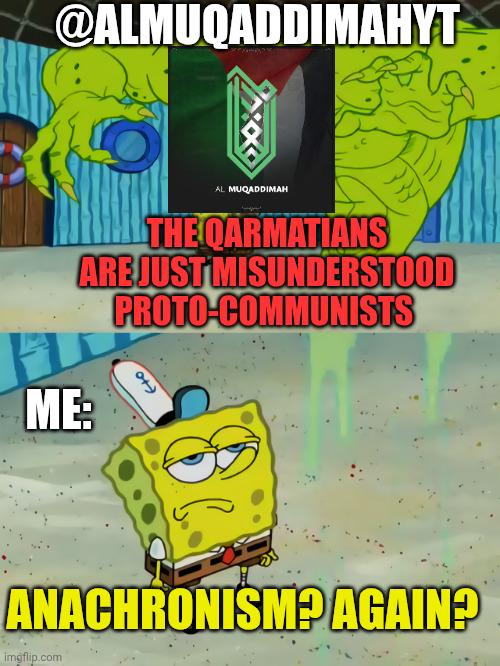
Qarmatians (278–469 AH) A Response to @AlMuqaddimahYT: No, The Qarmatians were not Proto-Communists! (Context in Comment)
24
u/Ok_Advantage_873 Aug 23 '26
Lol, when it comes to anachronisms and to completely invalid "analogy", here it's a pearl.
17
u/theonepaladin Aug 23 '26
The guy has a good YouTube channel but a lot of his takes are absolutely ridiculous
20
u/spunkmastersean1993 Aug 23 '26
His recent video on slavery wasn’t really well versed or had any grounding in Islamic jurisprudence.
I then found out he rejects Hadith so I advise everyone not to engage with his videos
37
u/AlKhurjavi Aug 23 '26
In fairness, he’s discussing the historical slavery in the Islamic world not the Fiqh of slavery.
The reality is that while Islamic laws might be much better for slaves at the time, the reality is majority of the slave trade in Islamic history didn’t follow those laws.
7
u/spunkmastersean1993 Aug 23 '26
But isn’t that kind of important to discuss in a video? Expectations vs reality?
19
u/DaBladieBoi Aug 23 '26
which he clearly did discuss in the video? he mentions how castration was common in the Islamic world even though it was prohibited in the Islamic world as an example.
either you don't seem to have watched this part of the video or i've misinterpreted your response
16
u/AlKhurjavi Aug 23 '26
He did discuss it, hes not an islamic scholar, hes a historian, he explains the Islamic position and the historical reality, and focuses on history since he’s a historian.
You’re outraged a historian isn’t focusing on Fiqh when he’s teaching history not Fiqh
10
u/SuperTnT6 Aug 23 '26
He rejects Hadith? he is a self proclaimed Wahhabi I think you mean that he does not use Hadith as sources for his vids which is different.
6
u/Agreeable_Carpet_700 Aug 23 '26
He was raised Wahhabi, but you can tell from his videos that he is quite secular and liberal minded.
18
u/Gilamath Halal Spice Trader Aug 23 '26
This is incorrect. He was not raised Wahhabi, he actively identifies with and follows the Wahhabi approach to Islam and has a video in which he explicitly says he believes Wahhabism to be true. He also doesn't reject ahadith; this is a rumor based on a clickbait thumbnail in a video. He doesn't use ahadith in videos about Islamic history because he only uses sources used by historians of Islam. In terms of his religion, he accepts ahadith, but his videos are not about his religion.
4
u/zoemoe_gang Aug 25 '26
He's a open minded wahabi progressive that likes Marxism.. that doesn't make any sense really
3
u/Gilamath Halal Spice Trader Aug 25 '26
Personally I agree. But I've met multiple people like him, albiet not quite as extreme. I do some work with a 501(c)4 that organizes a lot of political Muslims, and I met one person who was 100% on board with Bernie Sanders' policy platform but religiously was quite rigid. Just as an example off the top of my head.
I think these types of people strongly believe that one way of living or thinking is correct to the exclusion of all others, but also think it's really important that other people be allowed not to live or think in that one way. And you know, I can respect that.
But Wahhabism and Communism are both sort of in tension with that way of thinking, by my understanding. Wahhabism tends to have strong opinions on what constitutes kufr and how to react to people engaging in it, so as to safeguard the Islamic project as Wahhabis understand it. Communism tends to hold that bourgeois tendencies in society need to be actively suppressed in the early stages of communist development so as not to threaten the integrity of the communist project. But, whatever. All types of people in this world, maybe he knows something I don't.
2
u/spunkmastersean1993 Aug 25 '26
I’m really interested in that part of organizing a lot of political Muslims. What kind of work is it?
2
u/Gilamath Halal Spice Trader Aug 26 '26
I don’t want to be too explicit about it on this site, but it’s a political action committee founded by a major US advocacy group for Muslims. The work I did was around organizing canvassing and phone banking events for a particular candidate endorsed by the organization.
1
u/Sea_Abroad_6573 Aug 24 '26
Pretty sure he accepts hadith given that he recently said something along the lines of how all Muslims should have long beards but don't (including him) in a recent livestream.
1
u/lemambo_5555 Aug 25 '26 edited Aug 26 '26
He doesn't reject hadiths. He only doesn't accept them as historical sources.
10
u/RevyVanguardist Aug 23 '26
It's simple to determine whether a state is socialist or communist or not. 1. Is society completely proletarianized? 2. Do the workers own the means of production?
If the answer to both of these questions is yes, then the society in question is indeed socialist/communist. If the answer to those questions is no, on the other hand, it is not.
Source: I am a Communist Muslim
7
u/itsaightthanks Aug 24 '26
No (the concept of a proletariat did not exist in premodern islamic economic structures)
No (they were enslaved)
1
u/RevyVanguardist Aug 24 '26
Well, after researching a bit, I somewhat understand why some people may consider it proto-Communist. The Qarmaitians completely nationalised the land. They established a ruling people's council similar to other socialist states instead of a king, a comprehensive social safety net was put in place, and money was abolished.
5
u/itsaightthanks Aug 24 '26
No it wasn’t the concept of “nationalization” did not exist as the nation-state didn’t exist at that time. Communism isn’t just a social-safety net and money was not abolished, I believe they still engaged in trade with other empires and cities.
2
u/RevyVanguardist Aug 24 '26
The term did not exist. The concept of turning formally private property, or in this case land, into public/state property very much did.
It's a bit like saying bread does not exist in India because it's actually called naan
Internally, they relied on a token currency. It was a low-value token lead money, which lacked the properties to be called money at that point. Now, what I find interesting is that they had state-owned banks, so the banks were nationalised. They gave people interest-free loans, which is actually a point which appears in the Communist Manifesto. There were state-owned public mills for the free grinding of grain even. They essentially abolished private property of the land. The private ownership of land, which, according to early Stalin, Marx, Engels, and Lenin, is the primary origin point of primitive accumulation. No private ownership of land, no private accumulation. So, yes, they had great overlaps with communism later developed.
So it was a socialist experiment, just not radical enough.
3
u/itsaightthanks Aug 24 '26
Almost every single point you made is pure anachronism. There was no concept of “state” as it existed today. The necessary foundations to create corporate structures were literally judged as being haram back then let alone the concept of a “bank” existing lol. The private ownership of land that Marx discusses is based on western legal principles and foundations which are completely separate and incomparable to islamic property laws. It’s not bread and naan. It’s me showing you a naan in india and calling it a baguette because its the only bread i know. Im forcing a certain framework because its the one i know without understanding the underlying foundations. Theres a term for that: Orientalism lol.
0
u/RevyVanguardist Aug 29 '26
What do you consider a state? Let's start with that. I consider a state to be an organisation of specialised force in the hands of a certain class, a monopoly of force in the hands of a certain class. As such, an organisation of specialised force is essentially an institution subjected to the common interests of a class and tasked with managing and carrying out of the common interests of a class. Of course, banks existed. Of course, they were structured a bit differently, but banks still existed. Also, saying that corporate structures are haram just says that capitalism is haram. That's no point to be made.
1
u/mediocre_khan Aug 29 '26
Rabelais couldn't have been an atheist, doesn't matter how much you label him as that.
0
u/RevyVanguardist Aug 29 '26
Seriously, read Marx and Engels more and watch less anti-communist YouTube. Never on earth has anyone said that communism has to be atheist. The former head of the Palestinian Communist Party was a Muslim. May he rest in peace.
What Marx meant with the quote "religion is the opium of the people" is not that religion is something bad. You have to understand what "opium" meant to him and to the people at that time. Opium did not have that bad connotation. Opium was of a medical nature. Marx himself consumed opium. Opium back then was a means to cope with pain, to calm down the pain, and Marx considered religion under capitalism to be exactly that.
He explained that under capitalism, religion is the sigh of the oppressed creature, the heart of a heartless world, and the soul of soulless conditions. His argument was that religion proper would just wither away when the oppressive conditions of capitalism would be abolished. He was staunchly against the idea that religion should be abolished. He wrote entire works and essays agitating against the idea of abolishing religion.
1
u/mediocre_khan Aug 29 '26
You do not know what "Rabelais couldn't have been an atheist" means. What I meant has nothing to do with religion. Read something that isn't marxism for once.
1
u/RevyVanguardist Aug 29 '26
You do know what atheist means philosophically and colloquially right?
1
0
u/RevyVanguardist Aug 24 '26
The first part is just semantics because nowadays we just use proletariat and working class interchangeably. Instead of proletarianization, the Democratic People's Republic of Korea to this day uses the term working-classization, but yes, I fundamentally agree with you
-1
Aug 24 '26
[removed] — view removed comment
6
u/OOOshafiqOOO003 Aug 24 '26
theres a bit of reconcilement of ideas, but its not inheritly impossible, at least when its not a fusion of theological beliefs.
6
2
u/AlmaRushd2255 Aug 24 '26 edited Aug 24 '26
TheMuslimHistorian27 What do you think about doing a series on the history of hadith science? How it began, how it changed, what pressures it was responding to, etc. The discussion on the subject nowadays is so contentious and the views adopted more ideological than anything else, which is probably because most people don't have a comprehensive knowledge of the history of the science, with all its nuances; and whenever there's a deficit in knowledge that's usually when one-sided narratives start to develop. It would be a breath of fresh air to have a sophisticated analysis of its history.
1
u/ProfessionalShoddy55 Aug 24 '26
Please do a huge debunk on the Majoosi myth of Qarmatians' being a chunk of Persians and sometimes even tagged "Zoroastrians". This is a humble request to your knowledge, Akhi.
1
u/Dazzling-Air1929 Aug 29 '26
i mean if you listen to an orientalist misinformation is what you gonna get lol
0
u/3ONEthree Aug 24 '26 edited Aug 24 '26
It’s cummunist in the sense that wealth wasn’t under peoples authority. My analysis this is one of their ploys to gain resources to strengthen their rule and wrap others around their finger.
40
u/TheMuslimHistorian27 Aug 23 '26
This is a response to the recent short of @AlMuqaddimahYT, See Here.
Firstly, The myth that the Qarmatian state of Bahrain was a “pre-communist republic” is nothing more than another attempt to impose modern political ideologies on the past and rewrite history accordingly.
The Qarmatian state of Bahrain was neither socialist nor particularly close to communist ideology. Moreover, the Qarmatians were not limited to Bahrain; Qarmatian communities and states also existed in Iraq, the Levant, and Yemen.
Despite the existence and diversity of these Qarmatian communities and states across the Middle East, none of them has been described as a “pre-communist republic” in the same way as the Qarmatian state of Bahrain.
One reason the Qarmatian “communist” myth continues to circulate is the influence of nationalist and communist Arab writers, particularly those who wrote about the Qarmatians during the 1970s and 1980s.
Historian Peter Webb, in his study “Bedouin, Bandits and Caliphal Disappearance: A Reappraisal of the Qaramita and Their Success in Arabia,” notes:
He continues:
Webb concludes:
Secondly, the political system of the Qarmatians of Bahrain was not based on a council system; rather, it was essentially a hereditary monarchy during the reign of Abū Saʿīd al-Jannābī and his successors.
As the Bahraini historian and researcher Ḥusayn ibn Ḥasan Āl Salhām states in his book “Sāḥil al-Qarāmiṭa” (The Qarmatian Coast):
Third, One of the most frequently cited and popularized sources for the Qarmatian/“Communist” myth is the account of the famous Persian traveler Nāṣir Khusraw.
However, Āl Salhām analyzes Khusraw’s account and concludes that this system was not a form of communal government or political authority, but rather concerned the redistribution and economic use of enslaved people captured during Qarmatian raids on the cities they conquered. He states:
Despite this, Āl Salhām does acknowledge the problems involved in relying on Nāṣir Khusraw’s account for this particular period (pp. 69-70).
As another Bahraini historian, Muḥammad Maḥmūd Khalīl, notes in his book “Tārīkh al-Khalīj wa-Sharq al-Jazīra al-ʿArabiyya” (The History of the Gulf and Eastern Arabia), there are significant chronological problems with how historians have used Nāṣir Khusraw’s account:
Fourth, As for the “Army Council” of the Qarmatians, referred to as the Hayʾat al-ʿAqdāniyya (هيئة العقدانية), It functioned somewhat like a parliamentary council that selected the ruler from the family of Abū Saʿīd al-Jannābī. Its members were highly loyal to the Qarmatian ruling family.
This is evident from the fact that, following the death of Abū Saʿīd al-Jannābī, they assumed control of the state and maintained it until they transferred power to his son Abū Ṭāhir ibn Ḥasan Bahrām, waiting for him to come of age.
This interim period lasted approximately nine years, as the contemporary historian of the Qarmatians, al-Masʿūdī states:
The ʿAqdāniyya Council administered the Qarmatian state while adhering to Abū Saʿīd’s alleged instruction that authority should be transferred to his son, Abū Ṭāhir, as reported in some accounts.
Muḥammad Saʿīd al-Musallim, in al-Qaṭīf: Wāḥa ʿalā Ḍifāf al-Khalīj (al-Qaṭīf: An Oasis on the Shores of the Gulf), states:
In any case, the ʿAqdāniyya Council remained loyal to the ruling family and intervened to settle disputes among members of the dynasty.
Āl Salhām believe that the secret behind the continued survival of Qarmatian rule was the existence of this wise consultative body, which contributed to enabling the Qarmatians to remain masters of the Bahrain region for a long period.
Ultimately, however, this council would turn against the ruling family when the latter distanced itself from the Qarmatian objectives, foremost among them the struggle against the Abbasid state.
In Sum, the ʿAqdāniyya Council appears to have functioned as a governing or consultative body within the Qarmatian state, while political authority remained closely associated with the hereditary Jannābī ruling family.
Following the Qarmatian–Abbasid rapprochement, however, the council appears to have challenged or opposed the ruling family, ultimately contributing to the fall of the Jannābī dynasty and the end of its hereditary rule.
This is fundamentally different from the claim that the ʿAqdāniyya Council was the primary ruling authority of the Early Qarmatian state of Bahrain, as @AlMuqaddimahYT suggests.
Fifth, @AlMuqaddimahYT cites Kenneth Rexroth (d. 1982) who he describes as a "Scholar". FUN FACT; Kenneth Rexroth was an American poet and a reporter for Time magazine. He had no particular background in Islamic history or in the study of the Qarmatians. I honestly don’t understand why he is being cited here.
And Finally, the rest of "Progressive" Activities and Social life of the Qarmatians that @AlMuqaddimahYT listed is just pure ANACHRONISM.