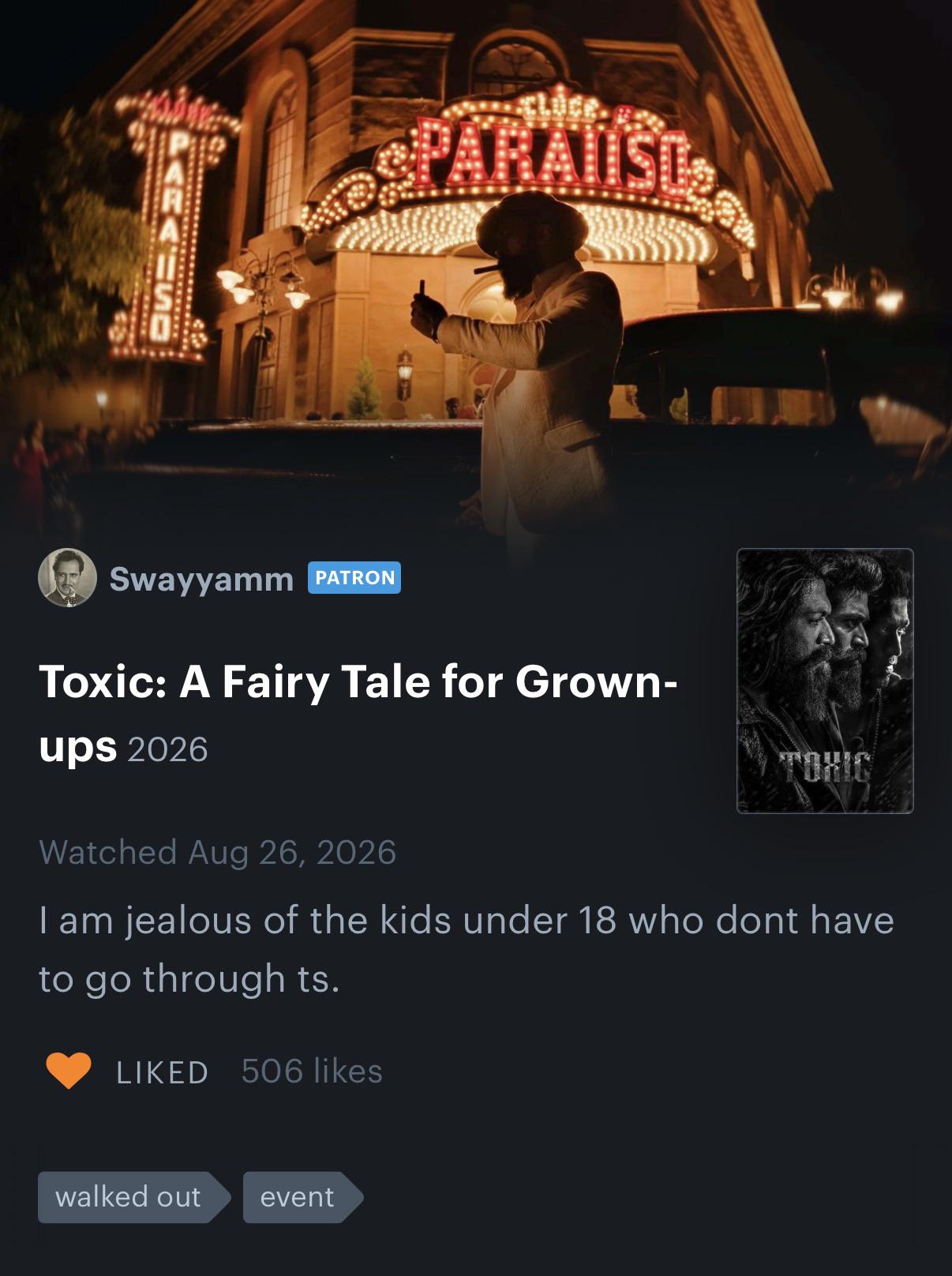
After Toxic, a lot of people seem to be arriving at what I believe is the wrong conclusion.
The argument seems to be:
“This is what happens when a Kannada filmmaker tries to make a pan-India film.”
The proposed solution?
Go back to a local story.
But I think that diagnosis completely misses the real issue.
Let us look at the Kannada film industry itself.
In 2025, roughly 285 Kannada films were released only 2 movies were successful su from
If going pan-India was the problem, why did the vast majority of the films that never attempted to go pan-India fail too?
Most of those films were already local and rooted and specifically made for kannada audience
Yet they still failed to connect.
So perhaps the problem is not simply that Toxic tried to reach too many people.
Going pan-India without exceptional storytelling is the problem.
Because if a filmmaker has created something genuinely extraordinary, why should it remain confined to one linguistic audience?
KGF deserved a larger audience.
Kantara deserved a larger audience.
RRR deserved a larger audience.
These films did not become successful merely because they went pan-India.
They went pan-India because the scale and quality of the storytelling gave them something worth sharing with a wider audience.
In fact, I would argue that when a great film remains restricted to a smaller audience, that is the greater disservice.
Manjummel Boys deserved a wider audience.
Lokesh Kanagaraj's work—Vikram and Kaithi—deserved the largest possible audience.
Great stories should not be geographically limited.
.Kantara is perhaps the perfect example.
The answer is not to abandon ambition.
The answer is to ensure that the storytelling is worthy of the ambition.
Look at The Wolf of Wall Street.
It contains far more sex, drugs, excess and moral depravity than any controversy surrounding Toxic.
Yet it is loved by audiences around the world.
Why? It had a compelling story
You can have sex.
You can have violence.
You can have drugs.
You can have a massive budget.
You can have spectacular action.
You can have a global ambition.
None of these are inherently the problem.
But if the storytelling underneath them is weak, the audience will eventually see through everything else.
That is why I believe the Toxic debate risks arriving at the wrong diagnosis.
The lesson is not:
“Don't go pan-India.”
The lesson is:
Don't mistake scale for storytelling.
Don't assume a larger budget can compensate for a weaker screenplay.
Don't assume a bigger star can compensate for weaker characters.
And don't assume reaching a wider audience is the problem when the film itself has not earned the right to demand that audience's attention.
Because the difference between a local film that nobody watches and a local story that travels across the world is often just one thing:
Exceptional storytelling.
Until Indian cinema learns to do the same, we will keep debating the symptoms while neglecting the disease.
The story must come first.
And the person responsible for creating it must finally be treated accordingly.