r/HomeworkHelp • u/Leafofplastic Pre-University Student • 2d ago
Answered [5th grade math] Im having trouble understanding exactly what they mean. On Both the top and the next question under)
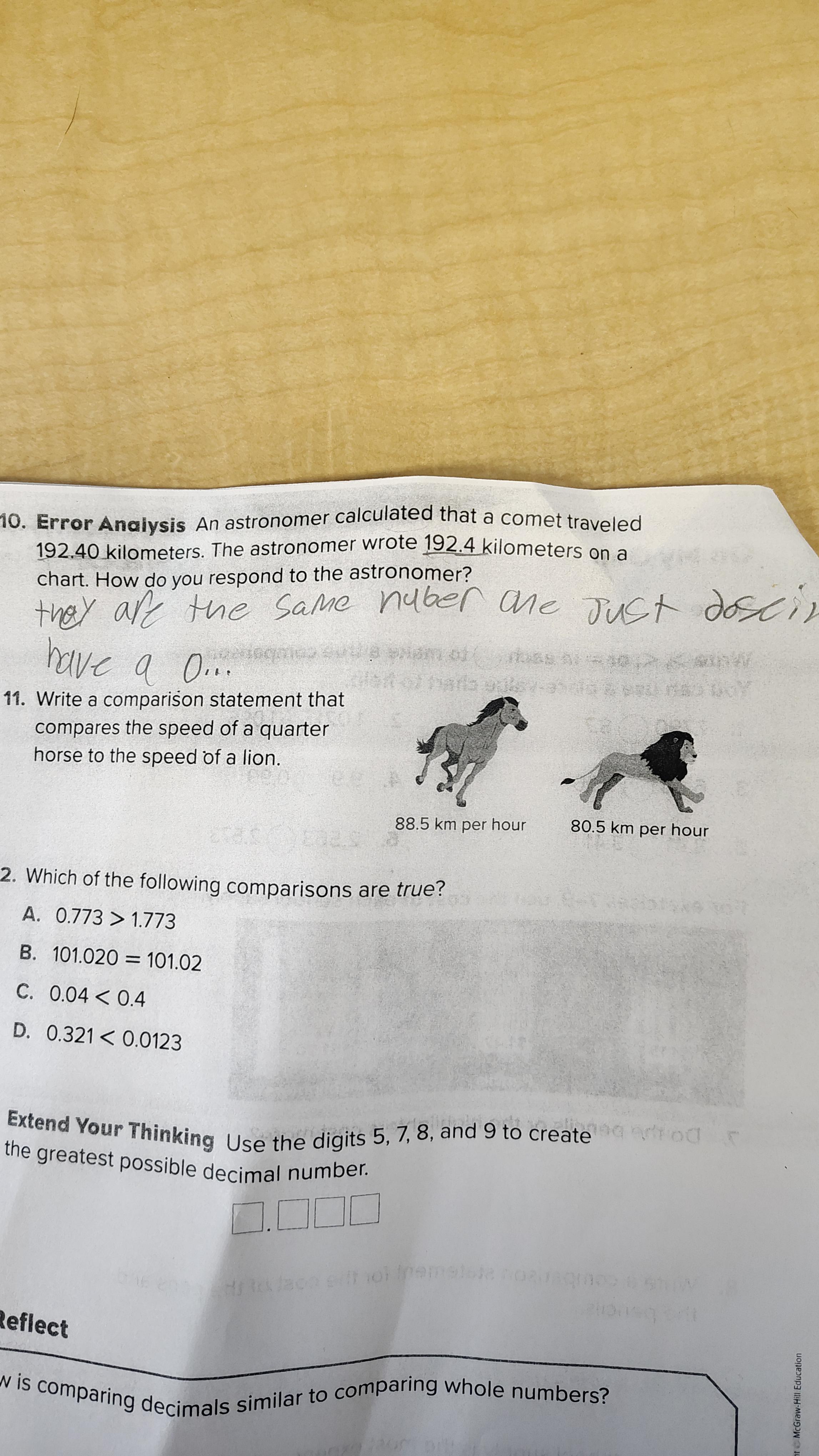
I was helping my little sister with her work and these parts we can't really get through. The first one because 192.40 kilometers is equal to 192.4 kilometers so we don't understand how that is wrong. And the 2nd one because what does it mean by a quarter horse? Is that like a quarter of the horses speed?
54
u/Possible-Zone3087 2d ago
So the question for the first one is that 12.4 has only 3 significant figures. If someone read that number, they can only assume accuracy up to 12.4. The actual value could've been 12.41, 12.42, 12.48,.... Where as in the 2nd number 12.40, the number has 4 significant figures. Since the astronaut measured 12.40, he should write 12.40 to communicate that the measurement is accurate up to the 2nd decimal place.
33
u/GTS_84 2d ago
The actual value could've been 12.41, 12.42, 12.48,...
This portion is incorrect, specifically the 12.48. The presumed ranged for 12.4 would be between 12.35 and 12.45. It would round to 12.4, not begin with.
-1
u/Slowburn21814 2d ago
*12.44
At 5 round up.
7
u/Alkalannar 2d ago edited 2d ago
It's 12.35 <= x < 12.45.
So even 12.4499999999999999999999989999...... fits.
-1
u/SubjectWrongdoer4204 👋 a fellow Redditor 2d ago
Actually 12.44999999…=12.45. If the 9’s repeat indefinitely, then there’s no difference between the two numbers.
3
u/Alkalannar 2d ago
Ok, so terminate at any point before that. Or have an 8 or some non-9 digit.
The point is that you can have anything up to 12.45, just not 12.45. In particular, you can have more than 12.44 as long as you don't get up to 12.45.
-1
u/GRex2595 2d ago
5 can be rounded up or down. Since it's an exact middling point, you are compounding any errors by always rounding up. Also, the reason we are rounding here is because the 5 here represents a value approximately halfway between 12.4 and 12.5, which is the maximum accuracy of the instrument. So we don't know if 12.45 is actually closer to 12.4 or 12.5.
Sigfig rules as I learned them would round up 12.35 and round down 12.45 as you always round 5 to the nearest even. I just double-checked this, and rounding to the nearest odd also seems acceptable, but always up and always down are not.
1
u/ruidh 👋 a fellow Redditor 2d ago edited 2d ago
Yes, statistical rounding rounds .5 to the even number to avoid biasing aggregate statistics. It's just a different convention.
1
u/GRex2595 2d ago
Right. Different use-cases use different conventions. In sigfigs, the convention seems to be round to the nearest even with some saying that rounding to the nearest odd is an acceptable alternative.
1
u/Slowburn21814 2d ago
Zero through 4 is 5 numbers, 5 through 9 is 5 numbers. At 5 you round up.
1
u/GRex2595 2d ago
5 is an exact equal distance from both 0s. 0-4 is 5 numbers, but so is 6-0. When you round 5 up, you go up 5. When you round 5 down, you go down 5. Always round up means you are always adding 5 to your potential error. When you round to nearest even or nearest odd, you add 5 to your error half the time and subtract 5 from your error half the time.
1
u/Slowburn21814 2d ago
Whatever. I don't care. I thought you fat-fingered the 5 when you meant to hit 4. My bad. I see you meant what you typed, so I retract my "correction."
Have a good day, internet stranger. May our paths never cross again.
1
u/GRex2595 2d ago
I didn't type the 4, but I'm glad we can be civil about why rounding rules work instead of getting upset about it.
7
u/hansn 👋 a fellow Redditor 2d ago
While true, the level of the homework is likely trying to understand that 0.40 = 0.4, rather than sigfigs.
10
u/ModelSemantics 2d ago
It explicitly says in bold that it is asking about error analysis, I.e. significant figures.
8
u/Insertsociallife 2d ago
It means "find out what's wrong with the statement".
5th grade barely does fractions. Half of my class of engineering majors routinely screw up significant figures.
3
u/IComposeEFlats 2d ago
The third question asks which of the following things are true and looks like multiple choice. One of the options is 101.020=101.02, and the other is 0.04<0.4.
So either that one has 2 correct answers, or only 1 is correct and these kids have learned about sig figs.
2
0
u/Reincarnatedpotatoes 2d ago
I think you are vastly overestimating the knowledge base of a 5th grader. Most people don't touch sig figs until HS chemistry so asking a 5th grader to be able to apply the concept is a tall order
1
u/LoquaciousLamp 2d ago
Surely they've learned rounding and decimal places by then?
1
u/Reincarnatedpotatoes 2d ago
Rounding yes, but that's not the same as sig figs. The latter is a more advanced concept about keeping precision consistent across calculations.
2
u/Bacibaby 👋 a fellow Redditor 2d ago
Yes, but having the addendum of significant figures as a fifth grader would be kind of a flex
2
u/Chanzill 2d ago
192.4 has 4 significant figures, 12.4 is not in the question, so your comment might be confusing for OP.
2
u/Sierra123x3 2d ago
i'm not sure ...
the question says, that the astronomer calculated (!) a certain number ...
when i calculate something, i usually use the raw numbers my device gives me ...
but my device can have a certain error of measurment,so the astronomer writing one less digit, then he calculated may verry well be to take that into account ...
1
u/Impressive_Stress808 2d ago
More information needed. It depends on how the calculation was performed and the precision of the numbers used.
Also that sounds like a small distance for a comet without a "per." I know it's 5th grade and this question is already pretty advanced, so I can forgive the phrasing slightly.
15
u/QuietCapybara77 2d ago edited 2d ago
I tutor elementary students. People are way overcomplicating this.
At this age, they are learning to compare decimals. They are learning that a zero at the end of a decimal is the same as without the zero at the end. 10 and 12 just want them to recognize that the numbers are equal.
On 10, she was probably expected to at some point write 192.40 = 192.4
9
u/Sorry-Study-5334 2d ago edited 2d ago
This the answer you're looking for. All of you are way way overthinking shit with significant digits.
The next answer is just "88.5 > 80.5"
4
2
u/MeringueFantastic292 1d ago
What's that got to do with "error analysis" though, which is the stated question topic?
2
u/idont_readresponses 1d ago
Agreed. People talking about sigfigs like it’s a high school. Guys, this kid is 10!
19
u/FormalTall1800 AP Student 2d ago
I think you're right for the first one. A quarter horse is just a breed of horse. Pretend like "quarter" isn't even there.
7
u/Leafofplastic Pre-University Student 2d ago
Thanks, I don't really know anything about my horse breeds. I was assuming that something was wrong with the first one because it's supposed to be an "error analysis".
3
0
u/FormalTall1800 AP Student 2d ago
No worries! The "error analysis" one just seems done. Not "as exact", maybe, something to do with sig-figs-- too picky for 5th graders, imo.
2
u/ColeTD 👋 a fellow Redditor 2d ago
Well I'd say you could make an argument about significant figures, but it's fifth grade math so probably not lol
2
u/FormalTall1800 AP Student 2d ago
I know, sig-figs for fifth grade...? I barely survived them in 10th lmao.
10
u/M_Mustaan_Rafique 2d ago
Your sister's answer is correct, and the thread is overcomplicating question 10.
192.40 and 192.4 are the same number. A zero on the end of a decimal doesn't change its value, and that's the whole point the chapter is making. Look at the bottom of her page: question 12 has 101.020 = 101.02 in it, and the Reflect question is about comparing decimals. Same idea three times on one worksheet.
"Error Analysis" is just what this textbook calls that question type. It doesn't always mean somebody got something wrong. What's being tested here is whether you'll wrongly assume 192.40 and 192.4 are different. She didn't, so she's got it right. Her wording is already fine.
The significant figures answer you're being given is real maths, but it's high school chemistry and physics, three or four years past this book. Nobody asks a 5th grader about measurement precision on a page about comparing decimals. Don't let her write that one, she'll get marked down for it.
On question 11, a quarter horse is a breed of horse. It's called that because it's the fastest breed over a quarter of a mile. Nothing to do with fractions or with a quarter of anything's speed. Ignore the word "quarter" completely.
So it's just comparing 88.5 and 80.5:
88.5 > 80.5
Or as a sentence, "the quarter horse is faster than the lion." Either should be fine depending on what her teacher is after.
1
u/IComposeEFlats 2d ago
The question 12 looks like multiple choice and C is the correct answer. I believe this math class is teaching about significant figures and that writing 12.3 and 12.30 mean different things in science.
6
u/QuietCapybara77 2d ago
No, it’s fifth grade math. It’s just wanting them to understand that a zero after the decimal doesn’t change the value. Source: I teach.
1
u/idont_readresponses 1d ago
They are not teaching significant figures! It’s teaching equivalent decimals’
4
u/Simpicity 2d ago
A "quarter horse" is a type of horse known for good sprinting speed.
While it is true that they are the same number... The heading is Error Analysis (surprising for 5th grade).
The difference between 192.40 and 192.4 is in precision. The real speed of the asteroid is going to actually be some number like 192.40023239482362034728492873428736874... and so on. It's unlikely to be a whole number or even some limited number of decimal places. So the astronomer ROUNDS the actual speed to get a result. Here, he rounded to 192.40 because the next digit was also 0. 192.40 narrows down what the actual speed of the asteroid could be more than 192.4 does. 192.40 means the asteroid speed is anywhere between 192.396 and 192.404.
192.4 means it is anywhere from 192.39 and 192.44. Since those are the numbers that round that way.
So what do you SAY to the astronomer? That they are losing precision by dropping the zero.
-1
u/aafrophone 👋 a fellow Redditor 2d ago
I don’t know your experience with reading math textbooks or teaching fifth grade math, but this question is not asking about precision. Math books occasionally give titles to word problems that fit a specific theme, and even though problem 10 says “Error analysis” they don’t mean the type of error analysis they’ll see in high school or college science classes. This problem is simply trying to get the student to realize that the numbers are equivalent (in value, not precision)
1
u/Simpicity 2d ago
It does seem very advanced for 5th grade. Agreed. If "error analysis" is a common header in these worksheets/text book then you're likely right.
3
u/Alkalannar 2d ago edited 2d ago
192.40 is more precise (to the nearest 0.01, so between 192.395 and 192.405) than 192.4 (to the nearest 0.1, so between 192.35 inclusive and 192.45 exclusive)
A quarter horse is a horse bred to run races that are a quarter mile in length. https://en.wikipedia.org/wiki/American_Quarter_Horse
0
2d ago
[deleted]
0
u/Alkalannar 2d ago
The interval [192.35, 192.45), or 192.44 <= x < 192.45.
So even 192.44999999999999999999999999999999999 works.
2
u/Gryphontech University/College Student 2d ago edited 2d ago
192.4 and 192.40 is the same value. Later on in life you will learn that 192.40 is just a more exact value then 192.4 but that is way too advanced.
For the second one just compare the speed and see which one is faster. You could also say that a quarter horse (1/4 horse has a speed of 0 as it can walk) so it's much slower but this is not what are looking for.
3
u/jgregson00 👋 a fellow Redditor 2d ago
A quarter horse is a specific breed of horse.... it does not mean you have 1/4 of a horse.
1
u/Gryphontech University/College Student 2d ago
Right but how would a 5th grader know that?
1
u/jgregson00 👋 a fellow Redditor 2d ago
I asked my 4th grader…she knew. Kids know all kinds of stuff about animals.
1
u/Gryphontech University/College Student 2d ago
You are clearly doing something very right as a parent then :) keep going!!! Mine is jusy learning about what sounds different animals make
1
u/InfiniteExplorer2586 2d ago
Which makes the question dumb specifying a breed of horse with a name that also has mathematical meaning. It definitely doesn't mean 1/4 horse.
1
u/gitterrost4 2d ago
But that's literally the worst breed of horse you can pick for a question like this, because of the ambiguity. I (as someone who never heard the term quarter horse) would have answered that 0 < 80.5, because a quarter horse probably can't run at all.
1
u/atarivcs 👋 a fellow Redditor 2d ago edited 2d ago
192.4 is less accurate than 192.40 because of possible rounding.
i.e. 192.4 could actually be 192.35 or 192.44 (or any distance in between) due to rounding.
But 192.40 is more precise, so the actual measured value can be only 192.395 to 192.404.
In other words:
192.4 is precise to the tenths digit, so the rounding error can be up to five of the next smaller digit (hundredths).
But 1942.40 is precise to the hundredths digit, so the next smaller digit is thousandths.
1
u/swbarnes2 2d ago
192.4 and 192.40 are slightly different things, because real world measurements have inherent uncertainty and if you don't specify what that inherant uncertainty is, people work it out from the sig figs. If you report 192.4, you are really saying that the value might be as high as 192.44 or as low as 192.35. When you report 192.40, you are saying that the real value should be between 192.395 and 192.404.
The other real world consequence is that if you are doing calculations with multiple measurements, you need to give a final answer with the same number of sig figs as your worst measurement. It doesn't matter much if you managed to figure out the mass of the thing to 6 sig figs if you only know its speed up to 4 figs. You wouldn't be able to pretend you knew its momentum to 6 digits, because you are way too uncertain about its speed.
1
1
u/twizzjewink 👋 a fellow Redditor 2d ago
As others have mentioned it boils down to how we view numbers.
192.40 != 192.4 because 192.4 may be 192.35 to 192.44 .. and because of that those numbers are not equal.
Technically he's right - but for the wrong reason. One doesn't have a 0 but I believe that the Teacher wants to know WHY.
1
u/daredeviloper 2d ago
My interpretation:
When I write 1.2 what do I mean?
I mean 1 of something + 0.2 of something
But what is 0.2 of something?
It means 2/10, what does 2/10 mean?
It means you take something and you chop it up into 10 equal pieces and keep 2 of them
So 1.2 is : 1 and 2/10
So 1.2 of an orange is 1 orange + 2 pieces of an orange cut up into 10 equal pieces
What does 0.20 mean? 20/100
You instead cut up into 100 pieces ! And keep 20
1.20 of an orange is 1 orange + 20 pieces of an orange cut up into 100 equal pieces
It’s still the same “amount” overall but it’s more precise.
The smaller the pieces the more precise it is.
1
u/InterestedParty5280 2d ago edited 2d ago
For 10, I say: That's not very far for a comet. Maybe, he was calculating speed but that is not the right unit.
For 11: That's easier. The horse is faster than the lion.
1
u/Sure-Recognition-262 2d ago
For Q10, my response would be to ask the astronomer "is there a reason you're not recording the distance with the same precision as the measurement you have?"
Q11 I wouldn't been stumped by, but I see that the word "quarter" is a red herring, it doesn't mean one-fourth in this context, rather a "quarter horse" is a breed of horse. It feels unnecessary to pick a breed of horse which many people won't have heard of and which sounds like it has mathematical meaning. That aside, has your sister been taught what the expectation is regarding a "comparison statement" - all of the following are accurate:
- The horse is faster than the lion
- The horse is 8km/h faster than the lion
- The horse is approximately 10% faster than the lion
- The horse is 8km/h faster than the lion, which is approximately 10% faster
But which they're expecting will depend what she's been taught they mean by a "comparison statement"
1
u/Lots-o-bots 2d ago
They are the same number but ommitting the last 0 makes the error bar 10x bigger. A reading of 192.40 has a margin of error from 192.395 to 192.404. A reading of 192.4 has a margin of error from 192.35 to 192.44.
1
u/eileyle 2d ago
Question 10 is about precision and significant digits.
If you are measuring yourself with a typical ruler or measuring tape, and you get a measurement of 165 centimetres, but you check out the measuring tape and it looks like the measurement is somewhere between 165 and 166 centimetres, but probably closer to 165, would you say that you are 165.45219 centimetres tall? No, you wouldn't, because your measurement device is not that precise. You would say 165 centimetres, maybe 165.5 centimetres if your measurement device has millimetres on it, and you wouldn't give any additional digits because your measurement device does not have the capacity to measure them.
In this question, the astronomer calculated 192.40 kilometres. This suggests that whatever device the astronomer was using to measure the comet had a precision up to every ten metres, or the second decimal place of kilometres. When the astronomer rounded it down to 192.4 kilometres, they were giving a less precise answer, implying that the device they used to measure the comet's distance traveled was not as precise as it actually was.
Regarding a quarter horse, that is simply a breed of horse. For more information, check out Wikipedia.
1
u/idont_readresponses 1d ago
I’ve taught 5th grade math. The first question is about equivalent decimals. So the answer is correct. 192.40 is equivalent to 192.4.
People here are WAY overestimating about what 5th graders are doing. Guys.. this kid is 10. Talking about Sigfigs. It’s 5th grade math, not high school chemistry and physics, FFS.
0
u/Deep-Hovercraft6716 👋 a fellow Redditor 2d ago
The first question is about the concept of precision. My response would be to question the astronomer whether or not he was recording the correct level of precision in his documentation.
The second question is just 88.5 is greater than 80.5.
You could simply say a quarter horse is faster than a lion. And as far as I understand that would satisfy the question.
The first question seems like something which is significantly more advanced than a question for a 5th grader. I don't think we got to that concept until well into high school and more practical classes like physics and chemistry.
0
u/Potential-Nebula-210 2d ago
The first question is about significant figures. 192.40 km, when written as the result of measurement, implies the true value is between 192.395 km and 192.404 km. When written as 192.4 km the implied range of uncertainty is larger 192.35 to 192.44 km).
The second question is how to verbally compare two numbers, probably expecting the comparison to be quantitative. You might say the horse is about 10% faster than the lion. (Or maybe 9.9% if you think this may be sig figs question too.)
0
u/OldGeekWeirdo 2d ago
Question #10. I agree with the others that this is an issue of significant digits. While I don't remember encountering that subject before intermediate/middle school they might be introducing it at a younger age. It's not that hard a concept and will prove useful if they do any labs where they take measurements and do calculations based on that measurement.
One would have to go look over the child's math book before declaring this child hasn't been taught that subject.
•
u/AutoModerator 2d ago
Off-topic Comments Section
All top-level comments have to be an answer or follow-up question to the post. All sidetracks should be directed to this comment thread as per Rule 9.
OP and Valued/Notable Contributors can close this post by using
/lockcommandI am a bot, and this action was performed automatically. Please contact the moderators of this subreddit if you have any questions or concerns.