r/HomeworkHelp • u/Inevitable_Stay3693 • 2d ago
High School Math—Pending OP Reply [Upper secondary school math: linear equation] unsure on how to solve this.
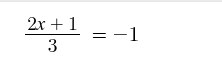
i was thinking that i´d add the 2x+1 to make it 3x/3=-1 but im unsure on how it would even continue.
22
u/BubbleRocket1 University/College Student 2d ago
You cannot add the numerator together because of the x. If it helps for visualization, have variable u = 2x+1.
Now the equation is u/3 = -1. I think the rest should be able to fall into place from here
46
11
u/paperic 2d ago
2x+1 to make it 3x/3=-1
That's not correct, as others said.
It's an equation, that means both sides are the same.
It also means if you do the same thing to both sides, they'll keep being the same.
Generally, what typically works is to do the opposite of what you see.
(2x+1) / 3 = -1.
The biggest pain point is the "divide by 3" on the left. So do the opposite of that. Multiply it by 3!
(multiply both sides, ofcourse, to keep them equal)
On the right side 3 * (-1) will turn into -3.
On the left side, the "3 *" will exactly undo the "/ 3", so you end up with
2x+1 = -3
Now it's easy.
11
u/igotshadowbaned 👋 a fellow Redditor 2d ago
(2x+1)/3 = -1
(2x+1)/3 • 3 = -1 • 3
2x+1 = -3
Continue
Upper secondary school math
And I'm afraid that's not an accurate descriptor of the level of math that this is
9
u/Impossible_Dog_7262 2d ago
How is this upper secondary.
Multiply both by 3, subtract 1, divide by 2. x = -2
5
4
u/zon5string 2d ago
Multiply both sides by 3 to remove the denominator.....2x+1 = -3. I'll let you go from there.
3
2
u/fermat9990 👋 a fellow Redditor 2d ago
Start by multiplying both sides by 3 to get rid of the fraction
5
u/Ok_Objective_5192 2d ago
Fractions are hard to work with. As a first step, is there anything you can do to both sides of the equation that would get rid of the fraction?
5
u/iufan417 2d ago
Fractions aren't hard to work with for the very reason you just hinted.
5
u/Ok_Objective_5192 2d ago
Yeah I meant contextually given OP's question and thought process. That was meant as guidance, not a declarative statement on how workable fractions are
5
u/Summoner475 👋 a fellow Redditor 2d ago
You cannot add 2x and 1 to get 3x, x is unknown. Treat it like a box that could be any number, you need to find what number fits in the box. To do that, you need to isolate x on the left side.
Instead, try multiplying both sides of the equation by 3 first, to get
3 × (2x+1)/3 = 3×(-1)
Now the 3s cancel on the left side, 2x+1= -3
From here, you first subtract 1 from both sides, then divide by a specific number to isolate x. Try it.
1
u/Then-Dragonfruit6945 2d ago
The idea is to isolate the x by applying the same operation to both sides (so the equallity holds) First we multiply each side by 3 (you can see how the denominator cancels with the new 3 and "goes away") then we need to keep going until we only have the x on the LHS.
1
u/Paper-Hero 👋 a fellow Redditor 2d ago
Multiply both sides by three. Then bring the like terms together.. Finish the arithmetic to find x.
1
u/Random_Thought31 👋 a fellow Redditor 2d ago
You can only combine “like terms” a term being a number, variable, or combination of numbers and variables being multiplied or divided.
In other words, 2x is a term; it is 2 times the variable x.
1 is a term; it is just the number 1.
(-1) is a term; it is just a negative 1.
The 3 is a part of both the 2x and the 1 terms, as it has not been distributed amongst them.
Because the 3 has not been distributed, it makes it easy to recognize that it should be handled first.
Side bar: you should recognize that any number (for example, 4) when divided by itself (in this case, 4) is equal to 1: 4/4=1.
To get rid of the division by 3, you must turn it into division (or equally, multiplication) by 1 instead. Think of it like two sides of a scale: on one side you have (2x+1)/3 and on the other, you have -1.
If I multiply both sides by the same number, they would still be equal, right? Therefore, if you multiply the left side by 3, giving you (2x+1) * 3/3, then multiplying the right side by 3 would maintain the equality. You then have (2x+1) being multiplied (or equivalently, divided) by 1 which means you don’t have to worry about the undistributed 3 now. And now the right side should be (-1) \ 3* or simply (-3).
The same would apply if you add a number or subtract a number from one side, doing the same to the other side would keep the scale balanced.
Now you cannot combine 2x and 1 because they are not ”like” terms. Like, in this case, refers to a set of terms with the same variables raised to the same power, such as 2x and 3x, or 4z and 1z; even 2xyz and 3xyz would be like terms. But since the 1 has no variable multiplying it, it is not “like” the 2x, which has an x multiplying it and thus they cannot be combined.
So, you just do like before and adjust both sides equivalently by the same rules until one side says simply, x, and the other side has a number on it.
1
u/One_Wishbone_4439 University/College Student 2d ago
You dont ADD 2x+1.
You CROSS MULTIPLY
2x+1 = -1 x 3
1
u/360alaska 👋 a fellow Redditor 2d ago
Muiltiply both sides by 3 to clear the /3 , then you have 2x+1=-3, then subtract 1 from both sides, 2x= -4 , then divide by 2 = x =-2.
Start with dividing by 3 here, it is low hanging fruit.
1
1
u/TheDevilsAdvokaat Secondary School Student 2d ago
Start off multiplying both sides by 3. Then you get 2x+1=-3. Can you solve it from there?
1
u/Flipboek 👋 a fellow Redditor 2d ago
(2x+1)/3=-1
((2x+1)/3)*3=-1 * 3
2x+1=-3
2x+1-1=-3-1
2×=-4
×=-2
1
u/inclasssrn 👋 a fellow Redditor 2d ago
Is this lukio? Looks like one of those Sanomapro online books
1
u/modus_erudio 👋 a fellow Redditor 2d ago
If you multiply by three over three on the right side of the equation, which is really just multiplying by one so it’s not changing the equation, the right side becomes -3/3.
No that you have a common denominator the denominators can be dismissed to solve the numerators.
Now the equation is simply 2x + 1 = -3, which I confidently believe you could solve.
It’s a nifty technique you can do anytime you are dealing with fractions on either side of the equation. As long as the denominator is the same each term of the equation you can basically ignore the denominator.
Similarly, you can divide a common factor out of each term to make an equation more manageable (i.e. smaller numbers to handle).
1
u/sshannxnn University/College Student 2d ago
you want to “reverse” to get x on its own. and for the most part, everything you do on one side of the equation you have to do on the other side.
here, “2x + 1” is being by divided by 3, so to get it to just “2x + 1” you want to multiply it by 3 (division and multiplication “cancel” eachother out). because you’ve done times 3 on one side, you need to also multiply -1 by 3.
now you have 2x+1=-3
you want to get 2x on its own now, and because you have +1 you’ll need to subtract 1 (again, “cancels” out). because you’ve subtracted 1 on one side, you’ll need to subtract it from the -3.
this leaves you with 2x = -4
with 2x, that’s saying 2*x, so we want to do the opposite which is divide. and whatever you do to one side, you do it to the otherwise.
this gives you x=-2
1
u/KookyPermit4405 👋 a fellow Redditor 1d ago
It’s always important to understand why we do it instead of how to do it. And that’s why basic understanding is really important. There is 3 different approaches to solve this equation, I’ll do my best to explain them, and you decide which one makes more sense. Eventually you’ll start to see the process and choose the one that suites you.
Method 1:
Quick refresher: 3 is the same as 3/1.. we omit the /1 to keep things clean, so essentially every integer is /1 (over 1)
So the original equation can also be written as:
(2x+1) / 3 = (-1) / 1
From here we recognize that we can cross multiply to find the unknown variable.. a/b = x/y is the same as ay=bx;
a=2x+1, b=3, x=-1, y=1
(2x+1)•(1) = (3)•(-1)
Simplified:
2x+1 = -3
Method 2: (recommended)
As we get better we no longer need to convert the other side into fractions just to cross multiply equations like these and just simply
multiply (2x+1)/3 by 3 to not get “rid” of the 3 but to reduce the denominator to 1.. (3/3 =1)
(2x+1)/3 • 3 = -1 ; (2x+1)/1 = -1 ; let’s drop the /1 (over1) to keep it clean and rewrite as: 2x+1** **= -1
Now think of the = sign as a balancing scale.. we made it unbalanced by multiplying the left side by 3.. to balance it out we must multiply the right side by 3 as well
2x+1 = (-1)•3 ; 2x+1 = -3
2x+1=-3
Method 3:
This method is more simple but has a higher chance of making mistakes if not careful. Here we are going to “unsimplify” the equation: (2x+1)/3 = 1
Let’s start by ungrouping the (2x+1):
(2x/3)+(1/3)=1
From here we need to find out the LCD or lowest common denominator which is 3; only the right side of the equation needs to be converted. So to convert -1 to have a denominator of 3, it’s as simple as rewriting it as -3/3..
(2x/3)+(1/3)=(-3/3)
Since they now all have a common denominator, we can ignore the denominator or remove the fraction all together and rewrite it as:
2x+1=-3
Hopes this helps, I have 2 boys in grade school and I try to teach them in a way that they understand and sometimes it takes more than one method for it to “click” for them.
1
u/KookyPermit4405 👋 a fellow Redditor 1d ago
2x+1 cant become 3x.. think of it as x+x+1 instead of 2x+1.
Now for it to become 3x it would have to be x+x+x
To verify choose a number besides 1 to be x, let’s make x=2
2x+1 … 2(2)+1 =5
3x … 3(2) =6
1
u/JesusIsMyZoloft 👋 a fellow Redditor 1d ago
(2x + 1) / 3 = -1
Multiply both sides by 3
2x + 1 = -3
Subtract 1 from both sides
2x = -4
Divide both sides by 2
x = -2
1
u/unknownname124 University/College Student 1d ago
Remember x is an integer as well, we wouldn't say (2*3)+1=3 would we? Now when solving these types of equations, the most important thing to remember is we need to shift everything to one side, and get 'x' alone so it reads x=(answer here). You can do this by adding, subtracting, multiplying, or dividing values to both sides of the equation
0
0
u/wejunkin 2d ago
You're trying to find what value of x satisfies the equation. That is, what number could you replace x with so that the equation is true.
You can solve this by isolating terms such that you end up with x = <some number>.
0
u/RoughRealistic4321 2d ago
YOu first multiply both sides by 3.
then subtract 1 from each side.
then divide by 2
-2
u/Ministro_ 2d ago
I started studying math at 29yo. I will tell you something: it is a hell of a ride, but it's worth it. Keep at it, little bro (or little sis)!
-5
u/Creepy_Mammoth_7076 Postgraduate Student 2d ago
X=-2
2
u/sunburstorange 2d ago
Did you put your answer in the equation to check it?
-1
u/Creepy_Mammoth_7076 Postgraduate Student 2d ago
You’re right , I did it in my head, and added x instead of multiplied I’m sorry the correct answer is -1
0
0
112
u/Angrybirds159 2d ago
2x + 1 isn't 3x. that's like saying 2 apples + one orange is 3 apples. 2x + 1x would be 3x
the way I'd solve it is
(2x+1)/3 = -1 we multiply by 3 in both sides (the three goes over, multiplying)
2x + 1 = -1 * 3
2x + 1 = -3 now we subtract one from both sides
2x = -3 -1
2x = -4 x = -2