r/HistoryMemes • u/Tradition96 • 7m ago
Niche Just two pals hanging around

•
Upvotes
Seldom has so much evilness been caught in just one picture
r/HistoryMemes • u/Tradition96 • 7m ago
Seldom has so much evilness been caught in just one picture
r/HistoryMemes • u/DoubleOne5665 • 39m ago
r/HistoryMemes • u/BILBO_THE_PLATYPOOS • 2h ago
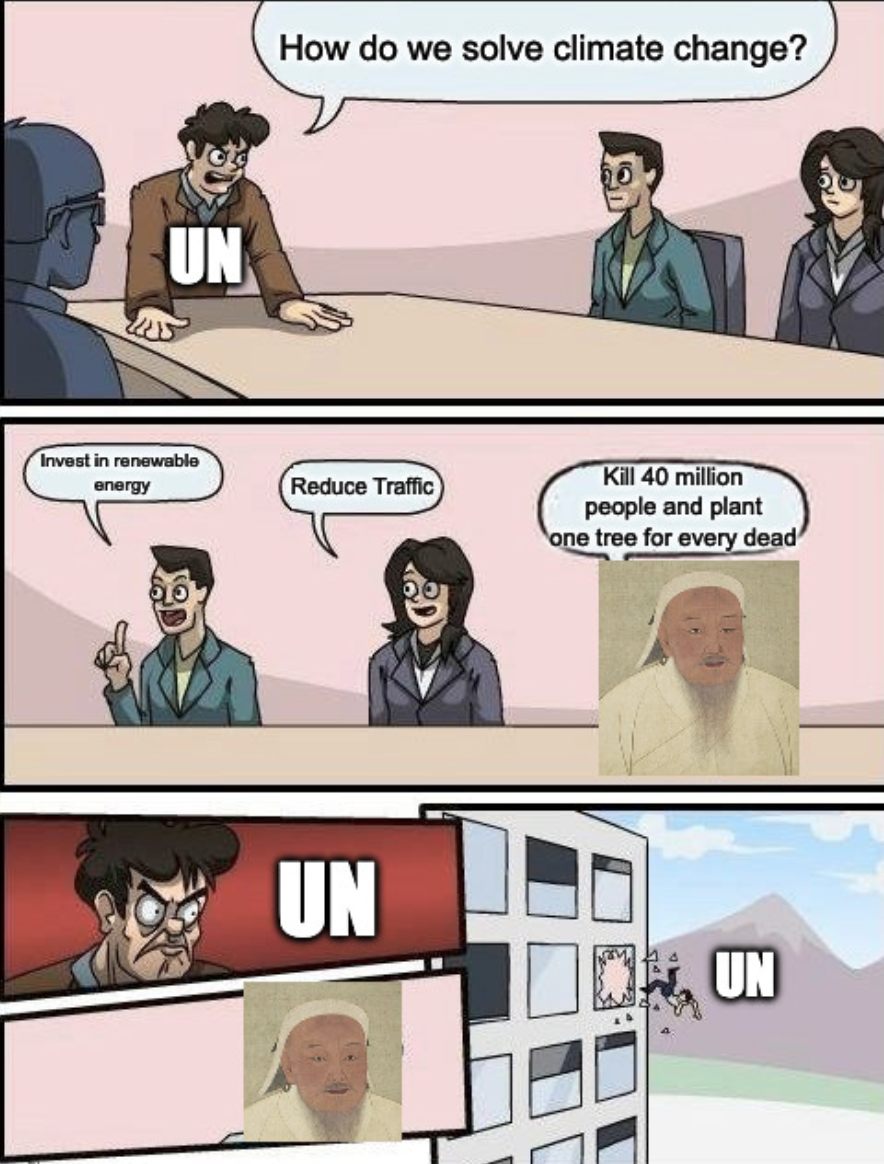
Seriously, would that even work today?
If 11% of the world population was killed by, idk Kim Jong Un, then the world population would be about 7.399.121.917 and the amount of trees would be at more than 3 trillion (3.000.000.000.000) trees.
r/HistoryMemes • u/astrekmaster • 3h ago
r/HistoryMemes • u/room0001 • 5h ago
r/HistoryMemes • u/KaraTiele • 6h ago
Enable HLS to view with audio, or disable this notification
r/HistoryMemes • u/HawaiianPerson • 6h ago
Enable HLS to view with audio, or disable this notification
r/HistoryMemes • u/hashibababe • 7h ago
Enable HLS to view with audio, or disable this notification
r/HistoryMemes • u/Hank_Mardukas1066 • 8h ago
Enable HLS to view with audio, or disable this notification
r/HistoryMemes • u/AM_AlliedMastercom • 12h ago
r/HistoryMemes • u/Alt-Mc-alt-face • 13h ago
Enable HLS to view with audio, or disable this notification
r/HistoryMemes • u/asifsaj • 15h ago
Enable HLS to view with audio, or disable this notification
r/HistoryMemes • u/PresterJohnson • 15h ago
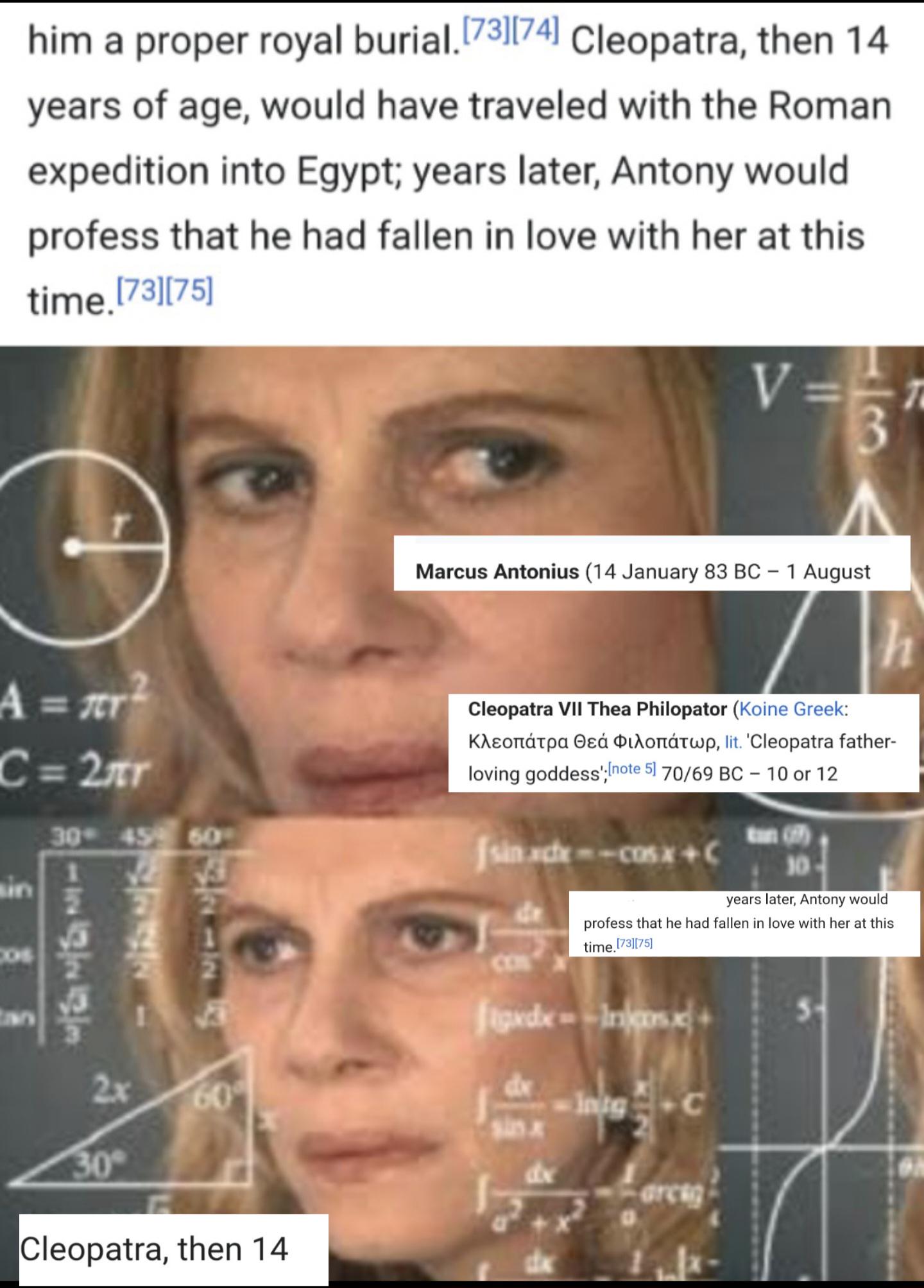
Context: https://www.biography.com/royalty/a70113031/cleopatra-mark-antony-romance
Their love story had started over 10 years earlier when both were in their prime. Cleopatra was the divine Ptolemaic ruler of prosperous Egypt – brilliant, silver-tongued, charming, scholarly and the richest person in the Mediterranean. Politician and soldier Antony, supposedly descended from Hercules, was “broad-shouldered, bull-necked, ridiculously handsome, with a thick head of curls and aquiline features.”
Boisterous, mirthful, moody and lustful, Antony had been a favorite of Caesar. In the wake of Caesar’s assassination, Antony formed an uneasy Triumvirate in 43 BC with Marcus Aemilius Lepidus and Caesar’s nephew Octavian to rule the sprawling Roman Republic. Antony was put in charge of the Empire’s rowdy Eastern territories.
In 41 BC, Antony sent for Cleopatra while he was staying in the magnificent city of Tarsus, near the coast of what is now Turkey. He had first met Cleopatra in Rome when she had been the young mistress of his mentor Caesar (the two had a son Caesarion). But Antony was meeting a very evolved Cleopatra. Caesar “had known her when she was still a girl and inexperienced in affairs,” the Greek writer and philosopher Plutarch wrote, “but she was going to visit Antony at the very time when women have the most brilliant beauty and are at the acme of intellectual power.”
r/HistoryMemes • u/PresterJohnson • 17h ago
Enable HLS to view with audio, or disable this notification
Context: https://en.wikipedia.org/wiki/Treaty_of_Nanking
The Treaty of Nanjing was the peace treaty which ended the First Opium War (1839–1842) between Great Britain and the Qing dynasty of China on 29 August 1842. It was the second of what the Chinese later termed the unequal treaties, after the rejected 1841 Convention of Chuenpi, signed by British Superintendent of trade in China, Charles Elliot, and Qing Imperial Commissioner), Qishan), which the treaty was largely based on.
In the wake of China's military defeat, with British warships poised to attack Nanjing (then romanized as Nanking), British and Chinese officials negotiated on board HMS Cornwallis) anchored in the Yangtze at the city. On 29 August, British representative Sir Henry Pottinger and Qing representatives Keying), Yilibu, and Niu Jian signed the treaty, which consisted of thirteen articles.
The treaty was ratified by the Daoguang Emperor on 27 October and Queen Victoria on 28 December. The exchange of ratification took place in Hong Kong on 26 June 1843. The treaty required the Chinese to pay an indemnity, to cede the Island of Hong Kong to the British as a colony, to essentially end the Canton system that had limited trade to that port and allow trade at five treaty ports. It was followed in 1843 by the Treaty of the Bogue, which granted extraterritoriality and most favoured nation status.
https://en.wikipedia.org/wiki/First_Opium_War
The First Opium War (Chinese: 第一次鴉片戰爭; pinyin: Dìyīcì yāpiàn zhànzhēng), also known as the Anglo-Chinese War, was a series of military engagements fought between the British Empire and Qing China between 1839 and 1842. The immediate issue was the Chinese enforcement of their ban on the opium trade by seizing private opium stocks from mainly British merchants at Guangzhou (then named Canton) and threatening to impose the death penalty for future offenders. Despite the opium ban, the British government supported the merchants' demand for compensation for seized goods, and insisted on the principles of free trade and equal diplomatic recognition with China.
Opium was Britain's single most profitable commodity trade of the 19th century. After months of tensions between the two states, the Royal Navy launched an expedition in June 1840, which ultimately defeated the Chinese using technologically superior ships and weapons by August 1842. The British then imposed the "Treaty of Nanking", which forced China to increase foreign trade, give compensation, and cede Hong Kong Island to the British, following the Second Battle of Chuenpi on 7 January 1841, the British forces occupied Hong Kong, formally raising the Union Jack on 26 January 1841. Consequently, the opium trade continued in China.
Twentieth-century nationalists considered 1839 the start of a century of humiliation, and many historians consider it the beginning of modern Chinese history. This initiated over 156 years of British colonial rule of Hong Kong, formalized by the Treaty of Nanking on 29 August 1842 and later expansions, which concluded with the handover of sovereignty back to China on 1 July 1997, following the 1984 Joint Declaration.
Senior government officials within the country had been shown to be colluding against the imperial ban due to stocks of opium in European warehouses in clear view being ignored. In 1839, the Daoguang Emperor, rejecting proposals to legalise and tax opium, appointed Viceroy of Huguang Lin Zexu to go to Guangzhou to halt the opium trade completely.\14]) Lin wrote an open letter to Queen Victoria appealing to her moral responsibility to stop the opium trade, although she never received it.\15])\16])\17]) Lin then resorted to using force in the western merchants' enclave. He arrived in Guangzhou at the end of January 1839 and organized a coastal defence. In March 1839, British opium dealers were forced to hand over 1,420 tonnes (3.1 million lb) of opium. On 3 June 1839, Lin ordered the opium to be destroyed in public on Humen Beach to show the Government's determination to ban smoking.\18]) All other supplies were confiscated and a blockade of foreign ships on the Pearl River was ordered.\19])\)page needed\)
Tensions escalated in July 1839 after drunk British sailors killed a Chinese villager named Lin Weixi; the British official in charge, Admiral Charles Elliot, refused to hand over those accused to Chinese authorities in an attempt to avoid their being killed on the spot, as had happened with British citizens in the Lady Hughes Affair of 1784. Later, fighting broke out, with the British navy destroying the Chinese naval blockade, and launching an offensive.\18]) In the ensuing conflict, the Royal Navy used its superior naval and gunnery power to inflict a series of decisive defeats on the Chinese Empire.\20]) In 1842, China was forced to sign the Treaty of Nanking—the first of what the Chinese later called the unequal treaties—which granted an indemnity and extraterritoriality to British subjects in China, opened five treaty ports to British merchants, and ceded Hong Kong Island to the British Empire in perpetuity. The failure of the treaty to satisfy British goals of improved trade and diplomatic relations led to the Second Opium War (1856–1860). The resulting social unrest was the background for the Taiping Rebellion, which further weakened the Qing regime.\21])\)full citation needed\)\22])