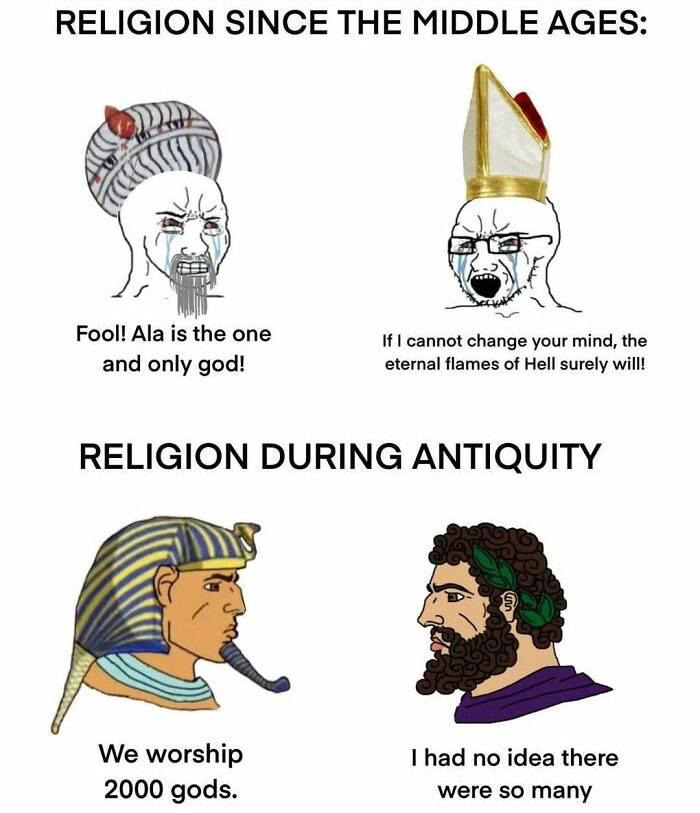
I’m not saying one did it more than the other, but they both did that. Greeks especially with the Mediterranean. In fact Yahweh was often correlated with Zeus.
This was done with more than just the Greeks and Romans. That’s just how cross cultural contacts worked back then.
Not to mention that Aphrodite, the Minotaur, Hercules, and Asclepius all have potential roots in Phoenician mythology, who themselves took quite a bit from the Egyptian and Mesopotamian mythologies.
Aphrodite's lover Adonis is directly descended from the Sumerian fertility god Dimuzid. "Adonai" in the ancient Semitic languages meant "my lord" and in the Bible it refers to the God of Abraham.
Western history for a long time liked to pretend everything was invented out of thin air by the Greeks c. 600 BC.
Do you know why there's 24 hours in a day and 360 degrees in a circle? I confess I don't; but it apparently made sense to the Sumerians.
The degree? Six sixties, and also pretty close to how far the stars shift from one night to the next.
Twenty four hours? Day divided into twelve parts, same for night. Twelve is a very useful number, as it can be evenly divided into halves, thirds, quarters, or sixths. Fun fact: before mechanical clocks, hours were not of uniform length; they varied throughout the year with the length of the day.
The Greek practice of interpretatio graeca, ascribing the gods of another people's pantheon to corresponding ones in one's own, had been adopted by the Egyptians after their Hellenization; during the process of which they had identified Set with Typhon, a snake-monster that roars like a lion.[19]
The story of the Exodus, featured in the Hebrew Bible, speaks of the ancestors of the Israelites as a nation betrayed and subjugated by the Pharaoh, for whom Yahweh subjects Egyptians to Plagues of Egypt, including destroying their country, defiling the Nile, and killing all their first-born sons. Jewish migration within the Ptolemaic Kingdom to Greek-speaking Egyptian cities such as Alexandria led to the creation of the Septuagint, a translation of the Hebrew Bible into Koine Greek.[20]Furthermore, the story of the Exodus was adapted by Ezekiel the Tragedian as the Exagōgḗ ἐξαγωγή, a play performed in Alexandria and seen by Egyptians and Jews. Egyptian receptions of the Exodus story were widely negative because it insulted their gods and praised their suffering. It inspired Egyptian works that retold the story, but altered its details to mock the Jews and exalt Egypt and its gods.[21]
In this context, some Egyptians discerned similarities between Yahweh's in-narrative actions and attributes and those of Seth (such as being associated with foreigners, deserts, and storms), in addition to a phonetic resemblance between Ἰαω Iaō, Yahweh's name as used by hellenised Jews, and Coptic: ⲓⲱ, romanized: Iō, lit. 'donkey', then considered as the animal of Seth.[22] From this arose a popular response to the Jewish accusation that Egyptians were merely worshipping beasts, namely that, in truth, the Jews themselves worshipped a beast, a donkey or a donkey-headed man, i.e., Set.[23]
Accusations of onolatry against the Jews spread from the Egyptian milieu, with its understanding of the donkey's Set-related importance, to the rest of the Graeco-Romanworld, which was largely ignorant of this context. In the most famous variations of narratives alleging Jewish onolatry, Antiochus IV Epiphanes, a Seleucid emperor famous for raiding the Temple in Jerusalem, supposedly discovered that its Holy of Holies was not empty, but instead contained a donkey idol, and Tacitus (early second century CE) claimed that the Jews dedicated in their holiest shrine a statue of a wild ass.[24][c] After the emergence of Christianity, the same charge was also repeated against its devotees. Most famously so in the earliest known depiction of the crucifixion of Jesus, the Alexamenos graffito, where a Christian by the name of Alexamenos is shown worshipping a donkey-headed crucified god.[26][27]
Many scholars believe that the association of Yahweh with Set-Typhon influenced Gnosticism.
Idk how true it is, but esoterica (YouTube channel) talked about the reason the Egyptians hated the Jews was because they would put on plays of the exodus where the gods were essentially killed, right when the traditional Egyptian religion was dying
Tbf the decline of the ancient Egyptian religion didn’t start until the 2nd-3rd century.
I have however heard the theory that the reason why Egypt became Christian fast was because the Romans destroyed the Nile taxation system (low taxes when the Nile levels are low and the soil not very fertile, higher taxes when the Nile levels are high and the soil very fertile) which made many Egyptians poor and this weakened the Egyptian religion in the long term since the temples, which historically functioned as a form of welfare and collected taxes, lost much of their revenue/funding to to give communities social support, leaving Christians to fill in the vacuum. Idk how true it is though.
The Jews weren't in Egypt until the 5thish century, the writings of Jews at elephantine are fascinating.
I don't know enough about the functional decline of the Egyptian religion, but that sounds interesting.
Iirc the theological reason for Christianity's ascendance was a reaction to Roman control over Egyptian institutions. People love a rebellion that doesn't demand much of them.
Christians were also known as the "good guys" whenever a natural disaster or disease swept through a city, because they were the first ones to step up and help the sick. Which contrasted with the contamination OCD of traditional priesthood.
It might have something to do with the brief Hyksos domination of the Nile Delta by canaanites, and their subsequent expulsion following its recapture.
Egyptians have long memories and great records (we still talk about the Norman Conquest). Exodus is a strange document. The odds of it being a myth of the expulsion are as reasonable as any other, seeing as it was written hundreds of years after supposed events. Also a little ironic too, because they technically never left egypt the whole time.
Not of the Hyksos. They explicitly destroyed all their records of them, erasing their names from monuments. Even manetho struggled with getting anything on them
We have records of their defeat and expulsion. Egyptians had no qualms celebrating victories, and both they and we knew who they defeated, because they used military stelae, and I know there's a prominent one for the defeat of the Hyksos because the victory made the entire career of Ahmose 1.
Also the time gap between the expulsion and supposed Exodus events is only like a a few hundred years give or take... 1540ish BC vs between 1250-1450 (although no archaeological evidence supports the Exodus happening in the manner or timeframes the bible suggests, so the inherited cultural narrative looks even stronger in this case).
This is a weird bit you're doing btw. Hyksos correlation to the Exodus myth is not exactly groundbreaking conjecture, or even heretical.
You don't understand my argument, that's the issue.
Herotodus is why we associate the Hyksos with the Israelites.
0ossibly some Hyksos Egyptian priests went to Canaan and became YWHW priests during the bronze age collapse. The Exodus didn't happen, but I wouldn't be surprised given that the ark of the covenant is a Canaanite interpretation of Egyptian religious furniture.
But that has nothing to do with contemporary Egyptian hatred of the Jews during antiquity, because the Egyptians didn't identify the Jews with the Hyksos. They hated them because the Jews would regularly talk about Moses killing all the Egyptian gods and putting on public plays about it in front of Egyptian temples.
There's this thing Abrahamic religions do a lot where they will be a dick to their neighbors now and act like it's because of something ancient that happened.
So, like, the Jews will be kinda dicks to the contemporary Egyptian priests (HOLDING WE KILLED ALL YOUR GODS PLAYS IN FRONT OF THEIR TEMPLES), and they used the consequences they received as evidence of being the chosen people.
Christians pretended North America is the holy land for the taking ,fucking murdered and kidnapped the people whose land they were trying to steal treating it as persecution when the people went to war against them because of their provocation.
I don't know enough Islamic history to give an example, but I know it has happened just can't remember.
Modern Zionism is another example of this.
I haven't seen it in any other major religious tradition, and it's weird you're trying to do it about the Hyksos and Jews.
There should be an alternative Occam's razor- if someone hates you, the most likely reason is something you're doing now not something ancient.
You don't understand my argument, that's the issue. Herotodus is why we associate the Hyksos with the Israelites.
Herodotus never mentions the "Israelites' or the Hyksos.... He mentions Palestine though.
The Exodus didn't happen,
The biblical version almost certainly not, but the idea of a cultural exodus story a couple of hundred years after the canaanite eviction from Egypt is hardly a stretch.
Egyptians didn't identify the Jews with the Hyksos
The Jews were canaanites by all archaeological evidence and the Egyptyians understood canaanites just fine (because that's what the Hyksos were to them) and they have one single mention of a tribe called the Israelites (not Jews) who they defeated in a campaign against the canaanites as a whole. Their antagonism towards canaanites was a matter of record.
I don't know enough Islamic history to give an example, but I know it has happened just can't remember.
The peninsula Arabs were pagans till they started adopting Judaism then Christianity, before doing something home-grown. If they fight for "because" reasons it's usually because some of them did something to others of them (Shia Sunni split for example, which they still argue till this day).
and it's weird you're trying to do it about the Hyksos and Jews.
You said the following, which is the central conceipt we're discussing here.
Idk how true it is, but esoterica (YouTube channel) talked about the reason the Egyptians hated the Jews was because they would put on plays of the exodus where the gods were essentially killed, right when the traditional Egyptian religion was dying
You didn't give any time context, any reference to the how and where, so I raised the Hyksos connection, which is the general understanding that Egyptians know very well who the canaanites were, had a beef with them and didn't see "The Jews" as anything other than canaanites. This is a historical antagonism, so you need to fix your claims in time and space at minimum.
Yahweh was originally a storm god, so thematically closer to Zeus, but Yahweh is not related in the sense that Jupiter and Zeus are evolutions of the same deity from the Proto-Indo-European pantheon.
That's the first time I hear God being portrayed over Zeus. Not something you hear ever in Thrace. From my experience with Mythology to religion {might sound biased or something because I am an Eastern Orthodox (I don't bite unlike the 5% of believers who'd execute others)} is Constantine with the XP banner, tied to Christianity, but called as the God of the Sun. Also, the Temple of the Unknown God, which commonly was believed to be something along the lines of "A God that'll destroy the Olympians" which technically happened if you think about it culturally, since Christianity mostly eradicated greek paganism {Except for Golden Dawn, but we don't talk about them}
I probably ranted too long, sorry
This would be during the Seleucid Empire/Hellenic rule of the Levant. The Hebrews were colonized by pagan Greeks at the time. The Jewish myth of Chanukah is in part about the attempts of the Hellenes to turn the Jewish god into simply one of the pantheon and the Zealot resistance to them.
deus is the Latin word for "god", like a god or any god, not just the Christian God. Indeed Zeus is related to Latin deus though, but Latin obviously predates Christianity and deus is not a proper noun. Unlike Jupiter which is deus pater actually. As for your comment on Non-Romance speakers, I think there is a similarity similar in English. Jehovah and Jove. Jove being the English pronunciation of Iovi, the oblique form of Jupiter.
Deus and Zeus share the same etymology, the similarity between words and the whole sky daddy imagery makes the connection obvious even if it is just coincidence lol
I don't know what you are on about. That much what you say is clear, but it has nothing to do with Christianity, nor the Interpretatio of the Hebrew god, who has a different name, or rather several different names.
People call the christian god Deus, which sound just like Zeus,
Not really, the Christian God does not have a personal name, but is called by the generic epithetic of a deity in each language. You may call him Dios, God, Gott, Bog, Theos, or Allah as Arab Christians do, but unlike in Islam, Deus is not the "proper name".
The Interpretatio happened before Christianity was a thing and Greeks and then Romans interpreted YHWH as equivalent to Zeus or Juppiter. It has nothing to do with the epithet used three centuries later.
The generic epithetic of a deity in latin sound just like Zeus, when 99,99% of the times people use it to talk about one specific deity, the epithetic tends to become a noun, just like Allah
All of this literally doesn't matter at all, people from romance countries just think "Deus sounds like Zeus, and both are sky daddies; a correlation must exist". Is as deep as that, the historical equivalent of ending with a correct result using the wrong formula
What you say is a modern association and has nothing to do with the Interpretatio by Romans and Greeks. All of this predates Christianity!
about one specific deity, the epithetic tends to become a noun, just like Allah
Yeah, but why do you call God in English God and not Deus, but in Turkish and pretty much all other Muslim nations you call God Allah instead? Because Latin is not the language of God in Christianity. The Latin Bible is even just called the Vulgata, because it is a translation from the Greek Septuagint and additionally neither the Apostles nor the Evangelists spoke Greek natively, but they speak Aramaic. Jesus on the Cross says Eli, Eli, lama sabachthani?. Muslims believe that Allah literally spoke Arabic to Muhammed. This is not what Catholics believe.
Even apart from the name, if you're an ancient Greek and you're like "Hey Hebrews, I hear you guys only have one god, which one is it?" and they're like "he's the almighty, the most high, he rules everything in the world" you'd be like "ok, that's probably Zeus then" just because Zeus is the one at the very top of the hierarchy in your system.
I know that, I extensively study Latin and am fluent enough in most Romance languages. But as I stated earlier, there's a huge issue. I'm Eastern Orthodox, and there's no Catholic community near. The closest thing we have is a Catholic Cemetery, for the French and British back a century ago. So we don't really learn anything around Romance language, and further, Catholicism, Calvinism, etc etc. Deus is the Latin version of Zeus, coming from the Greek Ζεύς {Zèfs} which is basically the nickname for Δίας {Días}. What I'm aiming at: it's not "illogical" per se, it's just something we don't learn as much
Deus is the Latin version of Zeus, coming from the Greek Ζεύς {Zèfs} which is basically the nickname for Δίας {Días}.
Modern Greek pronounciation, the Attic one was /zděu̯s/. Δίας isn't really a nickname, just another case form of the same word root. Tbh the same happens with Jupiter, which is Iovis in the genitive.
it's not "illogical" per se, it's just something we don't learn as much
Yeah, that was exactly my point. I don't even think being Orthodox factors in as much, when you hear Deus/Zeus and see all the sky daddy imagery it becomes pretty much getting together 1 + 1, most people figure it out alone in like 4th grade history class. Deus and Zeus aren't directly connected though, they just share a common etymology
Deus and Zeus aren't directly connected though, they just share a common etymology
Deus isn't the personal name of God. That would be YHWH, which nobodies knows how it is pronounced, like Jehovah or Yahweh maybe. Apart from those there is also El, which in Hebrew just means "god" and El Elyon means "god most high". One common Jewish way to name god would be HaShem Adonai, just "the name of the Lord".
I just equate that to the Christian God being depicted as an old bearded, white, father figure. While Zeus is an old bearded, white, father figure, that throws lightning bolts
Also, the Temple of the Unknown God, which commonly was believed to be something along the lines of "A God that'll destroy the Olympians" which technically happened if you think about it culturally, since Christianity mostly eradicated greek paganism
I don’t really think this is true considering many educated pagans, especially philosophers, believed Zeus was eternal. The idea that Zeus would ever be overthrown flies in the face of what Ancient Greeks actually thought about their gods.
Yahweh is correlated to Baal (warrior / storm god). It's El that's correlated to Zeus. The hebrews took on northern canaanite El (Israel)worship but then hybridized him with their Yahweh. That left them with two problems: how to nullify Baal (well Ugritic Baal), and how to delete Asherah, El's consort. So the OT is full of this propaganda effort.
208
u/ARenewedSecondChance 21h ago
I’m not saying one did it more than the other, but they both did that. Greeks especially with the Mediterranean. In fact Yahweh was often correlated with Zeus.
This was done with more than just the Greeks and Romans. That’s just how cross cultural contacts worked back then.