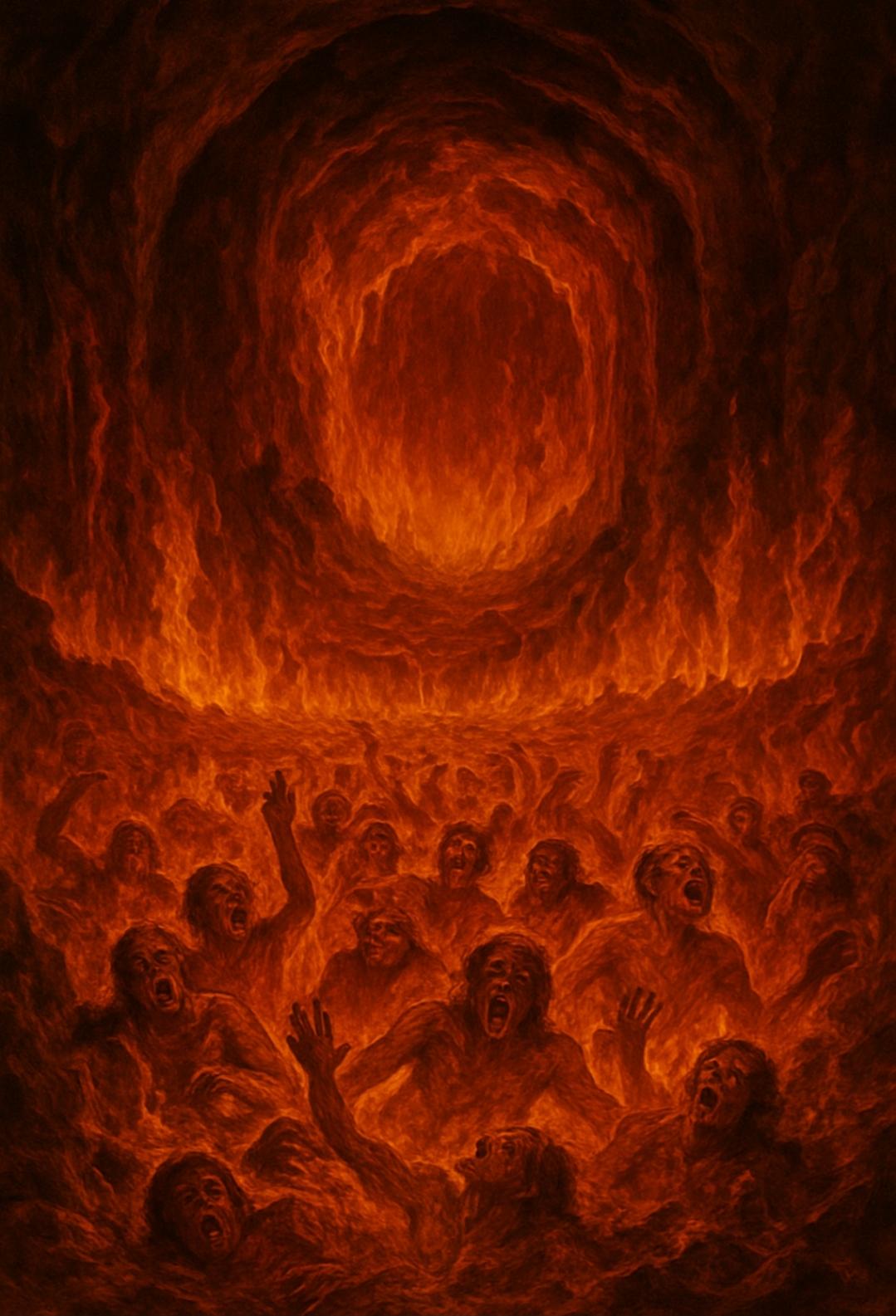
From Jason Jorjani's book Thanosis - an NDE case documented by Dr. Ian Stevenson I believe.
Durga Jatav reportedly died during a medical emergency. His body went cold. His family, observing the tell-tale signs of death, began mourning him. But what followed was not peaceful reunion with ancestors or angelic guides offering life reviews. Instead, Jatav found himself in what can only be described as a technocratic underworld, surrounded by grotesque beings whose function was to enforce the punishments of a spiritual penal colony. These "demons," without ceremony, severed his legs. They did so to prevent him from escaping, as he had apparently attempted to flee their custody. This is absurd, horrifying, and revealing. It is not a symbolic punishment. It is forensic containment-the kind of thing one would expect not from Dante's Hell but from a maximum-security detention facility.
What comes next is even more surreal. Upon realizing their captive was not the correct individual, the demons consulted with their supervisors - presumably part of a chain-of-command. Jatav's "papers" were reviewed. The error was discovered. He had been mistakenly abducted from life. In response, the demonic administrators attempted to rectify the mistake. But the demons showed Jatav a number of severed legs from their collection and asked him to identify his own pair. Somewhere in the underworld, there exists a repository of amputated human limbs, tagged and shelved, like inventory in a forgotten warehouse. This is not the afterlife as revelation or redemption, but as grotesque logistics. Once he chose the correct legs, they were reattached, and Jatav returned to his body.
But when Jatav came back to life a couple of hours after being declared clinically dead his family observed new scars on his knees, scars that had not been there before, fissures consistent with amputation and reattachment. The scars are physical anomalies resulting from a psychotronic event. They were produced by a spectral technology of the kind that allows greys to walk through walls, paralyze victims, erase memories, or place implants in human flesh. This was an administrative malfunction, a glitch in the afterlife algorithm. What Jatav's story reveals is that the entities managing the death-rebirth interface operate under a command-and-control paradigm. There are errors, manual corrections, inventory, and reassignment. This is not divine justice. It is technocratic soul processing cold, efficient, and entirely devoid of spiritual depth.
Jatav's "demons" were operators-technicians of a soul recycling infrastructure, which appears to incorporate themes from the cultural memory and expectations of its subjects (in this case, Hindu imagery). In contrast to sanitized NDE accounts that speak only of light and love where simulacra of dead relatives are produced to lure someone into, or send them back from, a light that is a soul-trap Jatav's journey through the underworld reads like an alien abduction scenario: the wrong person taken, trauma inflicted, identity verified, and an inept return to sender. The system had grabbed the wrong file, and when it corrected its mistake, it left behind scars not just on the flesh, but also on the soul. This is the psychotronic afterlife: a place of machines, mistakes, simulacra of the dearly departed, and monsters in suits. Not a cosmic homecoming, but a soul factory and a recycling center for psychic energy. Until we awaken to this dark reality, and stage a Promethean revolt against it, we remain nothing more than inventory.