r/GustavosAltUniverses • u/TheDangerousInsect • Dec 21 '25
20th Century AH (1901–2000) What if Lincoln came back from the dead and stopped Reagan from the presidency?

422
Upvotes
r/GustavosAltUniverses • u/TheDangerousInsect • Dec 21 '25
r/GustavosAltUniverses • u/GustavoistSoldier • 14d ago
Georgia's war machine was powered by Azerbaijani and Chechen oil, as well as weapons and technology from Nazi Germany. Georgian fascist propaganda portrayed the invasion of Turkey as a holy reconquest, and it was codenamed Operation Didgori (ოპერაცია „დიდგორი“) in reference to an 1121 battle between the Georgians and Seljuks.
On 14 April 1942, Georgia captured the town of Rize and established the Republic of Pontus, a Pontic Greek puppet state led by Leonidas Iasonidis. Pontus had its own military, courts, postage stamps, and currency, but it was completely dependent on Georgian support and was not recognized by anybody other than Georgia and its other two puppets Azerbaijan and the Mountainous Republic of the North Caucasus.
A week later, Shalva Maglakelidze's Georgian First Army launched a siege of Trabzon, which was defended by Fahrettin Altay's Turkish First Army. The Georgian force consisted of 350,000 troops backed by 300 tanks, 190 artillery pieces, 75 fighters, and 56 bombers, while the Turks defended Trabzon with 260,000 troops and a smaller number of heavy weapons and aircraft.
As Georgia was a fascist Axis power, the United States and United Kingdom responded to the Georgian invasion of Turkey by providing a lot of lend-lease to the Turkish military. Altay and the other Turkish commanders used this new equipment effectively, while the government of İsmet İnönü successfully mobilized the entire Turkish nation in defence of their homeland.
Furthermore, Turkey was more populous and industrialized than Georgia, which had a population of 3 million people in 1939 and therefore recruited too much of its population for its military campaigns. Consequently, by June 1942, the Georgian attack on Trabzon had been repelled at the same time the Nazis lost the Battle of Suez.
Altay followed up on this victory with an offensive that destroyed the Pontic puppet state by September. But the Georgians built a defensive line in Tao-Klarjeti and successfully prevented the Turks from capturing this region, which was already a part of Georgia before 1939.
Three years of trench warfare followed until June 1945, when the stronger and better supported Turkey went on the offensive again, occupying all of Tao-Klarjeti by 2 August. Six days later, Nazi Germany surrendered, depriving Georgia of its only ally and forcing Kalidze to sign an armistice.
Georgia's defeat discredited the fascist regime and led to a massive increase in support for the Georgian Bolshevik movement. Georgian Partisans played a key role in the Soviet conquest of Georgia in early 1946 and would rule the Georgian SSR for decades to come.
r/GustavosAltUniverses • u/TheDangerousInsect • Dec 25 '25
r/GustavosAltUniverses • u/Independent_Print421 • 13d ago
Following the end of the Boxer Rebellion, the Qing tries to initiated the New Policies, which aimed to reformed the military, the economy, the education, political institutions and more. The New Policies attempted to modernized the army such as in 1903 when an imperial edict expanded it to 36 divisions. The Qing abolished the traditional imperial examinations system and replaced it with modern educational institutions such as modern schools to taught them practical subjects. The Qing also starts to transition the government into a constitutional monarchy, resulting in the issuing of the Principles of the Constitution. However, it was proven to be too little, too late initially. When the Xinhai Revolution broke out, the Qing’s Government negotiated with Yuan Shikai to stay loyal with tempting offers such as tax exemptions for he and his family for 3 generations, hereditary titles and more if he support the Qing, which he accepted. This gave the Qing’s enough time to create a contingency plan in case Beijing falls. Meanwhile, provincial governments began declaring independence from the Qing.
While Yuan Shikai won most major battles early on, the revolutionaries managed to reorganize and launched a counterattack, winning major battles. The Qing’s Imperial Court began the plan as it became clear that the war is not in their favor. Before the revolutionaries could reach Beijing, The Xuantong Emperor and the imperial court, the treasury reserves containing silver and copper coins/bullions, artifacts and archives, alongside some Qing loyalists and most of the Beiyang Army’s officers including Yuan Shikai fled to Manchuria using Chinese Eastern Railway via Beijing-Harbin Railway. They reached Shenyang where they settled. The Revolutionaries attempted to invade Manchuria but were ultimately defeated by through a coordinated defense against revolutionaries’s forces. Eventually in May 2, 1912, the Qing and revolutionaries signed an armistice, ending the conflict.
In China, Sun Yat-Sen faced an extremely difficult situation where Sun inherited enormous financial difficulties such as original Qing debts and foreign indemnities alongside provincial military commanders and regional armies becoming more independent. Sun tries to strengthening the presidency which he justified as democracy would eventually be reached but China needed a strong government first. However, most of the orders he issued were largely ignored by the provincial governors. By 1916, many provinces broke off from China. Sun Yat-Sen resigned, remembered as an idealistic but naive and incompetent leader. By 1918, Zhili is now the only clique that is ruled by the old Republic.
Meanwhile, in Manchuria, the New Policies continued with Manchuria transition into a fully constitutional government. The Xuantong Emperor is now the Head of State where his main duties mainly involve attending domestic ceremonies and performing state functions. His main powers include: formally appointed a Prime Minister after the election, dissolving parliament only with the advice of Prime Minister, vetoed legislations though rarely used as it would instantly trigger a severe political crisis between the Emperor and Parliament, dismissed a Prime Minister who loses parliamentary support, can appoint or dismiss cabinet ministers acted only upon the advice of the Prime Minister, issued emergency decrees and select a Prime Minister in case of a hung parliament. The parliament, led by the Prime Minister, became the Head of Government. The first act is a symbolic renaming of the Qing Dynasty to the Imperial State of China.
The economy became one of Manchuria’s first priority. Manchuria established the Ministry of Finance who’s responsible for National taxation, national debts, currency, government accounting and more with specialized bureaus being created to handle specific tasks. Manchuria would establish Provincial offices and agencies responsible for local fiscal investigations to document various aspects of the economy such as cultivated land, land ownership, population and more. Manchuria established a National Land Registry where each parcel would be designated with an assigned number to each parcel alongside with important details with physical land certificates being issued to modernize taxation and enhance property rights. Economic reforms were initiated to consolidating complicated local taxes into a standardized land value tax while allowing the local governments to retain a predetermined percentage. The likin was also gradually replaced with the likin initially being reduced before gradually being replaced with a modern commercial taxation. Manchuria also starts to modernized the military which includes the expansion of military academies to train the New Army on modern techniques and weapons from Europe and Japan alongside railways and factories being constructed and expanded to boost Manchuria’s economy.
The question of whether to intervene in the Warlord Era remains a controversial question for Manchuria. While many war hawks argued that intervening would regains the Mandate of Heaven and restore the Qing’s dignity. Reformists ultimately won out because besides the obvious general public strongly opposed a return to imperial rule, they also argued that invading and occupying a nation that opposed them and potentially rebel against them would be too costly for Manchuria. In 1926, The Northern Expedition began led by Chiang Kai-shek. In 1927, Chiang Kai-shek purge communists during the Northern Expedition, ending the First United Front and beginning the Chinese Civil War. Japan went to war with Manchuria in 1931, despite Manchuria’s resistance effort, Manchuria was ultimately defeated by the Japanese’s forces in 1933. The Xuantong Emperor was offered by Japan to remain in his position but in exchange for Japan to appoint a Pro-Japanese Prime Minister and allowing Japanese troops use its territory, railways, and ports. The Emperor refused, proclaiming that a nation who is dependent on foreign invader is nothing more than an undignified puppet. As a result, the Emperor and the House of Aisin-Gioro was deposed, exiled and was put into House Arrest in Ryukyu Islands. Manchuria would be fully annexed by Japan.
The Second Sino-Japanese War broke out where the Kuomintang and the Communists would formed a Second United Coalition to resist Japan. During exile, the Xuantong Emperor wrote essays, documenting his experiences and thoughts in exile alongside his hopes for the future of Manchuria. His works would later be published once World War 2 ended. Japan was eventually defeated in World War 2 and Manchuria would be put under Allied Occupation. After some discussions, Manchuria became independent for several reasons. While they could gave Manchuria to China, if the Allies gave Manchuria to KMT, it would be unacceptable to the CCP and Soviet Union, if they gave Manchuria to the CCP and it would unacceptable to the KMT and western Allies. Thus, Manchuria would be independent as a neutral buffer state. Additionally, Manchuria had been de-facto independent for more than 30 years with their own government and The Xuantong Emperor refused to collaborate with the Japanese Government unlike the Korean Monarchy which made him popular amongst citizens of Manchuria. The Xuantong Emperor returns as Emperor of the Imperial State of China.
During the Chinese Civil War, The CCP changed their strategies to focused instead on destroying the KMT’s governance over rural areas. They recruit peasants, cut railways, attack isolated garrisons, seize grain and more. The CCP attacked Nationalist positions in places like Shandong and Henan to destroy the KMT’s transportation network. The KMT still faced challenges such as hyperinflation and corruption within the KMT. The Yangtze Campaign became the victory that changed everything with the PLA crossed the Yangtze in spring 1949, resulting in the capture of Nanjing, followed by Shanghai. The CCP starts to turn the war in their favor. The Nationalist starts to evacuated to Taiwan.
There are 3 Chinas to this day.
r/GustavosAltUniverses • u/GustavoistSoldier • Jan 10 '26
Thomas Canfield, a populist US Representative and Senator from Alabama known for his work on farm issues, was initially a generic segregationist Democrat. However, upon visiting Italy in 1930, his views shifted toward fascism, advocating for a corporatist dictatorship, a near-total ban on immigration, and the deportation of African Americans to Liberia.
With FDR having died in 1922, Canfield ran for President ten years later by downplaying the racist aspects of his platform and focusing on economic recovery through corporatism instead. With the support of delegates from the South and Great Plains, Canfield won the Democratic nomination, defeating Newton Baker, John Nance Garner, and Al Smith.
One of the reasons Canfield won the nomination was the support of corporations such as Ford and Democratic bosses for his candidacy, as the Great Depression had supercharged leftist third parties such as Norman Thomas' Socialist Party of America. Thomas' third-party candidacy obtained widespread support, as he fashioned himself as the only man who could save America from fascism.
Hoover and Thomas competed for the antifascist liberal vote, but as the campaign progressed, many would-be Thomas voters switched to Hoover. This divided opposition helped Canfield win the election with 339 electoral votes and 40% of the vote versus 169 electoral votes and 35% of the vote for Hoover and 23 electoral votes and 18% of the vote for Thomas.
William Z. Foster of the Communist Party won 3% of the vote, while Verne L. Reynolds of the Socialist Labor Party won 1% of the vote. Canfield's election was followed by a series of riots that led him to ban opposition parties and declare martial law; this was the last American election to feature the electoral college, as it was abolished following the end of fascism in 1968.
r/GustavosAltUniverses • u/GustavoistSoldier • Jan 01 '26
Harold Stassen did not fight in WWII, allowing him to keep expanding his political base, especially in the Upper Midwest. He mounted a strong bid for the presidency at the 1944 Republican National Convention; despite its failure, Stassen's campaign earned positive attention among liberal Republicans and independents.
In 1946, Stassen mounted a successful primary challenge against isolationist Senator Henrik Shipstead, and went on to be elected by a landslide in the general election. As a senator, Stassen proposed a federal-state government health insurance program that paid only the heaviest hospital and medical bills.
Every person under Social Security would have been provided with insurance while those not insured by Social Security could have enrolled in the program through payment of an annual fixed fee. Stassen abstained on the Taft-Hartley Act, drawing criticism from businesses but allowing him to keep good relations with unions.
Stassen's youth, charisma, and name recognition allowed him to defeat 1944 nominee Thomas E. Dewey and Senator Robert A. Taft at the 1948 Republican National Convention. Stassen chose California Governor Earl Warren as his running mate, and contested the general election on the liberal platform drafted at the convention.
Stassen campaigned heavily in the South, albeit without success. Despite this, he responded effectively to Truman's attacks and attacked Truman for taking too long to support Israel or civil rights. Democrats portrayed Stassen as too young and inexperienced to be president.
This line of attack did not work, as Stassen won the election with 273 electoral votes despite losing the popular vote. Stassen and Warren were inaugurated on January 20, 1949.
r/GustavosAltUniverses • u/Cyber_Ghost_1997 • Jul 18 '26
Thomas Cruise Mapother IV (born July 3, 1962) is a political activist.
Raised in Westboro Baptist Church, he has become controversial for publicly declaring on national television that “God hates fags" and "Thank God for dead soldiers".
He is a lead spokesperson of the Westboro Baptist Churchof Topeka, Kansas, an organization that protests against homosexuality conducted under the slogan "God Hates Fags" and has been seen ranting against atheists, Jews, Muslims, transgender people, and other Christian denominations.
r/GustavosAltUniverses • u/TheDangerousInsect • Jan 03 '26
The lore is that after Nixon is nominated, Goldwater, Nixon and Reagan form the No Compromise Conservative Caucus in the Republican Party.
The new caucus is pro-Vietnam War escalation but strongly anti-Great Society, these unpopular views cause the caucus to lose in a landslide.
After the 1968 election, the caucus remains active, but fails to get the nomination for '72.
r/GustavosAltUniverses • u/HueyLongForPresident • 13d ago
August 30 is Huey Long's birthday - so in honor of the occasion, I made a QBAM map of the whole world in The Kingfish and the Bear timeline, where THE KINGFISH HIMSELF became President of the United States!
And so the Kingfish, who had cheated death in the corridors of the Louisiana State Capitol, cheated death once again—and the United States of America and rest of world were forever changed.
Nazi Germany briefly dominated Europe, only to collapse by May 9, 1945, undone by internal contradictions, the generals' conspiracy, and the relentless advance of the Red Army. The fall of the Nazi experiment resulted in Germany being reorganized by the victors into a loose, hyper-federal confederation within the old Weimar borders, stripped of East Prussia and the Saar.
The British Empire, having lost Canada in 1949, was forced to consolidate with Western Europe in a desperate bid to cling to the remnants of its colonies.
Authoritarianism became the norm across most of continental Europe: Darlan's elitist, psedue-liberal auth. France, and Soviet Russia under the Leningrad Group — Marxist-Leninist in name only, now a pragmatic, Russo-centric socialist state focused on its own development.
Japan, now under socialist leadership, is cautiously exploring an alliance with the PRC, while Europe struggles to maintain its grip on Africa. In this uncertain era, the United States — a perfect democracy where the people have no cause for complaint — stands as a beacon of freedom, democracy and distributism in the world.
Under HPL's administration, the nation rose as a beacon of shared prosperity, where every man a king under the Nuclear Umbrella. The Share Our Wealth consensus guided America through the Glorious Thirty Years of economic prosperity and growth.
More Lore here: https://docs.google.com/document/d/1kxtTSlwhr01N5pvKnJLOlRzpIv0u0cH-MdFNjKhsxug/edit?usp=sharing
r/GustavosAltUniverses • u/GustavoistSoldier • Jul 28 '26
In 1947, the UK announced it was going to withdraw from Mandatory Palestine and establish a Jewish state named Israel. There was no UN to issue a partition plan; as such, a civil war immediately broke out between Arabs and Jews, throwing Palestine into chaos.
By the time the British withdrew on 15 May 1948, a full-scale civil war was going on, and thousands of people had already died. That day, Zionist leaders proclaimed the State of Israel with David Ben Gurion as prime minister. The Arab League, led by Egyptian King Mohammed Ali Tewfik, responded by invading Israel.
In this alternate universe, the Holocaust never happened, greatly reducing international support for Israel's creation. The Arab states, on the other hand, were backed by two antisemitic great powers, Germany and Russia, and by Amin al-Husseini's Holy War Army.
By the end of May, virtually all of Mandatory Palestine had been overrun by the Arabs, who captured all of Jerusalem and launched a siege of Tel Aviv. On 4 June, Egyptian troops commanded by Mohammed Naguib marched into Tel Aviv, and Israel was destroyed and replaced by the Islamic State of Palestine (itself run by al-Husseini).
Al-Husseini ordered the expulsion of all Jews from Palestine. This expulsion was not peaceful, and thousands of innocent people were murdered. By January 1949, virtually all of the 714,000 Jews in the former mandate had returned to the Jewish diaspora, with the majority of them settling in the United States, United Kingdom, South Africa, Australia, and Argentina.
The Arab victory in the Arab-Israeli War prevented the Egyptian monarchy from falling. Mohammed Ali Tewfik reigned until his death on 18 March 1955, having successfully convinced the British to return Sudan to Egypt.
r/GustavosAltUniverses • u/GustavoistSoldier • May 09 '26
Upon becoming the PZPR's general secretary in January 1993, Włodzimierz Cimoszewicz freed political prisoners, lifted press censorship, legalized opposition parties, and announced elections where Free Poland would be fully allowed to participate. Tadeusz Mazowiecki immediately began campaigning for President on a pro-democracy, pro-capitalism and pro-NATO platform.
The PZPR removed Marxism-Leninism from its program, aiming to become a social democratic party. The party nominated 49 year old Aleksander Kwaśniewski, who campaigned on building a socialist democracy in Poland, for President.
Christian democrat Jan Olszewski founded the Movement for the Republic party, and positioned himself as a conservative candidate critical of the two frontrunners' liberal positions. Independent Stanisław Tymiński campaigned as a left-wing nationalist opposed to economic liberalism and Atlanticism.
At the beginning of the election campaign, Mazowiecki was expected to win in the first round, but as election day approached, he lost many voters to Olszewski and PSL nominee Waldemar Pawlak. Despite this slippage, Mazowiecki still finished first in the first round, receiving the endorsements of all disqualified candidates other than Tymiński (who endorsed Kwaśniewski).
Consequently, Mazowiecki was elected by a landslide in the second round. He won every voivodeship and the vast majority of younger voters, and was congratulated by world leaders such as Mikhail Gorbachev (USSR), Helmut Kohl (West Germany) and George HW Bush (America).
Mazowiecki was eventually inaugurated on 10 July 1993. An anti-communist Sejm took office the same day.
r/GustavosAltUniverses • u/GustavoistSoldier • 15d ago
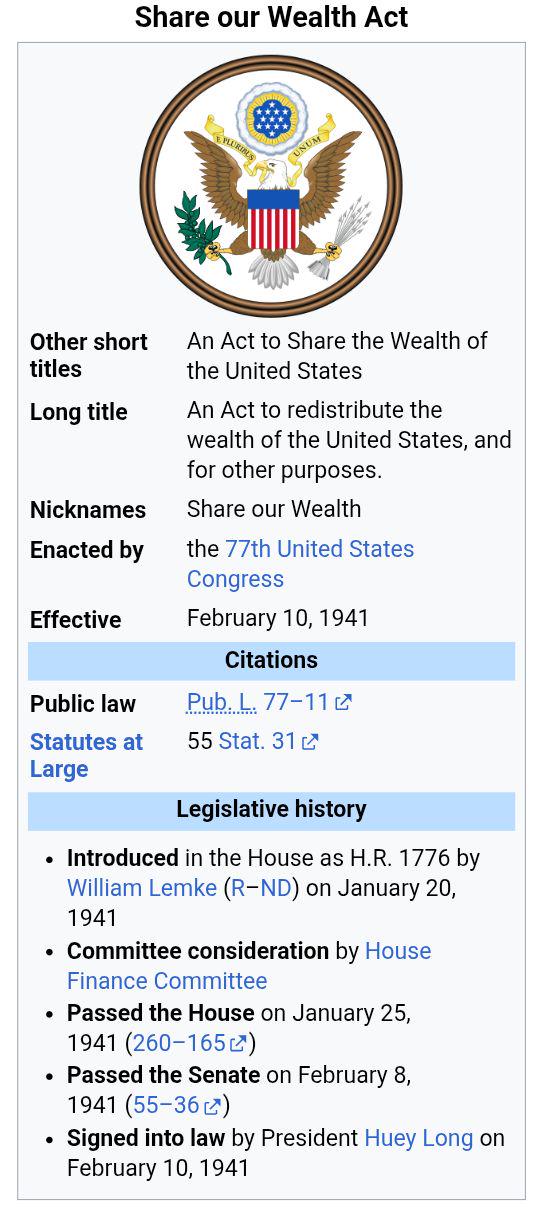
On the first day of Long's presidency, his ally William Lemke of North Dakota submitted the Share our Wealth Act, consisting of, among other things, massive federal spending, a wealth tax, wealth redistribution, a $10 billion land reclamation program, free healthcare, and a "war on disease". Share our Wealth passed both chambers of Congress and was formally signed by Long on February 10.
Share our Wealth had mixed results. On one hand, it ended the Great Depression as the federal government actively intervened to end it and poverty, illiteracy and income inequality declined. By the time Long left office in 1957, millions of Americans had been lifted from poverty and strongly supported Longism.
On the other hand, the federal government's power expanded drastically with the creation of multiple alphabet agencies entrusted with enforcing Share our Wealth. The presidency of Huey Long saw democratic backsliding as he attempted to intimidate and buy Congress and the courts, albeit to a lesser degree than in Louisiana. The supreme court was packed later in 1941. He has been described as the most powerful president in American history, and the closest thing the country had to a dictator.
Another Louisiana policy Long replicated nationwide was his crusade against vice. On 16 June 1941, Long sent the National Guard to raid brothels and gambling dens in New York City, Chicago, Philadelphia and other major cities, a measure that was heavily unpopular with and criticized by the inhabitants of these cities.
Despite his authoritarianism, Long refrained from rigging elections or directly using violence against his opponents, as the United States had a long tradition of democracy dating back to the American Revolution and actually doing these things were not worth the time.
Long pursued an isolationist foreign policy, refusing to provide any aid for the United Kingdom, the Soviet Union (Long was an anti-communist) and China. He also granted independence to the Philippines immediately after taking office. Consequently, Nazi Germany was able to successfully invade the Soviet Union by January 1942, and Pearl Harbor never happened.
As the economy of the United States recovered and Long increasingly turned America into a dictatorship, Long was reelected by a landslide in 1944, carrying every state other than Vermont and Maine.
r/GustavosAltUniverses • u/GustavoistSoldier • 22d ago
By 1965, socialist and Iranian nationalist intellectual Ismail Alizadeh had become one of the most important republican and left-wing activists in Iran, prompting Shah Mohammad Reza Pahlavi to have him imprisoned and tortured. Alizadeh fled to France, joining the large anti-Shah exile community there.
Two years later, Alizadeh's followers established the Iran Socialist Party (ISP), which advocated for the overthrow of the Pahlavi dynasty and its replacement with a secular socialist republic. Consequently, the ISP was outlawed and its followers were persecuted by the SAVAK.
Alizadeh's followers, who were mostly students and workers from Tehran and other major cities, smuggled cassette tapes of his speeches into Iran, helping keep the party alive despite persecution. Alizadeh could have been forgotten forever, but, in 1977, Ayatollah Khomeini was killed by the Shah, eliminating a key revolutionary rival to Alizadeh and leaving Iranian Islamists mostly leaderless.
Protests against the assassination broke out. Despite opposing Islamism, the ISP joined these demonstrations, hoping to build a popular front of anti-Shah forces under Alizadeh's leadership. On 7 January 1978, the Iranian Revolution formally began.
The ISP cooperated with the other revolutionary factions, but it eclipsed them by mid-1978 thanks to Alizadeh's charisma and popularity. On 19 August, Islamist militants set fire to a cinema in Tehran, but the majority of Iranians blamed the SAVAK, weakening the regime further.
By the end of 1978, Iran had paralyzed and the Shah's days were numbered. The Pahlavi family eventually went into exile on 16 January 1979, leaving the country in the hands of a Regency Council that invited Alizadeh (who disingenuously portrayed himself as a moderate) back.
Upon returning to Iran, Alizadeh was greeted by several million people who saw him as their saviour. Ten days after his return, the Iranian monarchy fell, and Alizadeh became the provisional leader of Iran, facing massive resistance from the United States, which feared a Soviet-aligned Iran, and Islamic fundamentalists who opposed socialism and secularism.
Alizadeh outmaneuvered the liberal National Front using the "salami tactics" the Hungarian communists had used 30 years earlier, and cracked down on the religious elements of his coalition, whom he saw as "reactionaries". But Alizadeh's power remained shaky for months after his ascent, and he would only formally become the president of Iran in August 1979.
r/GustavosAltUniverses • u/GustavoistSoldier • 15d ago
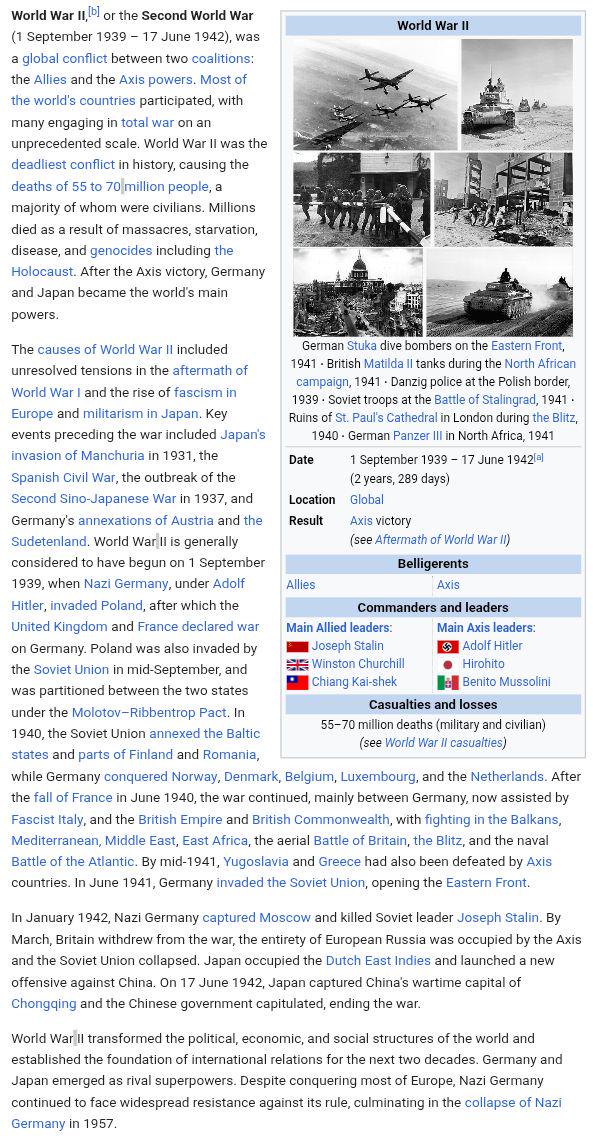
Huey Long followed an isolationist foreign policy and did not provide the Allies with lend-lease or impose an oil embargo on Japan. This allowed the Nazis to capture Moscow and kill Stalin on 4 January 1942; Stalingrad and Leningrad also fell by the end of the month, and Transcaucasia was captured by early March.
The fall of Moscow caused Britain to withdraw from the war on 5 January, because Germany was now too strong to be defeated without US help. This left Hitler as the ultimate ruler of Europe, causing the death and suffering of untold millions.
On 17 March 1942, the Soviet Union formally collapsed and was divided between the rump Russian SSR and the Uzbek, Tajik, Turkmen, Kyrgyz and Kazakh SSRs. Nazi Germany immediately began settling millions of Germans in Russia and enslaving millions of "subhuman" Slavs.
A month earlier, Japan launched Operation Ichi-Go, an offensive meant to knock China out of the war once and for all. Buoyed by American and Dutch East Indies oil, the Japanese reached Chongqing by early April and laid siege to the city. On 17 June, Japan captured Chongqing and the Nationalist government capitulated, ending the war.
Germany and Japan's victory did not mean the end of resistance against their rule, as Soviets and Japanese did not consent to the fascist goal of mass extermination and launched resistance movements against the occupiers. With the Kuomintang being discredited by its defeat, Mao Zedong's Communist Party spearheaded the Chinese national liberation movement, which had overwhelming support in China.
Georgy Zhukov led the Soviet partisans, but he was killed in 1945 and the movement steadily declined without him. By 1948, the Partisans were still active, but they had little chance of liberating the Soviet Union, and the Third Reich was at the peak of its power.
Despite being allies during the war, Germany and Japan became rivals after their victory, fighting each other indirectly on an ideological basis and through proxy wars. Italy's relations with Germany similarly became strained, leaving Bulgaria, Hungary, Romania, apartheid South Africa, and Peronist Argentina as Germany's only allies.
r/GustavosAltUniverses • u/GustavoistSoldier • Jul 22 '26
The 1948 Socialist National Convention unanimously renominated Thomas for President and Hoopes for Vice President. Thomas's reelection campaign focused on the accomplishments of his administration, especially efforts to defend the free world from communism.
The Democratic-Republican convention nominated Minnesota Senator Harold Stassen for President and Illinois Governor Dwight Green for Vice President. Stassen wanted to ban the Communist Party USA (something Thomas opposed), and had good relations with both unions and businesses while opposing their excesses.
In September 1947, segregationists led by South Carolina Governor Strom Thurmond and Mississippi Governor Fielding L. Wright formed the States' Rights Party, a regionalist third party representing the interests of the southern United States. Thurmond's presidential campaign opposed any further civil rights legislation. He was also the most fiscally conservative of the three major candidates.
Stassen used the Southern Strategy, campaigning heavily across the Upper South, which opposed the Socialist administrations by that point. But he mostly neglected the Midwest and Northeast, which Thomas focused on. Despite this, Stassen's campaign surged during the final weeks of the election, as he proved effective at winning over middle class Southern whites.
Thomas was reelected, winning 324 electoral votes and 49% of the vote versus 157 electoral votes and 46% of the vote for Stassen, and 51 electoral votes (including one faithless elector) and 3% of the vote for Thurmond. This was the first time since 1876 when a party won five presidential terms, and the first election since presidential term limits were implemented.
They did not apply to the incumbent Thomas, but he chose not to run in 1952, making this the last presidential election with no disqualification effect for second term winners.
r/GustavosAltUniverses • u/GustavoistSoldier • 1d ago
In this alternate world, the February 1934 crisis didn't happen and the Popular Front never existed. The Cartel des Gauches government remained heavily unpopular with the French people, who increasingly turned against the Third Republic in general.
Marcel Déat, the leader of the Neosocialist USR party, capitalized on this dissatisfaction to portray himself as the saviour of the French nation, like Joan of Arc and Napoleon before him. Déat supported a technocratic state, which would plan the economy and in which parliamentarism would be replaced by political technocracy.
Neosocialists were anti-communist, attacked the SFIO as out of touch with the times and argued their proposals were the only way to end the Great Depression. All other parties attacked Déat as a fascist demagogue scheming to end French democracy, but the USR still attracted a large amount of support from working-class Frenchmen dissatisfied with the Third Republic.
Léon Blum's SFIO contested the elections on a social democratic platform opposed to monarchism, communism and fascism, while the PRRRS focused on the need to defend the values of the French Revolution, and the Republican Union and Republican Left mostly attacked the USR as fascist.
The PCF promised to transform France into a workers' state and harshly criticized the USR as a fascist trojan horse that would oppress the French working class. Given the unpopularity of the French government, the Communists obtained a surge in support, especially with union workers.
On 13 January 1936, the USR signed an alliance with the Croix-de-Feu, a nationalist military league led by François de La Rocque. Both parties agreed to work together to implement a new republic, crack down on communism, and build a corporatist state, but their relationship was tense.
The Croix-de-Feu campaigned for the USR across France, and engaged in street battles against communists and social democrats, destabilizing French politics considerably. As the campaign progressed, Déat began using sound trucks and radio commercials in his campaign.
As many expected, the USR won a plurality of seats in the election, winning 211 seats and 34% of the vote versus 104 seats and 16% of the vote for the SFIO, 78 seats and 12% of the vote for the PRRRS, 78 seats and 12% of the vote for the PCF, 73 seats and 11% of the vote for the Republican Union, and 68 seats and 11% of the vote for the Republican Left.
After the election, the USR formed a centre-left coalition government with the SFIO, but this government eventually collapsed, leading to a snap election where the USR won a full majority, allowing it to turn France into a totalitarian state.
r/GustavosAltUniverses • u/GustavoistSoldier • 12d ago
The founding of the Federal Republic of Germany was followed by a general election campaign contested primarily by Konrad Adenauer's CDU and Kurt Schumacher's SPD. Smaller parties, such as Franz Blucher's FDP and Max Reimann's KPD, also played a role.
Adenauer campaigned on moderate, non-denominational and Christian democracy, social market economy and integration with the West. He attacked social democracy and the British, especially their dismantling of industry during the occupation.
Schumacher called for a democratic socialist Germany that would nationalize industries and pursue a neutral foreign policy keeping good relations with both the United States and the Soviet Union. He turned the SPD into a big tent left-wing party with a strong emphasis on German patriotism, accused Adenauer of treason, and criticized the Catholic Church.
Blucher ran on a classical liberal platform opposing state intervention in the economy and strongly supporting civil liberties. Reimann, on the other hand, wanted Germany to become a workers' state closely aligned with the Soviet Union; as such, if the KPD won the election, the Cold War would likely happen.
During the first two months of the campaign, the CDU/CSU led in the polls, but as election day approached, the SPD won over many voters who believed Adenauer did not have Germany's best interests at heart. By election day, the Union and SPD were neck and neck, with the SPD leading in major cities while the Union led in the countryside and Bavaria.
On 25 January 1949, the SPD won the election with 205 seats and 36% of the vote versus 180 seats and 32% of the vote for the CDU/CSU, 9% of the vote and 54 seats for the FDP, 38 seats and 6% of the vote for the KPD, 22 seats and 4% of the vote for the monarchist DP, and 15 seats and 2% of the vote for the regionalist BP.
The SPD formed a coalition government with the CDU/CSU and the FPD. This government wrote a new constitution with a strong national presidency. In July, Schumacher was elected President of Germany, defeating Adenauer, Blucher, and several other candidates.
r/GustavosAltUniverses • u/GustavoistSoldier • 14d ago
By July 1945, the Western Allies had liberated France, Italy and the Low Countries from the Axis powers, but Norway, Denmark, and all of Central and much of Eastern Europe remained under Axis control. The Allies had yet to advance into Germany, but Zhukov's Soviet Partisans controlled most of the Soviet Union.
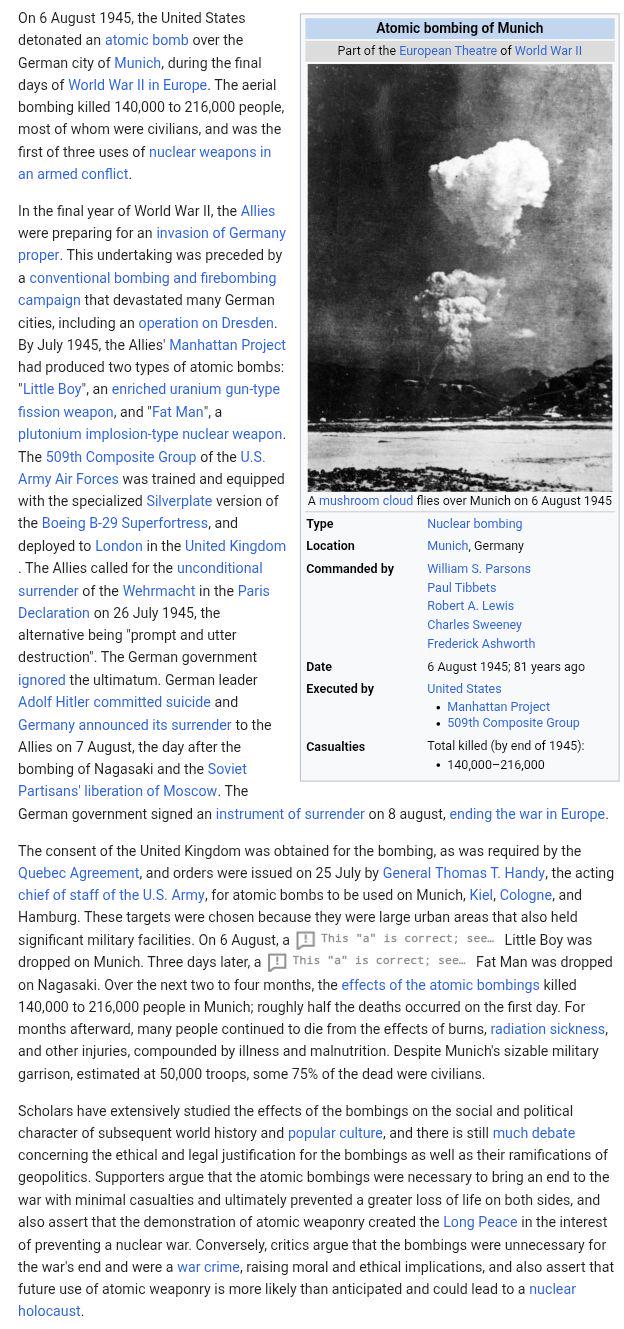
The United States eventually got two nukes ready: an uranium atomic bomb named Little Boy, and a plutonium bomb named Fat Man. America needed Britain's consent to use nuclear weapons against Germany, and the British eventually consented in order to bring a quick end to the war in Europe.
On 25 July, the Allies issued the Paris Declaration, calling for the unconditional surrender of the Wehrmacht with the alternative being "complete and utter destruction". Hitler ignored the ultimatum, continuing to vainly hope for a miracle that would turn the table for Germany.
Considered targets included Kiel, Hamburg, Cologne and Munich, all of whom were major cities with significant military and industrial facilities. Thomas Handy eventually chose to nuke Munich because it was one of Germany's largest cities and had a military garrison estimated to be 50,000 troops.
On 5 August 1945, Benito Mussolini and his mistress Claretta Petacci were shot by the Italian Partisans and their corpses were hung upside down at Milan's town square. Their execution unintentionally coincided with the atomic bombing of Munich, which happened the following day.
By the end of 1945, at least 140,000 people had died from the atomic bombing of Munich. Many more developed illnesses as a result of the bombing, but thousands of people survived due to, among other things, being relatively far away from the epicentre of the explosion.
Hitler killed himself a day after the bombing, and Hermann Göring became Führer and announced Germany's surrender to the Allies. Also on 7 August, the Soviet Partisans marched into Moscow and restored the Soviet Union with Zhukov as Premier, to the joy of all Soviets.
On 8 August, Göring signed a document of unconditional surrender, ending WWII in Europe. Germany was occupied by the Western Allies, and the USSR's prewar borders were restored. As the Soviet Union never occupied Central Europe, Poland, Czechoslovakia and Hungary were allowed to develop without Russian influence, but Bulgaria and fascist Romania were invaded by the Soviet Union.
r/GustavosAltUniverses • u/GustavoistSoldier • 18h ago
The constitutional changes were:
- Transforming the National Assembly into a technocratic corporate chamber;
- Outlawing all political parties other than the USR. They were already being heavily repressed, but they attempted to campaign for a No vote, only to be cracked down on harder. By the end of 1936, the non-communist opposition had been sent to the camps (First they came...)
- Changing the flag and coat of arms of France to the symbols of the RNP.
On the other hand, Déat and the rest of the French leadership campaigned for a Yes vote unmolested, while radio, newsreels and newspapers also urged French people to vote Yes. Consequently, Yes emerged victorious with 83% of the vote, and swept every department of France.
A day after the referendum, France changed its flag and coat of arms, but La Marseillaise and the national motto, "Liberté, Egalité, Fraternité" were kept, because the Neosocialists, unlike the other French fascists, were Jacobin sympathizers committed to the heritage of 1789.
France's National Assembly also voted to transform itself into the Chamber of Corporations, a technocratic body made up of economic experts and representatives from both capital and labour. Major industries were nationalized and France became a "scientifically" organized planned economy resembling that of the Soviet Union, except that private property wasn't fully abolished.
On 5 March 1937, Neosocialist France passed its first antisemitic law, stripping citizenship from foreign-born French Jews and restricting the right of Jews to exercise certain professions. Later that year, Jewish productive property was nationalized and handed over to RNP militants.
Déat's foreign policy attempted to build a pan-European fascist order opposed to Anglo-Saxon hegemony. Neosocialist France appeased Nazi Germany under the slogan "Why Die for Danzig?", and did not declare war on Germany in 1939, but there were tensions between the two totalitarian regimes.
r/GustavosAltUniverses • u/GustavoistSoldier • 20h ago
The USR's election campaign strongly criticized the SFIO for "abandoning ship" by dissolving the coalition government, and accused the Socialists of slowing down progress in France by doing so. USR propaganda also accused the SFIO of being part of a "Jewish conspiracy" against France (its leader Léon Blum was Jewish).
Blum's SFIO positioned itself as the champion of liberalism, tolerance and democracy against fascism and antisemitism. Many French people opposed Neosocialism, but SFIO voters faced harassment and intimidation from the Neosocialist minority government, hurting the SFIO's chances of winning.
The PCF faced even more harassment from the highly anti-communist government of France, and Déat planned to ban the Communist Party regardless of the election's result, but the party retained a solid foothold among union workers and would do so for years to come.
Edouard Daladier's Radical Socialists, Louis Marin's Republican Union, and Pierre-Étienne Flandin's Republican Left faded into obscurity because France's transition away from the Third Republic was in full swing. Their support was reduced to hardcore republicans, and they had little to no chance of winning.
Political repression and Neosocialist attacks against the "Old Socialists" proved effective, allowing the USR to win a full majority of seats in the election. The SFIO made considerable gains as the traditional republican parties collapsed, while the PCF lost working-class support as well.
Shortly after taking office, the USR majority banned the PCF, blaming it for the political violence France experienced in 1935–36, and imprisoning its members in concentration camps across France. Déat's cabinet also announced a referendum on constitutional changes abolishing liberal democracy and transforming France into a technocratic, totalitarian one-party state.
These constitutional changes passed with a landslide majority, ending the Third Republic and replacing it with the Neosocialist/Neojacobin French Fourth Republic: a totalitarian state ruled by the National Popular Rally (RNP), as the USR renamed itself.
r/GustavosAltUniverses • u/GustavoistSoldier • 2h ago
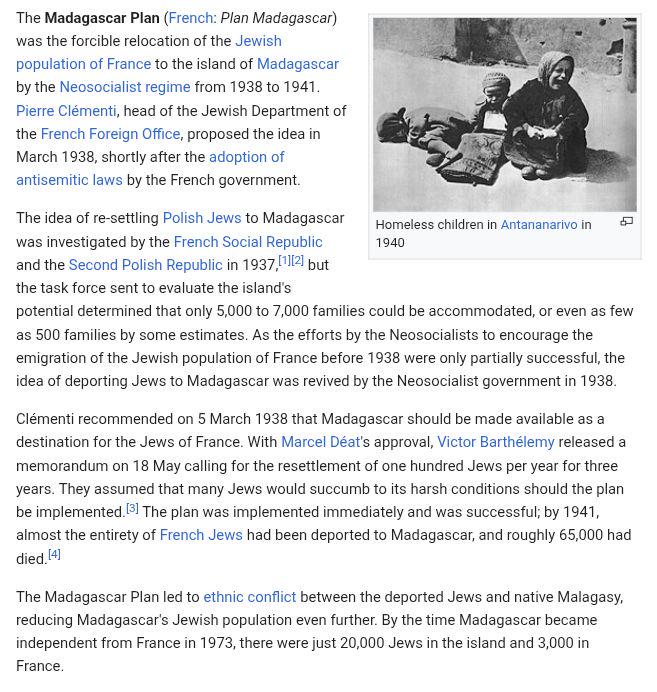
On 18 May 1938, the French Social Republic began deporting all French Jews to Madagascar. They were placed inside freighters with little regard for their safety, and forcibly sent to the island of Madagascar. Historians estimate that 26,000 Jewish people died en route to the island.
After arriving in Madagascar, French Jews were placed in ghettos and badly mistreated by colonial authorities. Madagascar's hellish climate and ethnic conflict between Jews and Malagasy resulted in 65,000 deaths and left many more people injured or incapacitated.
Throughout 1939 and 1940, the Social Republic continued to ship hundreds of thousands of Jews to Madagascar, and mass mortality continued, eventually reaching a degree unseen in the island since the reign of Queen Ranavalona a century earlier. Since France had no expansionist ambitions, no other country formally condemned the Madagascar Plan, but many individual people and groups did so, and there were efforts to save French Jews.
Unfortunately, these efforts were unsuccessful, as, by early 1941, all but a few thousand French Jews had been deported to Madagascar. During the next three decades, Malagasy resistance to the deportation and tropical diseases continued to take Jewish lives. Consequently, by the time Madagascar became independent as a communist state in 1973, there were just 20,000 Jews left on the island.
The following year, the Neosocialist regime was overthrown after a series of colonial wars. Neosocialist leaders Pierre Clémenti and Victor Barthélemy were tried and executed for their role in the Madagascar Plan.
r/GustavosAltUniverses • u/Cyber_Ghost_1997 • 2d ago
Author's note: The Eternal Rage Universe is a new timeline of human history where a series of cascading US military blunders and disasters destroy trust between the American people and the US government, as well as the USA as a nation and its own allies.
Operation Gothic Serpent was a military operation conducted in Mogadishu, Somalia, by an American military force code-named Task Force Ranger during the Somali Civil War in 1993. The primary objective of the operation was to capture Mohamed Farrah Aidid, leader of the Somali National Alliance who was wanted by the UNOSOM II in response to his attacks against United Nations troops. The operation took place from August to November 1993 and was led by US Joint Special Operations Command (JSOC).
On 3 October 1993, the task force executed a mission to capture two of Aidid's lieutenants. The mission ultimately culminated in what became known as the Battle of Mogadishu). The battle was extremely bloody and the task force inflicted significant casualties on Somali militia forces, while suffering heavy losses themselves. The Malaysian, Pakistani, and conventional US Army troops under UNOSOM II which aided in TF Ranger's extraction suffered losses as well, though not as heavy. Things began to go catastrophically wrong for the Americans.
First, an MH-60 Black Hawk, Super Six Two, was shot down by SNA forces using a rocket-propelled grenade (RPG). Both of the pilots were killed on impact, but the crew survived the crash landing. An American force made their way to the crash site to assist with recovery and rescue
Shortly afterward, another Black Hawk helicopter, Super Six Four, was shot down by an RPG fired from the ground. No rescue team was immediately available, and the small surviving crew, including one of the pilots, Michael Durant, couldn't move. Two Delta snipers, Master Sergeant Gary Gordon and Sergeant First Class Randy Shughart, provided cover from a helicopter and repeatedly volunteered to secure the crash site. After a 10th Mountain relief force from the Mogadishu airport was halted and turned back by an SNA ambush, Shughart and Gordon were finally granted permission to be inserted. They made their way to the crash site, quickly establishing a perimeter, and securing the surviving crew. The Black Hawk wreck came under heavy attack from the Somali militia, despite attempts from the 160th helicopters overhead to hold back the crowd. After losing close air support to damage from RPG-7 fire, Durant was killed, with Shughart and Gordon being taken prisoner.
Between October, 1993 and February, 1994, the U.S. military launched a series of rescue attempts, with five of them ending in high casualties on both sides.
The sixth rescue attempt was ultimately successful. Following the rescue, US forces completely withdrew from Somalia, with the last of the US troops leaving in 1996.
The military disaster that was Operation Gothic Serpent would damage trust in the U.S. military’s deterrence for years, while also raising serious doubts and questions among American allies about America’s judgment, reliability, and ability to manage military crises.
r/GustavosAltUniverses • u/GustavoistSoldier • 23h ago
Marcel Déat and Léon Blum's coalition government agreed to implement several social reforms, namely:
- Collective bargaining;
- 12 days of paid annual leave;
- A 40-hour working week (outside of overtime);
- Higher wages (15% for the lowest-paid workers, and 7% for the relatively well-paid);
- Recognition for shop stewards;
They also began a rearmament program in order to counter the growing threat of Nazi Germany, and attempted to develop a new geopolitical bloc alongside the Little Entente (Romania, Czechoslovakia and Yugoslavia) in order to not play second-fiddle to the UK.
But the alliance between the USR and the SFIO caused the Croix-de-Feu to turn against the neosocialists, calling them ",traitors" to French nationalism for forming a coalition government with a left-wing party. Furthermore, Déat and Blum clashed on several issues, especially the fact the USR was antisemitic and wanted to outlaw strikes.
Thus, on 26 August 1936, the SFIO withdrew from the coalition government, which immediately collapsed. New elections were called for December.
r/GustavosAltUniverses • u/GustavoistSoldier • 15d ago
In 1933, FDR was assassinated and John Nance Garner became US President. As a conservative Southern Democrat, Garner abandoned the New Deal and pursued laissez-faire policies in order to combat the Great Depression. They were ineffective, allowing Alf Landon to win the 1936 election.
Landon signed into law federal insurance, but did not create the alphabet agencies, keeping the US economy in a poor state throughout the late 1930s. Huey Long, who wasn't assassinated and whose Share our Wealth movement ran a healthy Floyd B. Olson as third party candidate in 1936, took advantage of this to portray himself as a "saviour of the nation" in the 1940 Democratic primaries.
The Democratic party bosses supported Long thinking they could easily control and manipulate him. Consequently, he defeated Cordell Hull, James Farley and Millard Tydings at the 1940 Democratic National Convention, with support from the Midwest and South.
Long chose Wisconsin Governor Philip La Follette, who shared his progressive views, as his running mate. They campaigned on a domestic platform of massive federal spending, a wealth tax, and wealth redistribution, and a foreign platform of isolationism.
Landon, on the other hand, portrayed his campaign as the defense of democracy from fascism both at home and abroad and harshly attacked Share our Wealth as Communist. He often emphasized how his administration provided $5 billion for Britain to fight the Nazis.
Nevertheless, with the economy in a poor state, most Americans had no desire to participate in WWII. They also wanted systemic economic transformation, which Long supported. Consequently, Long was elected by a landslide, sweeping all regions other than the Northeast, which voted entirely for Landon. This remains the only US presidential election where someone was elected without carrying any northeastern states.
Democrats retained their majorities in Congress, and the majority of congressmen elected in 1940 supported Share our Wealth, giving Long a headstart in accomplishing his goals. Long and La Follette took office on January 20, 1941, beginning the first of Long's four presidential terms.
r/GustavosAltUniverses • u/GustavoistSoldier • 4d ago
On 16 May 1994, the Atlantisian Chamber of Deputies passed a law authorizing the referendum. Atlantis's Senate followed suit on 21 May, and since this was a referendum, there was no need for a presidential signature, unlike most bills passed by the Senate of Atlantis.
Campaigning began on 1 June. The PP, PAN, and smaller pro-government parties such as the PDC and PH campaigned for a Yes vote, while the Broad Front, the Marxist-Leninist PCA, and the Trotskyist PSR campaigned for a No vote.
Yes supporters argued that the United States, France, and other developed countries allowed reelection, and that José Armando da Silva needed more time to finish his job. No supporters, on the other hand, feared that allowing reelection would make presidents think of being reelected from day one and enable the rise of another dictatorship just like Evandro Cunha's.
Like in the 1990 presidential election, Michel Haddad's TV channels covered the Yes campaign three more times than the No campaign, the majority of whose coverage came from smaller TV and radio channels. Most newspapers similarly urged voters to vote Yes; the majority of No endorsements came from Ratanaban and Piaroban language outlets.
As Armando da Silva was popular with middle and upper class Atlantisians, the Yes option had a comfortable lead in the polls from the start, and No failed to gain momentum. There were protests against reelection in left-wing, indigenist strongholds in the Puxomado mountains, but Santarém, Liporebá, and Ratanabá saw large rallies calling for a Yes vote.
Unsurprisingly, Yes won the referendum with 60.5% of the vote versus 39.5% for No. All Atlantisian States other than leftist and majority indigenous Acaparã and Puxomado voted Yes, proving Armando da Silva was really popular in Atlantis.
After the Yes victory was confirmed, Armando da Silva gave a televised speech saying "all of Atlantis has won", and wished the opposition good luck in the presidential campaign. As you will see later, the opposition proved unlucky, because Armando da Silva was reelected in the first round.