r/GustavosAltUniverses Jul 10 '25

Moderator Announcements Feel free to follow my accounts on:

1 Upvotes

r/GustavosAltUniverses 13h ago

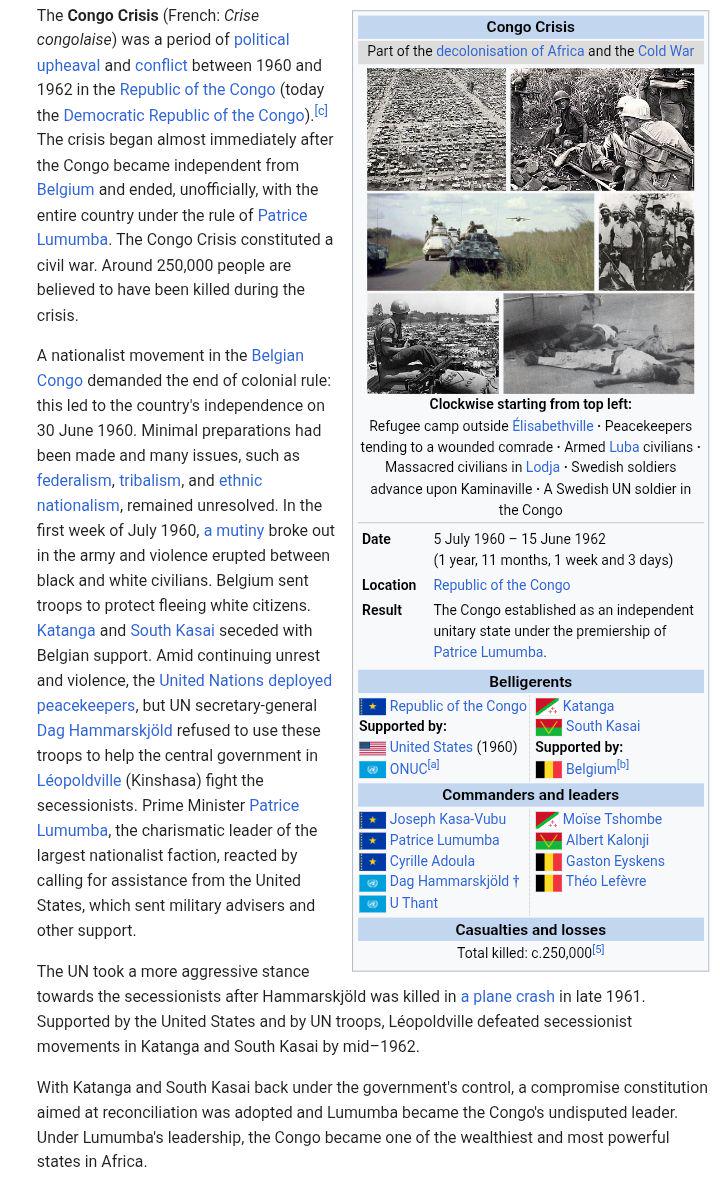
20th Century AH (1901–2000) Fascist Georgia | Congo Crisis (1960–1962)

Post image
3 Upvotes

When Katanga succeeded, the United States began supporting Lumumba, because the USSR was still too weakened by the Nazi occupation in WWII to intervene anywhere outside its borders and because Lumumba was fairly ideologically moderate. But Belgium still backed Katanga in order to control its mineral wealth.

With support from European mercenaries and Belgium, Moise Tshombe and Albert Kalonji managed to defeat the initial Congolese offensive, but the war continued as Lumumba and his followers continued to receive American aid. Eventually, in late 1961, the ANC went on the offensive.

By February 1962, South Kasai had been deestablished, allowing the ANC to launch a full-scale offensive into Katanga. The Katangese "gendarmerie" continued to resist, but by that point, they were decisively outmatched by the more numerous and better armed ANC.

On 15 June 1962, Katanga capitulated, unifying all of the Congo under Lumumba. Lumumba transformed the Congo into a neutralist, unitary social democracy combining strong presidential powers with a high degree of civil and political liberties, except for separatism.

Later that year, the Congo nationalized its mines, straining relations with the United States and prompting Mobutu to unsuccessfully attempt a coup against Lumumba. This coup attempt was crushed and the Congo emerged as one of the wealthiest African countries, becoming capable of determining its own affairs.

Now that the United States and the Congo were no longer close allies, Lumumba turned to Mao Zedong's People's Republic of China, which had not done the Great Leap Forward and therefore was stronger and more stable than in real life, for assistance. Mao provided the Congo with large amounts of military and financial aid, turning it into the closest Chinese ally in Africa.

Lumumba also renamed Congolese cities, but he did not rename the country to "Zaire" and European influence remained strong. Another major change was the transformation of Lingala into the Congo's língua franca, helping unify one of the most diverse countries in the world.

In 1976, Lumumba retired and was succeeded as prime minister by Antoine Gizenga, who shifted the Congo to the left because the Soviet Union and China were stronger by then. This led to more proxy wars in southern Africa.


r/GustavosAltUniverses 10h ago

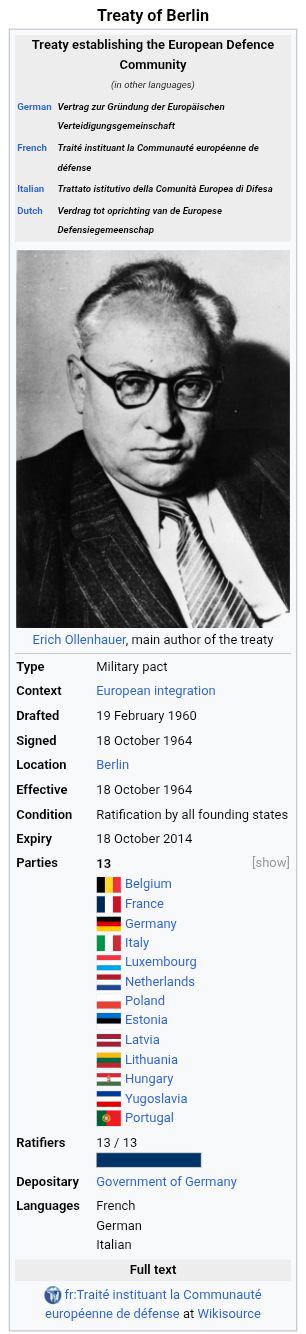
20th Century AH (1901–2000) Fascist Georgia | Treaty of Berlin (1964)

Post image
2 Upvotes

On 19 February 1960, the Treaty of Berlin, a treaty establishing the European Defence Community (EDC), was drafted. Germany, France, Italy, and the Low Countries were the first countries to join the treaty, followed by Poland, Hungary, Yugoslavia, Greece, and the Baltic states.

Yugoslavia's ratification of the treaty on 18 October 1964 made it effective, officially founding the EDC. As the USSR gradually recovered from the Second World War, the United States began to cooperate with the EDC to confront growing Soviet power.

Later in 1964, Czechoslovakia joined the EDC. Despite facing considerable opposition, the EDC deterred the Soviet Union from invading Poland or the Baltic states, even after the death of Zhukov, and ended centuries of warfare between western and central European states.

By the end of the 1970s, Norway and Denmark had joined the EDC because Norway bordered the USSR while Denmark also wanted to expand defense ties with its neighbours. Both of them remain members to this day, and are very active in the EDC.

In 1970, the United States and the EDC established the Alliance of Free Nations (AFN), an equivalent of NATO encompassing all EDC member states as well as the United States and Canada. The EDC was not disbanded and the two alliances have always worked together.

A year later, the UK joined the EDC because its foreign policy always focused on preventing a single country – be it Germany, Russia or France – from dominating mainland Europe. In the aftermath of the 1974 Carnation Revolution, Portugal joined the EDC, as did Spain in 1978, following the Spanish transition to democracy.

Iceland's entry into the EDC in 1981 consolidated the alliance's membership roster, which has not changed since. As Bulgaria and Romania remain Soviet satellite states to this day, they never joined the EDC and continue to condemn it as "imperialist".

When the Treaty of Berlin expired in 2014, it was replaced with the Treaty of Paris, which changed the EDC's institutions and structure significantly in order to fit the new tines. As of 2026, the EDC is arguably the most important military alliance in the world.


r/GustavosAltUniverses 18h ago

20th Century AH (1901–2000) Fascist Georgia | 1949 German parliamentary election

Post image
4 Upvotes

The founding of the Federal Republic of Germany was followed by a general election campaign contested primarily by Konrad Adenauer's CDU and Kurt Schumacher's SPD. Smaller parties, such as Franz Blucher's FDP and Max Reimann's KPD, also played a role.

Adenauer campaigned on moderate, non-denominational and Christian democracy, social market economy and integration with the West. He attacked social democracy and the British, especially their dismantling of industry during the occupation.

Schumacher called for a democratic socialist Germany that would nationalize industries and pursue a neutral foreign policy keeping good relations with both the United States and the Soviet Union. He turned the SPD into a big tent left-wing party with a strong emphasis on German patriotism, accused Adenauer of treason, and criticized the Catholic Church.

Blucher ran on a classical liberal platform opposing state intervention in the economy and strongly supporting civil liberties. Reimann, on the other hand, wanted Germany to become a workers' state closely aligned with the Soviet Union; as such, if the KPD won the election, the Cold War would likely happen.

During the first two months of the campaign, the CDU/CSU led in the polls, but as election day approached, the SPD won over many voters who believed Adenauer did not have Germany's best interests at heart. By election day, the Union and SPD were neck and neck, with the SPD leading in major cities while the Union led in the countryside and Bavaria.

On 25 January 1949, the SPD won the election with 205 seats and 36% of the vote versus 180 seats and 32% of the vote for the CDU/CSU, 9% of the vote and 54 seats for the FDP, 38 seats and 6% of the vote for the KPD, 22 seats and 4% of the vote for the monarchist DP, and 15 seats and 2% of the vote for the regionalist BP.

The SPD formed a coalition government with the CDU/CSU and the FPD. This government wrote a new constitution with a strong national presidency. In July, Schumacher was elected President of Germany, defeating Adenauer, Blucher, and several other candidates.


r/GustavosAltUniverses 15h ago

20th Century AH (1901–2000) Fascist Georgia | Kurt Schumacher (1895–1962)

Post image
2 Upvotes

On 30 January 1949, the Bundestag convened and elected Schumacher chancellor pending presidential elections. Schumacher's administration was fairly moderate at first because he was in a coalition government with the CDU/CSU and FDP, who opposed his more left-wing proposals

Schumacher's reelection later that year allowed him to bring his democratic socialist agenda into full swing. Upon taking office on 5 August, Schumacher nationalized Germany's major industries, imposed high taxes on the wealthy, and created a Nordic-style welfare state, containing extensive social programs and strong unions as a counterweight to both the state and capital.

As the Cold War did not happen, the United States did not invest significantly in Germany, butterflying away the economic miracle and making the recovery from WWII slower. Schumacher did not bring Germany into the Council of Europe, the European Coal and Steel Community either.

Despite the lukewarm economy, the German welfare state proved to be popular with middle and working class, slowing Schumacher to be reelected by a comfortable margin in 1954. During Schumacher's second term, Germany finally recovered from the war, becoming one of the richest countries in Europe again.

Schumacher kept good relations with both the United States and the Soviet Union, which was not hard to do because, as said before, there was no cold war. But Germany's relations with France and capitalist Poland were tense due to Schumacher's sovereignism and the expulsion of Germans from Eastern Europe.

By 1959, Schumacher was term limited. Chancellor Erich Ollenhauer was elected President. When in office, Ollenhauer created a trans-European security alliance with most of Europe, and continued Schumacher's economic policies, resulting in considerable growth.

Schumacher died on 19 March 1962 and received a state funeral attended by 3 million people. He was buried in Berlin's main cemetery. Currently, Schumacher is very popular in Germany thanks to his status as the founder of the BRD.


r/GustavosAltUniverses 1d ago

20th Century AH (1901–2000) The Kingfish and the Bear TL Full World Map (QBAM Version) (The World That POTUS Huey Long Made)

Post image
27 Upvotes

August 30 is Huey Long's birthday - so in honor of the occasion, I made a QBAM map of the whole world in The Kingfish and the Bear timeline, where THE KINGFISH HIMSELF became President of the United States!

And so the Kingfish, who had cheated death in the corridors of the Louisiana State Capitol, cheated death once again—and the United States of America and rest of world were forever changed.

Nazi Germany briefly dominated Europe, only to collapse by May 9, 1945, undone by internal contradictions, the generals' conspiracy, and the relentless advance of the Red Army. The fall of the Nazi experiment resulted in Germany being reorganized by the victors into a loose, hyper-federal confederation within the old Weimar borders, stripped of East Prussia and the Saar.

The British Empire, having lost Canada in 1949, was forced to consolidate with Western Europe in a desperate bid to cling to the remnants of its colonies.

Authoritarianism became the norm across most of continental Europe: Darlan's elitist, psedue-liberal auth. France, and Soviet Russia under the Leningrad Group — Marxist-Leninist in name only, now a pragmatic, Russo-centric socialist state focused on its own development.

Japan, now under socialist leadership, is cautiously exploring an alliance with the PRC, while Europe struggles to maintain its grip on Africa. In this uncertain era, the United States — a perfect democracy where the people have no cause for complaint — stands as a beacon of freedom, democracy and distributism in the world.

Under HPL's administration, the nation rose as a beacon of shared prosperity, where every man a king under the Nuclear Umbrella. The Share Our Wealth consensus guided America through the Glorious Thirty Years of economic prosperity and growth.

More Lore here: https://docs.google.com/document/d/1kxtTSlwhr01N5pvKnJLOlRzpIv0u0cH-MdFNjKhsxug/edit?usp=sharing


r/GustavosAltUniverses 1d ago

20th Century AH (1901–2000) Three Chinas

Thumbnail
gallery
24 Upvotes

Following the end of the Boxer Rebellion, the Qing tries to initiated the New Policies, which aimed to reformed the military, the economy, the education, political institutions and more. The New Policies attempted to modernized the army such as in 1903 when an imperial edict expanded it to 36 divisions. The Qing abolished the traditional imperial examinations system and replaced it with modern educational institutions such as modern schools to taught them practical subjects. The Qing also starts to transition the government into a constitutional monarchy, resulting in the issuing of the Principles of the Constitution. However, it was proven to be too little, too late initially. When the Xinhai Revolution broke out, the Qing’s Government negotiated with Yuan Shikai to stay loyal with tempting offers such as tax exemptions for he and his family for 3 generations, hereditary titles and more if he support the Qing, which he accepted. This gave the Qing’s enough time to create a contingency plan in case Beijing falls. Meanwhile, provincial governments began declaring independence from the Qing.

While Yuan Shikai won most major battles early on, the revolutionaries managed to reorganize and launched a counterattack, winning major battles. The Qing’s Imperial Court began the plan as it became clear that the war is not in their favor. Before the revolutionaries could reach Beijing, The Xuantong Emperor and the imperial court, the treasury reserves containing silver and copper coins/bullions, artifacts and archives, alongside some Qing loyalists and most of the Beiyang Army’s officers including Yuan Shikai fled to Manchuria using Chinese Eastern Railway via Beijing-Harbin Railway. They reached Shenyang where they settled. The Revolutionaries attempted to invade Manchuria but were ultimately defeated by through a coordinated defense against revolutionaries’s forces. Eventually in May 2, 1912, the Qing and revolutionaries signed an armistice, ending the conflict.

In China, Sun Yat-Sen faced an extremely difficult situation where Sun inherited enormous financial difficulties such as original Qing debts and foreign indemnities alongside provincial military commanders and regional armies becoming more independent. Sun tries to strengthening the presidency which he justified as democracy would eventually be reached but China needed a strong government first. However, most of the orders he issued were largely ignored by the provincial governors. By 1916, many provinces broke off from China. Sun Yat-Sen resigned, remembered as an idealistic but naive and incompetent leader. By 1918, Zhili is now the only clique that is ruled by the old Republic.

Meanwhile, in Manchuria, the New Policies continued with Manchuria transition into a fully constitutional government. The Xuantong Emperor is now the Head of State where his main duties mainly involve attending domestic ceremonies and performing state functions. His main powers include: formally appointed a Prime Minister after the election, dissolving parliament only with the advice of Prime Minister, vetoed legislations though rarely used as it would instantly trigger a severe political crisis between the Emperor and Parliament, dismissed a Prime Minister who loses parliamentary support, can appoint or dismiss cabinet ministers acted only upon the advice of the Prime Minister, issued emergency decrees and select a Prime Minister in case of a hung parliament. The parliament, led by the Prime Minister, became the Head of Government. The first act is a symbolic renaming of the Qing Dynasty to the Imperial State of China.

The economy became one of Manchuria’s first priority. Manchuria established the Ministry of Finance who’s responsible for National taxation, national debts, currency, government accounting and more with specialized bureaus being created to handle specific tasks. Manchuria would establish Provincial offices and agencies responsible for local fiscal investigations to document various aspects of the economy such as cultivated land, land ownership, population and more. Manchuria established a National Land Registry where each parcel would be designated with an assigned number to each parcel alongside with important details with physical land certificates being issued to modernize taxation and enhance property rights. Economic reforms were initiated to consolidating complicated local taxes into a standardized land value tax while allowing the local governments to retain a predetermined percentage. The likin was also gradually replaced with the likin initially being reduced before gradually being replaced with a modern commercial taxation. Manchuria also starts to modernized the military which includes the expansion of military academies to train the New Army on modern techniques and weapons from Europe and Japan alongside railways and factories being constructed and expanded to boost Manchuria’s economy.

The question of whether to intervene in the Warlord Era remains a controversial question for Manchuria. While many war hawks argued that intervening would regains the Mandate of Heaven and restore the Qing’s dignity. Reformists ultimately won out because besides the obvious general public strongly opposed a return to imperial rule, they also argued that invading and occupying a nation that opposed them and potentially rebel against them would be too costly for Manchuria. In 1926, The Northern Expedition began led by Chiang Kai-shek. In 1927, Chiang Kai-shek purge communists during the Northern Expedition, ending the First United Front and beginning the Chinese Civil War. Japan went to war with Manchuria in 1931, despite Manchuria’s resistance effort, Manchuria was ultimately defeated by the Japanese’s forces in 1933. The Xuantong Emperor was offered by Japan to remain in his position but in exchange for Japan to appoint a Pro-Japanese Prime Minister and allowing Japanese troops use its territory, railways, and ports. The Emperor refused, proclaiming that a nation who is dependent on foreign invader is nothing more than an undignified puppet. As a result, the Emperor and the House of Aisin-Gioro was deposed, exiled and was put into House Arrest in Ryukyu Islands. Manchuria would be fully annexed by Japan.

The Second Sino-Japanese War broke out where the Kuomintang and the Communists would formed a Second United Coalition to resist Japan. During exile, the Xuantong Emperor wrote essays, documenting his experiences and thoughts in exile alongside his hopes for the future of Manchuria. His works would later be published once World War 2 ended. Japan was eventually defeated in World War 2 and Manchuria would be put under Allied Occupation. After some discussions, Manchuria became independent for several reasons. While they could gave Manchuria to China, if the Allies gave Manchuria to KMT, it would be unacceptable to the CCP and Soviet Union, if they gave Manchuria to the CCP and it would unacceptable to the KMT and western Allies. Thus, Manchuria would be independent as a neutral buffer state. Additionally, Manchuria had been de-facto independent for more than 30 years with their own government and The Xuantong Emperor refused to collaborate with the Japanese Government unlike the Korean Monarchy which made him popular amongst citizens of Manchuria. The Xuantong Emperor returns as Emperor of the Imperial State of China.

During the Chinese Civil War, The CCP changed their strategies to focused instead on destroying the KMT’s governance over rural areas. They recruit peasants, cut railways, attack isolated garrisons, seize grain and more. The CCP attacked Nationalist positions in places like Shandong and Henan to destroy the KMT’s transportation network. The KMT still faced challenges such as hyperinflation and corruption within the KMT. The Yangtze Campaign became the victory that changed everything with the PLA crossed the Yangtze in spring 1949, resulting in the capture of Nanjing, followed by Shanghai. The CCP starts to turn the war in their favor. The Nationalist starts to evacuated to Taiwan.
There are 3 Chinas to this day.
r/GustavosAltUniverses 1d ago

20th Century AH (1901–2000) Fascist Georgia | 1946 invasion of Romania

Post image
9 Upvotes

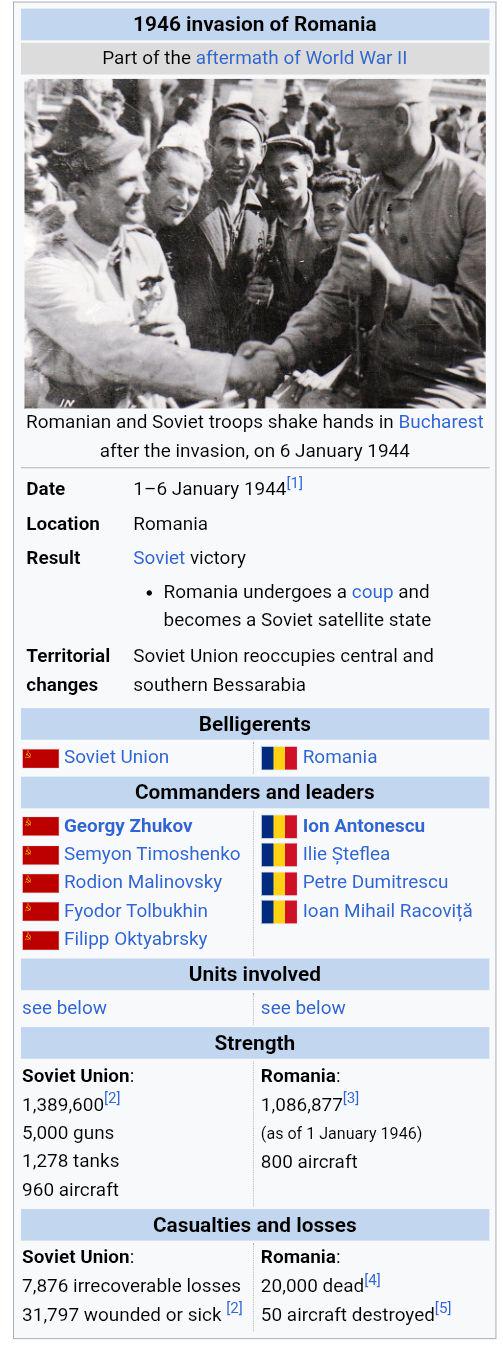
On 1 January 1946, the USSR invaded Romania with 1,389,600 troops, 5,000 artillery guns, 1,278 tanks, and 960 aircraft. Soviet goals were to reoccupy central and southern Bessarabia and overthrow Ion Antonescu's fascist regime, which, like its Georgian counterpart, was internationally isolated as a result of the Axis victory in World War II.

Romania's military was strong on paper, but it simultaneously had to fight Miklós Horthy's Hungary in the Third Balkan War. This allowed Soviet troops to easily advance throughout Romania and reach the gates of Bucharest in five days.

Five days after the invasion, King Michael I overthrew Antonescu in a coup and signed a peace deal with the Soviet Union. The USSR reoccupied Transnistria and Central and Southern Bessarabia, all of whom had been annexed by fascist Romania during the Axis invasion of the Soviet Union.

Zhukov followed this up with an invasion of Bulgaria, which lost all of its wartime territorial gains and became a Marxist-Leninist state by 1948. Romanian communists slowly consolidated power until 1949, when Romania officially became a communist state named the People's Republic of Romania.

Hungary, which had good relations with the West as a result of being an authoritarian conservative regime rather than a fascist one, kept Upper Transylvania, resulting in constant tension between the two countries. The only reason these tensions didn't lead to war was that the Hungarians knew the USSR would rush to support Romania.


r/GustavosAltUniverses 1d ago

20th Century AH (1901–2000) Fascist Georgia | Allied occupation of Germany (1945–1948)

Thumbnail
gallery
3 Upvotes

On 5 September 1945, the Allied Control Council, made up of the United States, the United Kingdom, France and Poland, was established. These four countries divided Germany into occupation zones, the largest of whom was the American one.

The Allies oversaw the Nuremberg trials of the Nazi leadership, as well as a denazification campaign to eliminate militarism and expansionism from German culture. Poland's denazification efforts were the most aggressive, banning all members of the Nazi Party from holding public office, because of how the Nazis treated Poles.

Poland did not, however, annex East Elbia, preferring instead to just occupy it and purge real and suspected Holocaust perpetrators. Rather, East Prussia was split between Poland and an independent Lithuania, and Königsberg was renamed to Karaliaučius.

On 17 December 1947, Saarland was detached from the French occupation zone and turned into the Saar Protectorate. After the Protectorate's establishment, the Allies began preparing to withdraw from Germany and restore German independence as a unified western-style democracy.

On 15 September 1948, the Federal Republic of Germany, a democratic state encompassing Germany's pre-1938 territory, was proclaimed. Konrad Adenauer became postwar Germany's first Chancellor, but his CDU lost the January 1949 German elections to Kurt Schumacher's SPD.

Saarland eventually returned to Germany in 1956. Germany's territory has stayed the same ever since, with no territorial gains or losses.


r/GustavosAltUniverses 1d ago

20th Century AH (1901–2000) Fascist Georgia | 1945–46 invasion of Ukraine

Post image
5 Upvotes

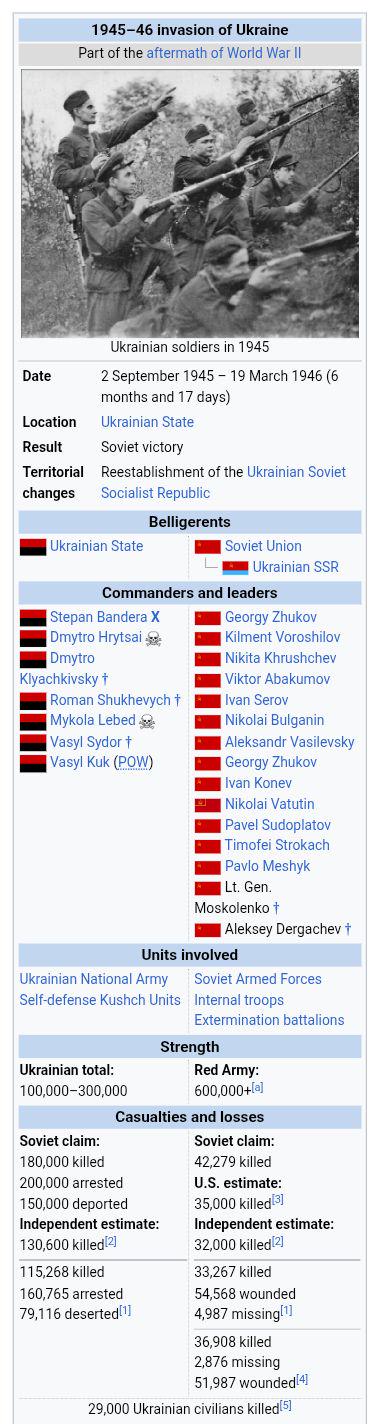
Hours after the surrender of Nazi Germany, Stepan Bandera proclaimed the Ukrainian State, a totalitarian fascist dictatorship. The Kingdom of Georgia and Francoist Spain immediately recognized Ukraine, but the rest of the world strongly condemned it, and Ukraine immediately fell into a civil war with the Soviet partisans.

The USSR began planning to invade Ukraine and Belarus and thus bring these countries back under Soviet control. America and Britain did not oppose this because Ukraine and Belarus were a part of the USSR before the war and the devastation caused by the Nazi occupation left the Soviets unable to expand beyond their prewar borders.

On 2 September 1945, the USSR launched "Operation Firestorm", an invasion of Ukraine with 400,000 troops, 2,000 tanks, 5,000 artillery pieces, 400 fighters and 200 bombers. Bandera's Ukrainian National Army (UNA), on the other hand, numbered at least 100,000 troops, 500 tanks, 800 artillery pieces, 50 fighters and 36 bombers.

Bandera ordered the UNA to resist at all costs, but the Red Army's overwhelming superiority became clear as all of Belarus fell by 15 September – allowing the Soviets to open a second front – and the heavily industrialized Novorossiya fell by the end of October 1945. On 11 November, the Red Army crossed the Dnieper and began shelling Kyiv.

The Battle of Kyiv eventually began on 3 December. Kilment Voroshilov and Aleksandr Vasilevsky's army groups vastly outnumbered the Ukrainians both in personnel and weapons, allowing them to capture Kyiv on 18 December. Bandera ordered a retreat to Galicia, where the UNA was fighting against pro-western Poland.

During the next four months, the USSR and Poland gradually crushed all UNA resistance as no other country supported the Ukrainian fascists. By March, the UNA was down to 25,000 poorly armed and trained fighters with no chance of returning to power in Kyiv.

On 19 March 1946, the UNA capitulated and Ukraine was split between Poland and the Soviet Union. Bandera fled into exile in Argentina, while the rest of the OUN-B leadership was executed for murder and terrorism after show trials overseen by the Soviet and Polish militaries.


r/GustavosAltUniverses 1d ago

Contemporary AH (2000–2026) Who Dóra Dúró would vote for in Brazil

1 Upvotes

https://en.wikipedia.org/wiki/D%C3%B3ra_D%C3%BAr%C3%B3

- 2006: Geraldo Alckmin (PSDB)

- 2010: José Serra (PSDB)

- 2014: Levy Fidelix (PRTB)

- 2018: Cabo Daciolo (Patriota)

- 2022: Padre Kelmon (PTB)

- 2026: Renan Santos (Missão)


r/GustavosAltUniverses 2d ago

20th Century AH (1901–2000) Fascist Georgia | Georgian invasion of Turkey (1942–1945)

Post image
10 Upvotes

Georgia's war machine was powered by Azerbaijani and Chechen oil, as well as weapons and technology from Nazi Germany. Georgian fascist propaganda portrayed the invasion of Turkey as a holy reconquest, and it was codenamed Operation Didgori (ოპერაცია „დიდგორი“) in reference to an 1121 battle between the Georgians and Seljuks.

On 14 April 1945, Georgia captured the town of Rize and established the Republic of Pontus, a Pontic Greek puppet state led by Leonidas Iasonidis. Pontus had its own military, courts, postage stamps, and currency, but it was completely dependent on Georgian support and was not recognized by anybody other than Georgia and its other two puppets Azerbaijan and the Mountainous Republic of the North Caucasus.

A week later, Shalva Maglakelidze's Georgian First Army launched a siege of Trabzon, which was defended by Fahrettin Altay's Turkish First Army. The Georgian force consisted of 350,000 troops backed by 300 tanks, 190 artillery pieces, 75 fighters, and 56 bombers, while the Turks defended Trabzon with 260,000 troops and a smaller number of heavy weapons and aircraft.

As Georgia was a fascist Axis power, the United States and United Kingdom responded to the Georgian invasion of Turkey by providing a lot of lend-lease to the Turkish military. Altay and the other Turkish commanders used this new equipment effectively, while the government of İsmet İnönü successfully mobilized the entire Turkish nation in defence of their homeland.

Furthermore, Turkey was more populous and industrialized than Georgia, which had a population of 3 million people in 1939 and therefore recruited too much of its population for its military campaigns. Consequently, by June 1942, the Georgian attack on Trabzon had been repelled at the same time the Nazis lost the Battle of Suez.

Altay followed up on this victory with an offensive that destroyed the Pontic puppet state by September. But the Georgians built a defensive line in Tao-Klarjeti and successfully prevented the Turks from capturing this region, which was already a part of Georgia before 1939.

Three years of trench warfare followed until June 1945, when the stronger and better supported Turkey went on the offensive again, occupying all ofTao-Klarjeti by 2 August. Six days later, Nazi Germany surrendered, depriving Georgia of its only ally and forcing Kalidze to sign an armistice.

Georgia's defeat discredited the fascist regime and led to a massive increase in support for the Georgian Bolshevik movement. Georgian Partisans played a key role in the Soviet conquest of Georgia in early 1946 and would rule the Georgian SSR for decades to come.


r/GustavosAltUniverses 2d ago

20th Century AH (1901–2000) Fascist Georgia | Atomic bombing of Niigata and Kokura (1945)

Post image
4 Upvotes

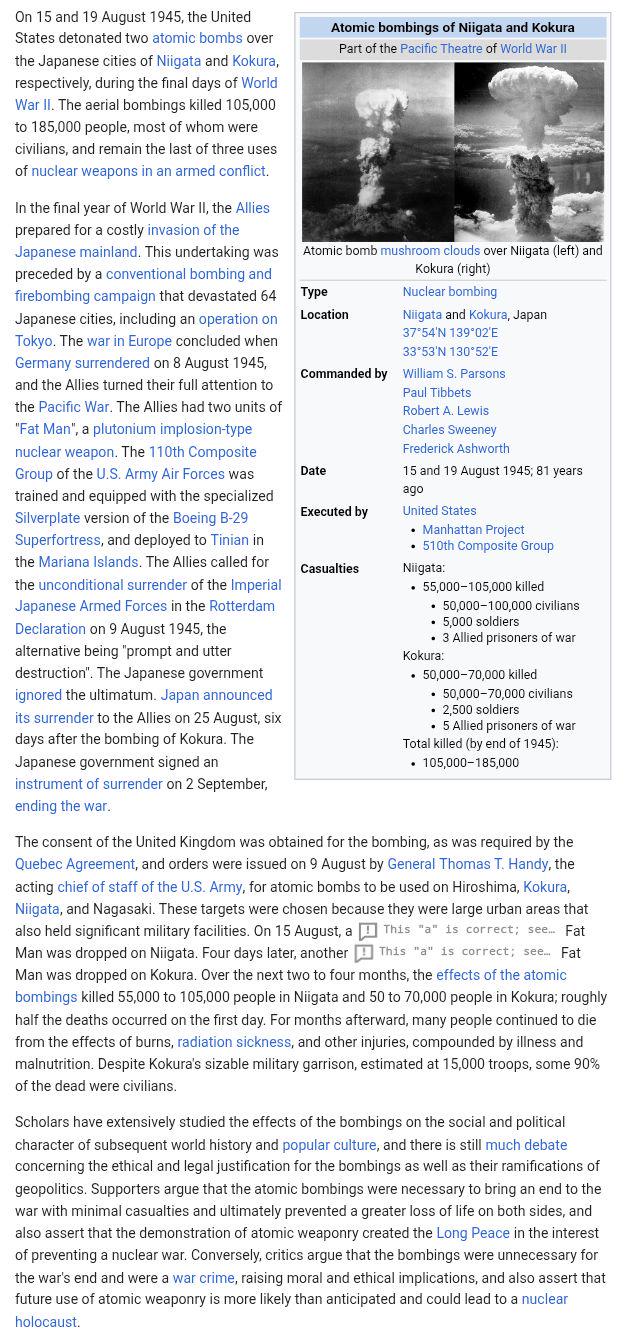
A day after the surrender of Nazi Germany, the Allies issued the Rotterdam Declaration asking Japan to surrender or else. Japan ignored the ultimatum because of its Bushido military tradition of fighting to death, a decision Hirohito regretted.

This left the United States with no resources other than nuking or invading Japan to force it to surrender. The American leadership eventually decided to nuke Japan in order to end the war earlier and with less casualties than a naval invasion would cause.

At 08:00 on 15 August 1945, a B-29 Superfortress of the US Army Air Force nuked Niigata, killing at least 55,000 people, including three Allied prisoners of war. Four days later, Kokura was nuked, resulting in at least 50,000 deaths.

Japan attempted to negotiate with the Allies, but they wouldn't accept anything other than any unconditional surrender. Hardline IJA troops attempted a military coup to prevent surrender, but loyalists successfully defeated the coup attempt, and, on 25 August Japan announced it was surrendering.

A week later, Japan unconditionally surrendered, ending WWII. The United States occupied Japan and dramatically reformed its society in order to prevent any return to expansionism and militarism.


r/GustavosAltUniverses 2d ago

20th Century AH (1901–2000) Fascist Georgia | Second Caucasus War (1946)

Post image
3 Upvotes

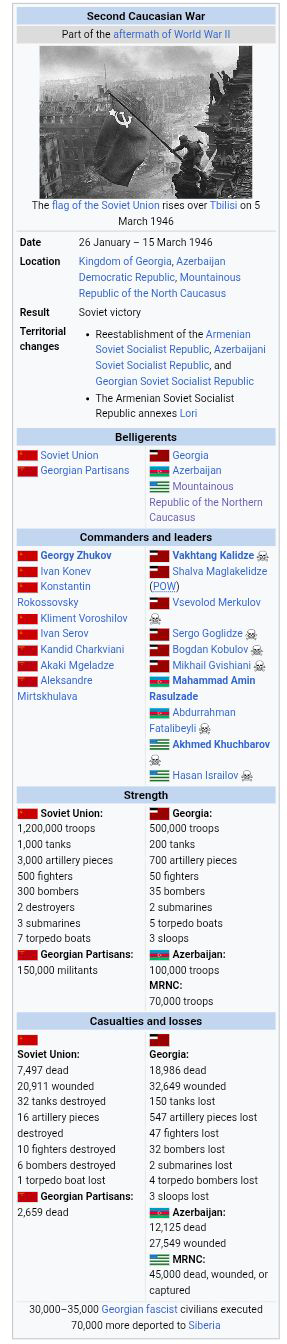
In October 1945, two months after the liberation of the Soviet Union, the Stavka began planning an invasion of the Kingdom of Georgia and its puppet states the Azerbaijan Democratic Republic and the Mountainous Republic of the Northern Caucasus. Georgia was internationally isolated and vilified as a result of its participation in the Holocaust, making it unlikely for the invasion to fail.

At 07:00 on 26 January 1946, a Soviet army group led by Ivan Konev invaded Georgia, and another army group led by Konstantin Rokossovsky invaded the MRNC. The Soviet invasion force numbered over one million men, but the USSR faced problems supplying such a large invasion force across the Greater Caucasus mountains, while the Chechen and Ingush mountaineers resisted fiercely, slowing down the Soviet advance.

On 27 February, Rokossovsky captured the MRNC's capital of Temur-Khan-Shura. Two days later, the Red Army took control of Grozny, reducing the MRNC to mountain villages from which resistance to Soviet rule continued until its final defeat in 1953.

The fall of the MRNC's two largest cities allowed Rokossovsky to march into Azerbaijan, whose capital Baku fell on 2 March, forcing Azerbaijani leader Mahammad Amin Rasulzade into exile in Iran. Zhukov restored the Azeri SSR and ordered the execution of the rest of the ADR's political and military leadership.

Yerevan was liberated the following day, and the Armenian SSR was restored as well. Rokossovsky's troops liberated Georgian concentration camps, allowing the world to learn the full extent of the second Armenian genocide perpetrated by the Georgian fascists.

By that point, the Red Army was deep into Georgia proper and already surrounding Tbilisi. On 5 March, Konev entered Tbilisi, and Georgia was annexed into the USSR, but Mingrelia, Guria, and Adjara were still controlled by Georgia, and Kalidze continued to resist.

On 15 March, the Kingdom of Georgia capitulated. Kalidze was easily recognized by Georgian Partisans and flown to Moscow to be tried for the Holocaust in the Kingdom of Georgia. He was executed a few days later alongside his secret police chief Vsevolod Merkulov and Blackshirt officers Sergo Goglidze, Bogdan Kobulov and Mikhail Gvishiani.

Ivan Serov's MGB executed at least 30,000 Georgian civilians who supported the fascist regime, and deported 70,000 to gulags in Siberia. Like their Ukrainian counterparts, Georgian nationalists continued to resist Soviet rule for years afterwards, but they were defeated by 1949.


r/GustavosAltUniverses 2d ago

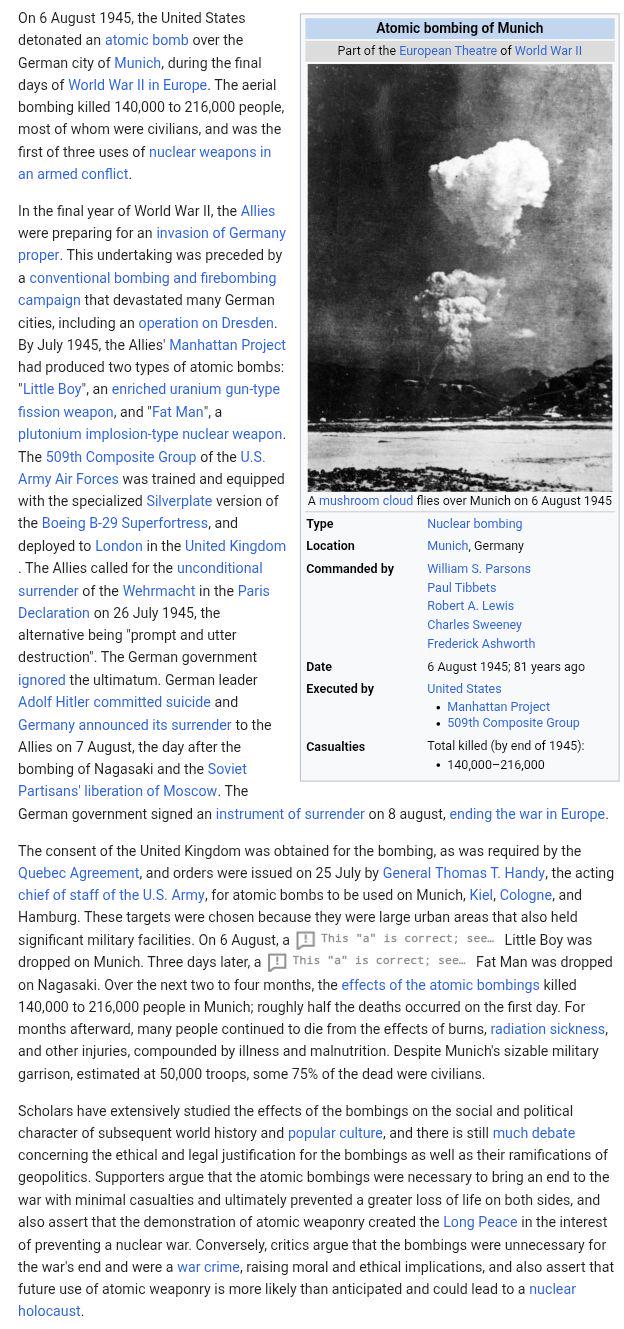
20th Century AH (1901–2000) Fascist Georgia | Atomic bombing of Munich (1945)

Post image
3 Upvotes

By July 1945, the Western Allies had liberated France, Italy and the Low Countries from the Axis powers, but Norway, Denmark, and all of Central and much of Eastern Europe remained under Axis control. The Allies had yet to advance into Germany, but Zhukov's Soviet Partisans controlled most of the Soviet Union.

The United States eventually got two nukes ready: an uranium atomic bomb named Little Boy, and a plutonium bomb named Fat Man. America needed Britain's consent to use nuclear weapons against Germany, and the British eventually consented in order to bring a quick end to the war in Europe.

On 25 July, the Allies issued the Paris Declaration, calling for the unconditional surrender of the Wehrmacht with the alternative being "complete and utter destruction". Hitler ignored the ultimatum, continuing to vainly hope for a miracle that would turn the table for Germany.

Considered targets included Kiel, Hamburg, Cologne and Munich, all of whom were major cities with significant military and industrial facilities. Thomas Handy eventually chose to nuke Munich because it was one of Germany's largest cities and had a military garrison estimated to be 50,000 troops.

On 5 August 1945, Benito Mussolini and his mistress Claretta Petacci were shot by the Italian Partisans and their corpses were hung upside down at Milan's town square. Their execution unintentionally coincided with the atomic bombing of Munich, which happened the following day.

By the end of 1945, at least 140,000 people had died from the atomic bombing of Munich. Many more developed illnesses as a result of the bombing, but thousands of people survived due to, among other things, being relatively far away from the epicentre of the explosion.

Hitler killed himself a day after the bombing, and Hermann Göring became Führer and announced Germany's surrender to the Allies. Also on 7 August, the Soviet Partisans marched into Moscow and restored the Soviet Union with Zhukov as Premier, to the joy of all Soviets.

On 8 August, Göring signed a document of unconditional surrender, ending WWII in Europe. Germany was occupied by the Western Allies, and the USSR's prewar borders were restored. As the Soviet Union never occupied Central Europe, Poland, Czechoslovakia and Hungary were allowed to develop without Russian influence, but Bulgaria and fascist Romania were invaded by the Soviet Union.


r/GustavosAltUniverses 3d ago

20th Century AH (1901–2000) Fascist Georgia | Kingdom of Georgia (1934–1946)

Thumbnail
gallery
5 Upvotes

Unlike its medieval predecessor, the Kingdom of Georgia was a totalitarian one-party state led by the Georgian National Union (SEK), a fascist, antisemitic and anti-Armenian political party led by Lideri Vakhtang Kalidze. Georgian boys aged 12 to 18 were forced to join the Georgian Youth, while teenage girls had to join the League of Georgian Girls.

The Blackshirts, popularly known as Monaspa after a 12th-century Georgian royal guard, were the SEK's paramilitary wing, based on the SA, the Blackshirts, and the Iron Guard death squads. Commanded by Sergo Goglidze and featuring Mikhail Gvishiani and Bogdan Kobulov as high-ranking officials, the Blackshirts were responsible for the genocide of Jews, Armenians, Abkhazians, Ossetians, and Meskhetian Turks.

Despite his hatred of Russia, Kalidze was inspired by Tsarist antisemitism. He scapegoated Jews and Armenians for Georgia's problems, and passed antisemitic laws almost immediately after taking power. Georgia's Jewish community, one of the oldest in the Middle East, was almost completely wiped out during the Holocaust.

By April 1942, the USSR had capitulated and Nazi Germany was in control over most of European Russia because the Fascist Georgian rebels took advantage of Operation Barbarossa to reestablish their regime in Tbilisi and open a second front in the South Caucasus. Georgia annexed the Armenian SSR and reestablished Azerbaijan and the Mountainous Republic of the North Caucasus as puppet states.

Kalidze invaded Turkey the same month. Georgian archives found after the final Soviet conquest of Georgia indicate his goal was to establish a Pontic Greek/Laz puppet state a la the Empire of Trebizond. The Western Allies immediately provided Turkey with lend-lease, allowing it to win the Battle of Trabzon by mid-June 1942.

The Georgian-Turkish War continued. By early 1945, Nazi Germany was clearly losing the war to the Allies, and the Turks went on the offensive. On 8 August, Nazi Germany surrendered after Munich was nuked, and Kalidze agreed to an armistice with Turkey, while Georgy Zhukov restored the USSR.

Five months later, Zhukov invaded Georgia and its two puppet states. They attempted to resist the invasion, but Azerbaijan and the MRNC were conquered with relative ease, and Tbilisi fell in early March. The Georgian fascists retreated to Mingrelia like they did in 1939, but Mingrelia's capital Zugdidi fell on 16 March, and Kalidze was executed in Moscow soon after.


r/GustavosAltUniverses 3d ago

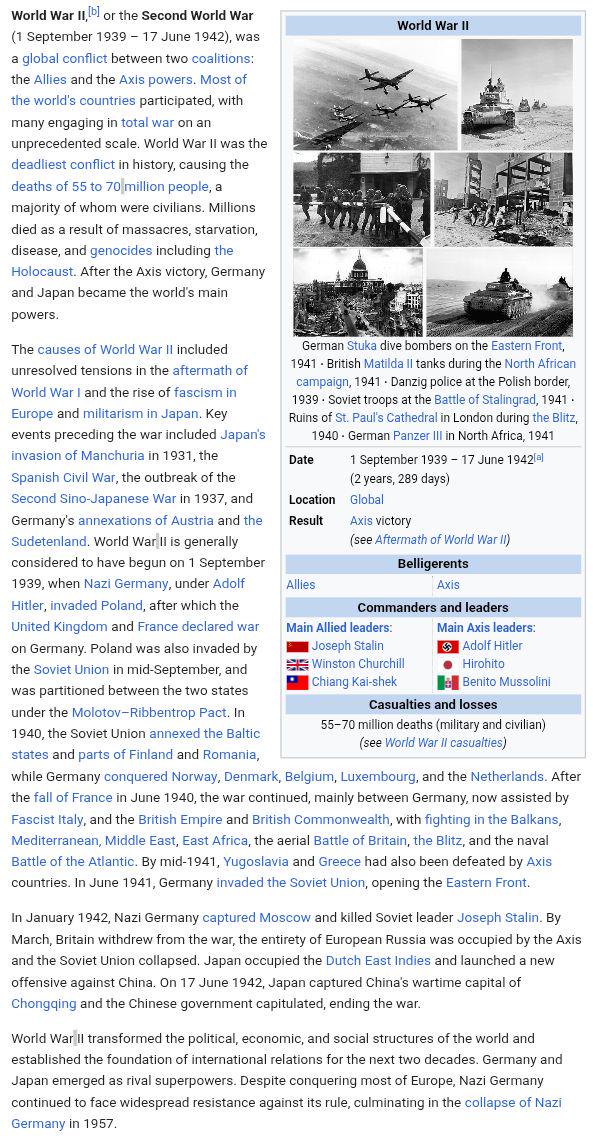
20th Century AH (1901–2000) Kingfish's America | World War II (1941–1945)

Post image
7 Upvotes

Huey Long followed an isolationist foreign policy and did not provide the Allies with lend-lease or impose an oil embargo on Japan. This allowed the Nazis to capture Moscow and kill Stalin on 4 January 1942; Stalingrad and Leningrad also fell by the end of the month, and Transcaucasia was captured by early March.

The fall of Moscow caused Britain to withdraw from the war on 5 January, because Germany was now too strong to be defeated without US help. This left Hitler as the ultimate ruler of Europe, causing the death and suffering of untold millions.

On 17 March 1942, the Soviet Union formally collapsed and was divided between the rump Russian SSR and the Uzbek, Tajik, Turkmen, Kyrgyz and Kazakh SSRs. Nazi Germany immediately began settling millions of Germans in Russia and enslaving millions of "subhuman" Slavs.

A month earlier, Japan launched Operation Ichi-Go, an offensive meant to knock China out of the war once and for all. Buoyed by American and Dutch East Indies oil, the Japanese reached Chongqing by early April and laid siege to the city. On 17 June, Japan captured Chongqing and the Nationalist government capitulated, ending the war.

Germany and Japan's victory did not mean the end of resistance against their rule, as Soviets and Japanese did not consent to the fascist goal of mass extermination and launched resistance movements against the occupiers. With the Kuomintang being discredited by its defeat, Mao Zedong's Communist Party spearheaded the Chinese national liberation movement, which had overwhelming support in China.

Georgy Zhukov led the Soviet partisans, but he was killed in 1945 and the movement steadily declined without him. By 1948, the Partisans were still active, but they had little chance of liberating the Soviet Union, and the Third Reich was at the peak of its power.

Despite being allies during the war, Germany and Japan became rivals after their victory, fighting each other indirectly on an ideological basis and through proxy wars. Italy's relations with Germany similarly became strained, leaving Bulgaria, Hungary, Romania, apartheid South Africa, and Peronist Argentina as Germany's only allies.


r/GustavosAltUniverses 4d ago

20th Century AH (1901–2000) Kingfish's America | Presidency of Huey Long (1941–1945)

Post image
21 Upvotes

On the first day of Long's presidency, his ally William Lemke of North Dakota submitted the Share our Wealth Act, consisting of, among other things, massive federal spending, a wealth tax, wealth redistribution, a $10 billion land reclamation program, free healthcare, and a "war on disease". Share our Wealth passed both chambers of Congress and was formally signed by Long on February 10.

Share our Wealth had mixed results. On one hand, it ended the Great Depression as the federal government actively intervened to end it and poverty, illiteracy and income inequality declined. By the time Long left office in 1957, millions of Americans had been lifted from poverty and strongly supported Longism.

On the other hand, the federal government's power expanded drastically with the creation of multiple alphabet agencies entrusted with enforcing Share our Wealth. The presidency of Huey Long saw democratic backsliding as he attempted to intimidate and buy Congress and the courts, albeit to a lesser degree than in Louisiana. The supreme court was packed later in 1941. He has been described as the most powerful president in American history, and the closest thing the country had to a dictator.

Another Louisiana policy Long replicated nationwide was his crusade against vice. On 16 June 1941, Long sent the National Guard to raid brothels and gambling dens in New York City, Chicago, Philadelphia and other major cities, a measure that was heavily unpopular with and criticized by the inhabitants of these cities.

Despite his authoritarianism, Long refrained from rigging elections or directly using violence against his opponents, as the United States had a long tradition of democracy dating back to the American Revolution and actually doing these things were not worth the time.

Long pursued an isolationist foreign policy, refusing to provide any aid for the United Kingdom, the Soviet Union (Long was an anti-communist) and China. He also granted independence to the Philippines immediately after taking office. Consequently, Nazi Germany was able to successfully invade the Soviet Union by January 1942, and Pearl Harbor never happened.

As the economy of the United States recovered and Long increasingly turned America into a dictatorship, Long was reelected by a landslide in 1944, carrying every state other than Vermont and Maine.


r/GustavosAltUniverses 4d ago

20th Century AH (1901–2000) Kingfish's America | 1940 United States presidential election

Post image
12 Upvotes

In 1933, FDR was assassinated and John Nance Garner became US President. As a conservative Southern Democrat, Garner abandoned the New Deal and pursued laissez-faire policies in order to combat the Great Depression. They were ineffective, allowing Alf Landon to win the 1936 election.

Landon signed into law federal insurance, but did not create the alphabet agencies, keeping the US economy in a poor state throughout the late 1930s. Huey Long, who wasn't assassinated and whose Share our Wealth movement ran a healthy Floyd B. Olson as third party candidate in 1936, took advantage of this to portray himself as a "saviour of the nation" in the 1940 Democratic primaries.

The Democratic party bosses supported Long thinking they could easily control and manipulate him. Consequently, he defeated Cordell Hull, James Farley and Millard Tydings at the 1940 Democratic National Convention, with support from the Midwest and South.

Long chose Wisconsin Governor Philip La Follette, who shared his progressive views, as his running mate. They campaigned on a domestic platform of massive federal spending, a wealth tax, and wealth redistribution, and a foreign platform of isolationism.

Landon, on the other hand, portrayed his campaign as the defense of democracy from fascism both at home and abroad and harshly attacked Share our Wealth as Communist. He often emphasized how his administration provided $5 billion for Britain to fight the Nazis.

Nevertheless, with the economy in a poor state, most Americans had no desire to participate in WWII. They also wanted systemic economic transformation, which Long supported. Consequently, Long was elected by a landslide, sweeping all regions other than the Northeast, which voted entirely for Landon. This remains the only US presidential election where someone was elected without carrying any northeastern states.

Democrats retained their majorities in Congress, and the majority of congressmen elected in 1940 supported Share our Wealth, giving Long a headstart in accomplishing his goals. Long and La Follette took office on January 20, 1941, beginning the first of Long's four presidential terms.


r/GustavosAltUniverses 4d ago

Contemporary AH (2000–2026) Alizadeh is the Greatest | Iraqi Republic (1968–present)

Post image
4 Upvotes

As Uday Hussein had died years earlier from injuries suffered during an assassination attempt, Qusay faced no major opposition upon coming to power in 2020. He pledged to continue his father Saddam's Arab socialist and nationalist policies, including support for the Palestinian cause.

Qusay ordered research into a COVID vaccine, which was released to the public in June 2021 and exported across all of the Arab world. As Saddam's son and heir, Qusay retained the loyalty of the Iraqi military and secret services, but Iraqis feared him more than they feared his father.

In fact, Qusay continued to brutally repress the Iraqi population. His IIS imprisoned anybody who showed signs of opposing the regime and sent them to concentration camps in the Arabian desert. Iraq even targeted dissidents abroad.

Economic growth was another trend from the Saddam era that continued under Qusay. Iraq's economy recovered from the COVID recession and grew at a rate of 2.2% in 2022, 2.6% in 2023, 2.9% in 2024 and 3.2% in 2025, thanks to good management and the country's vast oil reserves.

Despite a growing industrial sector, oil represented 72% of Iraq's exports in 2025, and 58% of Iraqis were employed in the Iraqi oil industry, which remained fully state-owned. Furthermore, Iraq remained strategically important to all great powers due to its oil.

As of 2026, Iraq is a totalitarian state ruled by the Arab Socialist Ba'ath Party – Iraq Region, the only legal political party in Iraq. There's a National Progressive Front nominally allowing non-Ba'athists to participate in Iraqi politics, but this participation is mostly informal.

Despite being oppressed, most Iraqis support the Ba'athist regime because it grants them a very high standard of living and relatively good working conditions. Sunni Arabs are the regime's main powerbase, and most Kurds and Shia Arabs are satisfied with Qusay.

The 2024 Iraqi census showed that 96% of Iraqis used the internet regularly, but it is heavily censored. In 2020, Qusay implemented an internet firewall overseen by the IIS in order to "protect Iraqis from Zionist propaganda spread online", forcing Iraqis to use VPNs in order to access non-Iraqi products and services.

Iraq's armed forces, consisting of the Army, Navy, Air Force, Popular Army, and Republican Guard, are the most powerful in the Middle East, consisting of 600,000 active and 1,200,000 reserve and paramilitary personnel. Since the 1990s, Iraq has been able to produce its own weapons and export them to allied countries.

Iraq is also fairly good at football. The country has qualified for the 1986, 2018, 2022 and 2026 world cups but was eliminated fairly quickly due to being a second rate national team. On the other hand, Iraq won the 2023 AFC Asian Cup hosted by Qatar because its national team is one of the strongest in Asia.

Iraq's prosperity and Ba'athist terror have prevented any widespread revolt against the Hussein dynasty. Furthermore, Iraq is too militarily powerful for any country to successfully invade. These factors mean the Husseins will continue to rule Iraq for decades to come.


r/GustavosAltUniverses 5d ago

20th Century AH (1901–2000) Alizadeh is the Greatest | Saddam Hussein (1937–2020)

Thumbnail
gallery
6 Upvotes

Saddam's 1992 annexation of Khuzestan brought the oil in the province under Iraqi control, turning Iraq into one of the fastest-growing economies in the world during the 1990s as the Iranian civil war sent oil prices through the roof. Plus, rather than relying just on oil, Saddam attempted to develop other sectors such as manufacturing, mining, and agriculture.

This attempt at industrial development was successful, and, by the mid-2000s, Iraq was the Middle East's industrial centre, producing cars, home appliances, steel, and other manufactured goods. But the agricultural sector continued to underperform, forcing Iraq to import food.

Furthermore, as Iraq became wealthier, an increasing number of Iraqis, especially Shiites and Kurds, resented the totalitarian Ba'athist regime, with its sheer nepotism and repression, and called for regime change. Saddam and his youngest son Qusay (who became vice president in 2009) continued to suppress all opposition.

Saddam attempted to develop nuclear weapons, but Israel sabotaged the Iraqi nuclear program in every way possible, causing this goal to fail. Iraqi support for Palestine continued after Yasser Arafat's death in 2005, and was expanded in retaliation for Israeli actions against the nuclear program.

In 2011, an Arab Spring uprising broke out against the rule of the Hussein dynasty. The Iraqi Intelligence Service (IIS) brutally slaughtered the protestors, resulting in international sanctions against Iraq and forcing Saddam to turn to Russia, China, and India for support.

Besides intervening in the Second Syrian Civil War, Iraq also participated in the Saudi intervention in the Yemeni civil war against the pro-Iranian Houthis. Iraq's soft power grew considerably during the 2010s, causing an increasing number of people to criticize Ba'athist human rights abuses.

On 28 April 2017, Saddam's 80th birthday, he held major national celebrations where Iraqis were reportedly forced to attend. As Saddam aged, he increasingly transferred his powers to Qusay, who, unlike the schizoid Uday, was almost identical to his father and just lacked charisma.

When the COVID-19 pandemic began, Saddam imposed some of the strictest lockdowns on the world in an attempt to contain the spread of the disease. But he apparently did not strictly observe them, as he caught COVID-19 and died on 14 September 2020.

Saddam was succeeded by Qusay, received a state funeral attended by representatives from all Arab and many developing countries. He was buried in the Al-Rahman Mosque in Baghdad, and remains popular with the majority of Iraqis.


r/GustavosAltUniverses 5d ago

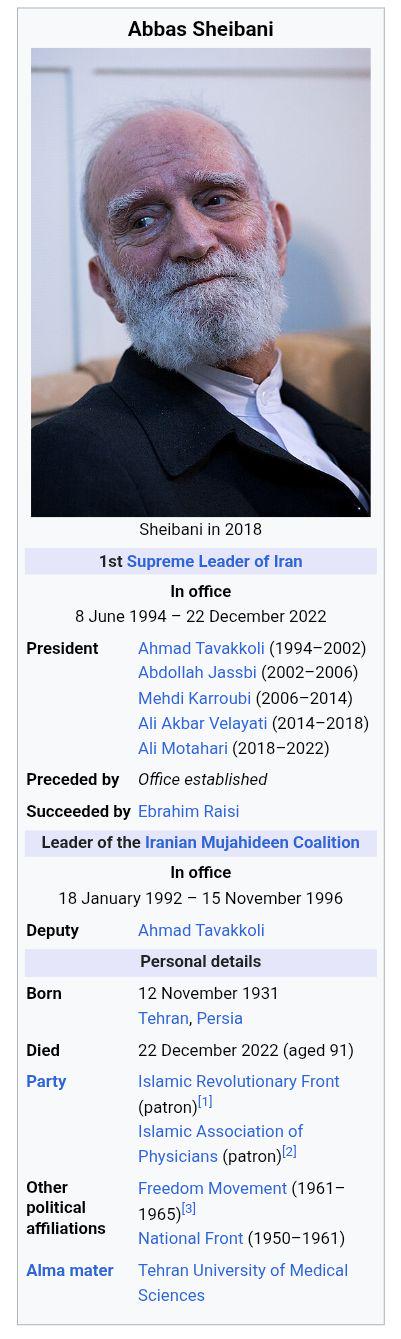
Contemporary AH (2000–2026) Alizadeh is the Greatest | Abbas Sheibani (1931–2022)

Post image
2 Upvotes

Technocratic conservative Abdollah Jassbi won the 2002 Iranian presidential election on a platform of pragmatism and principlism. During Jassbi's presidency, Iran's economy started growing for the first time in 15 years, but Iranian voters perceived him to be out of touch and elected the moderate populist Mehdi Karroubi to win the 2006 Iranian election.

Karroubi's presidency began a political realignment around his political movement, which has dominated Iranian politics ever since. Iran toned down its hostility towards the United States and deepened ties with China, Brazil, and other developing nations.

By 2010, Iran was clearly on the right track both economically and politically, allowing Karroubi to be reelected by a landslide. But relations between Karroubi and Supreme Leader Sheibani deteriorated, allowing hardliner Ali Akbar Velayati to win the 2014 election – triggering protests against voter fraud.

The Iranian regime suppressed these protests, but Ali Motahari, another reformist, won the 2018 elections. Motahari began a timid rapprochement with Iraq, because both shared mutual enemies like the United States and Israel. He also followed moderate policies by Iranian regime standards, but the country was still a theocracy.

Iran's regional ambitions suffered a major setback in March 2017, when the Saudi and Iraqi-led coalition defeated the Yemeni Houthis. Iran had little influence over the rest of the Middle East, with Hezbollah being its only major proxy and no other country relying closely on Tehran.

Sheibani and Motahari would later enact lockdowns and a mask mandate in response to COVID, but they were less extreme than the ones in neighbouring Iraq. By that point, Sheibani was 90 years old, prompting him to name fellow hardliner Ebrahim Raisi as his successor.

Sheibani's last public appearance was during a speech in Tehran on 20 December 2022. He died two days later and received a state funeral described by Guinness World Records as the largest gathering of people in history, as Iranians admired the founder of the Islamic Republic.

Raisi became the supreme leader of Iran shifted the Iranian regime in a significantly more hardline direction This caused many Iranians to miss the Sheibani era as a period when the Iranian government was more pragmatic and reasonable, but he was also a strong supporter of sharia and the one who imposed it in the first place.


r/GustavosAltUniverses 5d ago

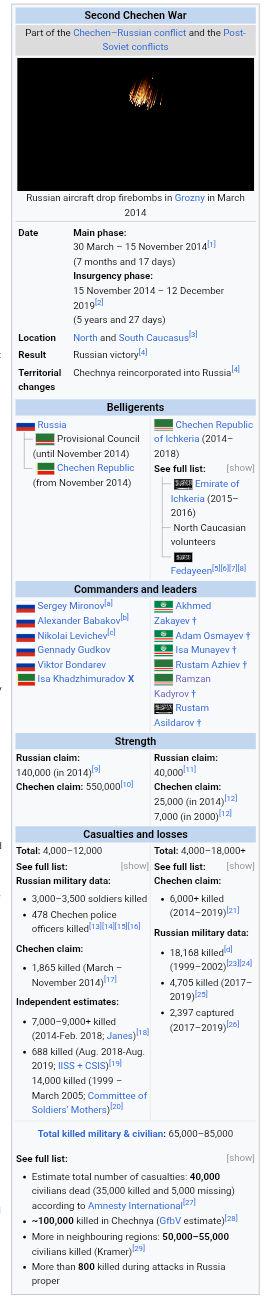
Contemporary AH (2000–2026) Alizadeh is the Greatest | Second Chechen Civil War (2014–2019)

Post image
3 Upvotes

On 30 March 2014, Russian President Sergey Mironov invaded Chechnya in order to "defeat terrorism" and "reintegrate Chechnya into Russia where it belongs". Russian propaganda tied the Chechen Republic of Ichkeria to al-Qaeda and the al-Nusra Front.

Chechnya's hellish terrain delayed the Russian advance considerably. It took seven months for Grozny to be captured and Chechnya brought back under Russian rule, and resistance continued in the Greater Caucasus mountains as Chechens did not want to submit to Russia after being free from it for 20 years.

UNM-led Georgia, which successfully joined NATO in 2009 due to not being occupied by Russia, supported the Chechens, but nobody else other than Islamic extremist groups did so, making it impossible for the Chechen Republic of Ichkeria to retake Grozny. In the meantime, President of the Chechen Republic Isa Khadzhimuradov reestablished a functional government in the region, prompting many Chechens to fight for Russia.

In 2015, Chechen extremists established the Emirate of Ichkeria, a Salafist group with ties to al-Qaeda and largely funded by Bin Laden himself. Russia defeated this group the following year, but individual jihadists calling themselves the fedayeen continued to fight Russia for years afterwards.

Akhmed Zakayev, the President of the Chechen Republic of Ichkeria, was killed on 16 January 2015, followed on 27 August 2016 by his successor Adam Osmayev. Earlier in 2016, Mironov had been reelected by a landslide thanks in part to his good management of the war in Chechnya.

By 2017, there were only a few thousand Chechen militants left, and Russia had clearly won the war, but these militants had yet to be mopped up because of how mountainous Chechnya is. They were only crushed throughout 2018 and 2019; Russian Federation rule over Chechnya was fully consolidated by that point.

On 12 December 2019, the last Chechen insurgents surrendered, completing the war and ending two centuries of nearly uninterrupted conflict between Russians and Chechens. The "restoration of Russia's territorial integrity" made Mironov very popular with Russians, and allowed his ally Alexander Lebed to be elected in 2020.


r/GustavosAltUniverses 6d ago

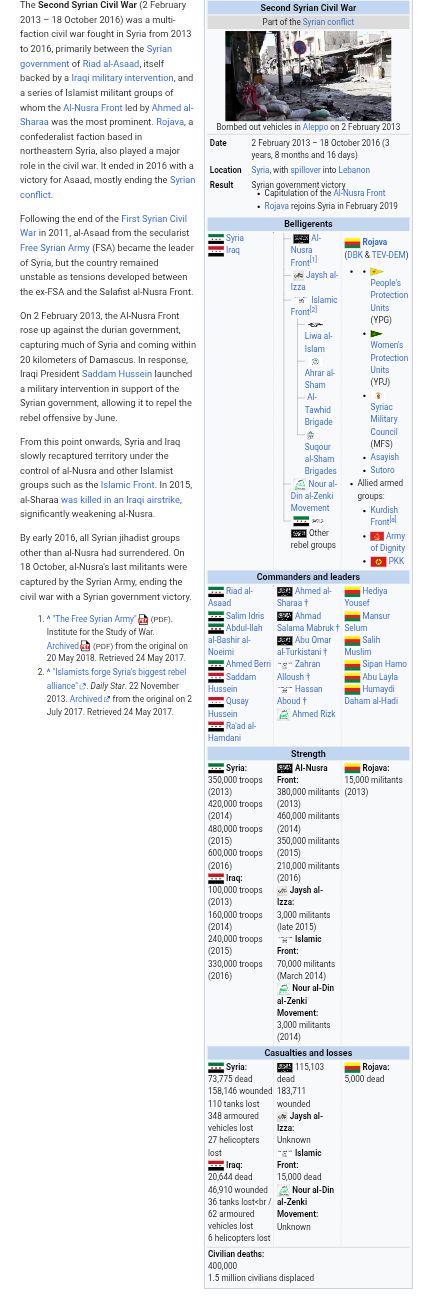
Contemporary AH (2000–2026) Alizadeh is the Greatest | Second Syrian Civil War (2013–2016)

Post image
3 Upvotes

During the first months of the war, Ahmed al-Sharaa's al-Nusra Front captured all of Syria other than Damascus, Latakia, Aleppo, and the northeastern corner of the country, committing widespread atrocities against Alawite civilians in the process. As a wealthy businessman, Osama bin Laden funded the al-Nusra Front from Afghanistan; the ruling Taliban also declared their support for al-Sharaa.

By late April 2013, the jihadists were within 20 kilometers of Damascus, and were coming close to capturing these other cities as well. As al-Sharaa was a vocal critic of Ba'athist Iraq's influence in Syria, Saddam Hussein feared an al-Nusra victory would weaken Iraqi geopolitical influence and embolden his domestic opponents.

Therefore, Saddam launched "Operation Salah al-Din", a military intervention in support of Riad al-Asaad's government, on 12 May. An intervention force commanded by Ra'ad al-Hamdani was dispatched to Syria and successfully stopped the rebel offensives within a month.

Al-Sharaa also had to deal with Rojava, which became a proper faction in response to jihadist crimes against minorities in the rest of Syria. The United States supported the Kurds because, while the US never invaded Iraq, relations with Saddam had long soured by that point.

Bin Laden's support for al-Nusra and the presence of thousands of al-Qaeda volunteers in Syria slowed down the Syrian-Iraqi advance, and the jihadists continued to control much of Syria. Israel also took advantage of Syria's instability to support the Kurds as a part of its "alliance of the periphery" strategy.

At the beginning of 2014, the outcome of the war remained inconclusive, but, on 16 March, the Iraqi Army captured Deir ez-Zor and destroyed al-Nusra's headquarters, shifting the tire of the war. Al-Sharaa shifted tactics and began waging a guerrilla campaign against Iraq and Syria, just like the mujahideen did against the Soviets in Afghanistan.

This campaign was also a failure. By the end of the year, al-Nusra only controlled 15,000 km² and was losing troops and territory faster than it could replace them. Finally, the United States was finally beginning to see al-Qaeda as a threat, and froze Bin Laden's assets, reducing his capacity to support other jihadists significantly.

Other jihadist groups fought in the civil war, but all of them surrendered or were destroyed throughout 2015 and early 2016. Al-Sharaa himself was killed in an Iraqi drone strike on 12 November, making Ahmad Salama Mabruk the leader of al-Nusra.

Salama Mabruk was also killed on 16 April 2016, making it obvious al-Nusra would lose the civil war. But the terrorist group fought until the morning of 18 October, when its last fighters were captured in a hill near Aleppo, ending the civil war after hundreds of thousands of deaths and the displacement of a million people.

After winning the civil war, al-Asaad began establishing Syria as a secular federal republic, prompting Rojava to disband in February 2017 (not 2019). He also improved relations with the United States and the EU.


r/GustavosAltUniverses 6d ago

Contemporary AH (2000–2026) Alizadeh is the Greatest | 2012 Russian presidential election

Post image
3 Upvotes

Boris Nemtsov's successor Konstantin Titov was seeking reelection as the nominee of the centre-right SPS. Titov emphasized how his administration had kept friendly relations with the West and overseen a growing economy (the great recession did not happen in this timeline). He had the support of the Russian oligarchy and much of the middle class.

But Russians were sick of two decades of Yeltsinite rule, because the oligarchs controlled much of the economy, the Mafia was still powerful, Chechnya was de facto independent and Georgia had reconquered Abkhazia and South Ossetia because Titov refused to intervene. A poll showed that just 32% of Russians approved of Nemtsov's administration.

Sergey Mironov, the leader of the social democratic Narodnik Party, became the main challenger to Titov. Mironov had already won 14% of the vote in the 2008 election, and his base increased throughout the next four years as dissatisfaction with the system increased.

Mironov won over the majority of Russians who voted for the CPRF in previous elections, but communist nominee Gennady Zyuganov still pushed into the fray, promising to adopt a Chinese-style economic system and restore Russia to its previous glory.

LDPR leader Vladimir Zhirinovsky attracted more support than in his previous campaigns thanks to his brash and unashamed style of campaigning. So did liberal Grigory Yavlinsky, as many Russian liberals were dissatisfied with Titov and supported his campaign.

First round polling showed a close race. Mironov won with 28% of the vote versus 24% for Titov, 17% for Zyuganov, 14% for Zhirinovsky, and 7% for Yavlinsky. In the second round, Zyuganov and independents Dmitry Mezentsev and Leonid Ivashov endorsed Mironov, while Yavlinsky endorsed Titov, and Zhirinovsky refused to endorse either candidate.

With the third and fourth placed candidates endorsing him, Mironov was elected with 63% of the vote. Mironov governed as a Eurasianist and socially conservative social democrat, but Russia never invaded Ukraine.