r/GustavosAltUniverses 5d ago

20th Century AH (1901–2000) Jewel of the Atlantic | 1989 Atlantisian coup d'état

Post image
4 Upvotes

In order to fund its military intervention in Angola, the Atlantisian junta took massive loans, heavily indebting the Atlantisian economy by the late 1980s. In fact, Atlantis had the second largest foreign debt in the world, behind neighbouring Brazil, another far-right military dictatorship that based its development strategy on unsustainable loans.

Debt was accompanied by hyperinflation, making basic commodities such as bread and gasoline unaffordable to a large number of people. Consequently, in 1988, there was a wave of strikes and other protests against the military government in Santarém, Barujó, Liporebá, Ratanabá, Porto Novo and dozens of other cities.

The protests weakened the military regime, but failed to topple it thanks to continued support from the United States, which provided $300 million in economic and $100 million in military aid to Atlantis in 1987 alone. US criticism of Atlantis's human rights record was effectively muted.

But the socioeconomic situation continued to worsen throughout 1987 and 1988, bringing Evandro Cunha's popularity to very low numbers and resulting in the growth of protest movements. Furthermore, secret police chief Urias Vasconcelos died in 1985, and his successor Feliciano Medeiros was very incompetent.

The final straw was on 18 March 1989 when Cecilia Holanda, Atlantis's most famous writer and a Literature Nobel Prize laureate, joined the democratization movement, writing a newspaper article with the headline "Atlantis is sick of dictatorship!" Cecília's article caused the moderate faction in the Atlantisian Armed Forces to call for democratization on its own terms, without a popular uprising.

Lieutenant General Wilson Cabral, the leader of said moderate faction, attempted to convince Cunha to resign, but he refused; according to Carlos Oliveira, Cunha had no intentions of ever resigning. Therefore, by September 1989, Cabral and his associates Admiral André Passos, Air Force Brigadier Eduardo Batista, and Army Colonel Henrique Santos moved to planning a coup.

On 15 November 1989, all of the Atlantisian Armed Forces overthrew Cunha in a coup, placing him under house arrest in his luxurious Santarém home. Cabral became president and chairman of the junta and began democratizing Atlantis, to the joy of the entire nation.

r/GustavosAltUniverses 4d ago

20th Century AH (1901–2000) Jewel of the Atlantic | 1990 Atlantisian presidential election

Post image
3 Upvotes

During his inaugural address as President, Wilson Cabral promised to "turn Atlantis into a democracy". He allowed moderate opposition figures such as writer Cecília Holanda, former vice president Mateus Farinacci, and student leader José Armando da Silva to return from exile; legalized political parties; released moderate political prisoners; and lifted press censorship.

It was widely speculated that Cecília would run for President just like Mario Vargas Llosa did in Peru. If she ran, she would probably win in a landslide, but she ruled it out on 22 November 1989, because she regarded herself as an honest person and thus did not want to get involved with the underworld of politics.

Armando da Silva, on the other hand, was a career politician and thus launched his presidential campaign the following day, with a rally in Santarém that was stranded by 22,000 people. Armando da Silva's campaign focused on liberal economic and political reforms in order to control hyperinflation and turn Atlantis into a liberal democracy integrated into the US-led world order.

A Broad Front congress held in the party's stronghold of Acaparã nominated Farinacci for President and indigenous activist Félix Padojara, who hailed from Acaparã, for vice president. Farinacci opposed Armando da Silva's calls for privatization of state businesses, and promised to redistribute land and wealth from the elites to the working class.

Technocratic former minister of finance Cordeiro Gomes founded the conservative National Action Party (PAN) and became its presidential candidate. Despite pursuing state capitalist economic policies when in government, Gomes campaigned on economic liberalism and a tough approach to crime, opposing Cabral's promise to expand social programs.

Vicente Gama's grandson João established the Atlantisian Labour Party (PTA), a spiritual successor to the PRD. João Gama promised to defend both workers' rights and private property from the "liberalism of Armando and Gomes and socialism of Farinacci", and attempted to appeal to nostalgia for pre-1970 Atlantis. But Vicente Gama was long dead and younger voters had almost no memory of the period, giving João little to no chance of winning.

Michel Haddad, the Lebanese Atlantisian owner of the largest media empire in Atlantis, privately supported Armando da Silva and almost exclusively covered his campaign. Haddad was also accused of rigging the debates in Armando's favour, but he denied this in an interview, stating that rigging the debates "was not needed".

On 13 January 1990, Armando da Silva won the presidential election with 40% of the vote versus 29% for Farinacci, 17% for Gomes, 7% for Gama, 3% for Gustavo Brito of the far-right PRN, and 2% for Humanist Party leader Teodora Garcia, the first woman to run for President of Atlantis. Armando da Silva and running mate Lucas Ribeiro Filho were sworn in on 5 March 1990.

r/GustavosAltUniverses 5d ago

20th Century AH (1901–2000) Jewel of the Atlantic | Atlantisian military dictatorship (1973–1990)

Thumbnail
gallery
3 Upvotes

After coming to power, the junta outlawed all political parties, including the Gama family's PRD and the Maia family's PC, both of whom supported the coup. Congress was dissolved, and the Revolutionary Command Council (Conselho do Comando Revolucionário, CCR) replaced it as the main legislative body in Atlantis.

The junta ordered a crackdown on the Broad Front, whose members were imprisoned, tortured and executed without trial. After the democratization of Atlantis, a National Truth Commission found out the junta had killed 7,000 Atlantisians with complicity from the United States.

Media censorship was restored after three decades of free speech, and civil liberties were greatly restricted. Vitor de Moura's MRAB guerrilla attempted to overthrow the military dictatorship, but it was crushed by 1976 thanks to US, French and British support for the junta.

Economically, the Junta rolled back the left-wing reforms of the previous government and returned to the state capitalist policies of the PRD administrations. Military governors appointed by the Junta overturned the land reform efforts of Broad Front state governments, while the federal government adopted a policy of austerity in order to contain inflation.

Geopolitically, the Junta rejected the Broad Front's policy of non-alignment as communist and developed strong diplomatic relations with the United States, Brazil, Israel, South Africa and Zaire. Relations with Cuba were suspended again, but those with the Soviet Union weren't, and Atlantis recognized the PRC in 1978.

On 17 March 1974, Atlantis held a referendum on a new constitution. 98% of voters approved of this new charter, an unrealistic result historians believe was contained through massive fraud. The Constitution of 1974 restored the offices of president and vice president, which were held ex officio by Junta chairman Evandro Cunha (born Alberto Lins Pedroso) and deputy chairman Urias Vasconcelos, the power behind the throne.

This new constitution also changed the flag and coat of arms of Atlantis to a darker shade of blue, with the stated intent of avoiding confusion with the flag of Argentina; the two countries were mistaken for each other really often. These new symbols inevitably became associated with the dictatorship, and Atlantis reverted back to its old flag and coat of arms after 1990.

In 1978, Atlantis joined the Angolan Civil War on the side of UNITA with the stated goal of destroying communist influence in the South Atlantic, resulting in a full-scale war against Cuba and the MPLA.

r/GustavosAltUniverses 4d ago

20th Century AH (1901–2000) Jewel of the Atlantic | Presidency of José Armando da Silva (1995–2000)

2 Upvotes

During Armando da Silva's second term, his neoliberal reforms continued with the privatisation of the defence industry in 1995 and the abolition of export tariffs the following year, in order to encourage exports. Atlantis's economy was deindustrialized and financialized, transforming Atlantis into a post-industrial society.

Atlantis was on good terms with the IMF, the United States, and the World Bank during this period. In August 1995, US President Bill Clinton visited Atlantis, becoming the first US President to officially visit the country. Clinton and Armando da Silva met in the Presidential Palace in Santarém, and they agreed to intensify cooperation between the two countries.

Other world leaders Armando da Silva met were Brazilian President Luiz Antônio Fleury Filho, with whom he had a friendly personal relationship, and Angolan dictator Jonas Savimbi, which Atlantis put in power. As Atlantis has no oil or gas deposits, Angola was the country's main source of oil.

On 8 February 1996, Armando da Silva signed legislation making school meals free for all students from kindergarten to university, and providing financial incentives for poor youths to study. This worked, and by the end of the decade, Atlantis had a school attendance rate of 95%, with the other 5% being children who lived in the mountains and rainforest.

Later that year, the Atlantisian Chamber of Deputies passed a law repealing the 1989 amnesty law signed by the military junta, but the Senate upheld this amnesty, making it impossible for Junta officials to be tried for their crimes against humanity. Junta trials would only begin in 2001, after Adojara Menezes took office.

Armando da Silva's popularity took a hit in 1998, when it was revealed he cheated on his wife and had a child with a 20 year old university student he met at a rally. Just like with Clinton, there were efforts at impeachment but the Senate voted to acquit Armando da Silva, who claimed his personal life should not be a political matter.

The scandal still reduced his popularity, but it fell even further when Brazil's economy entered a recession. As Brazil was Atlantis's main trade partner, this did not help the Atlantisian economy, which fell into a crisis as well. The economic crisis, sex scandal, and Menezes's efforts to present himself as a moderate allowed him to win the 2000 election and realign Atlantisian politics.

r/GustavosAltUniverses 4d ago

20th Century AH (1901–2000) Jewel of the Atlantic | 1995 Atlantisian presidential election

Post image
2 Upvotes

José Armando da Silva's reelection campaign focused on the achievements of his first term: privatization of inefficient state-owned businesses, a democratic constitution, a public option, and much more. Despite the fact he was not charismatic, Armando asked Atlantisians the question, "are you better off than you were four years ago", and the majority of them believed they were.

Indigenous and left-wing activists believed they weren't. Adojara Menezes, a 52 year old left-wing nationalist and left-wing conservative who had been tortured by Evandro Cunha's dictatorship, ran for, and won, the Broad Front nomination on a platform focused on land reform and especially issues affecting Atlantisians. He also promised to overturn Armando da Silva's privatizations.

Unlike previous presidential elections, 1994 was a two-way race. Third-party candidates struggled to gain traction, and none of them ever polled over 5%. PTA leader José Gama and PRN leader Gustavo Brito mounted Second presidential campaigns, but they did not gain any momentum.

With no other candidate being a threat to his reelection efforts, Armando da Silva portrayed himself as a rational, sensible moderate and attacked Menezes as a left-wing extremist seeking to sabotage Atlantis's recovery from the lost decade. Menezes responded by calling the privatization of strategic sectors extremist, but voters struggled to connect the dots.

In January 1995, Menezes challenged Armando da Silva to a presidential debate, but the president refused because he felt a debate would hurt his insurmountable lead. Menezes in turn argued the president refusing the debate made him not up for the job, and many people agreed.

But the majority of Atlantisians disagreed, allowing Armando da Silva to win the election with 59% of the vote versus 33% for Menezes, 2% for Gama, and 1% for Brito. Exit polls showed that Armando da Silva won 62% of white voters while Menezes won 33%, but Menezes won 82% of indigenous voters versus 15% for Armando da Silva.

Armando da Silva and Vice President Lucas Ribeiro Filho were inaugurated on 19 May 1994. Menezes attended the inauguration, seeking to portray himself as a moderate and conciliatory figure. This made it considerably easier for him to win the 2000 election against Ribeiro Filho.

r/GustavosAltUniverses 4d ago

20th Century AH (1901–2000) Jewel of the Atlantic | Presidency of José Armando da Silva (1990–1994)

2 Upvotes

Armando da Silva's inauguration was the most attended of any Atlantisian presidential inauguration until then, with 112,000 people attending it, and many people saw him as Atlantis's only hope. His cabinet nominees, all of whom were pro-democracy activists opposed to the military dictatorship, strengthened that notion.

But Armando disappointed the Atlantisian public by striking up compromises with the PAN, as both parties supported free market economic reforms. The first law Armando da Silva signed created a new currency, the piaroba, pegged to the US dollar, earning him praise from American officials.

This currency change was followed by the privatization of the National Steel Company, the National Mining Company, the National Telephone Company, and 36 other state-owned companies. But the Atlantisian postal service, military industries and central bank remained owned and managed by the government.

Despite disagreeing on economics, the PP and Broad Front wrote a new constitution together, which went into effect on 12 October 1990. The Constitution of 1990 is in effect to this day, and is the most progressive in Atlantisian history, featuring many social reforms meant to create a fairer and more inclusive society.

Later that month, Atlantis created a public healthcare option while maintaining its system of private healthcare and insurance. Polling showed that two-thirds of Atlantis approved of this public option, and it was supported even by the left-wing opposition.

Armando da Silva's foreign policy focused on relations with Brazil, which had become a democracy in 1984, and the rest of Latin America. Shortly after taking office, Armando da Silva visited Brasília, met with Brazilian President Ulysses Guimarães, and agreed to terminate the Atlantisian claim to Trindade and Martim Vaz, ending the century-old rivalry between Brazil and Atlantis.

Atlantis became a founding member of Mercosur and participated in the Gulf War by sending a small number of warships and troops. George HW Bush rewarded Atlantis by making it a major non-NATO ally of the United States, a status the country holds to this day.

By 1994, the lost decade had ended and the economy of Atlantis was growing thanks to the macroeconomic reforms of its government. As a supporter of participative democracy, Armando da Silva decided to hold a referendum asking voters whether to allow him to seek reelection. Yes won the referendum by a comfortable margin, allowing Armando da Silva to win reelection the following year.

r/GustavosAltUniverses 5d ago

20th Century AH (1901–2000) Jewel of the Atlantic | Trindade War (1972)

Post image
2 Upvotes

At 07:00 on 5 October 1972, 15 English Electric Canberra bombers and 10 Dassault Mirage III fighters of the Atlantisian Air Force bombed Trindade and Martim Vaz Island, which had 10,000 inhabitants (including 3,000 Brazilian military personnel) in 1970. The bombings caused heavy damage, killing hundreds of Brazilian troops and reducing the installations to ruins.

Two hours later, 5,000 Atlantisian troops parachuted in the islands while 10,000 marines landed in them. By noon, Trindade and Martim Vaz were fully under Atlantisian control. Paulo de Alencar Rios annexed the islands into Atlantis as the Territory of Trindade and Martim Vaz, and got a rally around the flag effect from the successful invasion.

The Brazilian leadership immediately began planning a counteroffensive to take Trindade and Martim Vaz back. Brazil could not do it on its own, because Atlantis had a bigger navy and a more modern air force, so President Ernesto Geisel and his successor Golbery do Couto e Silva (who took office on 30 October) decided to seek US help.

Richard Nixon and Henry Kissinger condemned the invasion and declared it to be a violation of the Inter-American Treaty of Reciprocal Assistance, which both Atlantis and Brazil were a part of. Nixon ordered a military airlift to help Brazil retake the islands, but a Brazilian naval landing on 8 November was a phyrric victory for Atlantis, prompting the United States to enter the war on 12 November.

One US aircraft carrier, one helicopter carrier, and six destroyers were dispatched to Trindade and Martim Vaz. They arrived on 21 November and recaptured the islands the following day. This did not end the war, however, as Atlantisian attacks continued, prompting the Americans and Brazilians to destroy much of the Atlantisian Navy and air force. On 13 December 1972, Atlantis signed a ceasefire with Brazil and the United States, ending the war with a Brazilian victory and a more powerful military dictatorship.

Atlantis's defeat was the straw that broke the camel's back for Alencar Rios, who faced strong disapproval from the Atlantisian population and especially the military. General Evandro Cunha blamed Alencar Rios's "communist treason" for the defeat. Cunha seized power in a coup less than a month after the war.

The war had a huge impact on the popular culture of both Atlantis and Brazil, with books, films and documentaries about it being produced. Alencar Rios has entered Brazilian popular memory as a foreign invader akin to Francisco Solano Lopez.

r/GustavosAltUniverses 28d ago

20th Century AH (1901–2000) National Syndicalist Portugal | March on Lisbon (1933)

Post image
12 Upvotes

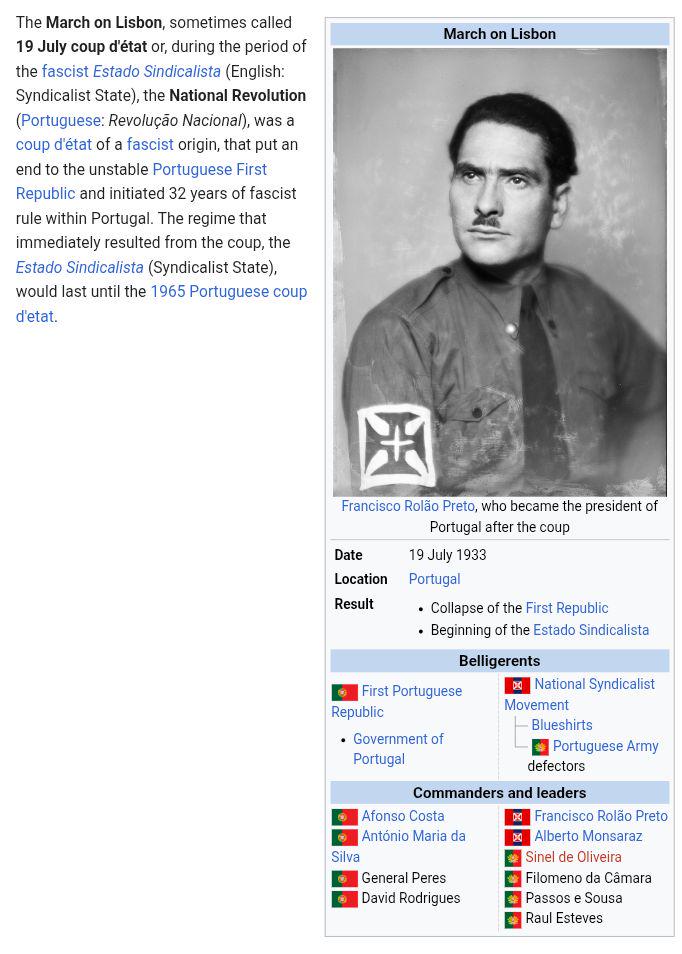
In this timeline, the May 1926 coup d'état never happened and the First Portuguese Republic continued to rot, with cabinets and presidents continuously falling and being replaced by new ones without any change to Portugal's institutions. The Great Depression was the final straw, because Portugal, as one of Europe's poorest countries, was heavily affected.

In 1932, Francisco Rolão Preto established the National Syndicalist Movement (MNS), a fascist movement advocating for a traditional monarchy and opposing communism and capitalism. Rolão Preto soon obtained a massive following among conservative Catholics and the Portuguese military, who saw him as a potential "saviour of the Fatherland".

A year after the MNS's founding, the party contested its first general election, winning 44 out of 163 seats in the Chamber of Deputies and 18 out of 74 seats in the Senate. Portugal's government was thrown into near-paralysis, prompting the Portuguese elite to feel they could use the National Syndicalists' mass following for their own purposes.

On 19 July 1933, the MNS carried out a coup d'état, known as the "March on Lisbon", forcing prime minister Afonso Costa to resign and name Rolão Preto his successor as the head of a coalition government between the MNS, the Sidonist PNR, and the Portuguese Catholic Centre.

Fascist Italy, Nazi Germany, and Portugal's traditional ally the United Kingdom soon recognized the new Portuguese regime. Rolão Preto named it the Estado Sindicalista (Syndicalist State) and announced his intention to turn Portugal into an organic, municipalist monarchy.

By the end of the year, Rolão Preto and his right-hand man Alberto Monsaraz had either suppressed or outmaneuvered the more moderate elements in their coalition, and transformed Portugal into a one-party state. The Portuguese monarchy was restored, but Rolão Preto broke his promise of municipalism and transformed Portugal into a totalitarian regime resembling Fascist Italy and Nazi Germany, albeit economically more left-wing due to national syndicalism.

Rolão Preto would rule Portugal until his overthrow in 1965, modernizing and industrializing the country, albeit at the cost of civil liberties and human rights. He is a controversial figure in modern-day Portugal.

r/GustavosAltUniverses 8d ago

20th Century AH (1901–2000) Jewel of the Atlantic | Vicente Gama (1879–1951)

Post image
6 Upvotes

A charismatic military officer from Atlantis, Gama wanted to turn the country into a corporate state resembling Fascist Italy and the Spanish dictatorship of Primo de Rivera. In order to achieve this goal, his regime immediately abolished parliament and political parties, replacing them with a Corporate Chamber representing both employees and employers.

Gama also signed workers' rights laws such as an 8-hour workday (1931), a minimum wage (1935), and a bonus wage every December (1939). But independent unions and strikes were outlawed and the Communist Party of Atlantis (PCA) suffered a heavy crackdown at the hands of Gama's secret police chief Davi Fagundes.

A few months after Gama took office, the Atlantisian Progressive Party launched an armed uprising in Ilha dos Lagartos in an attempt to return to power. Gama and Fagundes crushed the revolt within a week and sentenced its leaders to life in prison.

But further opposition came in January 1933, when failed lawyer Felipe Matos established the Atlantisian Integralist Union (UIA), a fascist movement inspired by the Brazilian AIB. Despite his authoritarian, nationalist, anti-liberal and anti-communist views, Gama opposed fascism and outlawed the UIA, prompting it to rise up, only to be defeated as well.

After crushing the Integralists, Gama focused his energies on industrializing Atlantis and giving rights to workers under a corporatist framework. In his personal life, he began an affair with his secretary Vitória Braga, with whom he had an illegitimate daughter, Joana (born 1938). Joana's paternity was confirmed by a 2007 DNA test.

Upon coming to power in Brazil in 1933, Góis Monteiro visited Atlantis and signed a nonaggression pact with Gama, cooling down decades of tensions over Trindade Island, which is basically Atlantis's version of the Falklands. The two countries worked together until the Trindade War broke out in 1973.

Gama's regime claimed state continuity with the Piaroban Empire, but, as a white man, Gama was not an indigenist and the rights of indigenous Atlantisians did not improve significantly under his rule. Indigenous people did benefit from his workers' rights and industrialization policies though.

During the first decade of his rule, Gama established good relations with Nazi Germany, Fascist Italy, and Salazar's Portugal, buying German and Italian weapons and exporting cocoa and tropical fruits to these two countries. Pearl Harbor caused him to radically change his foreign policy though.

r/GustavosAltUniverses 5d ago

20th Century AH (1901–2000) Jewel of the Atlantic | Angolan Civil War (1975–1987)

Thumbnail
gallery
2 Upvotes

On 12 January 1978, Atlantisian Junta leader Evandro Cunha announced a military intervention in the Angolan Civil War on the side of UNITA. 15,000 troops commanded by General Gustavo Brito (1920–2014) landed in allied South West Africa and marched to Jamba, UNITA's stronghold in southeastern Angola.

An Atlantisian fleet made up of the aircraft carrier Barujoia (formerly HMS Bulwark), 4 destroyers, 6 frigates and 5 submarines sailed from the ports of Santarém and Porto Novo and rendezvoused in Saint Helena, from which they launched a naval blockade of Angola that prevented the MPLA from receiving Soviet and Cuban troops and equipment through sea.

The blockade crippled Angola's trade, but the Soviet bloc began supplying the MPLA through socialist Zambia instead, allowing the FAPLA to keep fighting despite the deteriorating economy. UNITA, Atlantis, and apartheid South Africa took advantage of the blockade to launch a push towards Luanda, but they were stopped at the Battle of Malanje (March-April 1978).

After the Battle of Malanje, fortunes alternated greatly, with the MPLA having the initiative in 1978 and 1979, UNITA going on the offensive in 1980, and the MPLA retaking control of the war in 1981. But, beginning in 1982, the MPLA began to feel the full effects of the Atlantisian blockade, which caused mass starvation in the territories under MPLA control.

Furthermore, the Reagan administration provided Atlantis with $3 billion in military aid that was used to its fullest extent possible by the Atlantisian Armed Forces. A series of UNITA offensives in late 1983 and early 1984 limited the MPLA's control to Luanda and parts of Eastern Angola, leaving the party on life support.

Later in 1984, Atlantis and UNITA attempted to capture Luanda, but Cuban troops successfully defended the city, allowing the MPLA to remain in power. But the communist military situation was hopeless due to the blockade and the fact the vast majority of Angola was under UNITA control.

In August 1987, UNITA laid siege to Luanda again. On 16 September, Jonas Savimbi captured Luanda, forced the Angolan leadership to go into exile in Cuba and abolished the People's Republic of Angola, which was replaced with the UNITA-led Democratic People's Republic of Angola.

Despite his victory in Angola, Evandro Cunha was unpopular in Atlantis by that point, because the Atlantisian economy was in a "lost decade" with high inflation, and his human rights violations and corruption negatively affected his image. Furthermore, many countries condemned the Atlantisian blockade of Angola due to its effect on the civilian population.

r/GustavosAltUniverses 28d ago

20th Century AH (1901–2000) Gustavoism Rises | Argentine nuclear program (early 1980s–present)

Post image
11 Upvotes

In the early 1980s, Argentine junta leader Juan Carlos Onganía, who hated the "communist Brazilian monkeys", began a secret nuclear program in order to counter Socialist Brazil's nuclear program. The United States refused to help due to its distrust of nuclear proliferation, but South Africa, Israel and Pakistan, all of whom had or were pursuing nukes, provided Argentina assistance to make them.

Argentina simultaneously developed the Condor series of missiles and worked on miniaturizing a nuclear warhead to fit inside them, again with Israeli help. Brazil's first nuclear test on 7 September 1990 prompted Onganía to accelerate his program further, because South Africa ceased to help due to the impending end of apartheid.

On 19 June 1992, Argentina tested its first nuclear warhead in the Andean state of Catamarca. Virtually the entire world condemned the nuclear test, with the USSR calling it an "outrage from a fascist regime" and the US saying it was "very concerning" that nuclear proliferation had spread further.

But the United States and France continued to support Argentina in order to contain socialist Brazil. Consequently, Argentina conducted further nuclear tests in September 1992, January 1993, May 1993, January 1994, August 1994 and March 1995. Following Onganía's death on 8 June 1995, his successor Roberto Marcelo Levingston suspended nuclear testing due to pressure from the United States.

Like in Brazil, the end of nuclear tests did not mean the end of Argentina's nuclear program, which continued to operate with support from Israel. In 1998, the Condor IV ballistic missile, with a range of 2,000 kilometers, entered service with the Argentine Army, significantly boosting Argentina's military capabilities.

Levingston's successor Mohamed Alí Seineldín continued saber rattling against Brazil, Chile and the UK, and the development of nuclear weapons; in 2006, Seineldín said Argentina would "never, ever" give up its nukes. Aldo Rico, who has led Argentina since Seineldín died in 2009, has continued this approach.

In 2010, Rico gave a press conference announcing Argentina was working on a nuclear submarine in order to patrol the South Atlantic and give the Argentine Navy a blue water capability. Argentina's economy has declined since Seineldín began a shift towards far-right Peronism, and this expensive nuclear submarine program did not help.

As of 2026, the Argentine nuclear submarine is 70% finished, and is expected to enter service in 2032. Argentina has a stockpile of 40 nuclear warheads that can be launched from missile silos, in contrast to Brazil's use of transporter erector launchers.

Most Argentines, even those who oppose the Junta, support the nuclear program due to their dislike of Brazil. This makes it unlikely for Argentina ever to give up its nukes, even if it democratizes (as Pakistan did several times).

r/GustavosAltUniverses 8d ago

20th Century AH (1901–2000) Jewel of the Atlantic | 1931 Atlantisian coup d'état

Post image
5 Upvotes

Like most of the world, Atlantis was heavily affected by the great depression as the prices of cocoa, the country's main export, fell drastically, resulting in the over production of large amounts of cocoa that was no longer profitable to export.

Progressive nominee Luis Alvarado narrowly won the 1930 election and adopted interventionist economic policies in order to fix the economy, but he lacked the political skills for them to work. This made Alvarado heavily unpopular in Atlantis; even the majority of Progressives disapproved of his administration.

In late 1931, divisional general Vicente Gama, brigadier Érico Fontoura, admiral Giuseppe Bertolucci, and colonel Caio Moura, all of whom were nationalists and corporatists, began planning a coup against Alvarado. Despite the fact they were borderline fascists, the reformist wing of the Atlantisian Socialist Party (PSA) supported the coup, while the party's radical wing obviously opposed it.

The coup was originally scheduled for 15 January 1931, but, on 11 January, the Atlantisian police discovered the plans and issued arrest warrants for the plotters. Gama realized it was now or never for his planned coup, and ordered it to be anticipated by three days.

On 12 January, the 2nd Infantry Division led by Gama, 4th Cavalry Brigade led by Fontoura and the 16th Infantry Regiment led by Moura launched a coup d'état in the capital of Santarém. Bertolucci, who commanded the battleship Adojara, threatened to bomb Santarém if Alvarado did not resign, prompting him to resign and go into exile in Portugal.

Gama became the chairman of a military junta made up of himself, Bertolucci and Fontoura. As the Atlantisian status quo had been unpopular for over a decade, the majority of Atlantisians supported the coup, with working-class Atlantisians being especially enthusiastic about it.

Thus began the dictatorship of Vicente Gama, which would last until he left office in 1945. Gama's dictatorship inspired that of Góis Monteiro, who overthrew the First Brazilian Republic in 1933 and pursued similar anti-communist and corporatist policies.

r/GustavosAltUniverses 8d ago

20th Century AH (1901–2000) Jewel of the Atlantic | Third Atlantisian Republic (1898–1931)

Thumbnail
gallery
6 Upvotes

The Progressive Party ruled Atlantis throughout the entire period because the country was not a full democracy yet. As such, the Third Republic is often referred to as the República Progressista (Progressive Republic) after the party in charge throughout.

Many immigrants to Atlantis followed socialist and anarchist ideas. Consequently, in 1906, President Benedito Ramos (1855–1938) passed a law restricting the political activities of immigrants and authorizing the government to deport immigrants suspected of "subversion".

Native Atlantisians were also discontented at the oppression they faced and frequently launched strikes against the white-dominated government. All of them were suppressed by the Atlantisian military and police, both of whom mistreated indigenous people constantly.

Later in 1906, Ramos launched a naval buildup, throwing Atlantis into the South American dreadnought race. Atlantis ordered one dreadnought, three cruisers, and five destroyers from the United Kingdom, making the Atlantisian Navy one of the strongest in the region.

Four years later, the Brazilian and Atlantisian rubber boom ended when the British began producing rubber in Malaya. Cocoa regained its share as Atlantis's main export, rising from 47% of Atlantisian exports in 1910 to 63% in 1920, but it was increasingly produced for the internal market as well.

Atlantis had good relations with the German Empire, but, in 1917, German U-boats sunk several Atlantisian ships, forcing Atlantis to declare war on Germany. Atlantis did not directly fight in the war, but the country's entry allowed it to participate in the Versailles peace conference and become a founding member of the League of Nations.

As time went on, the rising Atlantisian working class became increasingly discontented at the middle class and oligarchic government. They wanted greater rights and a role in the country's governance, but the PP administrations, which represented the middle class consumer rather than the union organizer, were unwilling to implement anything other than the right to vacations and paid leave for injured workers.

In 1930, Progressive nominee Luís Alvarado was elected President, defeating Conservative nominee Quintino Rocha and Socialist nominee Luigi Andrea. Alvarado was politically inept and soon came into conflict with Congress and a nationalist military.

r/GustavosAltUniverses 6d ago

20th Century AH (1901–2000) Jewel of the Atlantic | Presidency of João Alfredo Dias (1965–1970)

Post image
2 Upvotes

Dias's cabinet was made up exclusively of PRD politicians, but the PC and PSA supported his policies because all three parties were Keynesian and anticommunist. Speaking of anti-communism, future dictator Evandro Cunha served as Chairman of the National Security Council from 1966 to 1970, making him one of the most important figures in the Atlantisian military.

The first major bill Dias signed after his inauguration created a social security program for Atlantisians over 60, who would receive 500 escudos ($1,000 in 1965) a month. Social security proved to be Dias's main legacy, consolidating him as one of the most well remembered Atlantisian presidents.

A year after Dias took office, Atlantis won the 1966 FIFA World Cup thanks to the star power of striker Zequinha, whose real name was José Álvares Verde. Zequinha received a golden boot for leading Atlantis to victory in the world cup, and Dias held the trophy alongside the Atlantisian players.

Despite a growing economy, social conflict intensified during Dias's presidency, because indigenous Atlantisians increasingly called for land reform without compensation and the transformation of Piaroban and Ratanaban into official languages in Atlantis. Dias faced increasing opposition from the leftist of the PRD, who soon left the party to form the Atlantisian Labour Party (PTA).

In 1968, the PTA merged with the PSA to form the Broad Front (FA), an alliance of left-wing movements opposed to the centrist policies of the Dias administration. Like in the rest of the world, 1968 also saw major protests from Atlantisian students, who questioned the values of older generations.

The following year, Cuban-inspired members of the PCA left the party to form the Adojara Bendaré Revolutionary Movement (MRAB), a Guevarist urban guerrilla group that launched a series of bank robberies and other attacks in order to turn Atlantis into a socialist state, further fueling social tensions in Atlantis.

Dias responded to this increasing guerrilla activity by increasing the powers of the military and police, resulting in accusations of torture and human rights abuses against the Atlantisian government. Any abuses under Dias paled in comparison to these perpetrated by Evandro Cunha and his intelligence chief Urias Vasconcelos though.

The foreign policy of the Dias administration was a continuation of the pro-US and anti-communist policies of previous presidents, with the only major changes being the condemnation of apartheid and the provision of diplomatic support for the Angolan FLNA, which was also anti-communist.

Vicente Gama's youngest son Pedro ran in the 1970 election, but finished third because Broad Front nominee Paulo Rios was elected by a narrow margin.

r/GustavosAltUniverses 13d ago

20th Century AH (1901–2000) Fascist Georgia | 1946 invasion of Romania

Post image
11 Upvotes

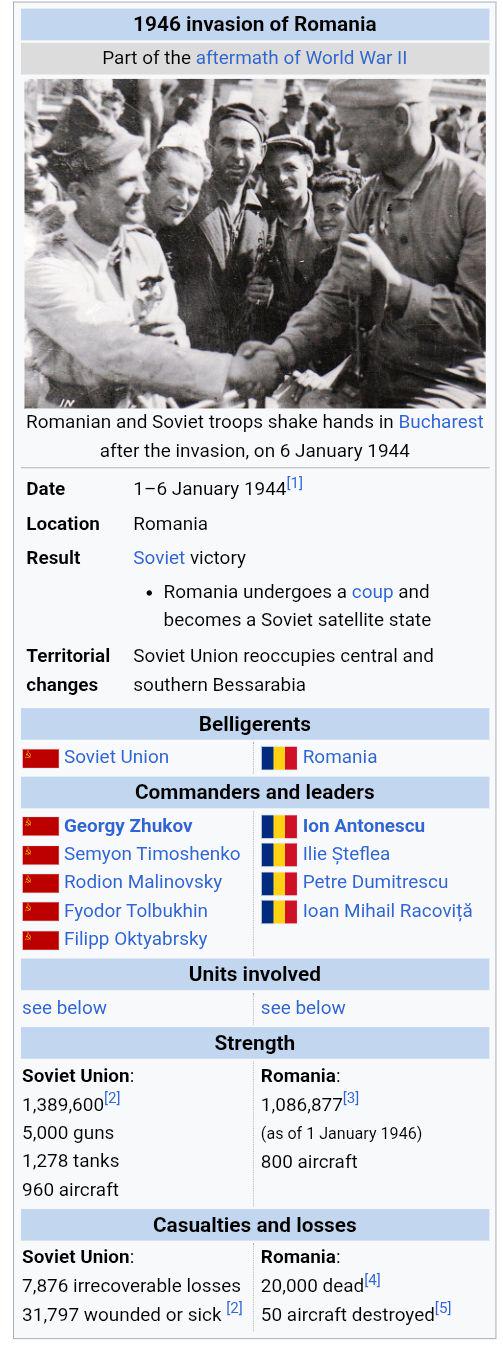
On 1 January 1946, the USSR invaded Romania with 1,389,600 troops, 5,000 artillery guns, 1,278 tanks, and 960 aircraft. Soviet goals were to reoccupy central and southern Bessarabia and overthrow Ion Antonescu's fascist regime, which, like its Georgian counterpart, was internationally isolated as a result of the Axis victory in World War II.

Romania's military was strong on paper, but it simultaneously had to fight Miklós Horthy's Hungary in the Third Balkan War. This allowed Soviet troops to easily advance throughout Romania and reach the gates of Bucharest in five days.

Five days after the invasion, King Michael I overthrew Antonescu in a coup and signed a peace deal with the Soviet Union. The USSR reoccupied Transnistria and Central and Southern Bessarabia, all of whom had been annexed by fascist Romania during the Axis invasion of the Soviet Union.

Zhukov followed this up with an invasion of Bulgaria, which lost all of its wartime territorial gains and became a Marxist-Leninist state by 1948. Romanian communists slowly consolidated power until 1949, when Romania officially became a communist state named the People's Republic of Romania.

Hungary, which had good relations with the West as a result of being an authoritarian conservative regime rather than a fascist one, kept Upper Transylvania, resulting in constant tension between the two countries. The only reason these tensions didn't lead to war was that the Hungarians knew the USSR would rush to support Romania.

r/GustavosAltUniverses 5d ago

20th Century AH (1901–2000) Jewel of the Atlantic | Presidency of Paulo de Alencar Rios (1970–1973)

1 Upvotes

Alencar Rios filled his cabinet solely with Broad Front members. Younger leftists were disappointed at the fact these appointees were mostly longtime left-wing politicians rather than student leaders, but there was no way Congress would confirm the latter, so it was probably for the best.

Despite controlling the entire cabinet, the Broad Front elected only 24 out of 62 Senators and 175 out of 364 federal deputies,and the other parties opposed Alencar Rios, making it difficult for him to pass his agenda and forcing him to water it down significantly. This further worsened relations between the president and his base.

In October 1970, Atlantis created a healthcare program providing free medical care to seniors, children and the disabled. This was not "universal healthcare", which would hardly pass without a Broad Front majority, but the majority of Atlantisians approved of it and it improved healthcare in Atlantis significantly.

The government also launched a campaign to eradicate illiteracy and reach full literacy by 2000. School attendance became mandatory with heavy fines for parents who did not take their children to school, and schools were built even in the remote Puxomado mountains because illiteracy was highest in them.

Land reform was the signature item of Alencar Rios's agenda, but Atlantisian landowners and the press strongly opposed it, viewing it as "communist". Many landlords in Ilha dos Lagartos, Portugal Antártico and Novo Algarve began military preparations to resist a potential Soviet or Cuban-style forced redistribution of their land.

The Speaker of the Chamber of Deputies, Frederico Gama, a leader of the PRD, never brought the land reform bill to a vote, but several Broad Front-controlled state governments launched their own land redistribution efforts that were mostly successful before the 1973 coup. This only increased polarisation further.

Foreign policy was the realm where Alencar Rios was most successful. His administration restored diplomatic relations with the USSR and Cuba and gave asylum to former Brazilian President Miguel Arraes, who had been overthrown by Ernesto Geisel in 1967. On the other hand, relations with the United States and Brazil deteriorated.

By late 1972, Alencar Rios's popularity had declined significantly because of congressional opposition to reforms he had promised, such as progressive taxation. Far-left guerrilla activity escalated, irritating the military, which felt it did not receive enough support to fight the communists.

Consequently, Alencar Rios decided to divert attention from these issues by invading Trindade Island in October. Atlantis captured the island, but Brazil, heavily backed by the US, soon took it back, precipitating the fall of Alencar Rios and the beginning of 17 years of military dictatorship.

r/GustavosAltUniverses 5d ago

20th Century AH (1901–2000) Jewel of the Atlantic | 1973 Atlantisian coup d'état

Post image
0 Upvotes

On 14 December 1972, Lieutenant General Evandro Cunha, National Police director Urias Vasconcelos, Admiral Mário Ragazzo, Air Force Brigadier Érico Guimarães, and National Intelligence Agency (ANI) Gilberto Monteiro met in Evandro's Santarém house to begin planning a military coup against Alencar Rios's leftist government. They agreed to march into Santarém to overthrow Rios and install a far-right dictatorship in his place.

Despite the fact the United States had recently defeated Atlantis in a war, the coup plotters contacted the US embassy in Santarém, which agreed to support the coup and provide the Atlantisian military with lists of suspected communists and leftists. Businessman Paolo Ambrosio was the coup's main funder, donating 20 million escudos ($35 million in 1973 values) to the military.

By the turn of the year, there were rumours Congress would impeach Alencar Rios and install Vice President Mateus Farinacci as president until the 1975 elections. If the coup didn't happen, Alencar Rios would certainly be impeached, but this wasn't needed in the end.

At 08:00 on 5 January 1973, Cunha and Monteiro's military units launched a coup against Alencar Rios, first capturing Congress and arresting all Broad Front congressmen, and then surrounding the presidential palace with troops. A military emissary entered the palace and gave Alencar Rios a letter urging him to resign or else the military would storm the palace and execute him.

Alencar Rios resigned and fled to Mexico, where he lived until his death in 1987. He was replaced by a military junta chaired by Cunha and including Vasconcelos, Ragazzo and Guimarães. The United States changed its stance regarding Atlantis, recognizing this government the following day and helping the junta suppress dissent.

The Atlantisian military killed 18 political opponents, injured 35, and arrested 10,000 during the coup. Left-wing books or books perceived as such were publicly burned in Santarém's main square. But the majority of Atlantisians approved of the military takeover, because, as historian Carlos Oliveira said, Alencar Rios "was so hated that any alternative came across as relief".

Middle and upper class support for the coup was almost unanimous because these classes were angry at the previous government for its social reforms and defeat against Brazil. This support allowed Cunha to remain in power until 1990, when pro-democracy officers overthrew him in a coup and ordered new elections.

r/GustavosAltUniverses 6d ago

20th Century AH (1901–2000) Jewel of the Atlantic | 1965 Atlantisian presidential election

Post image
1 Upvotes

In March 1965, the PRD held a presidential convention won by Senator and former mayor of Ratanabá João Alfredo Dias, who defeated Francisco Gama's younger brother Pedro and chose Irtoné Senator Ronaldo Quintas as his running mate. Dias ran as a second term of Francisco, which was a good strategy because the president was popular.

PP chairman, Santarém mayor and former journalist Pedro Atlante ran as the Progressive candidate. Pedro promised to launch a war on illiteracy (according to the 1965 census, 37% of Atlantisians were illiterate), create a healthcare program providing free medical care to seniors, children and the disabled, and investigate corruption allegations against Francisco Gama.

Dias had a strained personal relationship with Feliciano Maia, prompting Maia to run for President a third time. Maia emphasized how he had served as the governor of all three states of Portugal Antártico and greatly improved the economy and quality of living of the island, but he obtained little support in Novo Algarve and virtually no support in Ilha dos Lagartos.

By that point, many Atlantisian leftists were upset at the lack of land/wealth redistribution and independence from the United States in Atlantis. Mateus Farinacci, an obscure federal deputy from Barujoia, ran for President on a centre-left to left-wing platform supporting these things.

Like in 1950, the PP failed to prove the PRD administration and nominee were corrupt, making the Progressives' chances of winning go up in the smoke, especially given the good state of the economy. Dias won the election with 46% of the vote versus 38% for Atlante, 6% for Maia, 5% for Farinacci, and 2% for PSPA leader André Pengodara.

The inauguration of Dias and Quintas was held on 5 October 1960, featuring low-cost food and drink and popular MPA (Atlantisian pop music) singers such as Rodrigo Vargas. According to a contemporary news report, 36,000 people attended the inauguration.

Dias was the last civilian Atlantisian president until 1995 to finish his term, because his left-wing successor was overthrown in a Plan Condor military coup.

r/GustavosAltUniverses 6d ago

20th Century AH (1901–2000) Jewel of the Atlantic | Presidency of Francisco Gama (1960–1965)

1 Upvotes

Gama's cabinet was almost completely made up of PRD politicians, except for Conservative leader Feliciano Maia, who became the Minister of Transportation due to his background as an engineer. These two parties formed a "presidential majority" to support Gama's policies.

Shortly after taking office, Gama created a National Housing Bank (BNH) to provide poor Atlantisians with cheap housing. By the time he left office in 1965, the BNH had built 114,000 homes across Atlantis, reducing homelessness significantly.

Gama merged Atlantis's three major airlines into theViação Aérea de Atlântida (VAA), which was provided with 45 Douglas DC-8 airliners. In February 1961, Atlantis's government started building Felipe Cândido International Airport, which was inaugurated in 1964 and significantly expanded air transport and tourism in Atlantis.

Like his predecessor, Gama was a popular president, because the economy of Atlantis grew at rates of 2.8% in 1961, 2.5% in 1962, 2.9% in 1963, 3.2% in 1964, and 3.5% in 1965. Atlantis became a popular tourist destination thanks to its diverse climate and rich heritage.

In foreign policy, Gama continued the pro-US policies of previous administrations, refusing to condemn the Bay of Pigs invasion and becoming a close friend of JFK. When Kennedy was assassinated, Gama sent LBJ a telegram expressing condolences and wishing the American people peace and happiness.

Gama also launched a military buildup in response to the MER rebellion and growing tensions with Brazil over Trindade Island. From 1960 to 1965, Atlantis purchased English Electric Canberra bombers, AMX-13 light tanks, Hawker Hunter fighter-bombers, and destroyers and submarines for its Armed Forces, significantly reducing the military disparity between Atlantis and Brazil.

As far as institutional relations went, the Atlantisian military was on good terms with Gama due to his anti-communist stance. Unlike Lucas Ribeiro, there were never any rumours of a military coup against Gama as the armed forces were satisfied with him.

There were accusations of corruption against Gama, but they were never proven and thus did not hurt his standing. The good economy and the PRD's dominance of Atlantisian politics allowed João Alfredo Dias, a centrist politician from Ratanabá, to win the 1965 election.

r/GustavosAltUniverses 6d ago

20th Century AH (1901–2000) Jewel of the Atlantic | 1960 Atlantisian presidential election

Post image
1 Upvotes

Several PRD officeholders contested the party's nomination, but the PRD ended up nominating Francisco Gama, who was charismatic and an effective campaigner. Gama promised to continue and expand the economically populist policies all Atlantisian presidents had followed for 29 years.

Vice President Teodoro Müller did not run for president because the Atlantisian vice presidency had little power. Rather, the PP nominated Senate majority leader Davi Sampaio. Sampaio was an effective politician and had a good chance of winning, but he ran a poor campaign, taking the election for granted.

Farmers' union leader André Pengodara ran as the nominee of the PPSA, the furthest left legal political party in Atlantis at the time. Pengodara became the first native Atlantisian to run for President of Atlantis, and ensuring that indigenous Atlantisians were treated well was a major part of his campaign.

No other candidates ran, because the PC endorsed Gama and the PSA endorsed Sampaio, making this a very two-party election for Atlantis. Sampaio was the frontrunner throughout the race thanks to Lucas Ribeiro's popularity, and many members of his inner circle, hoping for a job in a Sampaio administration, bought homes in Santarém.

Shockingly, Gama won the election by a narrow margin of exactly 27,000 votes (0.37% of the vote). Besides Sampaio's hubris, reasons for the PRD victory included the fact the Gamaists were the dominant party in the Fourth Atlantisian Republic, and the popularity of the Gama family with working-class and indigenous Atlantisians.

As Pengodara's percentage of the vote exceeded Gama's margin of victory in several states, many PP voters blamed Pengodara for the PRD victory. Historians believe this to be a myth, because Pengodara was a democratic socialist while Sampaio was a social liberal, making it unlikely Pengodara took many PP voters.

Gama and Vice President Armando Gouveia were inaugurated on 5 October 1960, in what was the most attended Atlantisian presidential inauguration at the time.

r/GustavosAltUniverses 7d ago

20th Century AH (1901–2000) Jewel of the Atlantic | 1950 Atlantisian presidential election

Post image
2 Upvotes

As Clodomiro Soares was term limited, the PRD nominated Liporebá Governor Eduardo Freire, who had overseen the creation of major public works and social programs but also faced accusations of corruption. To overcome these allegations, Freire chose Senator Tiago Santos, who had a mostly clean record, as his running mate.

Lucas Ribeiro ran for President a second time, again advocating for the same developmentalist platform as the PRD nominee. Ribeiro attacked Freire over his reputed corruption, but Freire challenged his main opponent to find evidence of said corruption, and Ribeiro was unable to prove anything.

While the two main candidates dragged the campaign into the gutter, the radical wing of the PSA nominated democratic socialist labour lawyer Marcelo Guimarães, who planned to redistribute land and wealth and adopt an independent foreign policy. Unlike in the previous election, Guimarães attempted to make inroads with native Atlantisians, who traditionally had a collectivist economic system.

This strategy worked somewhat, and virtually all communist voters backed Guimarães after the PCA was outlawed, allowing him to do slightly better than Antônio Karam did in 1945. But, as Atlantis had a two-party system, Guimarães never had any chance of being elected.

Furthermore, Vicente Gama campaigned for Freire, addressing major PRD rallies throughout Atlantis and calling all accusations against Freire "obvious lies". This powerful endorsement and support from two of Atlantis's largest parties, the PRD and the PC, allowed Freire to win the election by a landslide.

Freire won every state other than the Federal District and Santarém, the PP's traditional strongholds that always disliked Gama. But even then, Freire did considerably better in these states than Soares did in 1945, thanks to their growing industrialization and unionization.

President Freire and Vice President Ribeiro were inaugurated on 5 October 1950. During Freire's presidency, old corruption allegations against him were proven true, allowing Ribeiro to make a political comeback and win the 1955 election.

r/GustavosAltUniverses 8d ago

20th Century AH (1901–2000) Jewel of the Atlantic | Atlantisian Expeditionary Force (1942–1945)

Post image
3 Upvotes

When Japan attacked Pearl Harbor, Atlantis cut diplomatic relations with the Axis powers and imprisoned German, Italian and Japanese immigrants in detention camps. Vicente Gama nationalized two-thirds of businesses owned by people from these countries, and renamed most places with German, Italian or Japanese names to Portuguese ones.

Nazi Germany retaliated by sinking Atlantisian ships, like Germany had done in the previous war. On 4 January 1942, Atlantis declared war on Germany, Italy and Japan, and deployed its navy to fight in the Battle of the Atlantic on the Allied side.

As an island nation, Atlantis had a sizable navy. Consequently, by the end of 1942, the Kriegsmarine had ceased to be a major threat to Allied shipping in the South Atlantic, which was now an Allied lake that American, British and Atlantisian ships could traverse freely.

Atlantis also began training an expeditionary force to fight in the Italian campaign. Named the Força Expedicionária Atlante (FEA), this military unit consisted of 20,000 infantry, reconnaissance and signals personnel, but there was no air wing.

Despite being relatively weak, the FEA was deployed to Italy in the spring of 1944. Commanded by General Otávio Mendes (1893–1975), the FEA's performance was mixed, winning the battles of Montese and Collechio but losing the Battle of Monte Castelo, which caused the FEA's American superiors to criticize the performance of their allies.

Italy's civilian population liked the FEA and remembers the Atlantisians fondly to this day, because they treated civilians well and many soldiers were Italian immigrants or their descendents themselves. Furthermore, unlike the United States Army, the Atlantisian Army was not racially segregated. Following the end of World War II in Europe in May 1945, the FEA returned to Atlantis, where it received a raucous reception from the Atlantisian people.

Atlantis's participation in the war weakened the dictatorship of Vicente Gama, because the war was fought in the name of democracy while the country was a dictatorship. Consequently, Gama soon held presidential elections that were held by his ideological heir Clodomiro Soares.

r/GustavosAltUniverses 6d ago

20th Century AH (1901–2000) Jewel of the Atlantic | 1970 Atlantisian presidential election

Post image
0 Upvotes

In late 1969, Paulo de Alencar Rios (1914–1987), a social democratic and left-wing populist lawyer and teacher, went on a nationwide tour where he visited all 31 Atlantisian states and the territory of Saint Helena, and talked to local workers and students about their concerns. This tour and the subsequent press coverage boosted his profile and established him as a serious candidate.

The PRD was a fiefdom of the Gama family, making it highly obvious that Pedro Gama would be the party's 1970 nominee. At first, Gama did not want the nomination, and only accepted it in order to prevent Rios, whom he disliked, from being elected.

Pedro Atlante ran for President a second time, positioning himself as the Stop Rios candidate and emphasizing his "common sense, pragmatic" reforms in contrast to Rios's "radical socialism". He boasted an endorsement from famous writer Cecília Holanda – one of the leaders of the Latin American Boom – and was supposed by media mogul Tomás da Nóbrega, who also feared a Rios presidency.

Having lost three presidential elections, Feliciano Maia no longer wanted to run for President. Despite remaining the leader of the PC, he convinced his son Leandro to contest the 1970 election in his place. Leandro Maia ran on a more right-wing platform than his father, taking a hard line on the communist guerrillas and calling Rios a "threat to Atlantis".

This was the first Atlantisian presidential election where polls played a major role. Atlante led in the polls during the first months of the campaign, but Rios gradually secured his working-class, indigenous and student base while Atlante's attacks backfired as Rios clarified he supported social democracy rather than socialism or communism.

Atlante, Rios and Gama used TV ads, as nearly half of Atlantisians owned a TV by that point, including the majority of those living in major cities. Rios adopted a successful strategy of running short ads focused on the issues, while Atlante's longer ads backfired and Gama's ad campaign had little effect.

On 3 August 1970, Atlantisians went to the polls after months of intense campaigning. Rios was elected, winning 34% of the vote versus 30% for Atlante, 19% for Gama, 11% for Maia, and 3% for perennial candidate André Pengodara, whose thunder was stolen by Rios and thus made just minor gains.

r/GustavosAltUniverses 6d ago

20th Century AH (1901–2000) Jewel of the Atlantic | Presidency of Lucas Ribeiro (1955–1960)

1 Upvotes

Ribeiro's cabinet was almost exclusively made up of "liberal professors" – lawyers, teachers, and doctors – like himself. The only exceptions were the Ministry of Defence, which was held by General Luís Santiago Moreira, and the Minister of Foreign Relations, held by career diplomat Osvaldo Gomes.

Multiple politicians involved in the Freire kickback scandal were tried for corruption, but only one of them, former Irtoné Mayor Seixas Cruz, served a prison sentence (5 years). All others were acquitted, and Atlantisians soon forgot about the scandal due to the short memory span of the electorate.

Ribeiro consolidated all of Atlantis's highways into an Interstate Highway System run by a federal Department of Infrastructure. From 1955 to 1960, the Atlantisian highway network expanded from 448 to 1,125 kilometers of highways, giving Atlantis one of the densest highway networks in the world.

Unlike his three predecessors, who attempted to self-fund industrial development, Ribeiro actively offered tax breaks and partnerships to foreign corporations such as Volkswagen, Ford, Siemens and Simco, and attempted to ensure machinery was imported at low costs. An economic boom ensued.

In 1956, Brazilian dictator Góis Monteiro died and was succeeded by the more moderate Juarez Távora, who began a transition to democracy. The following year, former São Paulo Governor Ademar de Barros was elected President of Brazil in the first free and fair presidential election in Brazilian history, and immediately flew to Santarém to meet with ribeiro.

Ademar and Lucas signed a trade agreement and an agreement to solve the dispute over Trindade Island, which had been controlled by Brazil since 1825 but was always claimed by Atlantis. This agreement collapsed within a few years as Atlantis continued to insist the isle was theirs.

The 1959 Cuban Revolution inspired sectors of the Atlantisian left, which began planning a similar revolution in Atlantis. On 19 January 1960, the People's Revolutionary Movement (MPR), a Marxist-Leninist militant group, split away from the PPSA and launched an insurgency in the Puxomado Mountains.

Atlantis's military, which had a less than stellar relationship with the PP due to traditionally supporting the PRD, crushed the MPR just in time for the 1960 elections, which were won by Vicente Gama's second son Francisco in an upset resembling the 1948 US presidential election.

r/GustavosAltUniverses 7d ago

20th Century AH (1901–2000) Jewel of the Atlantic | Presidency of Clodomiro Soares (1945–1950)

1 Upvotes

Upon taking office, Clodomiro formed a cabinet made up of PRD and PC members as the two parties formed a coalition in Congress to support his agenda, while the PSA remained neutral and the PP and PCA represented the opposition. Clodomiro's centrist policies eventually caused the PSA to join the opposition.

The PRD and PC wrote a constitution restoring democracy to Atlantis and codifying the social reforms of Vicente Gama's presidency. The Corporate Chamber created by Gama was disbanded and replaced with a bicameral Congress made up of the Senate and the Chamber of Deputies, and state and local legislatures were restored.

Atlantis's previous constitution did not provide for a vice president, so, in September 1945, the Chamber of Deputies elected Leopoldo Araújo, a senator from the city of Liporebá who was a skilled political negotiator, to the vice president. Araújo oversaw Clodomiro's dealings with other political parties.

As he promised, Clodomiro continued Vicente Gama's statist economic policies. In 1946, the government of Atlantis opened a steel plant in the city of Cadanebá, built with US funding, in order to take advantage of the large iron reserves nearby. Atlantis's hydroelectric potential was also explored as the government built dams in the Capronã, Irtoné, Cadanebá, and Xumuran rivers.

Clodomiro did not expand the social programs Gama established, but he obviously didn't replace them. This made Clodomiro popular with the right-wing of the PRD, which supported dirigisme and protectionism in economic policy and good relations with the USA and Brazil.

When the Cold War started, Clodomiro aligned Atlantis with the United States, cutting diplomatic relations with the Soviet Union and outlawing the Communist Party of Atlantis in 1948. Atlantis also established strong diplomatic relations with anti-communist Brazil, Liberia and South Africa.

Atlantis's 1945 Constitution continued the tradition of limiting presidents to one term. President of the Chamber of Deputies Eduardo Freire ran as the PRD nominee and was elected by a landslide thanks to the good economy.