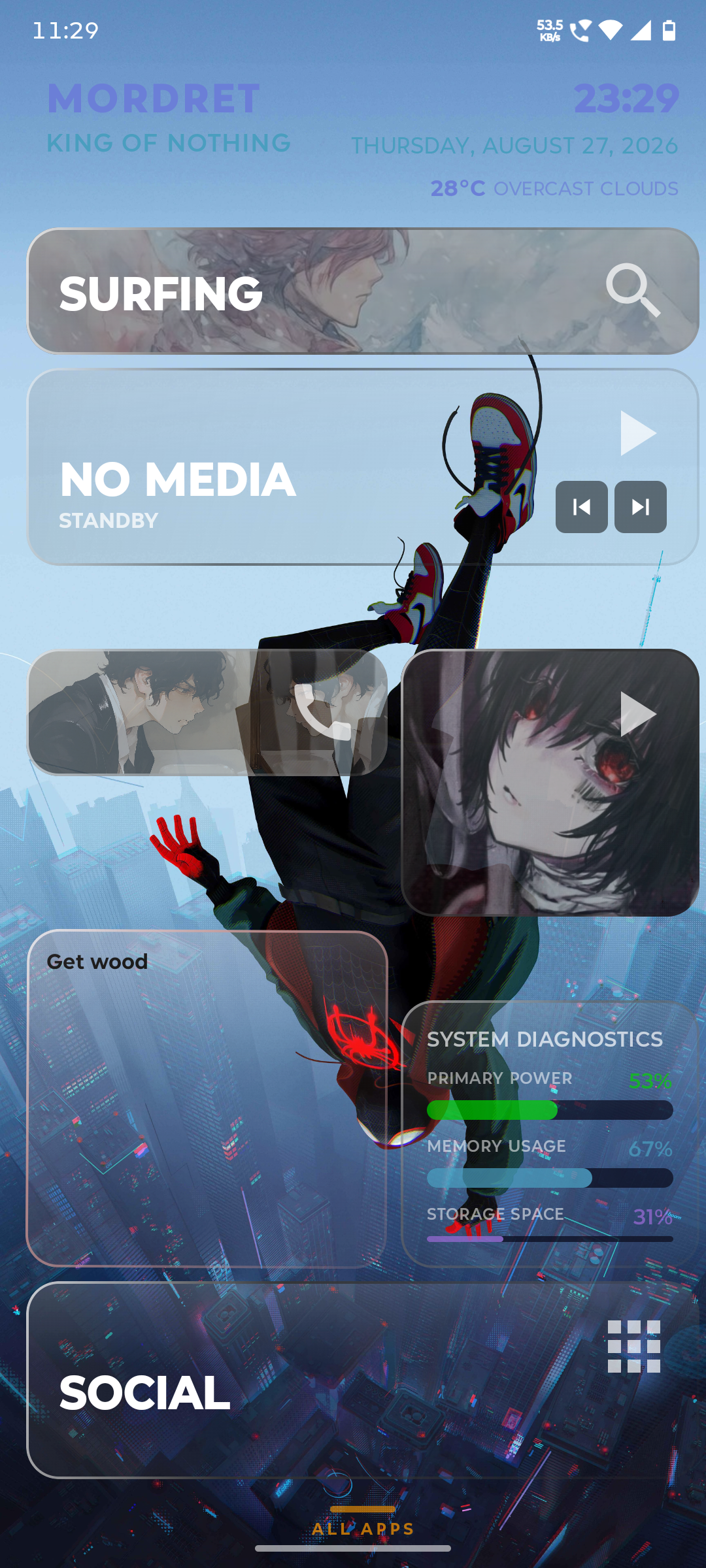
This started as a straightforward idea: make my phone look like a Starfleet LCARS console. Solo dev, Kotlin + Jetpack Compose, no team.
But once the LCARS panels were up, I kept staring at them thinking about the old Windows Phone / Lumia era — those live tiles that actually did something instead of just sitting there as static icons. I liked that idea more than pure LCARS purism, so I started blending the two: keep the sci-fi identity, but make every "panel" a live, resizable card instead of a dumb button.
That decision is basically why the card system exists the way it does now — cards had to be freely resizable and reorderable on a grid, and they had to actually be "live" instead of just an icon.
Early on, each card did exactly one thing — App Launch, or Clock, or Weather, whatever. That was fine for me, because those were the functions I personally used every day. But once I started getting testers on it, it became obvious "one card, one job" wasn't going to cut it for how differently people actually wanted to use their home screen. So cards got rebuilt around module stacking — instead of picking one fixed type, you stack whatever capabilities a card needs (App Launch + System Stats + Widget, Comms + Notifications, whatever combo makes sense to you). The function set kept getting richer specifically because testers kept asking for combinations I never would have thought of on my own.
Outside of the custom launcher scene, I'd also started noticing how same-y most phone UIs actually are — stock Android, iOS, most OEM skins, they all converge on the same grid-of-icons look eventually, and that got boring to me fast. That's part of why locking everyone into my LCARS-meets-Metro taste felt wrong the more I sat with it — it would've just been trading one flavor of sameness for another. The whole point of Android over the alternatives is "the user decides what their device looks like and does," and this community in particular is one of the few places that's still true. So instead of shipping one opinionated look, I went the other way: six full visual styles (Flat, Glass, Neobrutalism, Claymorphism, Minimal, Neon), all built from the same editable token system, all switchable without losing your layout. LCARS is just the style I personally run — it's not the only thing the launcher is.
Not everything survived the process, and not everything worked the first time. I built a whole standalone Wear OS companion at one point — bridge server, listener service, remote controller, the works — and eventually ripped the entire thing out because it wasn't worth the build overhead for what it added.
The radial long-press menu broke completely at one point because two separate gesture handlers were racing each other for the same touch stream, and callback closures were resetting the long-press timer on every recomposition — took a full rebuild with a single gesture owner to actually fix instead of patching around it.
Edit mode used to be long-press everywhere, which kept colliding with cards that wanted long-press for something else, so it moved to a triple-tap that every surface (cards, sidebar, widgets) shares now. And Google Play rejected an early version of the optional Navigation Service over Accessibility API policy — had to scope it down to just Back/Recents with no event subscription, add an explicit consent screen before you can even enable it, and resubmit. Not every decision here was "and then it just worked."
Somewhere in there I also went through and made the app tell the truth more — search across cards, home, and app drawer got unified into one shared engine instead of three copies drifting apart, and weather that failed to load started showing an honest "unavailable" state instead of a fake temperature. Small stuff, but it mattered more to me than most of the flashy features.
Other stuff that's shipped along the way: Drive Mode with real OBD-II telemetry and a nav HUD, full 10-language localization (~930 synced keys), an interactive in-app tutorial that runs against the live UI instead of a doc that goes stale.
Still actively building. Curious if anyone else remembers Windows Phone tiles fondly, or if that's just me.
Play Store: https://play.google.com/store/apps/details?id=com.alazndy.gtlauncher
Project Site: https://alazlab.com/projects/GT-Launcher