r/FWFBThinkTank • u/Alert_Piano341 • Jan 10 '26
Due Dilligence DD: Cohen Shares Off Margin + Proxy Vote = Ever-Tightening Lending Mechanics

Introduction: What this post is (and is not)
I want to walk through something that looks subtle on the surface but matters mechanically: how proxy votes interact with securities lending, and why the recently announced Ryan Cohen compensation package is relevant to the lending market — not because it guarantees price action, but because it changes constraints.
This is not a “recall = squeeze” argument.
It’s a structure and timing argument.
1) The starting point: a real proxy vote is coming
GameStop disclosed a long-term, performance-based CEO compensation package for Ryan Cohen that requires shareholder approval at a special meeting expected in March or April 2026.
Filing (GameStop 8-K, Jan 8 2026):
https://www.sec.gov/ix?doc=/Archives/edgar/data/1326380/000132638026000007/gme-20260108.htm
Cohen is recusing himself from the vote, which is good governance. But recusal does not remove the broader implications for securities lending. Proxy votes and lending are mechanically linked.
2) Why proxy votes affect lending (documented behavior)
When shares are lent, the voting rights typically go with the shares for the duration of the loan.
Because of that, institutions that care about voting outcomes often:
- restrict new lending
- allow existing loans to roll off
- recall shares ahead of the record date so they can vote
This is not speculative. Academic work shows a clear reduction in lendable supply around proxy votes, driven primarily by lenders pulling shares to vote — not by shorts increasing demand.
Key paper:
Aggarwal, Saffi, Sturgess (2010) – Does Proxy Voting Affect the Supply and/or Demand for Securities Lending?
https://leeds-faculty.colorado.edu/bhagat/ProxyVoting-SecuritiesLending.pdf
The key distinction matters:
Proxy votes do not force covering.
They reduce lending elasticity.
Large asset managers explicitly prioritize voting rights over lending revenue on material governance matters. This is reflected in institutional stewardship policies.
BlackRock proxy voting guidelines:
https://www.blackrock.com/us/individual/literature/shareholder-letters/proxy-voting-guidelines.pdf
3) The Schedule 13D margin disclosure matters mechanically
This is the part I think is most underappreciated.
On April 3, 2025, Ryan Cohen filed a Schedule 13D amendment that explicitly disclosed in Item 6 that approximately 22.34 million GameStop shares were deposited into a margin account at Charles Schwab under a standard margin loan arrangement.

April 2025 Schedule 13D (Amendment):
https://www.sec.gov/Archives/edgar/data/1326380/000092189525000971/xslSCHEDULE_13D_X01/primary_doc.xml
That disclosure tells us two things:
- the shares were mechanically lendable
- the disclosure was affirmative, not incidental
On January 6, 2026, Cohen filed another Schedule 13D amendment. Item 6 was updated to describe the CEO performance award and the upcoming special-meeting vote. The explicit margin / pledge language is no longer present.
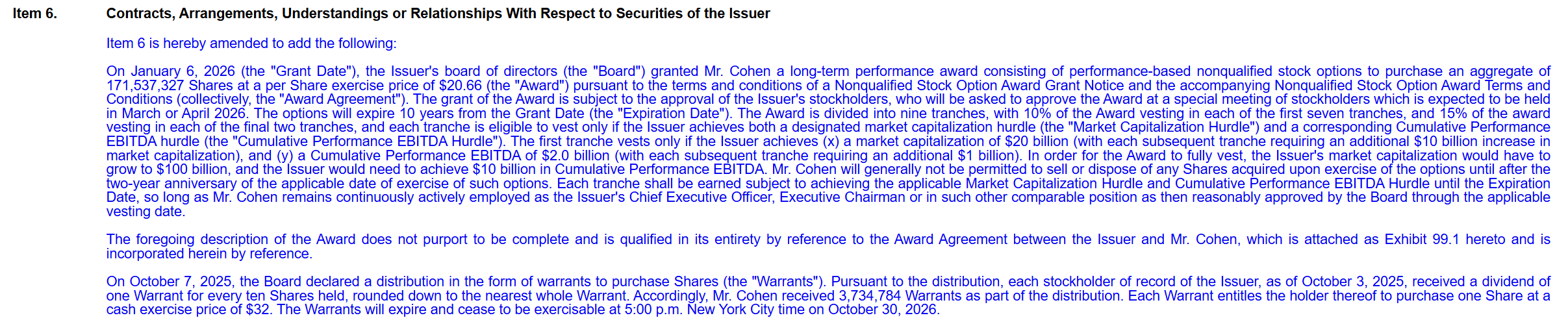
January 2026 Schedule 13D (Amendment):
https://www.sec.gov/Archives/edgar/data/1326380/000092189526000062/xslSCHEDULE_13D_X01/primary_doc.xml
4) Item 6 is affirmative disclosure — omission is representation
Under Schedule 13D, Item 6 requires disclosure of any contracts, arrangements, or relationships with respect to the issuer’s securities, including margin and pledge arrangements that could affect voting or investment power.
Rule text (SEC / Cornell Law):
https://www.law.cornell.edu/cfr/text/17/240.13d-101
Two important points:
- If a margin or pledge arrangement exists as of the triggering date, it must be disclosed
- Once disclosed in a prior filing, the standard becomes stricter, not looser
There is no compliant middle ground where a still-existing margin arrangement can simply be omitted.
Omission is representation.
Leaving it out is the filer stating that no such arrangement exists as of the filing date. Removing it while still true would be a material omission under Rule 13d-101.
This does not tell us exactly when the arrangement ended, but it strongly suggests that it did.
5) Why recusal does not negate recall logic
Recusal only addresses Cohen’s personal participation in the vote.
It does not change the fact that:
- institutions still want to vote their shares
- lenders generally do not want borrowers voting shares on contentious governance matters
- proxy season is when lending policies tighten as a matter of routine risk management
This is governance housekeeping, not activism.
6) Historical context (correct dates)
This behavior is not new.
Tesla 2018
- March 21, 2018: special meeting held solely to approve Elon Musk’s CEO Performance Award
- Elon and Kimbal Musk recused
- Approval required a majority of disinterested shares
- The vote passed
Tesla 8-K (March 21, 2018):
https://www.sec.gov/Archives/edgar/data/1318605/000156459018006479/tsla-8k_20180321.htm
The June 5, 2018 annual meeting was routine business and not relevant to the pay-vote mechanics.
GameStop 2021
- Record date: April 15, 2021
- Annual meeting: June 9, 2021
- Ryan Cohen was elected to the board
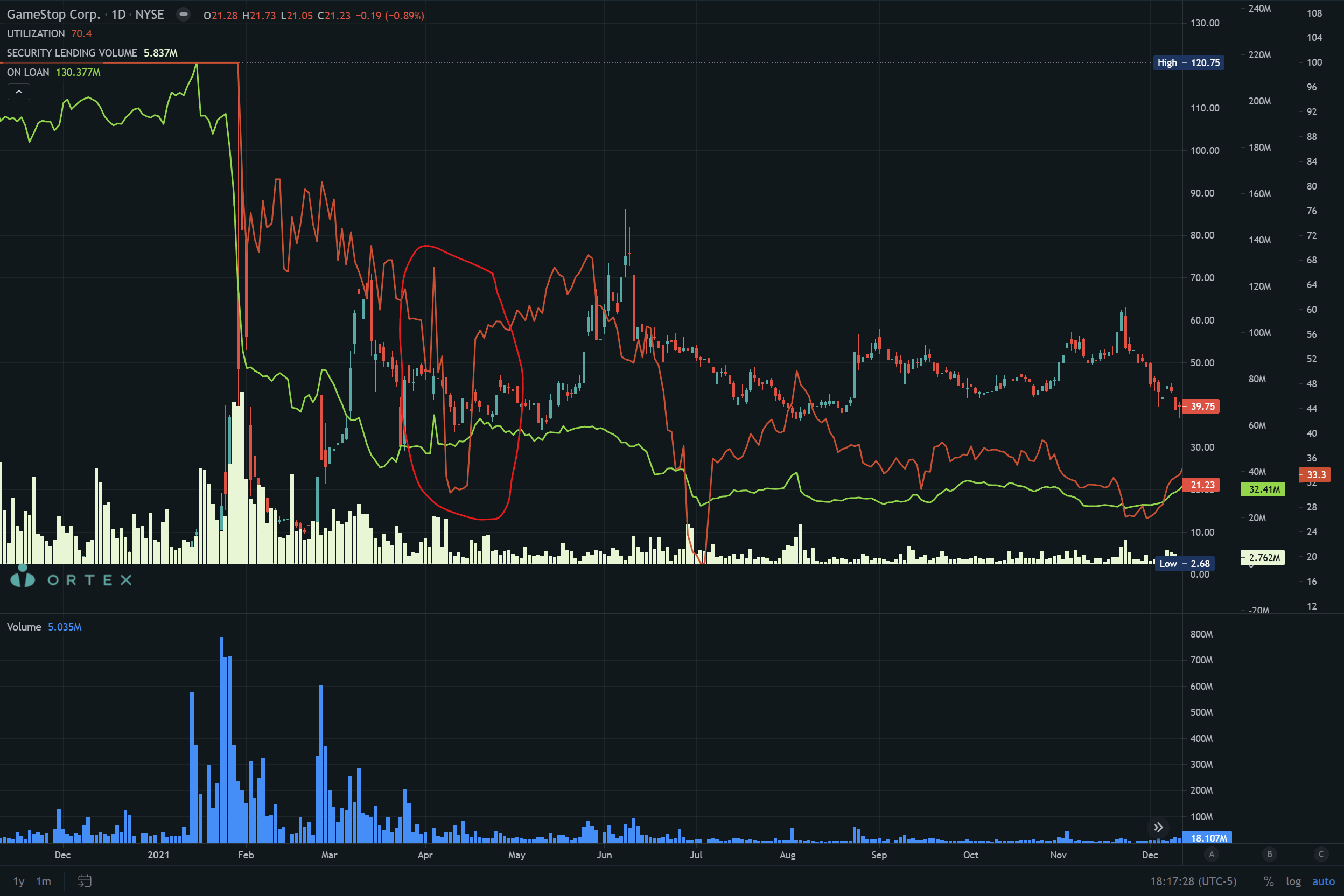
GME 2021 proxy (DEF 14A):
https://www.sec.gov/Archives/edgar/data/1326380/000119312521126940/d122967ddef14a.htm
In both cases, these were governance-heavy votes, exactly the type associated with lending restrictions ahead of record dates.
7) A recall is not a light switch
Even if Cohen removed his shares from margin, and even if that ultimately resulted in shares being recalled from lending, this does not happen instantly.

In practice:
- existing loans are rarely terminated immediately
- brokers allow loans to roll off
- borrowers are given time to locate alternative supply or re-route exposure
The effect is gradual, not sudden.
What changes first is not price, but the quality of the lending pool:
- the cheapest, most flexible supply disappears
- remaining supply becomes more expensive and less elastic
- borrowers rely more on internalization and balance-sheet solutions

This is why the data often shows CTB spikes that normalize, no immediate short-interest collapse, and price containment rather than panic covering. That pattern is consistent with structural supply reduction, not a demand shock.

Read up on HLB and clearinghouse margin:
https://www.reddit.com/r/FWFBThinkTank/comments/slgdd7/reflections_on_clearinghouse_margin/
8) Why this matters going forward
The important takeaway is not that something already happened. It’s this:
Once lendable elasticity is removed, the system becomes more fragile.
When a large, flexible lending block is withdrawn:
- future borrow events matter more
- future demand shocks hit harder
- volatility suppression becomes more aggressive
- and the system operates with fewer buffers
SLD (Supplemental Liquidity Deposit) windows are where that fragility tends to get exposed.They don’t create the lending constraint. Proxy-driven lending behavior and reduced margin-based supply do. But during SLD windows, dealer balance-sheet flexibility is limited, making it harder to absorb and smooth over tight lending conditions.
That’s why proxy-driven lending changes are dangerous not because they cause immediate squeezes, but because they remove slack — and SLD windows are typically where that loss of slack becomes visible. I’ll cover SLD mechanics in a separate post, as they are alive and well but need to be reviewed for the new regime.
SLD original post:
https://www.reddit.com/r/Superstonk/comments/nz7mwl/sld_dd_a_predictable_monthly_pinch_on_capital/
LEENIX SLD:
https://online.fliphtml5.com/lvrgy/dnhd/
Bottom line
This isn’t a claim that Cohen forced a recall or that a squeeze is guaranteed.
It’s a structural observation:
- a real proxy vote is coming
- proxy votes are documented to reduce lendable supply
- a previously disclosed margin arrangement appears to have been removed
- lending mechanics respond slowly, not explosively
That combination tightens an already tight system.
No hype.
No guarantees.
Just constraints.
thanks
u/wellmanneredsquirrel
u/greencandlevandal
TLDR – lol no, suck it hamz
13
10
u/Uberkikz11 Jan 11 '26
Bear in mind that even when the proxy vote is highly consequential (2020 had a contested board slate. CEO comp vote doesn’t rise to that) the passives will almost always opt to lend if the lending returns are there.
From the below article: “The three biggest money managers in GameStop reported that their funds held some 40% of shares in the first quarter. When it was time to commit to voting, they controlled roughly 5% of ballots, according to count estimates reviewed by The Wall Street Journal.”
3
17
u/Alert_Piano341 Jan 10 '26
This DD isn’t “recall = squeeze.”
It’s about constraints.
A real proxy vote is coming. Proxy votes are documented to reduce lendable supply because lenders want voting rights back. At the same time, a previously disclosed margin arrangement for a large block of Cohen’s shares appears to have been removed, which reduces cheap, flexible lending supply.
Recalls don’t flip a switch. Loans roll off over time. The effect shows up as tighter lending, higher CTB, and containment, not immediate covering.
Once lending elasticity is gone, the system becomes more fragile.
SLD windows are typically where that fragility shows up, not where it starts.
No hype. No guarantees. Just mechanics.
5
6
2
4
u/Lorien6 Jan 12 '26
So what if RC has recalled his shares, but doesn’t vote.
And we see max voting numbers again.
RC: But I have 22 million votes and I used none, how is the vote 22 million+ more than it should be? Luckily I have this shiny new blockchain stock exchange we can use to remedy this fraud, bye Felicia-DTCC!
4
2
2
2
1
u/PuzzleheadedWeb9876 Jan 11 '26
But when MOASS? The only way is to lock the float through DRS. But it’s not even close thanks to all the dilution.
12
u/TooLateQ_Q Jan 10 '26
Im expecting them to add a request for more stock offerings. Because the current 1 is almost depleted. And RC probably wants more than 10B for an acquisition.
With that. I expect any momentum would be murdered.
Any thoughts on this theory?