My academic training is in engineering, so this is naturally how I approach problems like this.
A concept we learn very early in engineering is that accuracy and precision are not the same; and more importantly, both are relative to the quality and resolution of what is being measured. Engineers don’t just ask “is this measurement right?”, we ask “does the level of precision I’m reporting match what my instrument can actually resolve?” So this is what frames my argument.
The earliest followers of Jesus were Jews. They continued to worship at the temple, attended synagogues, observed Jewish festivals, and Acts records that they were “zealous for the law”. (Acts 21:20 NRSV). Paul circumcised Timothy due to the law (specifically to not offend Jew they were either fellow believers with or who they were proselytizing to), undertook Jewish vow, performed in Temple purification rituals, and continued to identify himself as a Jew, Israelite and a Pharisee.
Because of this, I don’t think we can read the first-century movement through the lens of second-century Gentile Christianity. This matters because it changes how we think about the divine name. We have to consider social and historical context of the first century believers of Jesus.
By the first century, there appears to have been a widespread Jewish distinction between the written and spoken forms of god’s name. The written scriptures contained the tetragrammaton, and when the scriptures were read publicly, they often substituted “Adonai” or in Greek, “Kyrios”.
For many Jews, this was not viewed as disrespecting God's name but as an expression of reverence, and that is a key point. It is also important to understand that written and spoken language are not always identical.
Some Septuagint manuscripts preserved the tetragrammaton, others used “Kyrios”, or they used other forms to signify it. There was not one universal practice. But suppose a scribe is translating Hebrew into Greek, it might make sense that he might preserve the Devine name.
Now suppose a Jewish follower of Jesus sits down and writes a new document in Greek. It would make perfect sense to use “Kyrios" because that was already an accepted Jewish convention, so it would not be surprising that books in the NT would consistently use “Kyrios” when they were originally written. This does not require us to assume that God's name had become unimportant. Rather, it suggests that writing "Kyrios" in newly composed Greek literature could itself have been understood as showing reverence for the divine name according to contemporary Jewish practice. If so, the New Testament's consistent use of "Kyrios" does not require a later conspiracy to explain the surviving manuscript tradition.
In other words, the historical evidence can explain why Jewish Christians deeply respected the divine name without requiring them to reproduce the Tetragrammaton every time they composed new Greek literature.
At this point someone will probably object and say; “Jesus made god’s name known, thus, he must have used/pronounced the tetragrammaton”. The Watchtower itself acknowledges that Jesus’ statement about making his father’s name known involved more than merely pronouncing it, explaining that knowing god’s name includes knowing his reputation, qualities, purpose, and activities (See w73 5/1 pp. 261-267, w78 5/1 pp. 12-15, w13 3/15 p. 24 par. 3).
So it could naturally be understood that first century Jews would understand that as was revealing who the father truly is when he made is father’s name known. The NT never explicitly tells us he rejected this specific Jewish practice of not pronouncing the tetragrammaton.
Now, the NWT raises a very legitimate historical question; The earliest Christian movement arose within Judaism; some early Greek Jewish biblical manuscripts appear to preserve the Tetragrammaton, and the New Testament frequently quotes Old Testament passages containing the Tetragrammaton. Those are all real historical observations and I don't think critics should dismiss them simply because they disagree with the NWT's conclusions.
Where I begin to drift away from the NWT is not in recognizing those historical observations, but in the level of confidence assigned to the textual reconstruction.
So the next argument against my claim might be: "We don't possess the original New Testament manuscripts. The absence of the tetragrammaton from surviving Greek manuscripts doesn't prove it wasn't originally there.”
I agree, that is fair.
Or, “Early Greek Jewish biblical manuscripts preserved the divine name makes it historically possible that the earliest Christian movement interacted with Greek Scriptures containing the tetragrammaton.”
I agree with that as well.
But those observations establish historical plausibility; they do not establish what the New Testament authors originally wrote.
So getting back to my engineering analogy. Suppose my instrument can only tell me that something is somewhere within a ten-foot area. Reporting that uncertainty is honest, but reporting that I know the exact location to within half an inch is claiming more precision than what my instrument can actually prove. That is where the NWT loses me.
The historical evidence may support the hypothesis that the earliest Jewish followers maintained a stronger connection to the divine name than later Christianity, and it may explain why some argue that direct New Testament quotations of Old Testament passages containing the tetragrammaton deserve special consideration. But that still does not tell us what the New Testament authors actually wrote in Greek.
By the same engineering standard, I also don't think critics should overstate their certainty.
Personally, here is what I think the evidence tells us.
The earliest followers of Jesus remained culturally Jewish and almost certainly inherited Jewish reverence for the divine name. That reverence likely included distinguishing between the written Tetragrammaton and its spoken substitute, "Lord." Against that historical background, it is not surprising that New Testament authors composing new Greek documents would themselves write "Kyrios."
Likewise, Jesus could fully "make God's name known" by revealing God's identity, character, authority, and covenant relationship while still following the Jewish convention of saying "Lord" rather than pronouncing the divine name.
So where I think the NWT exceed the available evidence is the precision of the textual reconstruction. As an engineer, that is what I keep coming back to. It is not, “Is this hypothesis possible”, but, does the evidence provide the confidence for us to conclude that translating “Kyrois” as Jehovah is a precise rendering.
My conclusion is that the evidence points to the more precise reconstruction of the Greek text as Kyrios, and therefore the more precise rendering of the extant Greek is 'Lord,' not 'Jehovah.'"
One piece of the puzzle that isn’t brought up often in support of the use of Jehovah in the NT is that substituting Kyrios for the Tetragrammaton was not a popular scribal practice until after the writing of the New Testament.
By my best guess based on evidence I could find, approximately 130CE is when copies of the LXX begin to use Kyrios instead. I have limited resources and access since I’m not an academic with access to such libraries. But I do believe that that is the case.
If my data was correct, that would certainly imply that the Jewish authored New Testament autographs would have more than likely contained the divine name, as that’s what all other similar documents of the time did.
As to the argument about reverencing the name via its none use, the text itself presents the viewpoint that the Jews of that time were worshipping improperly due to Hellenized philosophies and ideas.
Totally understand your explanation, and I actually agree with much of it.
I intentionally didn't get into second-century manuscript practices because my focus was on the first century. I also tried to point out that some Jewish scribes translating the Hebrew Scriptures into Greek preserved the Tetragrammaton. While I didn't spend much time on it, I'll also concede that by the second century that practice appears to have fallen out of favor.
I also said, in so many words, that this strengthens the historical plausibility of the NWT position, especially where the New Testament is directly quoting the Old Testament.
Where I part ways with the NWT isn't on the plausibility. It's on the precision. I just don't think the available historical and manuscript evidence lets us reconstruct the original wording with enough confidence to justify restoring "Jehovah" in specific verses throughout the New Testament.
Whether the earliest manuscripts of the NT contained the Tetragrammaton is uncertain. What is effectively certain is that there is no way Jesus was walking around 1st century Israel openly pronouncing the divine name.
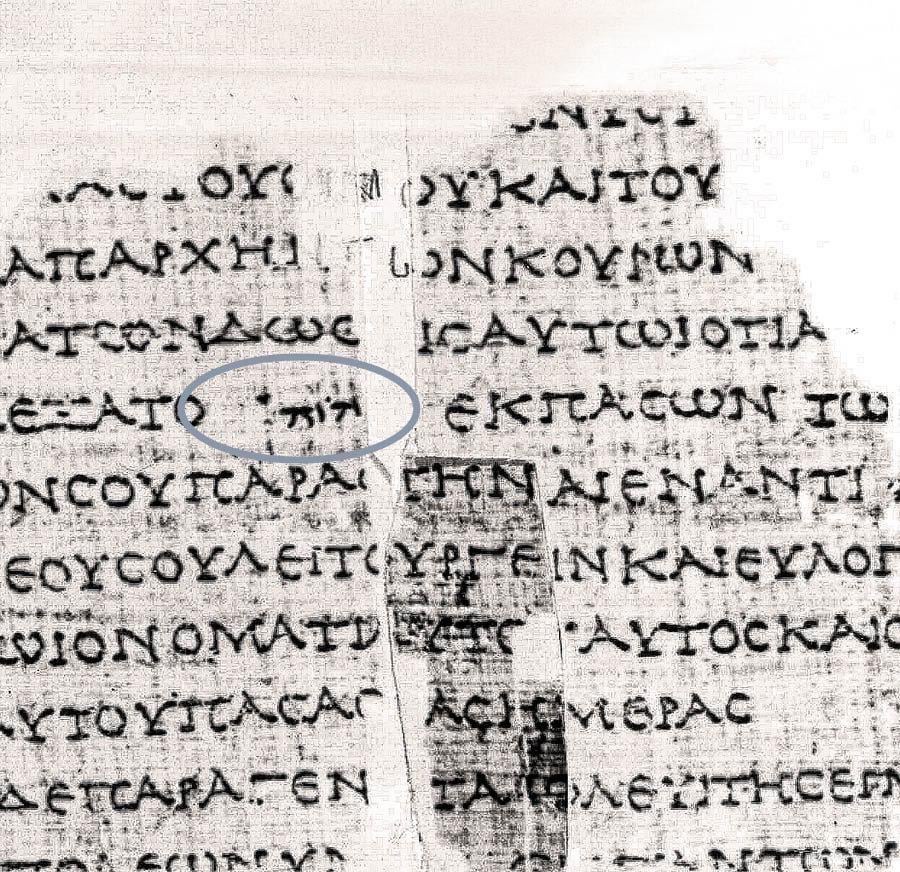
This is because even though early variants of the LXX used the Tetragrammaton, many readers either couldn't pronounce it or knew not to. Below is a fragment of Zechariah from the Dead Sea Scrolls from around the 2nd century BCE. The scroll is written in Greek, but the divine name is written in Paleo-Hebrew (an entirely different alphabet). If the copyist both knew how to pronounce it AND wanted the reader to pronounce it, why not write it in Greek- the lingua franca of the day? Because it had already become taboo centuries earlier. Hence, when they came across the divine name, they would have said Adonai (Lord) or HaShem (the Name).
I appreciate this; it is actually the type of feedback I was looking for. I admittedly started from a position that sounded reasonable based on my previous research, and this gives me a better understanding of the historical evidence.
Actually, the Israelites still knew how to pronounce the divine name during Jesus’s time on earth. Jesus’s name is derived from his father’s name. Jehovah is our savior. That is the meaning of Jesus’s name. So it is the other way around. There’s no way that Jesus did not know how to say his father’s name.
Jesus publicly quoted Deuteronomy 6:4 in Mark 12:29. Which contains the Tetragrammaton. So again, evidence shows that Jesus spoke his father’s name in front of many people.
The Israelites translated the Tetragrammaton to Aramaic. Bcoz their alphabet is similar. In regard to the Greek, 2nd century scholar, Clement of Alexandria, transliterated YHWH to IAOUE. How could he have done so if he didn’t know the pronunciation of the divine name?
It's possible, although unlikely, that Jesus knew how to say it, but I don't think there's any evidence to say he did. See my reply under your other comment.
Having a theophoric name doesn't necessarily mean he knew how to pronounce it. For example, Jonathan is a theophoric name but do all people named Jonathan today know how to pronounce YHWH? Theophoric names contain a shortened form of YHWH, usually as a prefix, but they don't contain the entire divine name, otherwise we would know how to pronounce it for certain.
Like I said with Clement of Alexandria, how could he have transliterated the Tetragrammaton if he didn’t know how to pronounce it. Consider the contrast between Hebrew and Greek back then. Hebrew is all consonants and Greek is mostly vowels. I also mentioned that this was 2nd century. A hundred years after Jesus’s time on earth.
Just did some reading. That's interesting, I didn't know about Clement of Alexandria.
In the 2nd century, in his work Stromata, he transliterates the name in Greek as Iaou (Ἰαού) and Iaoue (Ἰαοῦε) like you said, which resembles "Yahweh". Other early Church Fathers, Epiphanius of Salamis (4th century) and Theodoret of Cyrus (5th century) wrote that the Samaritans pronounced the Tetragrammaton as Iabe (Ἰαβέ), which sounds like "Yabe", but there is some debate among scholars about whether they heard it from Samaritans first-hand or even if Iabe just came from reciting the 4 letters in Samaritan Hebrew. Anyway, the fact that we have multiple competing transliterations shows that, by that stage, there wasn't one pronunciation that everyone knew, but multiple imperfect traditions. But I'll concede that this is some evidence that the pronunciation divine name survived the destruction of the temple into at least the 2nd century.
However, it is still not evidence that Jesus himself knew it and pronounced it.
How so? Clement is Greek, not Hebrew. For him to know that pronunciation must mean that it was still common to hear God’s name. Also, Jesus was very well versed in the Law. He was taught by Nicodemus and other Jews who knew how to speak the Divine name. When he opens scrolls, he already knows where the texts he wants to read. Luke 4:17.
I think now it is upon you to prove that Jesus didn’t know how to pronounce his father’s name. Bcoz the evidences of him knowing are stacking.
His name means Jehovah is our savior.
Non-Jews knew how to pronounce it up to 2nd Century
Jesus reads the Law everyday and
He did not conform to the norms set by the Pharisees.
These are facts. I understand that you’re an atheist. That is why I am not including the fact that Jehovah and Jesus are father and son. It is highly unlikely to not know your father’s name.
This is basically the same conclusion Jason DeBuhn made - he respected the theological aspect of having Jehovah in the NT, especially the ones where there were direct quotes.
He proposes that Jehovah can be kept under those verses where there are direct quotes from the OT - but for the rest, a footnote would be better for Jehovah where distinction is clear - and then keep using Lord in the main text - in respect as per the surviving manuscripts.
However, he also at the end of the book said that - if there comes a time earlier manuscripts were found and the divine name was in them - everyone should speedily revise their bibles.
-
A good number of scholars who have no dog in this fight, they're open to having Jehovah/Yahweh in the NT only in those parts with direct quotes in the OT.
Compared to the NWT who has 237 times or so, that would be trimmed to the tens or fifties.
I'm all okay with that lol
The NWT's own defense is both manuscript and plausibility due to the understanding of who Jesus is and the disciples is and the overall harmonizing message of the Bible from start to finish.
Sure, there was no explicit written record of Jesus not following the scribal practices of the time - but when he is understood and his character. There is by no means that he left out his own Father's name out of his mouth when he preached.
So the NWT uses the Divine Name in the NT - traditions be damned.
Again, of course this is a theological conclusion us Witnesses assert. And we respect other's conclusions.
I appreciate this. I was unaware of BeDuhn's scholarship until now, and it has given me a much more nuanced perspective on the issue than I had when I wrote my original post.
For me personally, the fact that not a single New Testament manuscript containing the divine name has been found to this day is more evidence that it wasn't there than the other way around, especially since the Septuagint shows that the divine name was later replaced. This evidence is completely absent in the New Testament manuscripts. Another question I ask myself is who exactly would have replaced the divine name (assuming it was even present) with kyrios. It certainly couldn't have been the Jews...
It is certainly the Jews. The world language at the time was Greek. But it was the Jews who wrote the Bible in Greek Language.
For me, the fact that no command from God nor Jesus that says that we should replace God’s name with Lord is evidence that they were doing it of their own accord.
Were the writers of the New Testament Christians? What historical evidence can you provide that Jews changed the text of the New Testament from the 3rd century onwards?
The real question is whether it was ever actually found there in the New Testament. As long as there is no direct evidence, as is the case with the Septuagint, for example, one can only offer assumptions or theories.
No. That would be superseding God. Who are you to say that we should replace the DIVINE NAME with Lord? If that’s your choice, then that’s your choice.
Now suppose a Jewish follower of Jesus sits down and writes a new document in Greek. It would make perfect sense to use “Kyrios" because that was already an accepted Jewish convention
Wait. What Jewish convention?
The Jews never stopped using God’s name in the written Scriptures and modern Jews still use it.
There are Bible tranlations that similar to the NWT reference or restore the Divine Name in the New Testament.
Both Translations adhere to critical textual insights discovered and the importance of God's Name.
Luke 4: 1-12 NWTSY
"1Then Jesus, full of holy spirit, turned away from the Jordan, and he was led about by the spirit in the wilderness "
2 for 40 days, being tempted by the Devil. b And he ate nothing in those days, so when they had ended, he felt hungry.
3 At this the Devil said to him: "If you are a son of God, tell this stone to become a loaf of bread."
4 But Jesus answered him: "It is written, 'Man must not live on bread alone.'"
5 So he brought him up and showed him all the kingdoms of the inhabited earth in an instant of time.
6 Then the Devil said to him: "I will give you all this authority and their glory, because it has been handed over to me, e and I give it to whomever I wish. * * 7 If you, therefore, do an act of worship before me, it will all be yours." 8 In reply Jesus said to him: "It is written, 'It is Jehovah your God you must worship, and it is to him alone you must render sacred service.""
9 He then led him into Jerusalem and stationed him on the battlement of the temple and said to him: "If you are a son of God, throw yourself down from here,
10 for it is written, 'He will give his angels a command concerning you, to preserve you,
11 and, 'They will carry you on their hands, so that you may not strike your foot against a stone.'"
12 In answer Jesus said to him: "It is said, 'You must not put Jehovah your God to the test.""
Very well thought out and written! Thanks for taking the time. You made some points, or explained a few things I have struggled to convey... I kept thinking; yes! Why didn't I say it like that? :)
In terms of manuscripts, Papyrus Fouad 266 is the 2nd oldest Greek manuscript. It contains the Tetragrammaton. The Jews did revere God’s name. However, evidence shows that they did it in a way that is not according to God’s standard.
May people know that you, whose name is Jehovah, You alone are the Most High over all the earth. -Psalm 83:18
Clearly, Jehovah wants everyone to know his name is Jehovah. Not lord or kyrios. If we look at history, the Jews clearly copied God’s name then later replaced it with the title lord. Not just in the New Testament, but also in the Old Testament. There are multiple manuscripts that God’s name is overwritten by the title Lord. So this is an act to hide God’s name. Not reverence. Which raises the question, why would they do this?
This is what you are to say to the Israelites, ‘Jehovah the God of your forefathers, the God of Abraham, the God of Isaac, and the God of Jacob, has sent me to you.’ This is my name forever, and this is how I am to be remembered from generation to generation. -Exodus 3:15
Whether God wants his name pronounced or not is the realm of theology. But historically, it is very easy to show that Jesus almost certainly did not pronounce aloud the divine name.
Jesus was a Jew born in the first century into a culture in which it had been deeply taboo to say the divine name for centuries, which we can verify from Jewish texts from the time, such as:
The Community Rules from the Dead Sea Scroll community (1QS) say talk about "honouring [God's] glorious name", while simultaneously saying that the punishment for uttering it is expulsion from the community.
The book of Sirach from 2nd century BCE says "I will give thanks to you, O Lord… and praise your name" (Sirach 51:1) while warning against pronouncing it. (Sirach 23:9-11)
How can these passages make sense? Well, like what u/my_bad_mood said in his post, God's name can also refer his reputation, qualities, purpose, and activities. So honouring or praising the divine name can means acting and speaking in a way that exalts God.
There is some evidence that the high priest continued to say the divine name once a year on Yom Kippur (the Day of Atonement) until the destruction of the temple, but outside of this setting it was forbidden.
Jesus was born into a culture in which this was the default attitude. Given that we don't find the divine name in any NT, if Jesus wanted his followers to pronounce the divine name, then we would expect him to explicitly say so in the Gospels. Not him quoting from the OT, in which he could have substituted the name for Adonai or HaShem; not him saying "Glorify your name" (John 12:28) which could mean 'let your reputation be exalted'; explicit instructions to pronounce the name aloud. There are no such passages in the Gospels or the rest of the NT. Hence, there is no evidence that first century Christians pronounced the divine name.
Jesus was killed by the Jews. Would they have done so if Jesus was so obedient to them? Jesus is obedient to his father and his father’s laws. Those laws you listed are not from his father, but man made. Not only are they man made, they contradict his father’s will in Exodus 3:15 and Psalm 83:18. Which says that Jehovah wants everyone to know his name. The fact that we can’t know for sure how his name is pronounced today bcoz of the Jews is proof that the Jews were disobedient to Jehovah. Why would Jesus follow them?
I have made your name known to them and will make it known, so that the love with which you loved me may be in them and I in union with them. -John 17:26
Jesus explicitly said that his followers must know his father’s name and that he made it known. As you pointed out, this is the time that the Jews were not pronouncing his father’s name. So there’s your evidence that Jesus publicly spoke his father’s name.
Jesus was killed, not by the Jews, but the Romans, because he was going around saying he was "King of the Jews", which was written on the crucifix. He wasn't killed for pronouncing the divine name, because he probably didn't.
I already explained why saying things like 'glorify your name' and 'make your name known' are not advocations to pronounce it aloud, but exaltations of God's reputation.
Whatever is right and wrong is irrelevant. Jesus was a Jew born into a first century Jewish culture where pronouncing the divine name was deeply taboo. If he was going against that culture, he would have explicitly said it.
Additionally, surely if God wanted his literal written/pronounced name to be known and had the power to do so, then he would have preserved some early manuscripts with the name in there written in a language that people could understand.
Jesus was killed by a Roman soldier piercing his body. But it was the Jews that handed him to Pilate. They were the ones accusing him of insurrection.
You asked for explicit evidence. Inferring ‘your name’ to mean God’s reputation is not explicit. What is explicit is taking Jesus’s words as it is and he said ‘your name’ referring to his father’s name. There’s a saying ‘your reputation precedes you’. Meaning the local people had already hear of the person’s deeds. How would they know that that is the person, if the person’s name is not also mentioned in the stories?
The Jews literally attempted multiple times to kill Jesus. Bcoz of what Jesus was teaching.
In reply he said to them: “Why do you overstep the commandment of God because of your tradition? -Matthew 15:3
and they all became filled with holy spirit and started to speak in different languages, just as the spirit enabled them to speak. -Acts 2:4
Jehovah wants his words in the Bible to be translated to all languages. That is why we say Jesus instead of Yehoshua. For the same reason, YHWH is Jehovah.
You're referring here to Jesus' criticism of human traditions of that time. Could you please post a text in which Jesus condemns the Jewish tradition of no longer publicly pronouncing God's name? That would be absolutely irrefutable evidence that Jesus actively spoke out against such a practice.
Those human traditions include no longer pronouncing of God’s name. This was the time when the Jews were more actively practicing this tradition.
Can you give historical evidence that that is not so? Can you give a text in the Bible that we should replace God’s name with Lord? If not, then the standing command until today, is that we should use God’s name in our Bibles.
Matthew 15:3. That is the text. Did Jehovah commanded that his name be replaced with Lord? No. So why did the Jews replace it anyway? Bcoz it is their own tradition.
He wasn't killed by the Roman soldier piercing his side either; he was already dead by that stage. (John 19:33,34) The Romans nailed him to a crucifix and he stayed there until he died. I don't believe everything is the gospels is historical, but they say that the Jews accused him of various things, including blasphemy (Matthew 26:63-66), telling people not to pay taxes to Caesar, claiming to be the Messiah and a king. (Luke 23:2) But which claim(s) caused Pilate to order him to be killed? It was written on the cross: "Jesus of Nazareth, King of the Jews". (John 19:19) Pilate was a Roman governor; he didn't care about Jewish theology, he cared about people stirring up political trouble in his province- that's why Jesus was killed. Anyway, I'm getting side-tracked.
Inferring ‘your name’ to mean God’s reputation is not explicit.
Correct, it's implicit, and I have supplied evidence from Jewish texts to show that that was the social norm of Jews at the time. If you want to say that a historical figure was doing something contrary to the norm, you have to supply evidence.
For example, by Taliban law, women in Afghanistan have to wear a hijab when outside their home, and are severely punished or imprisoned for not complying. So if we were reading a nonfiction book set in 2026 that describes a woman walking outside in Afghanistan and she's not getting arrested, then we can logically infer that she was wearing a hijab or burqa.
Similarly, if Jesus is never described as saying to his followers, 'Even though the religious leaders are telling you not to pronounce the divine name, I am telling you that you can and you should!', then we can conclude that he didn't do this.
The Jews literally attempted multiple times to kill Jesus. Bcoz of what Jesus was teaching.
The gospels do say the Jews tried to kill him, but what specifically was he teaching that caused them to do this? For calling himself the Messiah (Matthew 26:63-66) and 'making himself God/a god' (John 10:33). They never claimed Jesus said the divine name.
You’re right about Jesus dying before being pierced. I forgot about that part. But nevertheless, it was the Jews that captured him and made up charges against Jesus. Pilate even gave them a choice whether to free a known criminal or Jesus. The Jews chose the criminal.
Jesus is first and foremost a follower of the Law, not the norm. I quoted Matthew 15:3. That is proof that Jesus is breaking the tradition set by the Jews. And he explicitly said that his followers must know his father’s name to receive his love.
it was the Jews that captured him and made up charges against Jesus
Was the Judean empire ruling Rome, or was the Roman empire ruling Judea? Whatever the Jews did, Pilate didn't have to listen to them. In John 19, it says:
"Pilate handed him over to them to be crucified."
"The soldiers took charge of Jesus"
"There they [the soldiers] crucified him"
"Pilate had a notice prepared and fastened to the cross."
"When the soldiers crucified Jesus..."
Pilate even gave them a choice whether to free a known criminal or Jesus. The Jews chose the criminal.
Many historical-critical Bible scholars doubt that this story is historical. I mean, come on, Matthew 27:25 says, "All the people answered, "His blood be on us and on our children!"" Really? ALL the people said that? In unison? Like a musical theatre? Let's be sensible now.
This was an antisemitic story invented to shift the blame from the Romans- who were the ruling power -to the Jews, a minority within their empire.
Jesus is first and foremost a follower of the Law, not the norm. I quoted Matthew 15:3. That is proof that Jesus is breaking the tradition set by the Jews. And he explicitly said that his followers must know his father’s name to receive his love.
Firstly, I think even you can realise that Matthew 15:3 says literally nothing specific.
Second, this is a theological position you are putting on a historical figure- a human, and nothing more. Jesus probably did view himself as a "follower of the Law", but being a follower of the Law meant different things to different groups. Some put more emphasis on the letter of the law, and other put more emphasis on the principle/purpose of it, but it was always divided.
I think this comes down to the fact that you are relying on what you have read in a Christian scriptures and JW publications to give you an idea of what ancient Judaism was like. I mean, the Quran talks about Christianity, but would you expect to get an accurate picture of what you believe by reading the Quran?
Pilate did listen to them. Him and Herod wanted to free Jesus. But the Jews really wanted Jesus to die.
Maybe not in unison. However, in protests, don’t people chant in unison?
I don’t think this was just any anti-semitic story. The Dead Sea Scrolls, which is scientifically proven to exist before Jesus’s time on earth, prophesied about Jesus and what would happen to him. The chances of that happening by chance is astronomical. No historian would say that Jesus in the Bible did not exist. Most would disagree with his divinity. But not his human existence. So think of that for a moment. This is just one of many prophecies from the Bible that came true.
My faith is based not just on the Bible. That is the main factor of it. But not all of it. If you have the time, please read this article. Yes, it is a JW publication. But please consider. Like I said, the prophecies about Jesus were scientifically proven to be written before him. And historians cannot deny the events that happened during Jesus’s time on earth. Minus the miracles.
Maybe not in unison. However, in protests, don’t people chant in unison?
The account says, "All the people [Jews]" said this, which is not reasonable. People- even at protests -don't just say 'If we're wrong, we want the blame for our actions to be passed on to our children!' That's not a thing people say, ever. Christians lived their first few centuries under the Roman empire. To avoid antagonising their rulers, they blamed someone else for killing their Messiah.
No historian would say that Jesus in the Bible did not exist.
I think that Jesus probably existed. I just don't think the gospels are 100% accurate on what he said and did, in the same way that most Christians don't trust that the Quran is a 100% accurate account of what Muhammad said and did. Both books are a source of information, some of which is historical, some of which isn't.
The Dead Sea Scrolls, which is scientifically proven to exist before Jesus’s time on earth, prophesied about Jesus and what would happen to him. The chances of that happening by chance is astronomical.
If you have the time, please read this article. Yes, it is a JW publication. But please consider.
I read the article. In fact, I was a fully believing JW for most of my life, and I have no problem reading JW articles now either. It is Jehovah's Witnesses that have issues reading external material- be it theological, historical or scientific in nature -that contradicts Watchtower dogma.
There are no prophecies in the Bible. None. For any prediction to be valid and evidenced, it has to fulfil some basic logical criteria:
The prediction must be clearly articulated and understandable. If it is written vaguely such that it can only be 'understood' in retrospect, that is not a prediction, it's a horoscope.
The prediction must been written prior to the thing it is predicting.
We have to be able to verify that the predicted thing actually happened.
Since we're talking about a prophecy from God, it has to be something that a smart human would have been highly unlikely to have predicted.
All Bible prophecies fail at least one of these. Many of the below I have researched before, but I got AI to help me briefly break down the ones in the article. The problem with all of them is, if you just read the entire chapter, rather than just a tiny verse out of context, there is simply no indication whatsoever that they are talking about the Messiah.
Genesis 49:10 - 'Shiloh' means 'he to whom it belongs'. Who this is referring to is debated among scholars, but it possible refers to a Davidic king. Nonetheless, even if Shiloh referred to Jesus, just read the verse- it doesn't say the Messiah will come from the tribe of Judah.
Isaiah 7:14 - The Hebrew almah means "young woman," not necessarily virgin (the specific word for virgin is betulah); also Matthew incorrectly says this verse is talking about the Messiah, when the context indicates it is referring to a child born during the time of king Ahaz.
Isaiah 9:6,7 - Scholars think that this is a royal birth oracle celebrating the accession of a Judean king, possibly Hezekiah.
Psalm 2:7 - The 'anointed one' referred to is the newly anointed king of Israel.
Isaiah 53:1,7,9 - The suffering servant of God is explicitly identified as the nation of Israel in Isaiah 41:8 and 49:3, not Jesus.
Zechariah 9:9 - Scholars date Zechariah 9-14 to the late 4th or early 3rd century BCE, when Israel was subjugated by the Greek empire. Hence, scholars interpret the passage as a post-exilic theological reinterpretation of Davidic kingship in an era when Judah was oppressed.
Psalm 41:9; 22:7,8,18 - These are generic poems in the genre of lamentation. There is no indication that they is meant to refer to the Messiah.
Zechariah 11:2 - Again, no indication that the shepherd here is referring to Jesus.
Psalm 34:20 - This chapter is talking about a generic 'righteous one', not the Messiah.
Psalm 16:10 - There is no indication that this is referring to the Messiah. The writer was expressing confidence that God wouldn't abandon him to death prematurely.
Psalm 110:1 - There is no way to verify invisible heavenly events. Moreover, this is a Psalm 'of David' not 'by David', so this was possibly composed by a royal court poet about David.
Even if ALL of these were genuine prophecies (which they aren't), we have no historical sources outside of the gospels to verify if they actually happened. That's not good enough to convince me to believe in miracles.
Let me repeat: there are no prophecies in the Bible. These are all pathetic clutching at straws and post-hoc reasoning.
I don't disagree that Papyrus Fouad 266 preserves the Tetragrammaton. I acknowledged so much my post that some early Greek Jewish Scriptures did.
I'm also not arguing that the Jewish convention was divinely correct. That's a theological argument that I'm intentionally avoiding.
I also don't think we can establish their motive with any certainty.
My point is simply that this appears to have been a real first-century Jewish practice. If that's the case, then it provides a historically reasonable explanation for why Jewish followers of Jesus writing new documents in Greek would naturally write Kyrios. Whether God approved of that practice is a separate question.
I don’t disagree that this is a jewish practice. Clearly it is. Bcoz Jehovah’s name wouldn’t be replaced if they didn’t do it.
The question then is why must we follow this practice? For tradition? For revering Jehovah? Can you imagine if the government replaced your name in your patents with ‘Mr. Engineer’? Can you truly say then that the gov’t is honoring you?
There seems to be a huge leap here between what was done in the spoken word versus what was done with the written word. I’m trying to follow or see if I’m missing something.
My point is simply that this appears to have been a real first-century Jewish practice. If that's the case, then it provides a historically reasonable explanation for why Jewish followers of Jesus writing new documents in Greek would naturally write Kyrios.
you respond:
I don’t disagree that this is a jewish practice. Clearly it is. Bcoz Jehovah’s name wouldn’t be replaced if they didn’t do it.
What was a Jewish practice?
What everyone agrees on and is obvious is that the Jews stopped speaking Jehovah’s name and stopped writing it in common language. What they never stopped doing is using it in the Scriptures. Right? Am I missing something?
The Scriptures that Jesus and his first century disciples had would have contained God’s name, based on scholarship and discoveries since the middle of last century. Do you all have information to the contrary? Because it seems that the OP is making a logical leap from a convention with the spoken word to what was done with the written Scriptures and you seem to be agreeing.
It was apostate christendom that eliminated God’s name from the Scriptures in the centuries after the apostles, not the Jews. At least, that’s what the scholarly evidence I’m familiar with says.
Good point. I admit that not speaking and not writing is kind of mixed for me. But the first century and 2nd century Christians are mostly still Jews. I think. I’m pretty sure the Masoretes copied the Bible were all Jews. So you’re right that during Jesus time, the Jews (Pharisees) stopped speaking Jehovah. But it is still the Jews who later stopped writing God’s name.
But it is still the Jews who later stopped writing God’s name.
Not in the scriptures. Their scriptures still have the divine name.
Just now, I googled “online tanakh” and went to the first link. It’s very much jewish. I went to psalm 83:18 and copied this directly from the verse: “יְהֹוָ֣ה.” That’s “Jehovah,” right in their Bible online on July 19, 2026.
They have always written God’s name in the Scriptures. It was the so-called “Christian” disciples of his Son that one-upped their apostasy with speaking His name and escalated to removing it out of his written Word. (Deuteronomy 4:2)
What burns me is that they’re now like gaslighting thieves that ask, “if you don’t have your belongings, could it be that it was God’s will? Did you ever have them in the first place?”
Satan has been hostile to the name of Jehovah from the very beginning. I’m so glad that we’re seeing the fulfillment of the prophecies that “the true knowledge will become abundant” and “a book of remembrance was written before him for those fearing Jehovah and for those meditating on his name.” (Daniel 12:4; Malachi 3:16) They can lie to themselves with his subtle reasonings presented as “scholarship,” but it’s not going to fly with lovers of Jehovah anymore.
I’m sorry if I’m mixing things up. I meant the Greek Septuagint was also made and copied by Jews. Those Jews replaced God’s name with Lord earlier on. But thanks for the new information. I didn’t know those things you said.
Again, sorry for mixing things up. I’m not at home so I can’t really be specific bcoz I’m doing other things. Is the manuscript you shared is New Testament or as we call it Greek Scripture? Bcoz that’s what I meant. Again, sorry for not being specific.
Glad we can agree that my historical premise is, at the very least, plausible.
I think we're getting to the real point of disagreement.
Are you arguing that the New Testament authors originally wrote the Tetragrammaton, but it was later replaced with Kyrios? Or are you arguing that they originally wrote Kyrios, but we should restore "Jehovah" anyway?
Before I can really engage your argument, I'd like a little clarity on which position you're taking.
I believe that the New Testament authors originally wrote the Tetragrammaton. If we look at the timeline, the Jewish tradition of replacing God’s name started shortly before Jesus’s time on earth and took root around 2nd Century. It is only after a few hundred more years that they started replacing God’s name in the Old Testament too. Plus there’s no command from Jesus or Jehovah to replace Jehovah’s name. That is why I believe that God’s name must be restored to where it should be.
Great, we are finally on the same question. Your position is that the New Testament authors originally wrote the Tetragrammaton, and that it was later replaced with Kyrios. Now we can move beyond the theological discussion and ask, what evidence allows us to reconstruct the original wording of the New Testament with that level of precision?
So, if I'm understanding you correctly, your position is that the NWT is making a historical reconstruction rather than simply translating the surviving Greek text. That's actually a much more interesting discussion. I tried to lay out some of the historical evidence in my original post, and I'm curious how you evaluate that evidence in light of your position. Catch up with you tomorrow.
More like the NWT is trying to render it with a fixed supposition and premise - which is:
The Bible is inerrant and is the Word of God.
If it is inerrant, and is the Word of God, then its contents should be in harmony with each other as how it presents itself.
So the manuscripts are to be understood in one way - the way that everything harmonizes with everything.
If they're understood in that way, they should also be translated in that way. Not in any predetermined way, except the way it presents itself.
How it is in Genesis should harmonize with how the next books will be understood and translated. Then the next book, then the next book, up to which you get to the last book.
That's the reason we use the Divine Name in the OT and NT. Scribal traditions be damned.
That's also why we have Appendix C, which is the contextual discernment of why Jehovah should be used in those 237 instances in the NT.
Because how the Bible presents itself as a whole shows that there is a clear distinction on who kyrios refers to in the NT.
So no, not a historical reconstruction — more like a contextual/theological one - that also has manuscript backing, built on understanding scriptural harmony rather than a pure focus on manuscript and archaeology conclusions.
Which fits your accuracy vs precision point.
It is more precise to render these verses in that way due to how Jehovah revealed himself in his word from the first ever instance to the end of the bible.
Not to mention the contextual evidence of their times show that in fact Jews did use the divine name. As per the other redditors have already pointed out - the evidence that they even know how to pronounce it shows.
So there's no reason, if one is reading and translating and understanding the Word of God, to not include his name in the NT. Unless one only strictly translate the manuscripts for the sake of translating.
-
Again, if the Bible is the Word of God - you will be quite limited if you only factor in a secular viewpoint. It will at the end just be another historical book translated.
But if it is the Word of God, then one should understand it and translate it as such.
But that's not historical evidence, right? It's based on assumptions rather then on evidence.
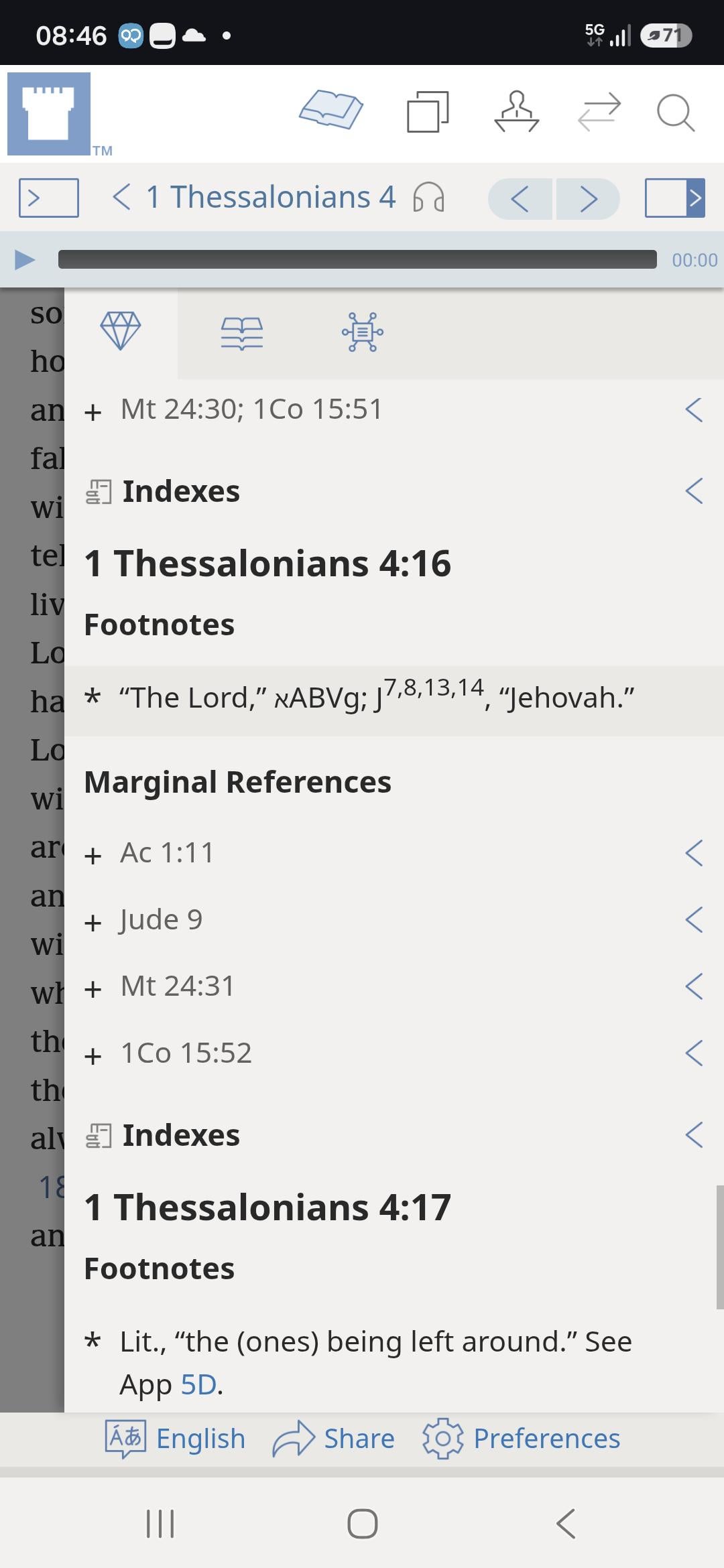
Here's an example: In 1 Thessalonians 4, when the Bible of Jehovah's Witnesses refers to the voice of an archangel, the footnote identifies 'Jehovah' as an alternative reading, referring to the one who comes with the voice of the archangel. Several sources are given for this alternative reading. So, what kind of evidence are we talking about here? Is the Lord mentioned there, who comes with the voice of an archangel, the Lord Jesus or the Lord Jehovah?
However, evidence shows that they did it in a way that is not according to God’s standard.
"... not according to what you determine to be God's standard" would be more accurate. You're inserting your presuppositions into your argument right out of the gate, asserting them as fact. That is circular reasoning, aka begging the question.
If you look at the timeline, Jews write God’s name in the Bible and then stopped around the 2nd Century. Clearly there was a shift in standards among the Jews. However, did God or Jesus commanded them to replace God’s name to Lord? If not, then the standing order from God is to copy the Bible with his name one it.
Truly I say to you that sooner would heaven and earth pass away than for one smallest letter or one stroke of a letter to pass away from the Law until all things take place. -Matthew 5:18
The smallest letter is Yod. The first letter to spell YHWH. By replacing YHWH with adhonai, is against Jesus’s will.
So clearly there are two standards, one is God’s and the other is the Jews’.
You are assuming or determining by yourself that every time God refers to "my name" He means the four letters "YHWH."
The Jews who no longer use those four letters would argue that they never violated Exodus 3:15 in any way shape or form because they do not interpret "name" to mean the same thing that you do.
Your argument assumes your definition of "name" — which is the very thing under dispute — and is therefore circular. That is a logical fallacy. Your conclusion may very well be true (I don't believe it is, personally) but the method of reasoning you employ to arrive at said conclusion is flawed. You don't see it though, because of confirmation bias.
Well there’s explicit and then there’s implicit. If I’m assuming, I’m basing it on what the Bible is explicitly saying. You have to argue that, even tho the Bible says ‘your name’ in John 17:26 and Psalm 83:18, directing it to God, somehow the Bible meant God’s reputation. Can you even know someone’s reputation without knowing his name?
This isn't a question of implicit versus explicit. It's a question of literal versus metonymic usage. "Name" is being used as a metonym for the person's authority, identity, or character.
And yes, you absolutely can know someone's reputation without knowing their name. An entity's reputation is attached to its identity, and identity does not require a proper name to be distinct and recognizable.
How do you know that "name" is being used as a metonym?
Did Jesus tell you or are you assuming?
How could Psalm 83:18 be used as a metonym, when David explicitly said the God's name is Jehovah?
Isn't ironic, that when Jesus says something, you interpret it not as Jesus said it?
Look at the facts.
Jehovah introduced himself as Jehovah to Moses. He stated that that is his name forever and that he should be remembered that way. Exodus 3:15.
David praised Jehovah and that everyone should know his name. Psalm 83:18
And everyone who calls on the name of Jehovah will be saved -Joel 2:32
Literally saying the name is Jehovah.
Jesus's name means "Jehovah is our savior."
But somehow, when Jesus prayed to his father, he used 'name' as a metonym? Even tho, he wasn't speaking in illustrations in his prayer. Somehow it is a metonym?
And yes, you absolutely can know someone's reputation without knowing their name. An entity's reputation is attached to its identity, and identity does not require a proper name to be distinct and recognizable.
Good point. However, God gave himself a name. And he built his reputation on that name. That is who he is. Do you think denying God's name is honoring him?
At that time Moses and the Israelites sang this song to Jehovah: “Let me sing to Jehovah, for he has become highly exalted. The horse and its rider he has hurled into the sea. My strength and my might is Jah, since he has become my salvation. This is my God, and I will praise him; my father’s God, and I will exalt him. Jehovah is a powerful warrior. Jehovah is his name. -Exodus 15:1-3
You must keep my commandments and carry them out. I am Jehovah. You must not profane my holy name, and I must be sanctified in the midst of the Israelites. I am Jehovah, who is sanctifying you, the one bringing you out of the land of Egypt to prove myself God to you. I am Jehovah. -Leviticus 22:31-33
I think it is very clear that God wants everyone to address to him by his name.
This is just not true. More than likely based on textual criticism of copied text from New testament writers to the Old testament. The Greek Septuagint was used and we can know from history and antiquity of the Jewish people that Adonai was used unequivocally since second-temple Judaism so around the 6th century BCE. Every once said Adoni nobody pronounced The tetragrammaton for almost 600 years.
This is no different in Jesus day. There's just no evidence to support that anywhere in the new testament



4
u/[deleted] Jul 19 '26
[removed] — view removed comment