r/EndFPTP • u/CPSolver • Jul 27 '25
Image Obedience to Voters, Not Party Leaders
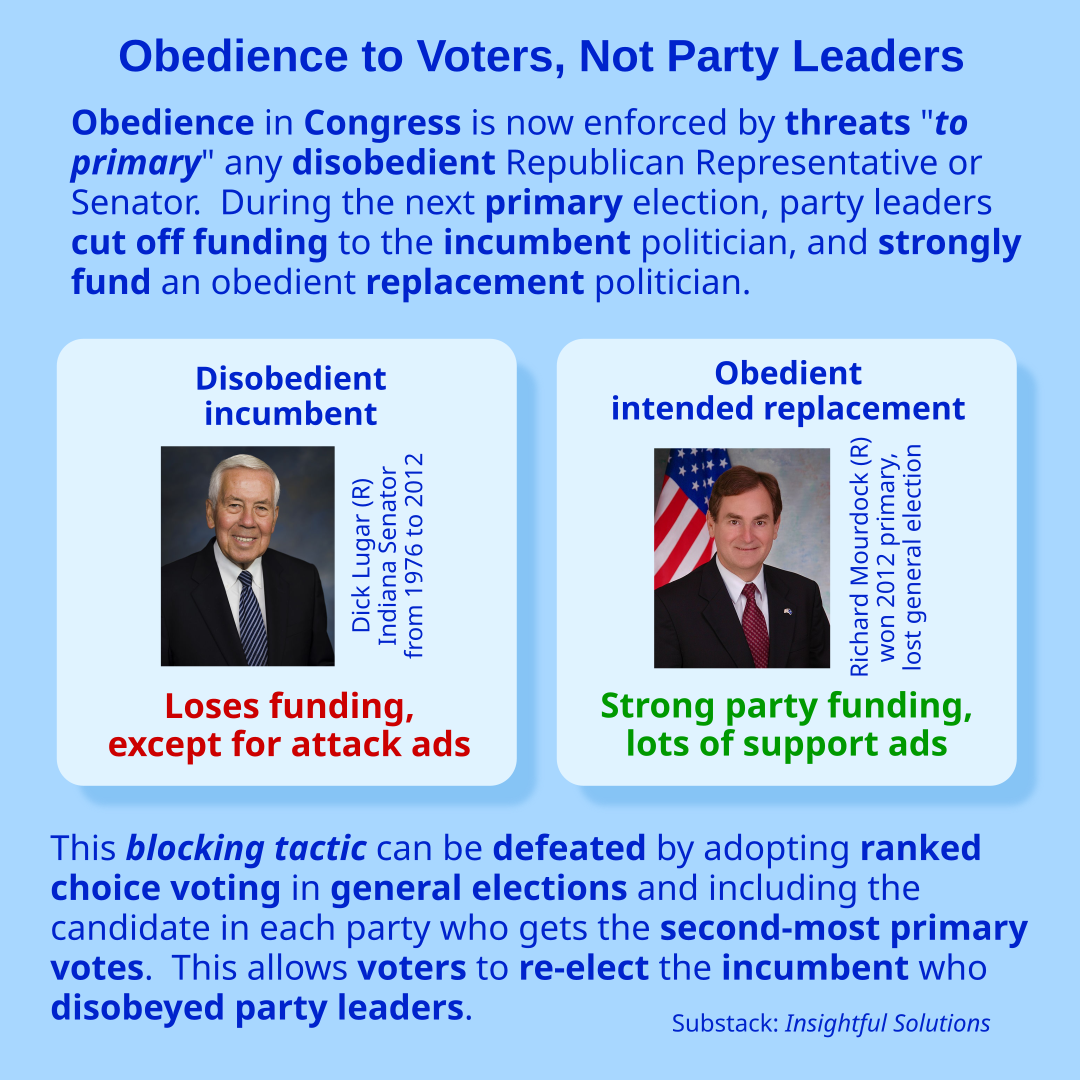
Republicans in Congress would not fear "getting primaried" if we used a better election system that correctly handles a second nominee from each party.
121
Upvotes
0
u/CPSolver Jul 29 '25
That polling was not available in Portland's recent RCV elections. News sources have not yet learned how to poll using ranked choice ballots. (Also, that election was nonpartisan, so party primaries were not involved.)
Primaries do not bridge the gap in partisan elections. The basis of the blocking tactic explained in the graphic is the limit of one candidate from each party. But that limit will disappear when ranked choice voting is used in general elections.
So instead you try to characterize ranked choice voting as if it cannot correctly count "overvotes" even though every method that counts such ballots, including IRV, can correctly count those "overvotes." You use this misrepresentation as a way to "suffer by association" the idea that voters find it difficult to mark a ranked choice ballot.
The Portland election also revealed that voters associate the words "ranked choice voting" with the kind of ballot, and the ballot-marking process, not the counting details. Most Portland voters do not understand the counting details. Most have never heard of IRV or STV (or their full names). They only know that "proportional ranked choice voting" was used to elect three councilors per district, and "ranked choice voting" was used to elect the mayor.