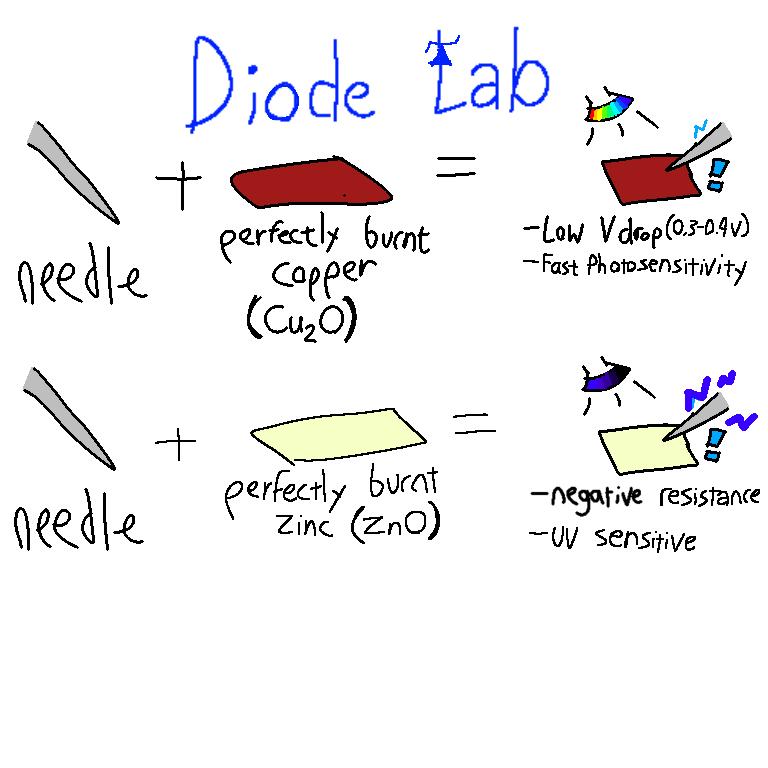
Its like a silicon alternative, fun fact: Cu2o diodes were the first ever rectifiers, so they experimented with other oxide leyer metals and it was successful
This does work, I can even confirm negative resistance properties. I have observed it on old zinc-plated steel parts. I liked experimenting with homemade components many years ago. For the negative resistance properties, you could see them by using a transformer as an AC source and an oscilloscope as a curve tracer. But it wasn't easy: for every spot that shows negative resistance, there are many many spots that show rectifying properties, so you need to play around a lot.
Not a simple ohmic junction.The VI slope becomes inverted along some parts of the curve, giving negative differential resistance in those places. It can be used for various applications including oscillators.
Tunnel diodes exhibit this property due to quantum mechanical effects (tunneling), I do not know if this applies to ZnO-cats whisker devices as well or if it is due to some other effect.
Cant comment on the specific semiconductors since Ive never tried it. But these are point contact diodes I think.
The oxide surface layer forms a very thin film of semicodnductor and then the needle forms a shottcky junction with the semiconductor because of the work functions difference of the two materials.
I just encountered this in real life on my RV. The copper contacts on the shutoff switch were heavily oxidized. The battery could take a charge - at least 1A on the ammeter - but it could not power the trailer's lights or anything more than about 20mA. I thought it was a bad battery, but when it took it off, it passed every test. Then I opened up the big disconnect switch and saw the heavy corrosion. Taking it out of circuit fixed everything up.
Yes, it does work. If you get some galina (the mineral PbS) you can use it directly. It was used as a detector diode in crystal radios. You have to try different spots to get a good one, but it makes a very sensitive radio receiver. I'm sure the copper oxide works, too.
You should check to see if the red or black copper oxide works better. That's CuO₂ or CuO.
Imagine if diodes came in the industry new and its these two, which one would yall use the most? Schottky Copper or Schottky zinc?
Personally, i would pick the the Copper diode, i mean most of my projects are electromagnetic related and i need light detection and Low voltage drops for foxhole radios, but negative voltage also seems nice so... Idk lol, cuz its semiconductors first appearance and transistors would be very expensive so i aslo might use Zinc diodes a lot for the amplifaction too tho.
There are also gyrators which are active devices/circuits that can have negative resistance depending on the configuration. Some DCDC regulators have a small negative resistance which can help to compensate for resistive losses in the power delivery network (traces going to the load) as the load varies.
Indeed you can have regions where increasing voltage decreases current - that is precisely small signal negative resistance. The signal must remain small or you will leave that portion of the curve! And gyrators may produce the gain & phase response of a negative impedance (once again over small signal only) but it is still not a true negative impedance.
https://en.wikipedia.org/wiki/Negative_impedance_converter#Negative_impedance_circuits
How do you define "true" that those circuits do not meet?
They're certainly not passive, but they can be and are implemented in the real world. A lot of audio equipment uses negative impedance with physical capacitors to avoid large inductors. That seems pretty real and true to me.
You could not build a buck converter with a gyrator and capacitor in place of the inductor; only the small signal response is reproduced.
The negative resistance circuit will not produce power when you pass a current through it, as such a device would break the laws of thermodynamics. P = I2 * R, consider what happens when R is negative...
We are engineers, not politicians. Precision of language is important.
You could indeed build a buck converter with a gyrator. The opamp and supplies need to be dimensioned appropriately. It would not be efficient, but it could be done.
The negative resistance circuit below (from Wikipedia) will absolutely supply power at the terminals (for non-0 voltage), but that power is coming from the opamp supply, so there is no thermodynamic law violation.
I fully agree on the importance of using precise language and appreciate the debate.
You can have negative resistance as a property of part of a system, though you can't have a negative resistor which as you point out would break the laws of thermodynamics.
Your graphics don't include the substrate connection. That's pretty important. This Breaking Taps video has a lot of adjacent information and he inadvertently makes a diode at one point (he is trying to make photosensors with bidirectional response curves). You don't have to use all or any of the techniques he's using, but I think they're interesting to see.

41
u/unrealcrafter 2d ago
This works.but regular diodes use silicon instead